Insulation Payback Period Calculator
Estimate R-value heat loss before and after an insulation upgrade, then convert annual BTU savings into a simple payback period.
🏠Insulation Presets
📏Payback Inputs
Insulation Payback Results
📚R-Value Reference Cards
📈Heat Loss Formula Reference
| Step | Formula | Output | Use In Calculator |
|---|---|---|---|
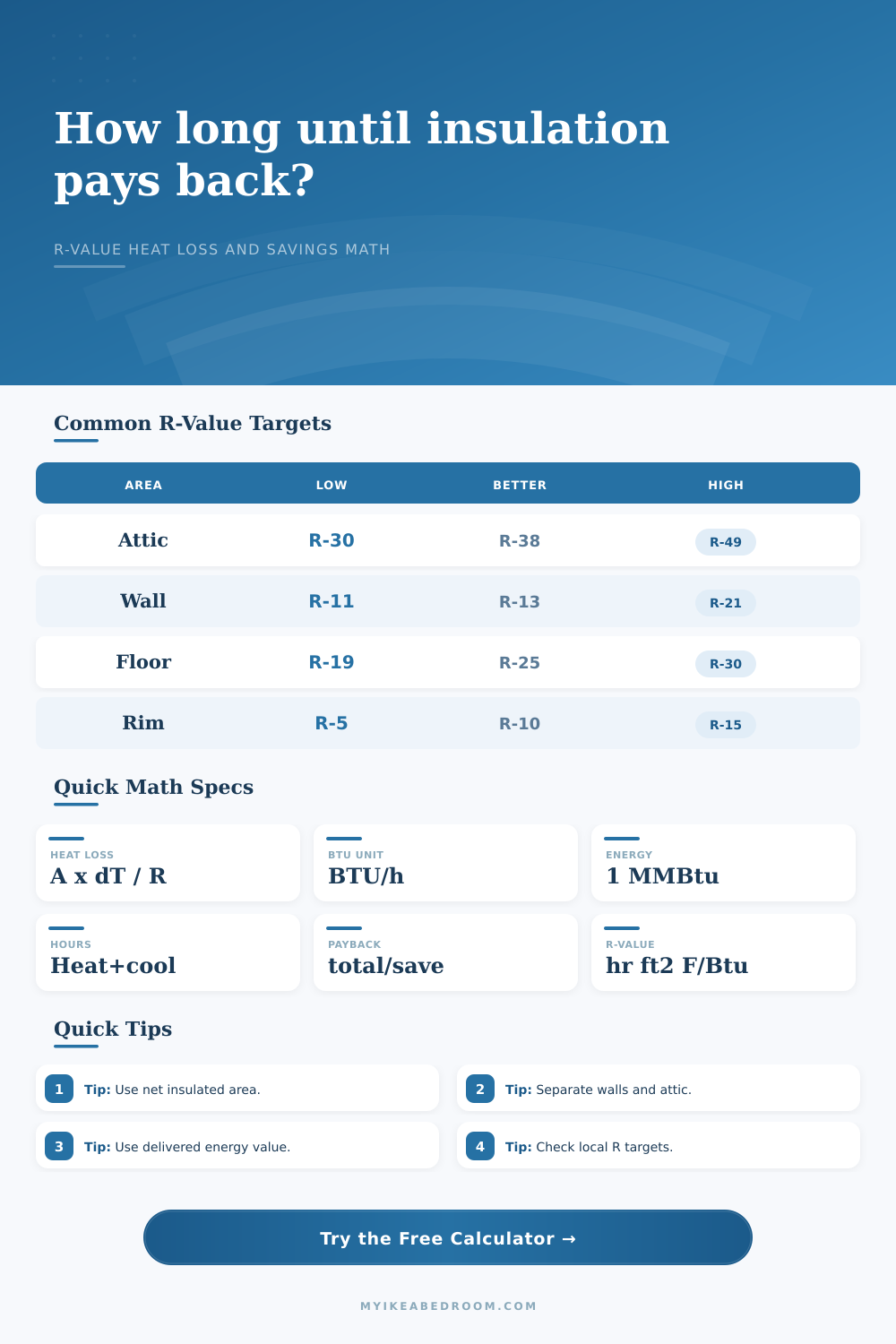
| Current heat loss | Area x delta T / current R | BTU/h | Existing surface load |
| Improved heat loss | Area x delta T / improved R | BTU/h | New surface load |
| Annual energy saved | BTU/h saved x annual hours | BTU/yr | Heating plus cooling hours |
| Payback years | Project total / annual savings | Years | Simple payback estimate |
📋Common R-Value References
| Assembly Area | Often Seen Existing R | Common Improved R | Modeling Note |
|---|---|---|---|
| Uninsulated attic or garage ceiling | R-0 to R-5 | R-30 to R-49 | Large delta from first layer |
| Older attic with shallow insulation | R-11 to R-19 | R-38 to R-60 | Diminishing returns at higher R |
| 2x4 wall cavity | R-7 to R-11 | R-13 to R-15 | Include sheathing and air films if known |
| 2x6 wall cavity | R-13 to R-19 | R-19 to R-21 | Whole-wall R may be lower than cavity R |
| Floor over crawlspace | R-11 to R-19 | R-25 to R-30 | Air sealing affects real savings |
| Basement wall | R-0 to R-5 | R-10 to R-15 | Use below-grade area separately |
| Rim joist band | R-1 to R-3 | R-10 to R-15 | Small area but high leakage risk |
| Attic knee wall | R-3 to R-11 | R-13 to R-19 | Treat as vertical exterior wall |
📝Preset Assumption Table
| Preset | Area | R Change | Hours Used |
|---|---|---|---|
| Attic top-up | 900 sq ft | R-19 to R-49 | 2,900 hr/yr |
| Wall retrofit | 620 sq ft | R-7 to R-13 | 3,100 hr/yr |
| Floor joist | 780 sq ft | R-11 to R-30 | 2,600 hr/yr |
| Rim joist | 160 sq ft | R-2 to R-15 | 3,100 hr/yr |
💡Calculation Tips
Insulation is the simplest kind of investment: You spend money today to buy back future energy bills. Most people think of insulation as an upgrade in home comfort… But that’s secondary to this simple math. Adding insulation always help. Always. The only question is: Is the math good enough for your home? For your climate?
The calculator above will do the math for you. It turns ideas like R-value into a real timeline… When you get your money back. Essentially this is based off some simple physics: Heat flows from hot to cold. Heat flow more quickly if there is less resistance. Resistance is expressed as R-value. So the tool wants to know both your starting R-value, and your goal R-value. And it will calculate the difference in heat flow.
How to Calculate If Insulation Saves You Money
It doesn’t simply consider the material within the cavity itself. It considers the entire assembly, so you must estimate the overall assembly resistance, not just the rated batts resistance. Understanding what is (and isn’t) being measured is key to the trick here. It really depends a lot on where it is: A giant improvement in a very small area isn’t as good as a moderate improvement in a very big area. This applies to rim joist insulation, exterior wall insulation, or the attic floor.
You have to count total amount of insulation installed in square feet. Then, multiply that by the average temperature difference, the “delta T“, between indoors and out. That’s not the coldest part of January; it’s the average season-long difference. The smaller your temperature difference, the milder your climate, which means less heat lost, and therefore fewer dollars saved.
The chart on the page explain what typical values would be for most assemblies. It also shows how they move up in attics or down in basements. The multiplier is time. It multiplies hourly heat loss into a cost for a year. It splits the hours between heating and cooling because most houses don’t require as much effort in one direction than another. Cooling dominates in hot climates; heating hours rule in cold ones.
You input those hours where you live, along with the cost of energy delivered to your house. This is the important bit: it is not the raw energy price per MMBtu from the utility bill. The delivered price after subtracting your heat pump‘s or furnace’s efficiency. Did you know that if you have an 80% efficient system, you’re paying for 20% of the energy you never see in your livig room? That inefficiency is nibbling at your potential savings even before they can begin.
You divide total project cost by annual savings and you get a payback period in years. It is a clean number. After the break-even point, amount of energy you save has value, and that value isn’t counted in payback. Utility rates will rise, but this is also not counted in payback. Your insulation won’t perform forever, unless it’s cellulose or fiberglass that stays dry, a reasonable assumption.
And there are other non-energy benefits: better insulation reduces drafts; helps stabilize room temperatures; makes the house quieter. These benefits are hard to measure but easy to feel.
Insulation projects fall prey to diminishing returns, which is the silent killer of insulation projects. If your base case is bad (attic insulation at R-19), then upgrading to R-30 will pay off very fast. If your house is already pretty tight (R-49), upgrading to R-60 may take a couple of decades to pay back. The higher up you go in R-values, the more difficult the math. Adding another inch of insulation saves less and less heat compared to previous inch. This isn’t a shortcoming in the insulation itself. It’s simply how thermal resistance builds up. Do you want the final ten percent? Or do you want to drop that money on a new roof instead?
One mistake people make is on the input side: they assume that because the house was built X years ago, it has an R-value of Y. That’s not necessarily true. The nineteen eighties isn’t the same as the late two thousands. A house from the nineteen eighties might have R-11, not R-13. And another common error is underestimating the price: not accounting for air sealing, which is the partner to insulation. If you have a gap in your wall, then all the air just goes around your insulation. The calculator assumes the R-value holds, but it cannot measure gaps. You need to take care of those gaps yourself.
Ultimately, it’s a matter of managing risk. If you’re looking at a short payback period, that’s money from your pocket, your utility bill won’t go down; it’s pocket money for comfort. But if you know you’ll be living there awhile, then even a longer payback could of made sense. The trick is to align the investment with your personal timeline.
Insulation falls into the rare group of home upgrades that almost never go out of style (and never lose their value). When the numbers add up, you just have to be patient.