🌱 Indoor Plant Pot Size Calculator
Match pot diameter, depth, and soil volume to the root ball, growth habit, and watering style
| Drill bit | Metric | Area | Best use |
|---|---|---|---|
| 1/8 in | 3.2 mm | 0.012 sq in | Seed trays |
| 3/16 in | 4.8 mm | 0.028 sq in | Tiny pots |
| 1/4 in | 6.4 mm | 0.049 sq in | Most pots |
| 5/16 in | 7.9 mm | 0.077 sq in | Large bases |
| 3/8 in | 9.5 mm | 0.110 sq in | Box planters |
| Pot size | Shape | Hole plan | Notes |
|---|---|---|---|
| 4-5 in | Round | 3/16 in, 1-2 holes | Starter pots |
| 6-8 in | Round or square | 1/4 in, 2-3 holes | Balanced houseplant |
| 9-12 in | Mixed | 5/16 in, 3-4 holes | More dry-down room |
| 13-18 in | Box or tub | 3/8 in, 4-6 holes | Big planter or box |
| Soil mix | Factor | Dry pace | Hint |
|---|---|---|---|
| Cactus or orchid mix | 1.22x | Fast | Use more open area |
| Aroid or bark mix | 1.12x | Quick | Chunky media drains well |
| Standard houseplant mix | 1.00x | Balanced | Best all-around default |
| Moisture-retentive mix | 0.86x | Slower | Fewer or smaller holes |
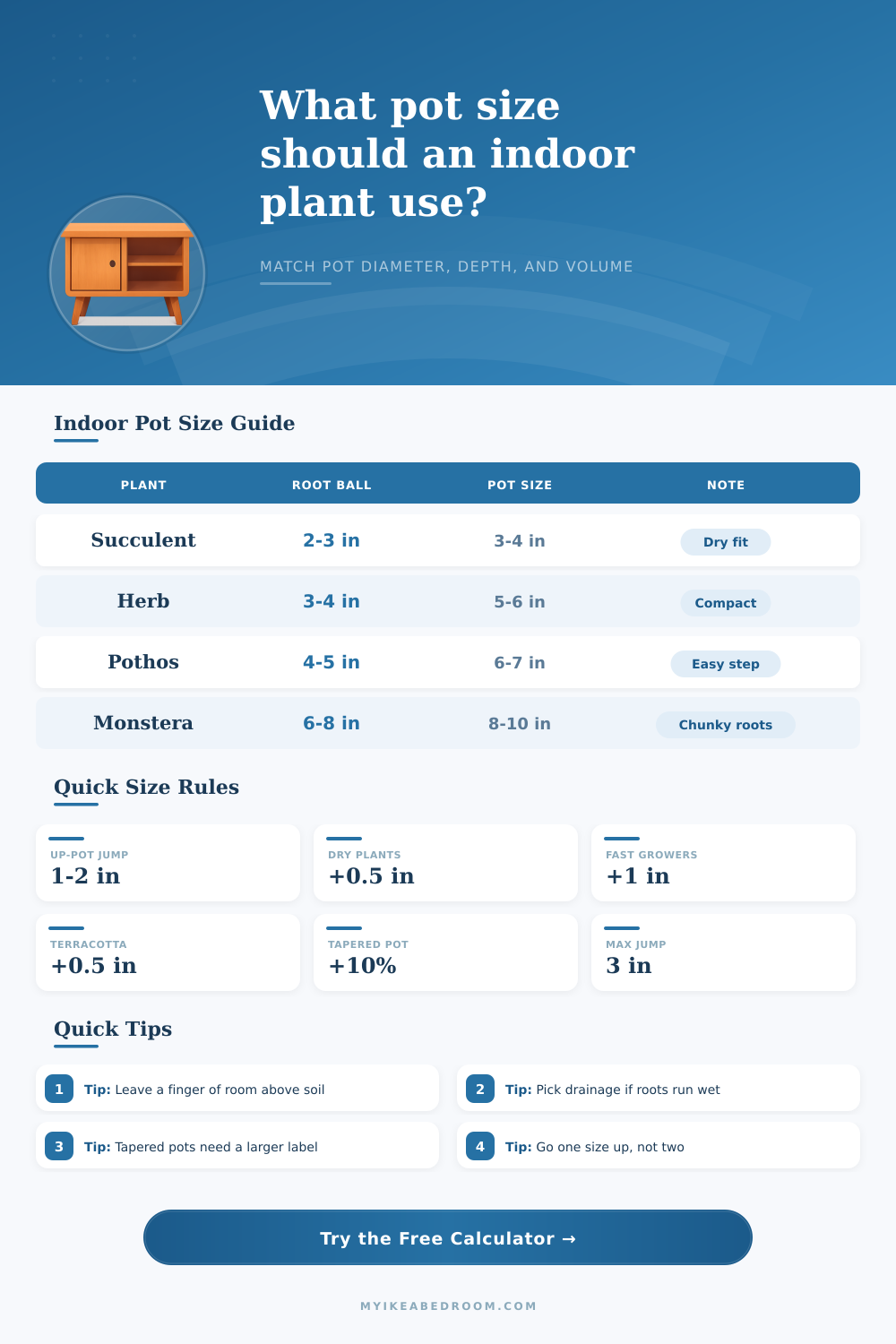
The size of the plant decides the right pot size during potting. Pot be 1-2 inches wider than the root ball. Plant experts most commonly advise to choose a pot 2 inches bigger than the bought or transferred plant.
Plant requires at least 1 to 2 inches of free space by diameter
How to Choose the Right Pot Size
Broadly, the bigger pot, the bigger plant. That depends on the ratio between roots and shoots, because each leaf and every branch requires enough roots to back it. Even so all plants differ.
Succulent in 4 inch pot and monstera in same size is entirely different, with separate needs.
If little plants enclose in much more big pots, soil surpasses roots. Too much soil causes big watre, what can cause root rot. Big tins keep more excess water, when roots do not absorb it.
So it matters to expand pot size step by step. The reason to start with a little pot and go to bigger is tied to the watering of plants.
Practical trick is buy decorative pot one inch bigger than the nursery pot. Measure the diameter of the top opening. For instance, if nursery pot has 4 inches, choose 5 inch.
Finding a good size can be hard. Occasionally pot is not exactly 4 inches, but 4.25, what will not enter in a 4 inch opening. It matters to estimate the diameter of the grow pot and compare with the opening of the decorative pot.
For indoor plants, little as cactus and succulents do well in 4-6 inch high pots. Flowering plants favor 8-10 inch. Little pots well serve for houseplants, succulents and herbs, and that is the most common size for tabletop plants.
Plants come in sizes as small, medium, big and huge.
Most pots follow a system in 2 inch steps, from 2 inches, then 4, 6 and so on. 10 inch plant grows in 10 inch diameter pot, usually 2.5 to 3 gallons. Decorative planters with clean lines seem nice in the family room.
Elegant ceramic flower pots and classic terracotta pots come in various sizes. For instance FÖRENLIG plant pot white in 3.5, 4.75, 7.5 and 9.5 inches work indoors and outdoors. Gray FJÄRILSBUSKE of 9.5 inches has a sand-like glaze with traditional form, what adds warmth and nature.
To plain pots you can add flower stickers to make them look cute and personal.