Humidifier Room Size Calculator
Estimate the output rate, daily water demand, tank refill timing, coverage margin, and humidity gap for a bedroom, living area, nursery, office, or plant room.
Start with a realistic room scenario, then adjust dimensions, current RH, target RH, leakiness, climate dryness, open doorway load, tank size, runtime, occupants, and plants.
Humidity sizing breakdown
Enter room and humidifier values to see the sizing result.
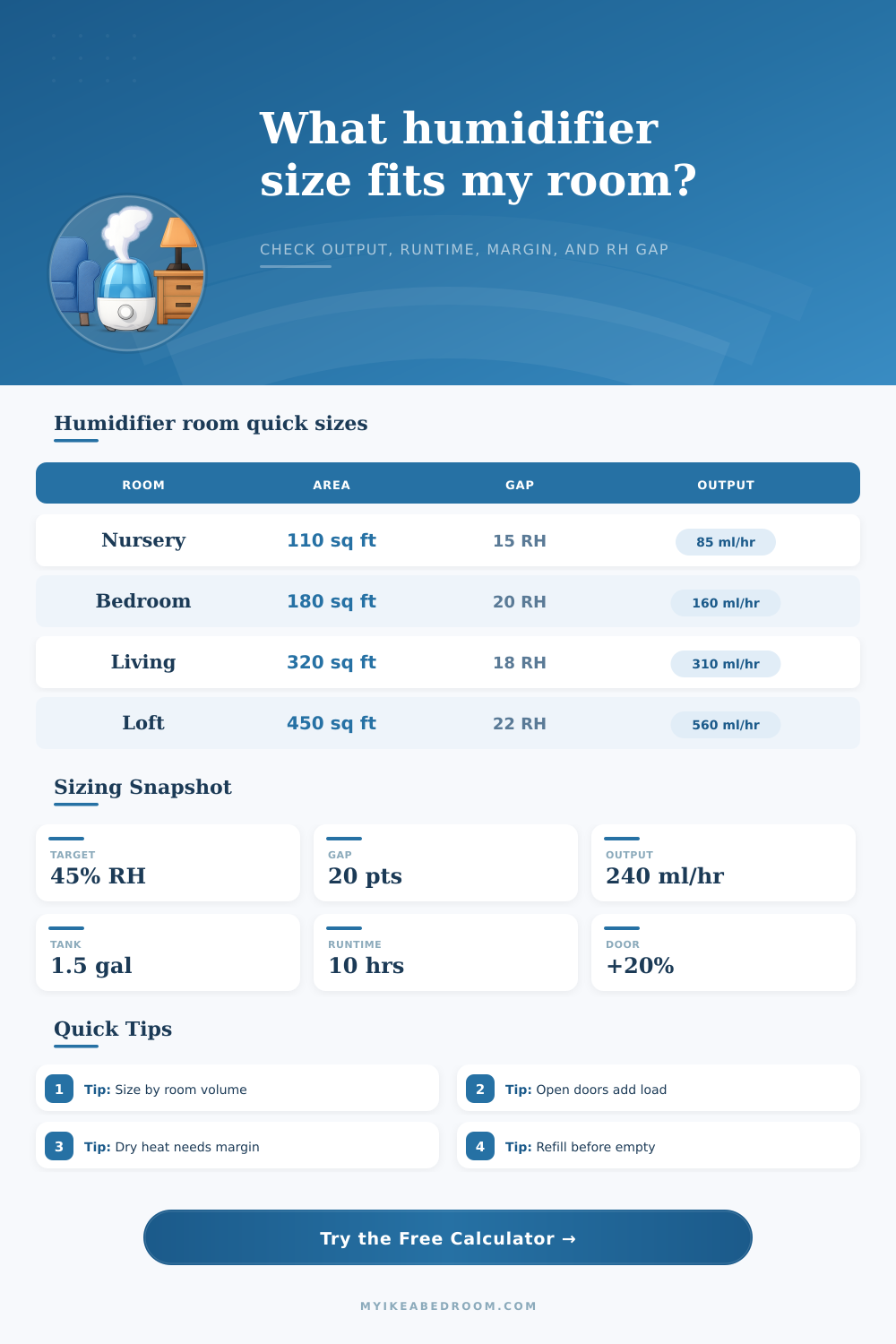
| Room type | Volume range | Typical RH gap | Starting output |
|---|---|---|---|
| Small nursery or office | 700 to 1,000 cu ft | 10 to 15 points | 70 to 120 ml/hr |
| Standard bedroom | 1,000 to 1,600 cu ft | 15 to 25 points | 120 to 220 ml/hr |
| Primary bedroom suite | 1,600 to 2,400 cu ft | 18 to 28 points | 200 to 360 ml/hr |
| Open living room | 2,400 to 3,800 cu ft | 15 to 25 points | 300 to 600 ml/hr |
| High ceiling room | 3,000 cu ft plus | 20 to 30 points | 500 ml/hr plus |
| Room condition | ACH value | Door factor | Calculator effect |
|---|---|---|---|
| Tight closed bedroom | 0.2 ACH | 0% | Lowest maintenance water demand |
| Average bedroom | 0.5 ACH | 10% to 20% | Practical baseline for overnight use |
| Leaky older room | 0.9 ACH | 20% to 35% | Needs more hourly output to hold RH |
| Drafty or frequent HVAC | 1.4 ACH | 20% to 50% | Output requirement rises quickly |
| Open-plan connected zone | 1.8 ACH | 35% to 50% | Often better served by multiple rooms or zones |
| Condition | Dryness factor | Ceiling note | When to use |
|---|---|---|---|
| Mild damp climate | 0.90x | Standard ceiling | Humid coastal or rainy weather |
| Normal indoor winter | 1.00x | 8 ft to 9 ft | Typical heated room baseline |
| Dry heated home | 1.15x | 9 ft to 10 ft | Heat runs often and RH falls steadily |
| Very dry climate | 1.35x | 10 ft to 12 ft | Desert, mountain, or cold dry air |
| Forced-air dry spell | 1.55x | 12 ft plus | High ventilation or persistent dryness |
| Tank size | 150 ml/hr | 300 ml/hr | 500 ml/hr |
|---|---|---|---|
| 0.8 gal / 3.0 L | 20 hours | 10 hours | 6 hours |
| 1.2 gal / 4.5 L | 30 hours | 15 hours | 9 hours |
| 1.6 gal / 6.1 L | 41 hours | 20 hours | 12 hours |
| 2.0 gal / 7.6 L | 50 hours | 25 hours | 15 hours |
| 3.0 gal / 11.4 L | 76 hours | 38 hours | 23 hours |
A small positive margin helps the humidifier hold target RH after doors open, heat runs, or outdoor air becomes drier.
The refill estimate compares tank capacity against the selected output rate, then checks planned daily runtime.
Connected halls and open-plan spaces behave like extra volume, so the doorway factor increases water demand.
Occupants and watered plants provide a modest credit, but they cannot replace steady humidifier output in dry rooms.
To increase the moisture in the air in your room, you need to purchase an humidifier that satisfies the moisture needs of that room. Many people may feel that a larger humidifier is always better for there rooms. However, if the humidifier is too large for the size of the room, then the humidifiers function may dampen the carpet in that room.
Additionally, the excess moisture in the air may encourage mold to grow on the drywall in that room. If the humidifier in this situation is also too small for the size of the room, then the moisture that the humidifier do produce will easily escape the room. To determine the correct humidifier for your room, you have to understand the humidity gap in your room.
How to Choose the Right Humidifier for Your Room
The humidity gap are the difference between the humidity level in your room and the humidity level that you want to provide in that room. For instance, if the humidity in your room is twenty percent, but the target humidity level is forty-five percent, then you are asking the humidifier to provide a significant amount of moisture to your room. The humidifier will have to first perform the work of adding the moisture to increase the humidity level in your room to your target humidity level.
Then, it will have to perform the same work again each period to replace the moisture that have escaped the room. The rate at which the moisture leaves a room has a significant impact on the work that a humidifier can accomplish in that room. For instance, if a room has many air changes per hour, it has drafts that allow the air in that room to escape the room.
Therefore, if the air in the room escapes quick, the humidifier will have to work harder to maintain the humidity level in the room. If you find that the humidity level in your room is not rising with your humidifier, you might think that the humidifier is broken. However, the level of humidity may not be rising because the room is losing humidity to the drafts in the room much more faster than the humidifier can replace that moisture in the air.
The number of doors and windows in your room will also affect the amount of moisture that remains in your room. If you leave a door in your room open, the moisture from the humidifier will travel into the hallway. Therefore, by leaving a door open, you are increasing the amount of moisture that your humidifier must produce to maintain the humidity level in your room.
Additionally, if the ceilings in your room are higher, or if the climate outside your home is dry, these factors will also change the way your humidifier must function. The higher the ceilings in your room, the more moisture your humidifier will have to produce to saturate all of the air in your room. Additionally, if the outdoor climate is dry, the humidity in the air that comes into your room will be very lowly.
The other important factor to consider is the size of the water tank in your humidifier. If your humidifier produces a high rate of moisture in your room, it will require a larger water tank to humidify your room without having to continually refill the water tank with humidifier water. If your humidifier has a high rate of output but a small water tank, your humidifier will quickly run out of water.
You will have to continually refill your humidifier to maintain the humidity level that it produces. Therefore, when you are purchasing a humidifier, you should of compare the output rate that it can provide to the size of the water tank to find a humidifier that work for your needs and allows you to avoid continually refilling the water tank. Though there are a few small ways to assist your humidifier, these are not the primary methods of humidifying the air in your room.
For instance, humans exhale moisture, and houseplants release moisture into the air through a biological process known as transpiration. These two factor will have a small impact on your humidifier. However, the amount of moisture that humans and houseplants produce will not be enough to replace a mechanical humidifier in a very dry room in your room.
Finally, purchase a humidifier that provides a comfortable margin of output for the level of humidity that you desire in your room. You want a humidifier that can reach the humidity level that you desire but does not have to work at one hundred percent of its capacity. A humidifier with a margin of output will allow the humidifier to maintain the humidity level that you set as your target for the room, even if a window is opened or the air in the room becomes more extra dry.
If you find a humidifier that is the correct size for your room and that matches the air change rate of your home, your humidifier will maintain the humidity level that you desire in your room.