HST Quilt Calculator
Plan half-square triangle quilts from finished unit size, layout density, construction method, fabric width, trimming allowance, backing overhang, and binding strip width.
Start with a common half-square triangle layout, then adjust the finished unit size, method, and fabric split for your project.
| Method | Yield from one fabric pair | Starting square formula | Best use |
|---|---|---|---|
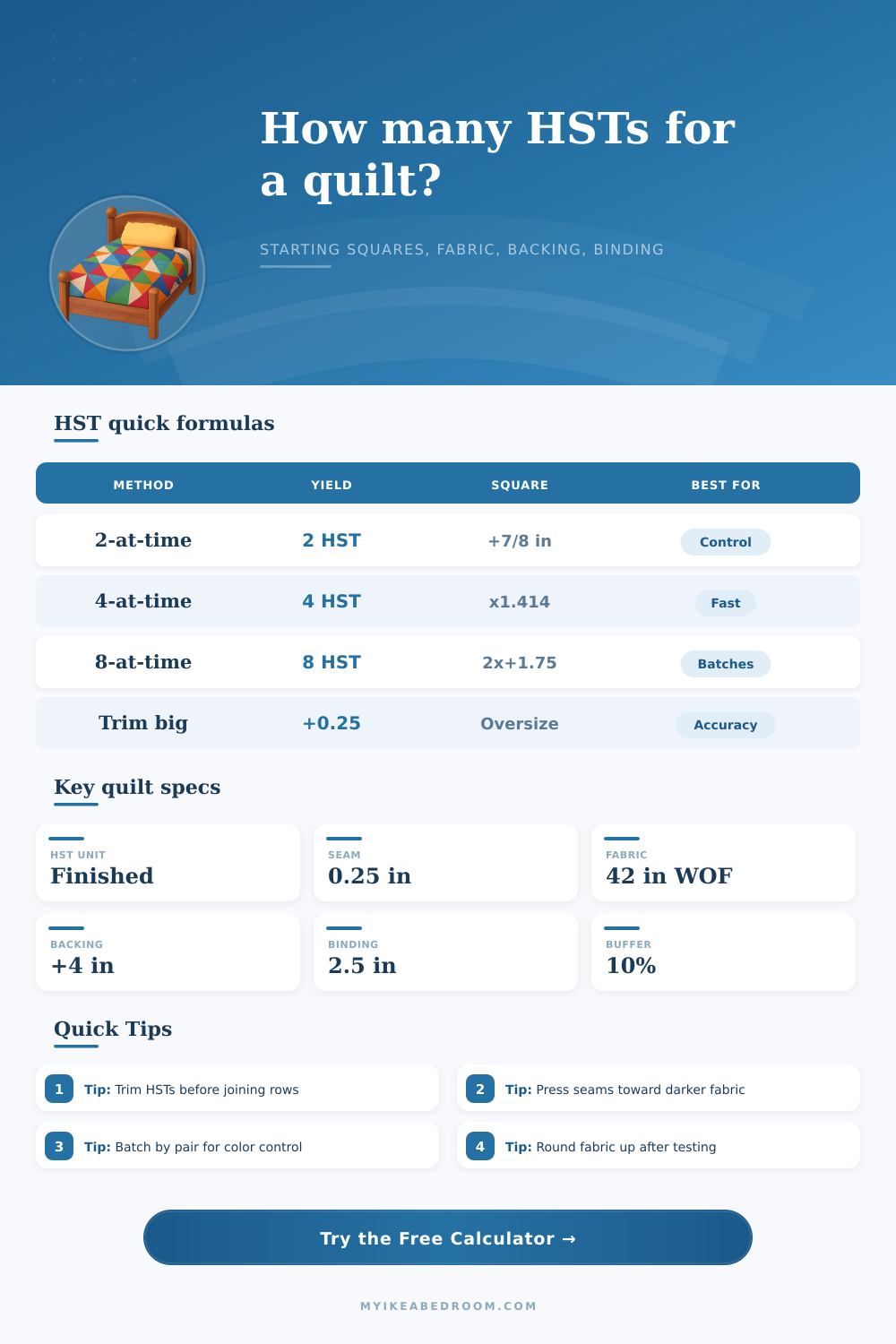
| 2 at a time | 2 HST units | Finished HST + 7/8 in, then add trim allowance | Best color control, small batches, directional pair planning. |
| 4 at a time | 4 HST units | (Finished HST + 1/2 in) times 1.414, then add trim allowance | Fast cutting, but edges are bias after cutting. |
| 8 at a time | 8 HST units | Finished HST times 2 + 1 3/4 in, then add trim allowance | Efficient for chevrons, waves, and repeated backgrounds. |
| Oversize trim | Any method | Add 1/8 to 1/2 in to the start square before trimming | Best accuracy for bedroom quilts with long visible rows. |
| Finished HST | Unfinished trim | 2-at-a-time square | Typical use |
|---|---|---|---|
| 2 in | 2 1/2 in | 2 7/8 in before oversizing | Mini quilts, borders, pillow details. |
| 3 in | 3 1/2 in | 3 7/8 in before oversizing | Baby quilts, dense chevrons, small stars. |
| 4 in | 4 1/2 in | 4 7/8 in before oversizing | Throws, lap quilts, bold pinwheels. |
| 6 in | 6 1/2 in | 6 7/8 in before oversizing | Twin and queen bed quilts with faster assembly. |
| 8 in | 8 1/2 in | 8 7/8 in before oversizing | Large graphic blocks and quick king quilts. |
| Quilt type | Finished size | Sample HST size | Approximate full-field count |
|---|---|---|---|
| Baby | 36 by 45 in | 3 in finished HST | 180 HST units in a 12 by 15 grid. |
| Throw | 60 by 72 in | 4 in finished HST | 270 HST units in a 15 by 18 grid. |
| Twin | 70 by 90 in | 5 in finished HST | 252 HST units in a 14 by 18 grid. |
| Queen | 90 by 108 in | 6 in finished HST | 270 HST units in a 15 by 18 grid. |
| King | 108 by 108 in | 6 in finished HST | 324 HST units in an 18 by 18 grid. |
| Fabric plan | Calculator split | Best layout | Planning caution |
|---|---|---|---|
| Two fabric contrast | One background and one focus fabric | Chevron, diamond, and bold pinwheel layouts. | Contrast must be strong enough after seams are pressed. |
| Background plus 2 prints | Focus yardage divided across two prints | Broken dishes, mountain rows, and mirrored halves. | Keep values balanced so rows do not look lopsided. |
| Background plus 4 prints | Focus yardage divided across four prints | Scrappy stars and repeating bedroom throws. | Batch squares by pair before chain piecing. |
| Background plus 8 prints | Focus yardage divided across eight prints | Ocean waves and stash-friendly quilts. | Cut extra squares for print placement flexibility. |
Yield: 2 HST units from each square pair.
Best when every color pair needs careful placement.
Yield: 4 HST units from each square pair.
Fast for balanced pairs, but handle bias edges gently.
Yield: 8 HST units from each square pair.
Best for repeated backgrounds, chevrons, and waves.
Accuracy: Cut larger, press, then trim.
Most helpful for long bed quilt rows that must align.
Trimming tip: Set the calculator trim allowance to at least 1/8 inch when using the 2-at-a-time method, then trim each unit to the unfinished size before joining rows.
Pairing tip: For scrappy HST quilts, treat the background as one fabric group and divide focus yardage across the number of print fabrics in your selected plan.
Making a half-square triangle quilt require you to make several decisions. You must decide on the finished size of the quilt, you must choose a block design for your quilt, you must choose the fabric that will be used for your quilt, you must calculate how many triangle will go into your quilt, you must calculate the size of the squares that you will need to cut from your fabrics, and you also have to calculate how much fabric you will need for your quilt. You can perform each of these calculations with the calculator above, you dont have to perform the math yourself.
Based off the finished dimensions of your quilt and the construction method that you will use for your half-square triangles, the calculator will determine for you how many squares you will need to cut from each of your fabrics. Each unit of half-square triangle is formed by joining two square of fabric together. There are an unlimited number of ways to arrange the triangles into a quilt.
Plan a Half-Square Triangle Quilt
The finished size of each half-square triangle is critical to quilting because it will determine the size of every other measurement for the quilt. For instance, a three-inch finished half-square triangle is small enough to allow quilts to be made for babies. A six-inch finished half-square triangle is large enough to create quilts that will cover large areas of a bed, such as for adults who lay on the bed.
You can alter the size of the half-square triangles with the calculator above. When you alter the size of the half-square triangles, the count for the number of half-square triangles will change. There are two main method for constructing half-square triangles.
The two-at-a-time method requires more precision for creating the half-square triangles, but it allows for the quilts to be completed at a more moderate rate. The two-at-a-time method also allows for more control over the placement of the fabrics with directional prints; the dark-colored fabrics will land on the same side of the quilt as each of the seam created during construction. The eight-at-a-time method is faster than the two-at-a-time method, but the eight-at-a-time method creates bias edge with each cut.
These bias edges will stretch if they are not handled proper during quilt construction. The calculator above accounts for both construction methods, as it will calculate the size of the starting squares and the number of batch of half-square triangles that will need to be cut. The width of the fabrics and the amount of fabric that is lost when cutting the half-square triangles to account for trimming must be considered when constructing a quilt.
Most cotton fabric will be approximately forty-two inches in usable width. However, the width of the quilt that can be effectively used will be smaller than the starting size of the squares after allowing for the space between each of the half-square triangles. Most quilters will add an extra quarter-inch to each of their measurements for their half-square triangles so that each of the unit can be fully squared up once they are pressed.
The yardage calculations will include these allowances for quarter-inch additions to the half-square triangles, as the total amount of yardage that the quilter requests will always be more than the estimation that the person might have performed with mental math. This extra yardage will act as a buffer for the quilting project, covering any mistake in cutting the fabric to the correct direction. You will perform the calculations for the backing and binding for the quilt in the same manner as the calculations for the half-square triangles.
Four inch of overhang should be added to each side of the quilt to account for backing the quilt properly. Extra length will also be required for the binding strips to allow for joining the strips and to allow for turning the corner of the quilt. These margins are accounted for in the calculator above so that the yardage estimations will be realistic.
Not all of the surface of the quilt will necessarily be covered by half-square triangles. For instance, quilts that use chevrons for the half-square triangles will only cover seventy-five percent of the total area of the quilt. In quilts with star point designs, only half of the quilt will be covered in half-square triangles.
The percentage of the quilt that is to be covered in half-square triangles will change the total count of the half-square triangles that are to be made. However, changing this percentage will not require the redrawing of the layout grid. The percentage used will also change the division of the yardage that is to be allocated for the background and focus fabric.
For instance, if four different prints of fabric are to be used for the focus fabric for the half-square triangles, then each of the print will require less yardage than if each of the half-square triangles used one print of fabric. However, there will still have to be enough yardage to provide for some flexibility in laying the fabrics out on the design wall. There are some mistake that are often made in the construction of half-square triangle quilts.
One mistake is cutting the squares of fabric to the size indicated in the pattern, but discovering afterwards that the half-square triangles are not perfectly squared once pressed; the starting squares were too small to allow for trimming of the excess fabric from each of the squares. Another mistake is in the handling of the eight-at-a-time half-square triangles. When made eight-at-a-time, the bias edges of the half-square triangles must be handled proper; handling them the same way as the two-at-a-time quilting method will lead to stretching of those bias edges.
The yardage and size of the starting squares for half-square triangles is displayed next to each count in the calculator so that quilters can understand the potential for mistakes during construction. One additional consideration for creating half-square triangle quilts is the color plan for the quilt. It is helpful for the background fabric for the quilt to be a contrasting color to the focus fabrics; this allows for the half-square triangles to be easily seen on the quilt top after the sewing of the triangles.
While the calculator can split the yardage for each print of fabric, it cannot provide an idea of whether the colors will appear balanced when the half-square triangles are cut. A visual inspection of the different colors on a design wall or on a digital mock-up of the quilt will help ensure that there are no dominant color within the quilt. Running the numbers for a half-square triangle quilt before cutting any fabric will prevent many anxieties regarding the fabric needed to complete the project.
By using the calculator above, quilters will know how many half-square triangles to be cut, how much backing fabric is needed for the quilt, and how many binding strip to make for the quilt. With these numbers noted, quilters will also know if they will have extra half-square triangles for a quilt pillow (assuming they used one of the construction method that enables the creation of such units), and whether or not there will be an adjustment to the layout grid of the quilt. Using the calculator will provide clarity regarding the needs of the quilting project.
This clarity will eliminate any anxieties regarding whether or not there will be enough fabric for the border of the quilt. The calculator is provided with accurate counts for each aspect of the quilt. Thus, the clarity that is provided will allow quilters to focus on the other important decision for quilting projects: how the half-square triangles are to move across the surface of the quilt.