House Cleaning Time Calculator
Estimate realistic cleaning time from room count, square footage, cleaning level, bathroom and kitchen multipliers, helper count, task pace, and cleaning frequency.
🏠Home presets
🧹Cleaning inputs
Time breakdown
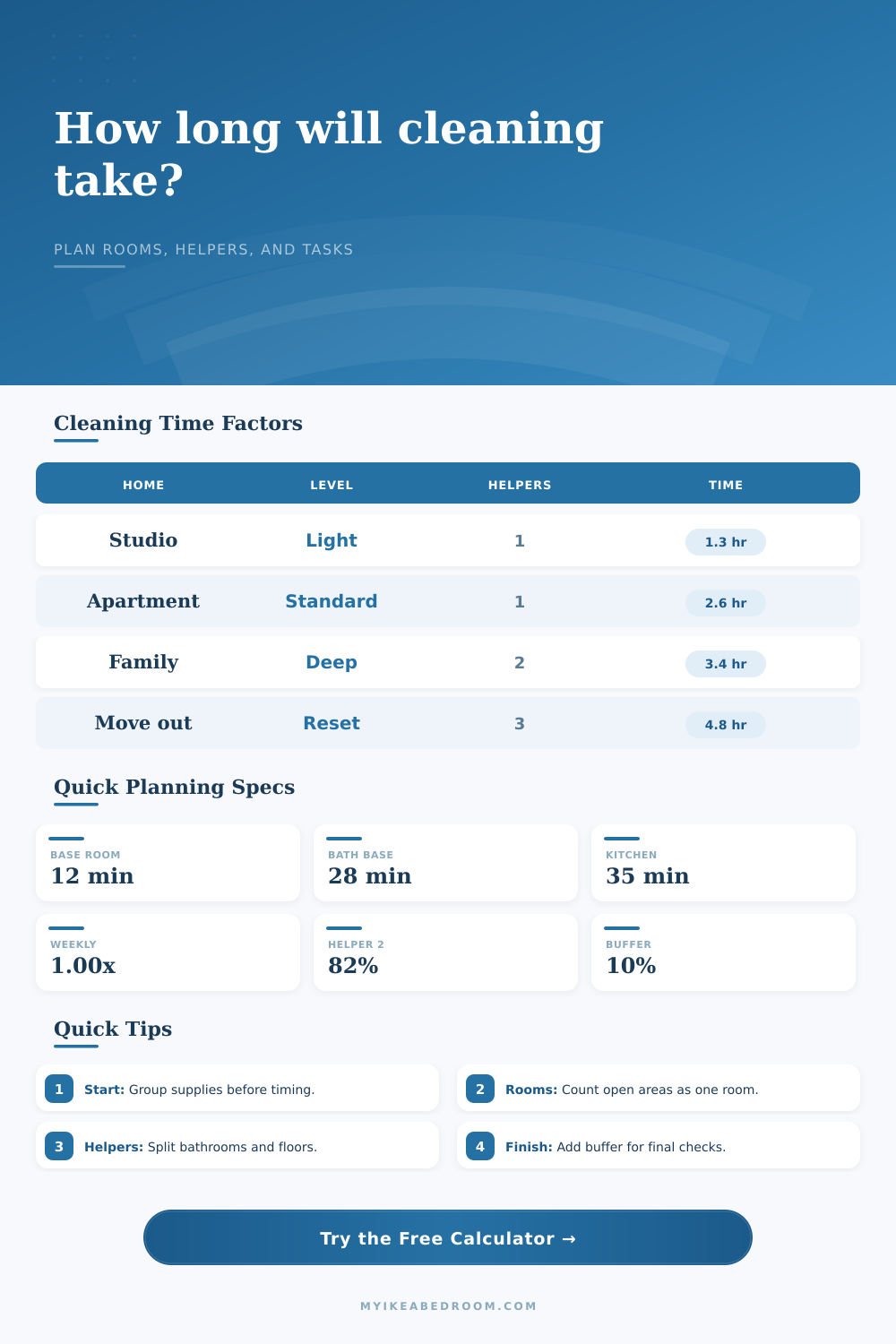
Planning note: elapsed time is divided by an effective helper count, because two people rarely work at exactly double speed when they share supplies, sinks, and floor paths.
📌Quick cleaning factors
📊Cleaning level reference
| Cleaning level | Factor | Typical tasks | Best use |
|---|---|---|---|
| Light touch-up | 0.75x | Reset surfaces, quick dust, visible floors, trash | Guest-ready pass or recently cleaned home |
| Standard clean | 1.00x | Bathrooms, kitchen, dusting, vacuuming, mopping | Weekly or twice-monthly household cleaning |
| Deep clean | 1.45x | Edges, buildup, appliance fronts, detail wiping | Monthly catch-up or before hosting |
| Move-out reset | 1.80x | Empty-home detail, cabinets, trim, full fixtures | Vacancy, move-in, or room-by-room reset |
🚿Bathroom and kitchen multipliers
| Area type | Light | Average | Detailed |
|---|---|---|---|
| Bathroom | 0.75x powder bath or quick wipe | 1.00x full bath with tub or shower | 1.50x buildup, grout, glass, or fixtures |
| Kitchen | 0.75x kitchenette or light counters | 1.00x counters, sink, stovetop, exterior fronts | 1.50x appliance detail and heavier buildup |
| Floors | 0.90x mostly hard floors | 1.00x mixed hard floors and rugs | 1.22x pet hair, stairs, or extra vacuuming |
| Pickup | 0.85x clear surfaces | 1.00x normal lived-in pickup | 1.35x heavy pickup before cleaning |
🔄Frequency and helper reference
| Frequency | Factor | Why it changes time | Planning note |
|---|---|---|---|
| Daily or every few days | 0.78x | Less dust, fewer dishes, less floor soil | Best for quick recurring routines |
| Twice weekly | 0.90x | Moderate buildup with shorter room resets | Works well for busy kitchens |
| Weekly | 1.00x | Balanced baseline for normal household cleaning | Default calculator setting |
| Every two weeks | 1.18x | More dust, bathrooms, and kitchen buildup | Add buffer if there are pets or kids |
| Monthly | 1.40x | Longer detail passes and slower floors | Use deep clean level if needed |
| Occasional or seasonal | 1.65x | More sorting, buildup, and repeated passes | Break the plan into zones |
| Helpers | Effective crew | Good task split | Watch point |
|---|---|---|---|
| 1 person | 1.00x | Top-down room order | Keep supplies close |
| 2 people | 1.82x | Bathrooms plus kitchen or floors | Avoid crossing wet floors |
| 3 people | 2.64x | Bathrooms, kitchen, dust and floors | Assign zones clearly |
| 4 people | 3.46x | Zone teams with one final checker | Limit shared tools |
📋Common home preset reference
| Preset | Inputs | Cleaning level | Typical elapsed time |
|---|---|---|---|
| Studio refresh | 3 rooms, 450 sq ft, 1 bath, 1 helper | Light, weekly | About 1 to 1.5 hours |
| Two-bed apartment | 6 rooms, 950 sq ft, 1.5 baths, 1 helper | Standard, weekly | About 2.5 to 3 hours |
| Family home | 9 rooms, 1900 sq ft, 2.5 baths, 2 helpers | Standard, weekly | About 2.5 to 3.5 hours |
| Move-out clean | 8 rooms, 1500 sq ft, 2 baths, 3 helpers | Move-out reset, occasional | About 4 to 5.5 hours |
💡Planning tips
Sometimes, we get stuck staring at our cluttered living rooms thinking that by attacking it, we’ll be making headway. We pick up the dustcloth… three hours later and nothing have been accomplished! More often then not, this is not a lack of effort but a lack of estimation.
We see cleaning as one block of time that must take up all of our afternoons. But, our houses are made of different surfaces which each need different amount of attention. Breaking down the big picture makes for doable chunks. Before you begin, mapping out what you plan on tackling changes way your day flows.
How to Plan Your Cleaning Time
We tend to count rooms rather than the tasks. For example, cleaning a cluttered closet plus a king-sized bed will take longer then a mattress in a guest room. With a calculation tool, you can think about real surface area and square footage. It understand that just because two object exist within the same room, it doesn’t mean it’ll take as long to dust something on a high shelf versus wipe down a nightstand.
Why? Because this shift makes you face the true physicality of your home. Instead of trusting your vague impression of what messiness looks like, you’re forced to rely on numbers.
Friction occurs where water and biological buildup meet. Water: Kitchens and bathrooms are prime candidates for grease and other buildups. Because they’re literal time-sinks, I’d give them special treatment. For example, a powder room will average 20 minutes to clean.
But if your shower is covered in scale from hard water and your grout is gross, it’ll need more attention, so there is the modifier. That way, it prevents you from scheduling a two-hour clean that actualy requires four.
Most folks ignore the final lever until they are tired of it. How many times have you noticed how much easier it is to clean your home if you do it every week, compared to how exhausting it is when the dust bunnies are an inch thick? How about how gross everything gets after six weeks with nobody touching it? Floors becomes covered with tracked-in dirt, dust collects on surfaces, and grease solidifies.
This extra effort is shown in the frequency factor applied by the calculator. It recognizes that infrequently cleaned areas require more work per session. A little bit oftener is easier than a lot all at once. It’s basic physics. And it’s good household management.
However, helpers are a game changer, although not how you’d think. Having two people doesn’t halve your work. There’s coordination overhead. You can’t both clean the same sink at the same time; you might wait for someone to finish using a room so you can move furnitures. The tool takes into account this law of diminishing returns with additional labor. A second helper cuts down your elapsed time quite a bit… But not entirely.
This is important information if you’re weighing working by yourself versus calling a buddy.
The presence of Clutter also makes cleaning less efficient. A pile of laundry prevents me from getting underneath it with my vacuum. Mail on the counter prevents me from wiping down the counters. To solve for this problem, the tool introduces a clutter factor.
Twenty percent? Okay, then you know to budget time to pick things up before you begin cleaning. Otherwise, your actual speed will be 20% slower than if there were no clutter to get in your way. It’s a way of recognizing that organizing is different than sanitizing, so that it doesn’t slow you down.
You see that’s what a cleaning plan really is, a budget of energy. It takes away the anxiety of the unknown. It breaks everything down into tasks, rooms, and how many hours each task take for each helper. So you know EXACTLY how long it will take you to do the deep clean. Now you can schedule when to have dinner.
We aren’t aiming for cleaning faster. We are aiming to clean smarter. We need to know what we are getting into beforehand. That knowledge should of been worth more than any moddern spray bottle you could buy.