Hot Tub Water Volume Calculator
Estimate usable hot tub water volume from tub shape, fill height, seat displacement, and hose refill speed.
★Fast Presets
Choose a common spa layout, then fine tune dimensions, seat volume, and hose flow.
⇄Units and Tub Details
Switch units anytime. The calculator converts measurements internally before estimating water volume.
Water Volume Estimate
▣Quick Volume Reference
📊Reference Tables
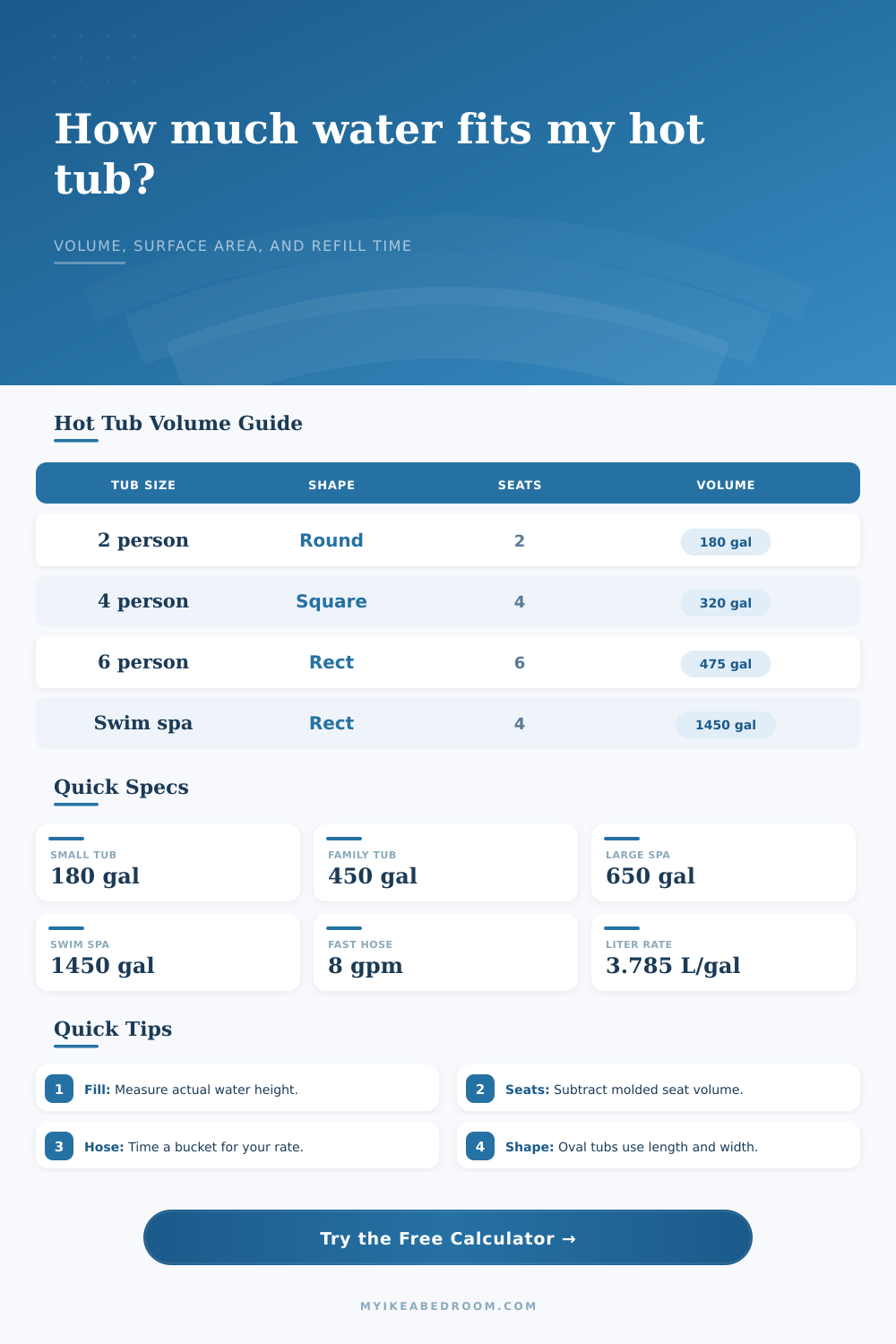
| Common tub | Typical footprint | Seats | Usual water range |
|---|---|---|---|
| 2-person round spa | 5.5 ft diameter | 2 seats | 150 to 220 gal |
| 4-person square spa | 6.5 ft by 6.5 ft | 4 seats | 280 to 380 gal |
| 6-person rectangle spa | 7 ft by 8 ft | 6 seats | 420 to 560 gal |
| Deep therapy spa | 8 ft by 8 ft | 7 seats | 550 to 750 gal |
| Compact swim spa | 12 ft by 7.5 ft | 4 seats | 1200 to 1700 gal |
| Shape | Surface area formula | Volume factor | Best use |
|---|---|---|---|
| Rectangle or square | Length × width | 1.00 before shell allowance | Cabinet-style acrylic spas |
| Round | 3.1416 × radius² | 0.92 to 1.00 taper choice | Round cedar or soaking tubs |
| Oval | 3.1416 × half length × half width | 0.97 default contour | Oval shell lounge tubs |
| Corner triangle | Side A × side B × 0.72 | 0.94 default contour | Corner spas with curved front |
| Hose flow | 300 gal refill | 450 gal refill | 650 gal refill |
|---|---|---|---|
| 4 gal/min | 1 hr 15 min | 1 hr 53 min | 2 hr 43 min |
| 6 gal/min | 50 min | 1 hr 15 min | 1 hr 48 min |
| 8 gal/min | 38 min | 56 min | 1 hr 21 min |
| 10 gal/min | 30 min | 45 min | 1 hr 5 min |
| Seat style | Typical displacement | When to use it | Calculator setting |
|---|---|---|---|
| Low bench | 8 to 14 gal each | Shallow bench around the wall | 10 to 12 gal |
| Standard molded seat | 12 to 22 gal each | Most acrylic spa seats | 18 gal |
| Lounger | 25 to 45 gal each | Long reclined molded seat | 32 to 38 gal |
| Raised footwell | 20 to 60 gal total | High center mound or foot dome | Use contour factor |
ℹMeasurement Notes
When you purchase a hot tub, you probably envision a life of endless relaxation. You see a steamy scene on a cool night and hear the soothing hum of massage jets relieving your tension. You won’t expect the logistical nightmare of tub-filling.
Pulling out garden hose in your backyard, you figure it should of only take an hour. It could take three or four hours if there’s low pressure. Why? Because we’re disconnected from the idea of volume, which is an abstract value on a spec sheet unless you experience it as actual water.
How to Calculate Hot Tub Water Volume
Your patience relies on it; so does your water bill and your chemical budget. If you get the estimate wrong, that’s where calculator comes in (above). Plug in your dimensions, and it’ll do the math for you; no more guesswork about how much space molded seats gobble up, or what kind of pressure your hose deliver.
The first trap most owner fall into: They measure the cabinet, not the shell. From the outside, a typical six person rectangular spa can appear as though it is a seven-by-eight foot box. However, what you see on the outside is not just the acrylic shell; there’s a thick cabinet (made of either wood or foam) around it.
If you assume the outside measurements, you grossly overestimate the amount of space you have. That means you buy more chemicals than necessary because you believe you’re treating four hundred gallons when in fact, you’ve got three hundred. Over time this can add up to a season.
Why? Because the tool want the interior water-line dimensions. And it forces you to look at the area where water resides. It’s a subtle thing, but it is the difference between a balanced spa and a chemical wasteland.
The other thing is that shape also becomes important. It’s easy math on a round tub. Radius squared times Pi = Base Area. The vast majority of new spas aren’t round though. New ones are rectangular shapes with curved bottoms, or they are oval shapes.
That reduces some of the possible volume because it have no hard corners at all. A corner spa loses even more volume different than a rectangular spa with rounded ends. So we apply shape factors based off those curve losses.
It’s kind of like integral calculus but you don’t really need to know what that means to use it. It adjusts up or down for the loss in volume caused by curves and tapers. This gives you a number based on real world volume instead of theory.
Seats is also sneaky volume thieves. A molded seat, bench, lounger, whatever, takes up space. Water doesn’t fit into that space. Each one of those seats removes fifteen gallons from total capacity. A full length lounger may remove thirty or more gallons.
If you don’t account for this, your chemical treatments will be weaker than intended because you’re dosing for empty space that doesn’t actualy exist. You’re dosing for empty space that doesn’t actually exist.
This is the kind of thing that make a plan versus a guess. How many seats? What is each seat worth? Subtract the dead weight. Don’t think you’re filling a hole in the ground. You’re filling a hole in the ground with a bunch of furnitures on the inside of it.
The last variable that screws folks over is hose speed. Depending upon your municipal water pressure, it can vary tremendously. Maybe your neighbor has ten gallons per minute of pressure? You have four gallons per minute. If you’re planning on filling up the tub on Saturday night and your hose is slow, come Sunday evening you’ll be staring at a half-full tub.
To find out the actual flow rate, time yourself filling up a five gallon bucket. Use that number to estimate how long a refill will take, and then schedule your fill to match. It turns what could be an exercise in frustration (the waiting game) into something you can manage.
It is not just a matter of idle curiosity to know how much you have. That’s not just about curiosity; it’s about knowing exactly how much water is in there. We want to have control over our chemistry so our schedule stay on track and our bills are predictable.
When you know what’s in the shell, then you don’t guess anymore… You manage. The jets hum along. The steam comes up in the evening. And you know, exactly, how many gallons of water make it all happen.