Hot Tub Chemical Dosage Calculator
Estimate sanitizer, pH, and alkalinity additions from spa volume, current readings, product strength, temperature, use load, and a dosing buffer.
⚙Fast Presets
📏Spa Volume And Sanitizer
🌡Temperature, Use Load, pH, And Alkalinity
Calculated Dosage
📊Quick Calculation Benchmarks
📘Reference Tables
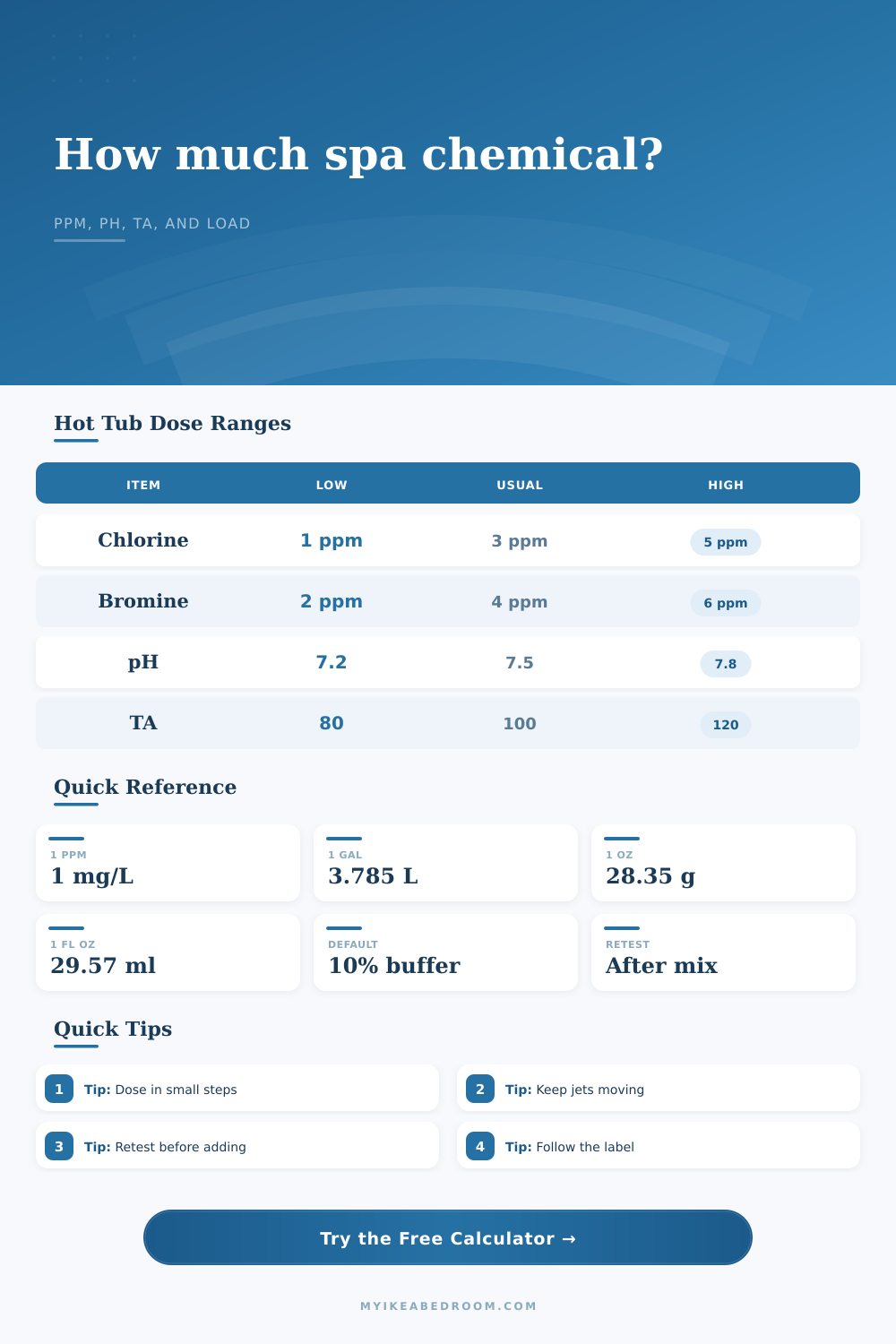
| Sanitizer Type | Common Test Range | Calculator Input | Strength Note |
|---|---|---|---|
| Chlorine | 1-5 ppm | Current to target ppm | Dry and liquid labels vary |
| Bromine | 2-6 ppm | Current to target ppm | Often dosed higher than chlorine |
| Non-chlorine oxidizer | Label-based | Target ppm equivalent | Use label active percentage |
| Maintenance trim | Small ppm gap | Use buffer 10-20% | Retest before second dose |
| Product Strength | Active In 1 oz Dry | Approx 400 gal 1 ppm | Best Input Use |
|---|---|---|---|
| 10% | 2.83 g | 0.53 oz | Low-strength liquids |
| 35% | 9.92 g | 0.15 oz | Moderate powder |
| 56% | 15.88 g | 0.10 oz | Common granular entry |
| 65% | 18.43 g | 0.08 oz | Higher-strength granular |
| pH Or TA Change | Base Estimate | Scaled By Volume | Calculator Treatment |
|---|---|---|---|
| Lower pH 0.2 | 1 oz dry acid per 500 gal | Linear estimate | Adjusted for strength |
| Raise pH 0.2 | 1 oz soda ash per 500 gal | Linear estimate | Adjusted for strength |
| Raise TA 10 ppm | 1.2 oz per 500 gal | Linear estimate | Increaser estimate |
| Lower TA 10 ppm | 1.6 oz per 500 gal | Linear estimate | Reducer estimate |
| Condition | Demand Factor | When It Applies | Dosing Buffer Pairing |
|---|---|---|---|
| Idle covered water | 0.95-1.00 | Low activity | 5-10% holdback |
| Normal 100-102°F | 1.10-1.20 | Typical soak use | 10% holdback |
| Heavy recent use | 1.25-1.35 | Several bathers | 10-15% holdback |
| Very hot or very busy | 1.35-1.60 | High demand water | 15-25% split dose |
💡Dosing Notes
The water doesn’t feel right in the hot tub. It’s hazy in the water. It stings your skin. Maybe it smells like chemical way too much. So most owners just dump some more sanitizer in the spa to correct it.
What does that typically do? Make it worse! Balance, not brute force, makes for good spa maintenance.
How to Fix Your Hot Tub Water
In science class, you’re the chemist running an experiment. Comfort is the primary stake. So what does that look like? The calculator up top can do it for ya but knowing how it does it is important too.
There are 3 elements to water chemistry. Alkalinity, a buffer that keeps pH from swinging wildly. It controls pH. PH (determines how well sanitizer work). Sanitizer destroys germs. So alkalinity buffers pH, and pH determine how well your sanitizer works. Without alkalinity, pH will shift (either up or down) and you will need to adjust with either base or acid. People mostly forget about alkalinity. They only treat the symptoms rather than stabilize the foundation.
First: Look at the inputs. Start with volume. Dosage errors occur when amount of water is inaccurate. You believe you have a four-hundred gallon tub, but in fact it’s five-hundred. That’s a twenty-five percent error on what chemicals you add. Everything will be scaled based off size of your tub. Use gallons or liters.
It’ll ask for how strong the product is. Product strength can vary by form/brand. Granular dichlor is not the same as liquid chlorine. Tablets aren’t like bromine tabs. Wrong assumption on strength means over-correction. Eyes gets irritated. Oils get stripped off the skin.
It’s complicated by temperature and volume of use. Cool water require less sanitizer than warm water. Biological activity and chemical evaporation are sped up by heat. The calculator accounts for that. Demand is also accounted for. How much you use it matters. A tub that sits covered and idle doesn’t require as much attention as a tub being used for a party. This is why the demand factor look at how often you use it. Avoiding waste means understanding that difference.
That’s where the shocking and chemical waste cycle ends. Adjust pH patiently. You can’t shoot your pH down with acid and then hope for it to remain there when your alkalinity is too high. See this interaction between those two parameters in the reference table. Adjusting pH without fixing alkalinity is a waste of time. Alkalinity has to come first. That’s why I call it pH patience. If you shoot in the wrong order, chemistry will push back. Your efforts is undone.
The dosing buffer provides a safety factor by holding back some of the chemical. So you cannot overdo it. Also, adding all at once causes a concentration hot spot that may harm your seals or irritate the bather. Adding gradually lets chemicals dissolve and spread through the water. Half now, retest later, wait a bit longer, and add more if necesary. This results in less waste and is safer on equipment.
Rushing causes common mistakes. People are overdosing now to get clear water. A double dose does not make chemicals work any quicker. It makes them work harder, with side effects. Rarely does cloudy water gets better with more chlorine. Cloudy water can be caused by high TDS (total dissolved solids) and improper pH. Drain the water to help. Sanitizer is an easy fix. PH and alkalinity need real work.
Test strips are not commands. They’re clues. Don’t make numbers the only thing you follow. Follow the process. Estimate doses using the test strips as your guide. Check the results with your nose and eyes. Soft-feeling water should smell clean. That’s obvious.
Patience, not panic, is the answer. The math will get you near. Observation keeps you there. You had a water problem. The solution should of been patience.