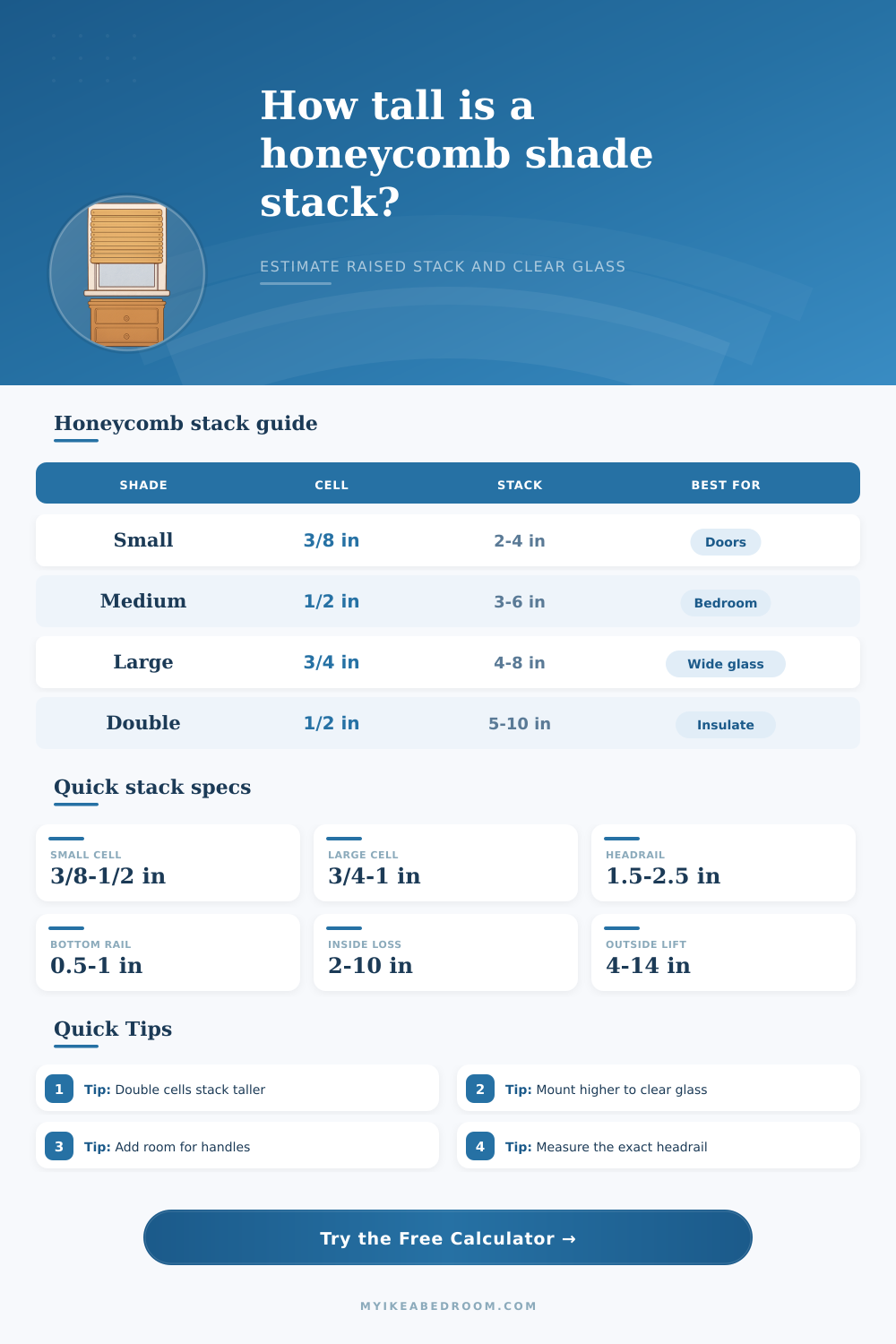
🪟 Honeycomb Shade Stack Height Calculator
Estimate how much window glass a raised cellular shade will cover, then size the mount height for cleaner daylight and handle clearance.
1 Shade presets
Start with a common honeycomb shade situation, then adjust the exact rail sizes from your product sheet.
2 Window and shade settings
3 Stack factor reference
Rail package
Headrail, bottom rail, end caps, and lift hardware form the stack base before fabric is counted.
Fabric stack
Cellular fabric often compresses to a small percentage of shade height, varying by cell and layer count.
Wide shade
Extra width can make the stack slightly uneven, especially on cordless and blackout products.
Outside mount
Mounting above the opening can move most or all of the raised stack off the glass.
4 Honeycomb shade stack tables
| Cell and build | Typical stack behavior | Best use | Measurement note |
|---|---|---|---|
| 3/8 in single cell | Compact rail with many tight pleats | Small windows, French doors, bathrooms | Watch handle clearance on door glass |
| 1/2 in single cell | Moderate pleat count and predictable stack | Bedrooms, offices, living rooms | Good default when product data is unknown |
| 3/4 in single cell | Fewer pleats but deeper cell folds | Wide or tall windows needing stronger scale | Check the bottom rail projection |
| 1/2 in double cell | Bulkier compressed fabric package | Cold rooms, street-facing windows | Plan more above-glass space if possible |
| Blackout cellular | Denser face layer and tighter side fit | Nurseries, media rooms, sleep spaces | Add clearance for trim and side channels |
| Window height | Light filtering single cell | Blackout single cell | Double cell or TDBU |
|---|---|---|---|
| 36 in | 2.5-3.5 in stack | 3-4.5 in stack | 4-6 in stack |
| 48 in | 3-4.5 in stack | 3.5-5.5 in stack | 5-7 in stack |
| 60 in | 3.5-5 in stack | 4.5-6.5 in stack | 6-8.5 in stack |
| 72 in | 4-6 in stack | 5-7.5 in stack | 7-10 in stack |
| 84 in | 5-7 in stack | 6-9 in stack | 8-12 in stack |
| Mount goal | What to measure | Calculator output to use | Practical clearance rule |
|---|---|---|---|
| Inside mount | Opening height and recess above visible glass | Glass covered when raised | Accept the stack unless it blocks a lock or sight line |
| Outside mount | Wall or trim height available above the glass | Outside mount lift needed | Mount high enough for stack plus handle clearance |
| Door mount | Glass height, frame space, handle projection | Covered glass and latch warning | Keep the stack above the active latch when possible |
| Blackout room | Trim overlap, rail height, and side gaps | Stack plus recommended lift | Leave enough overlap to reduce light leaks |
5 Measuring notes
Raise honeycomb shades for softer light and better insulation, but they is partially obscured by that pile of fabric. That’s because the amount of glass revealed depend on the stack height. So what percentage of your window will be blocked? Don’t guess: the calculator provides an estimate. Simply input the cell construction and your window dimensions. It instantly lets you know how much of your glass will stay covered once the shade is pulled up. It even recommends where to position headrail if mounting outside the frame.
Why guess based off unclear product text? Why do some shade stacks gets taller than others? How big are the cells? A three-eighth-inch cell has lots of tiny pleats that fold together very closely. When these shades go up, they don’t take up much room. In contrast, a three-quarter-inch cell have fewer folds and those folds is bigger and more bulky. Even stacked up, the fabric takes up more vertical space. Layer on an additional double or triple cell for thermal protection and the stack become considerably larger. You’ll enjoy more insulation and privacy, but you will sacrifice a bit of window space. Not a bad deal if you choose your mount height accordingly.
How to Choose Your Honeycomb Shade Size
Another factor is the weight of the fabric. Sheer fabrics, like light-passing sheers, fold up on headrail more nicely than blackout liners. Why? They are lighter and therefore less stiff. Their stiffness keeps the stack raised higher.
Cordless lifts are another part that adds more hardware to the rail package. They’re a fixed part in the rail package and don’t compress at all…just sit there and take up room above where you want to see out. Consider this rail height different than how much the fabric will compress on the rail.
Space becomes an issue for inside mounts. In most cases the recess above glass is narrow. And if your stack goes beyond depth of the recess, then it covers part of window. If you have wall space, outside mounts provide a solution. By mounting the headrail at or above height of the frame, the stack raises out of opening and provides a clear view. When raised, the shade do not obstruct your view. How high should you mount? The calculator tells you exactly.
People often forget about hardware clearance on doors. Does your crank on a casement window stick out? What about the handle on a patio door? Those things gets bumped into if you have a raised shade hanging down too far. And even worse, they will prevent the mechanism from functioning because the stack is blocking it. Plan for extra clearance, maybe add an inch or two so you don’t have to be frustrated later. Little change but a huge difference in day-to-day use.
The other thing that can impact the stack is width. Very wide shades tend to compress slightly unevenly because tension varies along the width. That results in a wavy top edge (instead of a flat line). This does not realy impact the height, but it looks messier. You’ll see this more on wider sets of windows or sliding doors. Expect the stack to be a little less predictable if that’s the case for you.
Take accurate measurements. If it is available, use the headrail height given by the manufacturer. A half inch of difference between rail sizes make a big difference in the finished product. Don’t go by guesses. Round up your estimates for the stack expansion. The fabric will stretch some with use and relax a little over time. Also keep in mind that the pleats will settle a bit, so the stack will increase. If you plan for it, the shade will look nice and neat years later.
Consider what’s most important to you before purchase. Is it being able to see everything or do you need to keep warm? Typically you can achieve both, but not at the same time within one real location. To get views you need clearances, to stay warm you need bulk. It’s simply a matter of location and numbers. Let the numbers direct where you place the mount, then rely on your eyeballs to make sure it looks right.
It really doesn’t take much. Keep it simple. Want heat but don’t lose touch with the outdoors, right? You should of planned accordingly. Measure twice, calculate once and savor the moment the next time you yank that cord.