Holdback Spacing Calculator
Place curtain holdbacks with matching side offsets, balanced height, clear reveal, and enough room for the gathered fabric stack.
Quick presets
Recommended Holdback Placement
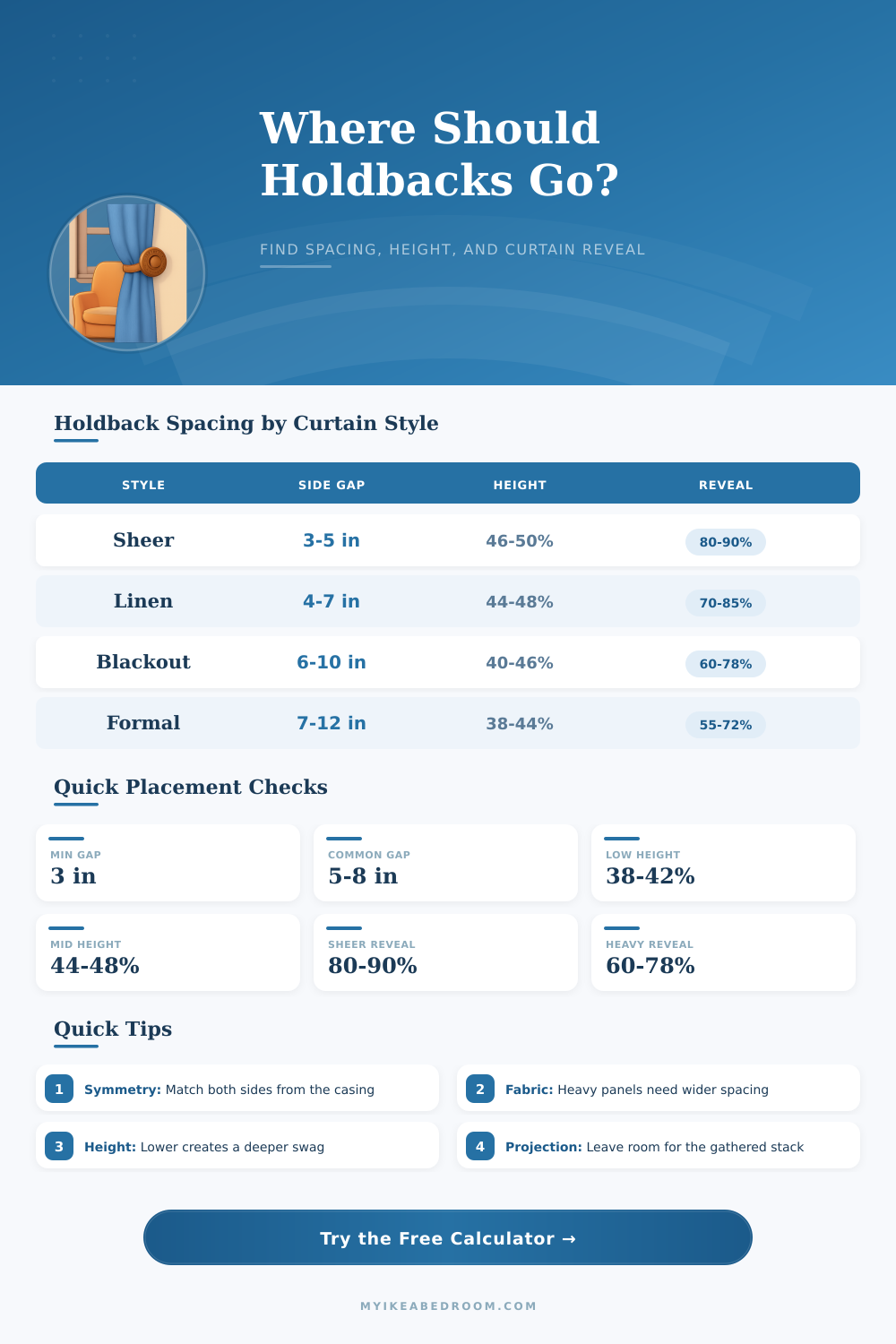
| Curtain style | Offset from casing | Mount height zone | Best use |
|---|---|---|---|
| Sheer or voile | 3-5 in outside trim | 46-50% down from rod | Light reveal without a deep swag |
| Linen or cotton | 4-7 in outside trim | 44-48% down from rod | Balanced bedroom or living room panels |
| Lined drapery | 5-9 in outside trim | 42-47% down from rod | Full folds with moderate projection |
| Blackout panel | 6-10 in outside trim | 40-46% down from rod | Bulkier stack and stronger side pull |
| Velvet or formal | 7-12 in outside trim | 38-44% down from rod | Lower swag and heavy visual weight |
| Target reveal | Use when | Stack allowance | Spacing note |
|---|---|---|---|
| 55-65% | Formal swag or heavy velvet | Wide stack | Allow extra side offset |
| 66-75% | Blackout or lined panels | Medium wide stack | Usually 6-10 in outside trim |
| 76-85% | Standard linen or cotton | Medium stack | Usually 4-8 in outside trim |
| 86-92% | Sheers or narrow panels | Light stack | Use a shallower holdback |
| Check | Formula basis | Good range | Adjustment |
|---|---|---|---|
| Side offset | Casing plus gathered stack | 3-12 in | Increase for bulkier fabric |
| Spacing pair | Window plus trim plus offsets | Window width plus sides | Keep equal from centerline |
| Height from floor | Rod height minus style drop | 38-52% of curtain drop | Lower for a deeper curve |
| Pull angle | Vertical drop vs side pull | 28-55 degrees | Move wider or adjust height |
| Projection fit | Fabric stack vs hook depth | Hook covers 35-65% | Use deeper hardware if needed |
There’s always the time in decorating where you’ve just hung these gorgeous drapes… and something’s not right. One side hangs over window handle, or the fabric isn’t realy falling the way you expected. It’s subtle; yet somehow it ruin the entire space.
While holdback spacing is about how light hits the fabric and how much space it need to breathe, you’ll need the calculator to handle the math so everything stays in visual balance. More often than not, it involve how much actual space there is for the gathered fabric to breathe and how the light falls on it. If it’s wrong it’s generaly because your curtains is either hanging too tightly or strangely loose.
How to Hang Curtains Correctly
You still have to do some math with that, like figuring out how much fabric weigh and how tall your rod is. And the calculator (above) does it for you, no conversions or factors required. But the grunt work come from knowing what all those numbers mean, and why they’re important.
A good way to look at it is to see the holdback less as a hook than as an anchor point for a dynamic curve. This is balanced by three things: vertical drop, horizontal offset, and fabric bulk. If you miss any one of these points, visual balance fails.
First, consider height. Most people get tripped up here. They find a location they like in their head but it’s not tall enough (or long enough) for their particular curtain type. The proportions are maintained by drop zones based off percentages. Sheer fabrics generaly fall higher on the rod, near the halfway point of your curtain length. That way the sheers drape airily, letting some light come through without being hung so low it makes a large, saggy pocket.
Blackout fabrics requires a lower hang. Going down to forty percent gives you a deeper swag, which visually balances out heaviness of the fabric. Velvet would look awkward if placed at the same level as linen; it’s simply too heavy for that area.
Next is the side offset. This is the amount of space between the window casing and where the holdback is mounted. How much do you want the curtain to stack back? Don’t put it so far out that it touches furniture or covers the glass! The calculator will help you figure this out because it considers the fullness ratio (the amount of fabric per inch of rod) and the width of your panels.
A higher fullness ratio mean a bigger piece of fabric per inch of rod, which in turn equals a larger stack back. Mounting the holdback right next to the frame leaves no place for all that excess fabric to go, it bunches and looks messy. For thicker fabrics, you’ll likely need wider offsets (because there’s just more fabric to compress horizontally). That’s why the tool recommend wider offsets for heavier fabrics.
It might project more than you realize. Thin cotton can stand up to a flatter hook; thicker velvet or doubled drapes may get pinched. You’ll want to run that through the projection check in the calculator, and make sure your hardware’s deep enough to accommodate the stack of fabrics. And if the numbers tell you there’s a lot of stack to cover, you’ll want something with a bigger side offset (or deeper hardware) so the fabric doesn’t look all bunched up against the wall.
Let the material breathe and fall where it wants to. You have no wiggle room because symmetry matter. If one holdback is 1/2 inch off-center compared than its partner, it’ll show in daylight’s bright light. To keep things even, the tool shows center-to-center distance. Instead of guesstimating from your curtain fabric (which changes), mark from a fixed point like the outside lining of the casing. Then use a level to make sure your marks align perfectly before drilling.
While a little variation in height is OK on an empty wall, it sticks out when your eye follow it across a large window. It’s always good to mock first: Gather the panel at the recommended spot and see how it fits. Will it cover a crank on a window? An outlet? Use the numbers provided by the calculator and then tweak them a bit based off your own window quirks. You should of checked that first. If there are shutters or trim involved, tack a little more into the equation. That attention to detail makes all the difference between a generic finish and one that feels custom.
All in all, styling curtains well means having just the right amount of pull. Use enough to create a clean shape, but not so much that the fabric stretches. With this tool out of the equation, we can eliminate some of the guesswork from measuring and find our “sweet spot” for pull.
After adjusting your height/offset, everything will line up. There is no more awkward bunching. The drapes fall cleanly and use the full window opening. It sounds like a small thing but it’s that one little detail that makes the whole room come together.