Hobbled Roman Shade Calculator
Estimate fabric yardage, hobbled fold allowance, lining yardage, lift rings, and ring tape from window size, mount type, fold plan, pattern repeat, lining choice, and shade count.
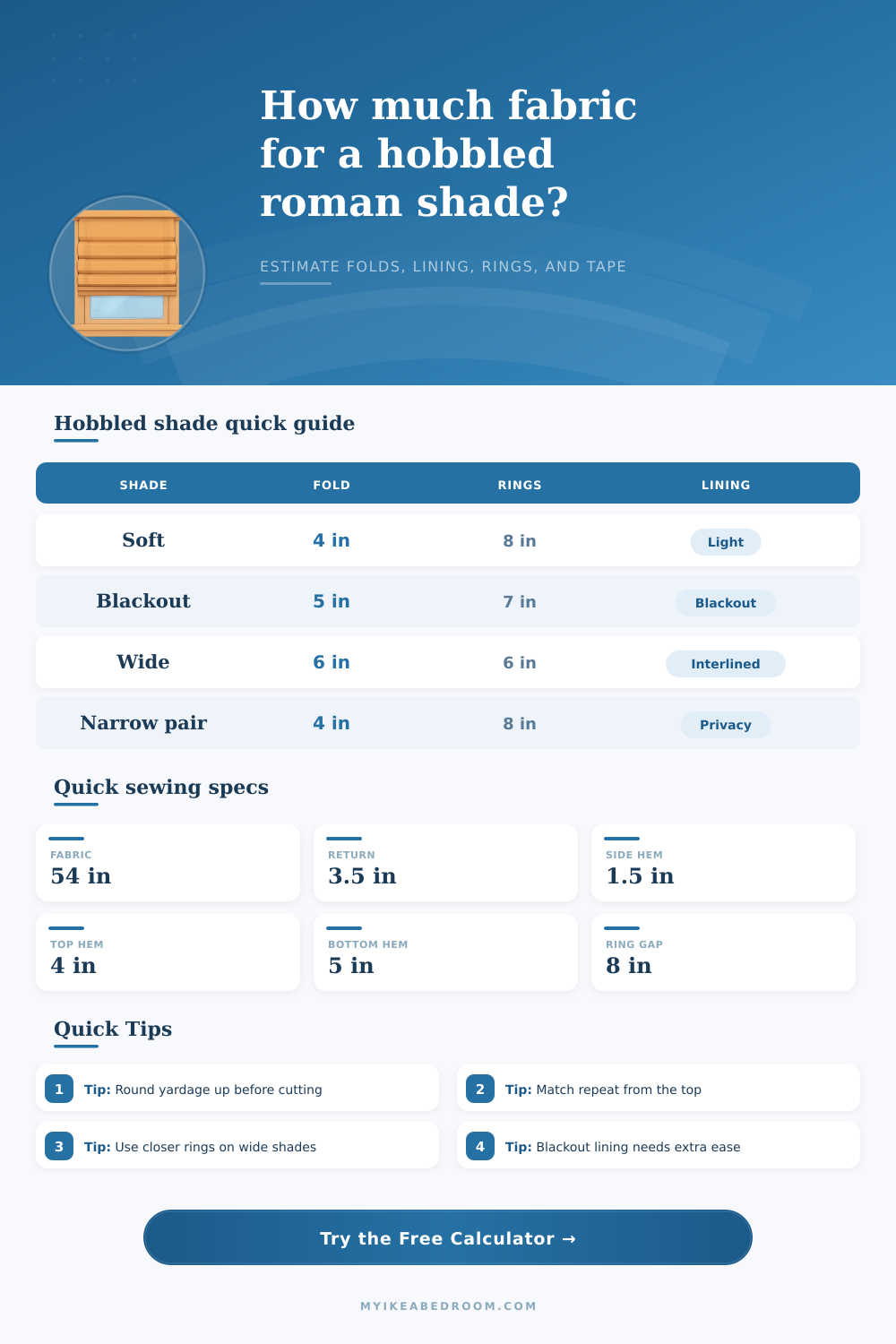
Start with a common hobbled roman shade layout, then adjust the exact window, fabric, lining, folds, and lift hardware spacing.
Calculation breakdown
Enter shade values to calculate the workroom material list.
| Finished shade width | Suggested fabric width | Likely widths | Planning note |
|---|---|---|---|
| 24 to 36 in | 48 to 54 in | 1 width | Usually simple for solids and small repeats. |
| 37 to 48 in | 54 in | 1 width | Check side hems and return allowance before cutting. |
| 49 to 72 in | 54 in | 2 widths | Plan seam placement away from the center lift line. |
| 73 to 96 in | 54 in | 2 to 3 widths | Consider splitting into paired shades for better lift. |
| Fold depth | Look | Best use | Allowance per 8 folds |
|---|---|---|---|
| 3 to 4 in | Tailored | Small windows and shallow inside mounts | 24 to 32 in |
| 4 to 5 in | Soft standard | Bedroom and guest room shades | 32 to 40 in |
| 5 to 6 in | Drapey | Tall windows and heavier face fabric | 40 to 48 in |
| 6 in plus | Very full | Feature windows or theatrical fabric | 48 in plus |
| Shade condition | Ring spacing | Minimum columns | Lift behavior |
|---|---|---|---|
| Narrow light-filtering shade | 8 to 9 in | 3 columns | Usually lifts evenly with standard rings. |
| Medium lined shade | 7 to 8 in | 4 columns | Good balance for most bedroom windows. |
| Wide or heavy shade | 6 to 7 in | 5 columns | Reduces sag across the hobbled folds. |
| Blackout or interlined shade | 5.5 to 7 in | 5 columns | Closer tape helps the thicker stack rise cleanly. |
| Lining type | Yardage factor | Best use | Workroom note |
|---|---|---|---|
| No lining | 0.00 | Decorative sample or sheer effect | No lining yardage is counted. |
| Light filtering | 0.96 | Soft bedroom privacy | Slightly less width than face fabric can work. |
| Privacy sateen | 1.00 | Everyday bedroom shade | Plan close to the same cut length as face fabric. |
| Blackout or interlined | 1.08 to 1.15 | Nursery, media, or sleep rooms | Extra ease reduces pulling and distortion. |
Uses extra fabric for permanent soft folds. Best when the shade should look dressed even when lowered.
Uses less face fabric because the panel is mostly flat until raised. Better for bold prints and less bulk.
Needs side rings and a center smile rather than repeated hobbled folds. Good for casual fabric.
Dividing a wide opening can reduce fabric widths, ring load, and lift drag while keeping a balanced window look.
Fold planning: Check the fold allowance against the finished drop before cutting. A very short shade with many deep folds can stack bulky and hide too much glass.
Pattern matching: For repeats, round each shade cut length before multiplying by fabric widths and shade count. This keeps paired shades aligned at the top fold.
Hobbled roman shades are a type of window treatment that sit between a flat panel and a full curtain. Hobbled roman shades provide a soft appearance to the bedroom or other area of the home. However, the design of a hobbled shade maintains the lines of a standard shade.
The folds of a hobbled shade is visible even when the shade is lowered. These folds have extra fabric within them to allow them to remain visible. Due to the extra fabric within each fold, the way that one plans for hobbled roman shades will be more different than planning for standard shades.
How to Use the Shade Calculator
Using the calculator will allow one to determine the amount of fabric that is required for the hobbled shades. The dimension of the window, the width of the fabric, the depth of the folds, the lining that is chosen for the shade, and the pattern repeat will all need to be entered into the calculator. Additionally, the user will need to enter the number of shades and the type of mount that will be used on the window into the shade calculator.
Each of these will impact both the amount of fabric that will be needed and the way that the shades will look when hung from the window. The depth of the folds will impact the appearance of the shades. A fold depth of four inches will create a gentle ripple in the fabric that is useful for bedrooms or guest room.
A fold depth of five or six inches will create a more drapey shade. However, a five or six-inch depth will require more fabric for the shades. The user can choose the depth of the folds within the calculator, and the calculator will show the total amount of fabric required for such a choice.
The type of mount for the shade will impact the width of the fabric that is required prior to cutting the fabric. Should the shades be mounted within the window frame, a small deduction will need to be made to the width of the fabric. Should the shades be mounted outside of the window or mounted to the ceiling, a return allowance will be made on each end of the shade.
These returns may impact the amount of fabric that is available for the shade. The user can choose the type of mount within the shade calculator, and the calculator will adjust the total amount of fabric. The lining that is chosen for the shades will impact the amount of fabric that is required for the project.
Should the lining chosen be a blackout lining or an interlined lining, the fabric will be thicker. Using too much fabric for the shade will cause the linings to potentially pull at the shade. To even out the thickness of the linings, the calculator will increase the lining yardage.
Lightly filtering linen can be cut to be narrower than the face fabric. The yardage for this type of linen will be reflected in the calculator. The pattern repeat for the shade will increase the total amount of fabric that is required for the project.
Should a pattern repeat be entered into the calculator, the length of each shade will be rounded up to the next full pattern repeat. The amount of fabric necessary for each shade will be reflected in the calculator based on the pattern repeat that is entered. The placement of the rings within the shade will impact the way that the shade will open.
Should the rings be closer together, there will be less sagging in the shade. Additionally, if blackout lining is used, the rings should be closer to the fabric. The calculator will determine the total amount of rings and the amount of tape that will be necessary for the project.
This allows for the determination of the total cost of the hardware for the shades. Additionally, the calculator will show how many fabric widths each shade will require. This will allow for the decision about whether one wide shade or two narrower shades will be ordered.
Due to the way that fabric often does not match up with the plans that are made, a percentage of the total amount of fabric will be needed as a buffer. Should the shade be a solid color, five percent of fabric may be required as a buffer. However, should the shade feature a large pattern repeat, a percentage of fifteen or twenty percent may be required for the project.
The percentage of fabric that is required as a buffer may be entered and adjusted within the calculator. Though the shade calculator will assist in determining the amount of fabric that will be required, it will not be able to determine the way that the shades will look within the room. Should the window be tall and deep shades is desired, the shades may appear luxurius within the window.
However, deep shades on a short window may create an issue where the folds of the shade cover the glass on the window when the shades are raised. These shades should be checked against the height of the sill or other furniture within the room. The placement of the seams within the shade will impact the appearance of the shade.
Should the shade require two widths of fabric, the seam should be placed away from the center of the shade. The placement of the shade seams will not be determined within the calculator. However, the shade calculator will determine the number of fabric widths, allowing for the decision about where to place the seam within the shade prior to cutting the fabric.
Though many people may think that hobbled roman shades will require special hardware, they will not. The same type of hardware that is used for flat roman shades can be used within the hobbled shades. The spacing of the rings will need to be close enough for the extra weight of the fabric.
Should the shade calculator determine the total number of rings for the project, youll order all of the hardware at once. One of the benefits of using a shade calculator is that each of the choices for the shade can be tested within the calculator. Each parameter can be altered to see how it will impact the total amount of fabric that will be required.
The fold depth can be changed, the lining can be changed from privacy to blackout lining, or the shade can be split into two narrower shades. The total amount of fabric will be reflected in the calculator. This allows for people to see the effect that each choice will have upon the total cost of the shades.
Though the shade calculator will help with determining the amount of fabric that will be required for the project, the calculator is not a replacement for measuring the windows in the actual house. Should the measurements from the shade calculator be entered into the project, a mock-up shade panel can always be made to determine the exact way that the shades will look. The information that will be gathered from this mock-up will be more detailed than that provided from the calculator.
Additionally, the yardage that was calculated for the project will be accurate enough to allow for the purchase of the fabric for the shades.