🏠 Hip Roof Framing Calculator
Calculate common rafter, hip rafter, valley rafter lengths, ridge board size, and cut angles for any hip roof
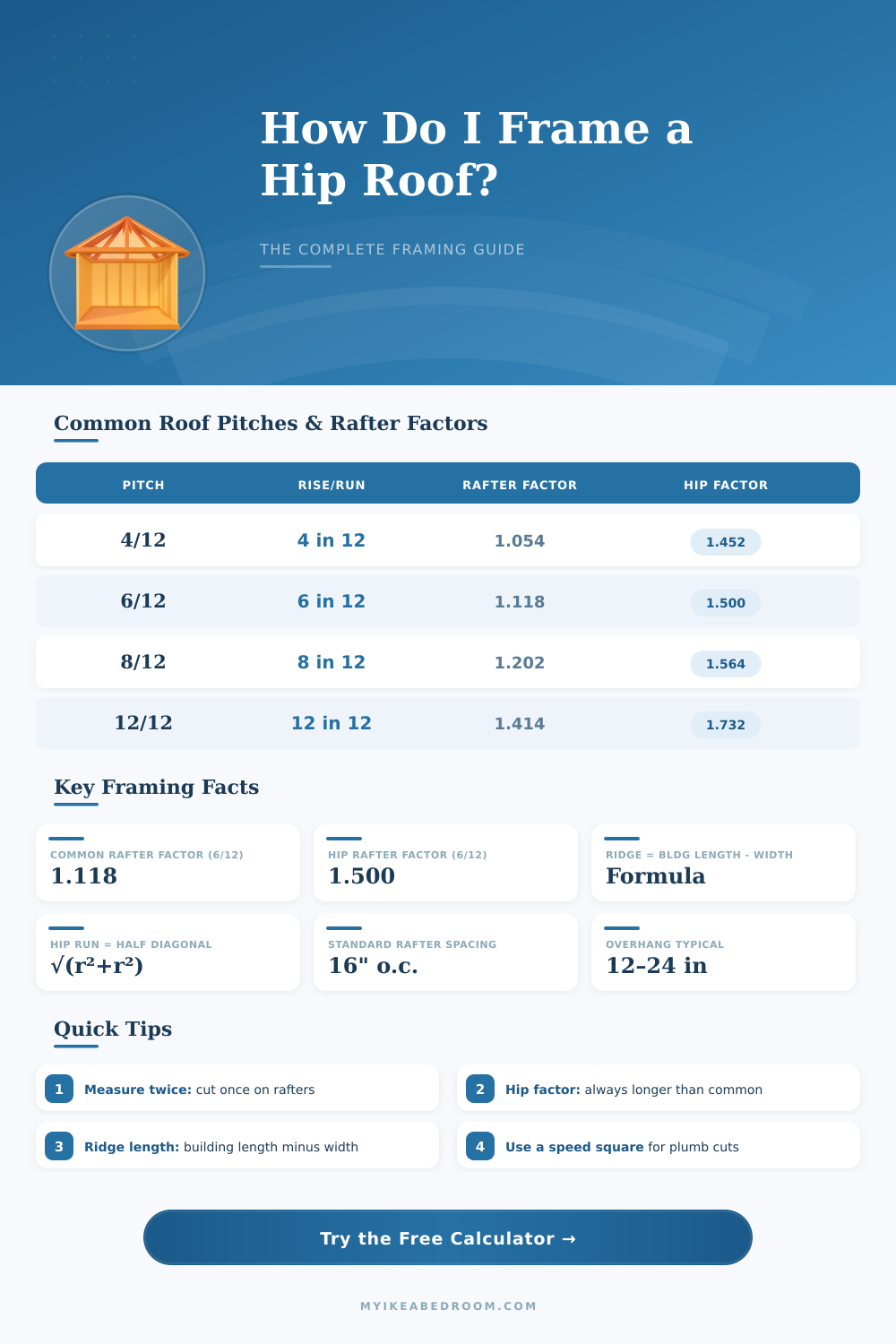
| Pitch | Angle (°) | Common Rafter Factor | Hip/Valley Rafter Factor | Plumb Cut Angle |
|---|---|---|---|---|
| 3/12 | 14.0° | 1.031 | 1.436 | 14.0° |
| 4/12 | 18.4° | 1.054 | 1.452 | 18.4° |
| 5/12 | 22.6° | 1.083 | 1.474 | 22.6° |
| 6/12 | 26.6° | 1.118 | 1.500 | 26.6° |
| 7/12 | 30.3° | 1.158 | 1.530 | 30.3° |
| 8/12 | 33.7° | 1.202 | 1.564 | 33.7° |
| 9/12 | 36.9° | 1.250 | 1.601 | 36.9° |
| 10/12 | 39.8° | 1.302 | 1.642 | 39.8° |
| 12/12 | 45.0° | 1.414 | 1.732 | 45.0° |
| Eave Length | Rafters at 12" o.c. | Rafters at 16" o.c. | Rafters at 24" o.c. |
|---|---|---|---|
| 10 ft | 11 | 8 | 6 |
| 16 ft | 17 | 13 | 9 |
| 20 ft | 21 | 16 | 11 |
| 24 ft | 25 | 19 | 13 |
| 30 ft | 31 | 23 | 16 |
| 40 ft | 41 | 31 | 21 |
| Lumber Size | Max Span (12" o.c.) | Max Span (16" o.c.) | Max Span (24" o.c.) |
|---|---|---|---|
| 2x6 | 14 ft 2 in | 12 ft 7 in | 10 ft 7 in |
| 2x8 | 18 ft 7 in | 16 ft 5 in | 13 ft 10 in |
| 2x10 | 23 ft 3 in | 20 ft 7 in | 17 ft 5 in |
| 2x12 | 27 ft 5 in | 24 ft 5 in | 20 ft 7 in |
| Rafter Size | Ridge Board Size | Notes |
|---|---|---|
| 2x6 | 1x8 or 2x8 | Standard non-structural |
| 2x8 | 1x10 or 2x10 | Most common |
| 2x10 | 1x12 or 2x12 | Larger spans |
| 2x12 | 2x14 or LVL | Structural ridge required |
Hip roof framing is a skill that many find really satisfying. It is pleasant work because you precut all the different pieces, the common rafters and the jack rafters, so that they perfectly fit. The basic rules for framing a simple equal-pitch hip roof include the right position of the hip and the precise cutting of the rafters
Hip roof is any roof with four sides that all slope up to meet at the peak. Probably it is one of the simplest styles of roofing. The framing supports create the sloping sides of the roof around the whole building.
How to Frame a Simple Hip Roof
If the house is square and the sides equal, the roof lines meet in one spot, like a piraymid.
If you compare it with gable roof, framing of hip roof is more difficult because it has four sides with different lengths instead of only two. The ridge board is centered regarding length and also width. Such roofs can have various sizes or forms, as T’s or L’s, which requires more complex structure.
The work goes quickly if you know how to cut everything on the ground and set everything immediately. Even so, it naturally requires more work than regular gable roof; there are at least twice as many cuts needed for framing hip roof.
The hip rafter or hip rafter gives the main support for the hole form. At small roofs, where you use 2×6 timbers, maybe you do not require big ridge rafter. Using story stick made from 2-inch plywood is very useful.
Laying it on the wall and the rafter line, you can mark the thickness of the wall and the overhang of the roof. The best part of that stick is that all initial measures for the framing are in one place.
When you know the lengths of the rafters, you cut the wooden boards to those measures. You make “birdsmouth” cuts in every rafter, so that they flatly connect with the walls. Later, the rafters are assembled and nailed to create the frame.
Finally, you nail plywood to the frame and add shingles to end the work. To calculate hip roof framing, it helps to first find the theoretical measures to the center, and later correct them according to the thickness of the materials. Trusses are a more efficient method for hip roof with flat ceiling, because that spares materialand work.