High Bay Lighting Layout Calculator
Estimate high-bay fixture count, row and column spacing, maintained illuminance, beam coverage, and spacing-to-height ratio for garages, warehouses, gyms, studios, racks, and mezzanines.
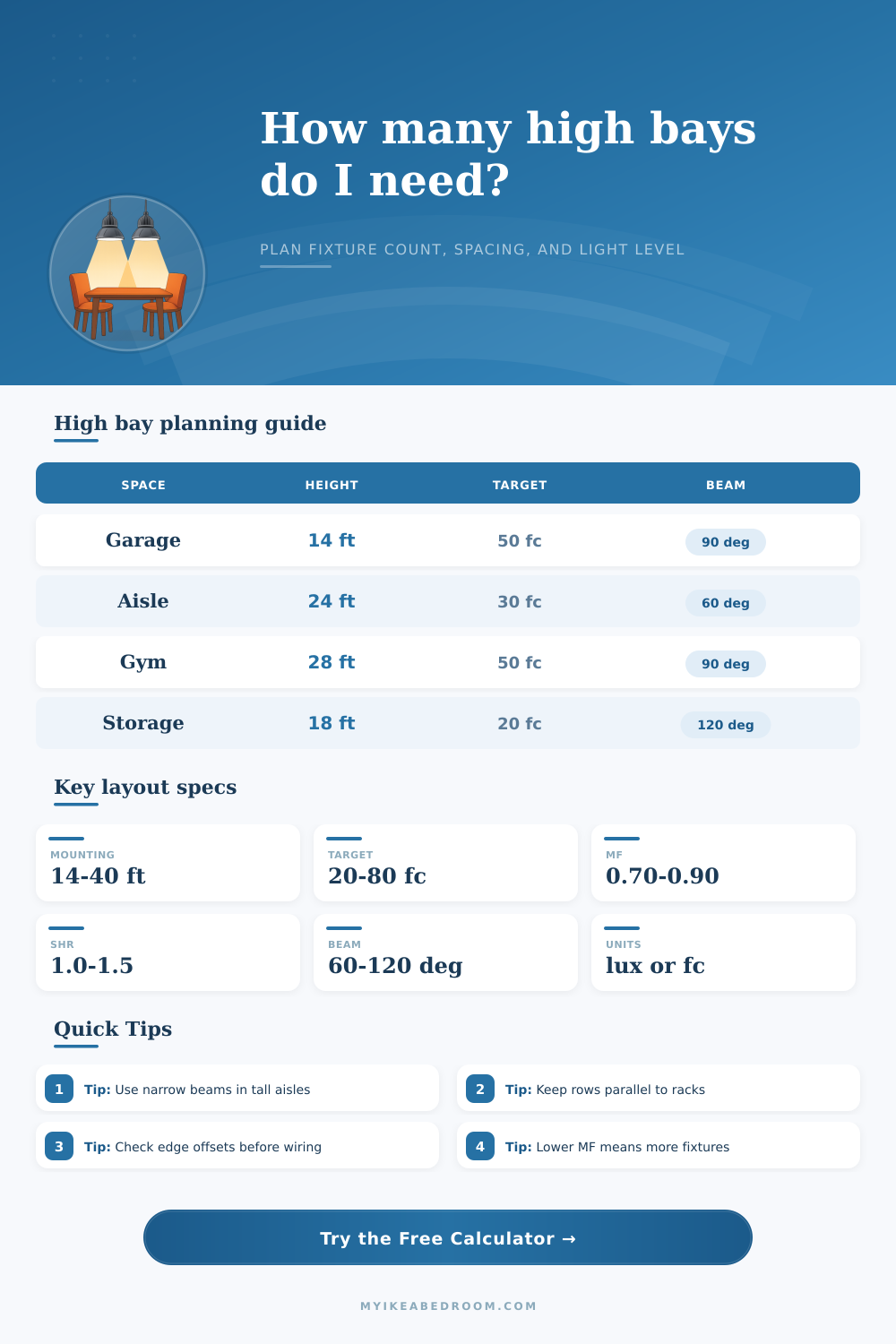
Choose a descriptive starting point, then tune the dimensions, target light level, fixture output, beam angle, reflectance, rack condition, spacing factor, and maintenance factor.
Calculation breakdown
Warehouse lighting is essentialy a geometric problem in that light travels through a space according to the distance and an angle of the light. Many people believes that if they increase the number of light fixture in a warehouse, they will increase the visibility in that space. However, increasing the number of light fixtures dont necessarily lead to an improvement in visibility.
If the light fixtures are placed too far apart in the warehouse, it can create the cave effect. In contrast, if you place the light fixtures too close together, it will waste more money on the electricity and hardware purchases for the light fixtures. The distance between the light fixture and the work plane is important when designing a warehouse.
How to Plan Warehouse Lighting
The distance from the ceiling to the floor isnt always the distance that should of been used. If there is tables or shelves in the warehouse, it is important to find the distance from the floor to the tables or shelves. If a warehouse contains many shelving unit or tables, you should subtract the height of the tables or shelves from the total height of the warehouse ceiling.
This value is the distance between the light fixture and the work plane. The beam angle is the shape of a cone of light created by the fixture. The beam angle determine the spread of the light within the warehouse.
If a narrow beam is used, it will shine the light deep into the aisles of the warehouse. A narrow beam is often used in high pile storage areas. A wide beam will shine the light over a large area.
This beam is often used for wide open floors or low mezzanines. A wide beam spread in a tall warehouse will scatter the light and not reach the floor with a great strength. The maintenance factor is the measurement of the brightness of the lights over time due to the environment of the warehouse.
The effect of the environment of a warehouse include the amount of dust, exhaust fumes, and the grime that can settle on the lenses of the light fixtures. If light fixtures lose their brightness due to the grime and the dust in the air, the warehouse will become dimmer over time. To account for the decrease in brightness, the lighting can be planned in a way that the warehouse is bright enough despite the effect of grime on the light fixtures.
In addition to the other factor that will impact the lighting in the warehouse, it is also important to consider the placement of the light fixtures in relation to the aisles of the warehouse. If the light fixtures are placed directly over the shelving in the warehouse, it will cause shadow to cast into the aisles. To prevent this, you should place the light fixtures in a way that they emit light that drops straight down into the aisles.
If the light drops straight down into the aisles, it will create a consistent ribbon of light in the aisles. This type of lighting will make navigation through the aisles of the warehouse safer for the individual who utilize the warehouse, and it will allow the individuals to see the path that they need to follow. The uniformity of the light is the final goal of the warehouse lighting layout.
Uniformity of light means that the light is seamless throughout the entire warehouse. To achieve uniformity, you should balance the beam angle of the fixtures, the spacing of the light fixtures relative to the height of the work plane, and the maintenance factor of the lights. By finding the proper balance of the beam angle, the spacing of the light fixtures, and the maintenance factor, it is possible to create a warehouse with consistent light and more clear visibility throughout the area.