Hearth Pad Size Calculator
Shape a hearth pad footprint with clearances, build depth, material weight, and bag counts for compact room layouts that still need confident fire protection math.
Calculation Breakdown
| Shape | Width formula | Area formula | Best use |
|---|---|---|---|
| Rectangle | W + 2S | W x D | Most pads |
| Corner cut | W + S + C | W x D - C2/2 | Wall turns |
| Circle | Max span | pi x r2 | Open rooms |
| Triangle | W + 2S | W x D / 2 | Wedge fits |
| Setting | Front | Side | Rear |
|---|---|---|---|
| Front apron layout | 18 in | 8 in | 8 in |
| Compact pellet unit | 12 in | 6 in | 6 in |
| Corner alcove | 18 in | 10 in | 8 in |
| Mass stove layout | 20 in | 12 in | 10 in |
| Build depth | Per sq ft | Per m2 | Use case |
|---|---|---|---|
| 1 in | 0.083 cu ft | 0.025 m3 | Thin stack |
| 2 in | 0.167 cu ft | 0.051 m3 | Light build |
| 3 in | 0.250 cu ft | 0.076 m3 | Default depth |
| 6 in | 0.500 cu ft | 0.152 m3 | Heavy mass |
| Material | Density band | kg per m3 | Notes |
|---|---|---|---|
| Micore board stack | 12-18 lb/ft3 | 190-286 | Lightest core |
| Cement board assembly | 55-70 lb/ft3 | 881-1121 | Common base |
| Mortar bed | 120-140 lb/ft3 | 1922-2243 | Dense fill |
| Stone slab | 160-175 lb/ft3 | 2563-2803 | Very heavy top |
Straight Rectangle
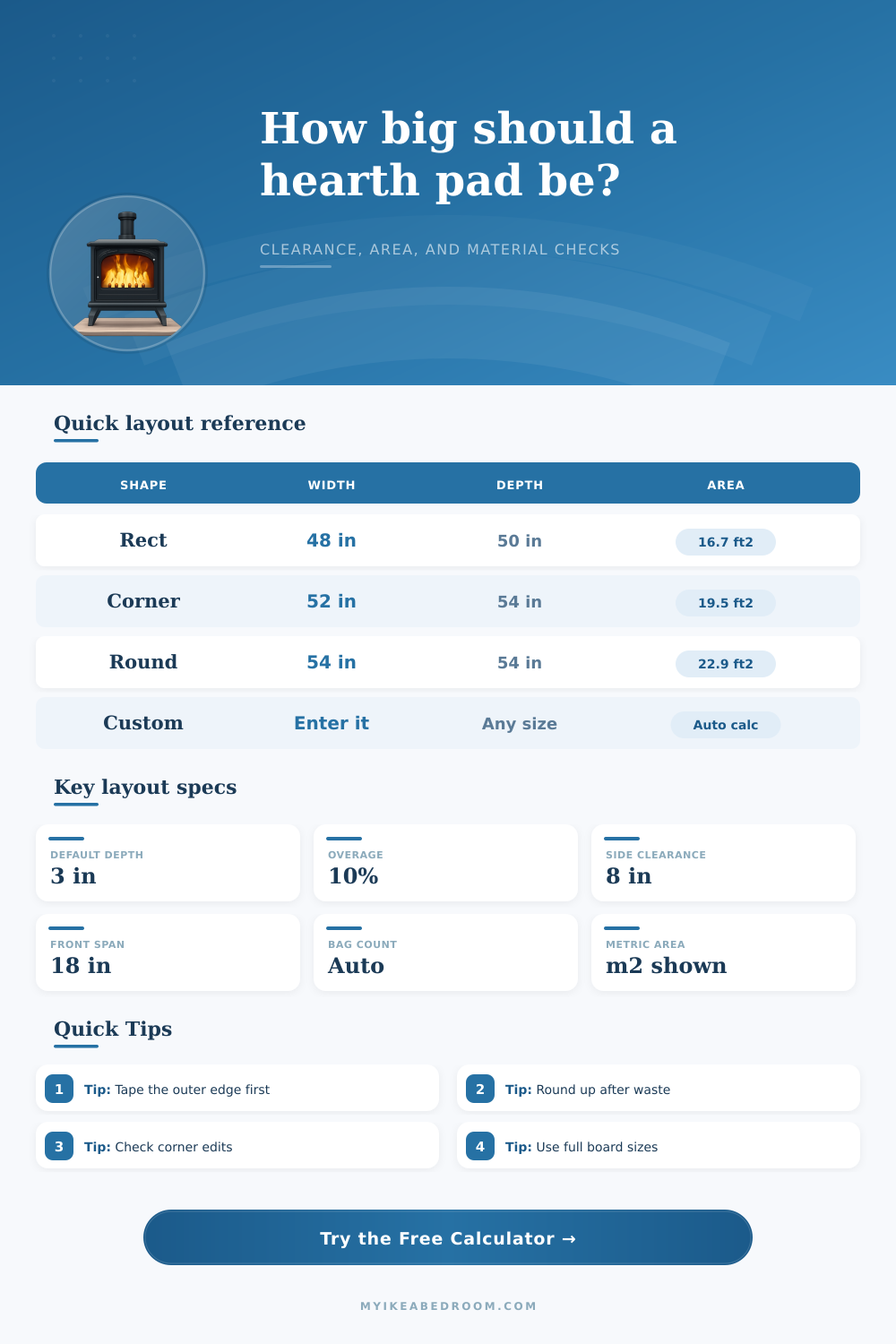
Best for easy framing. Example: 48 x 50 in gives a clean outer edge with predictable tile cuts and a simple trim line.
Corner Cut Pad
Use when the stove sits near two walls. The notch formula trims the corner while keeping the front apron generous.
Round Center Pad
Useful in open rooms where the hearth reads like a feature piece. Diameter is driven by the larger of width or depth.
Deep Apron Layout
Helps when ember projection is the main concern. The front extension grows the footprint while bag counts update automatically.
Dry fit the outer perimeter first, then compare the tape outline against the appliance manual before you lock in any board cuts.
If the pad looks tight, round each clearanced edge up to the next practical module so the final fit stays easy to trim and install.
A hearth pad is an non-combustible base placed underneath a wood stove. A hearth pad is used to catch the embers and sparks from the wood stove to keep the building floor safely from fire. Before installing a wood stove, you must plan the size and shape of the hearth pad.
If the hearth pad is too small, the hearth pad may not satisfies fire codes, and the floor may not be protected from the heat of the stove. If the hearth pad is too large, the hearth pad may take up too much space in the room. The hearth pad must extend beyond the footprint of the wood stove.
How to plan and build a hearth pad
The hearth pad must include clearances to the walls to keep the walls from catching fire, clearances to the stove’s vent, and an apron in the front of the stove to allow for the logs to roll or ashes to spill off of the stove. These different dimensions is required to allow the hearth pad to meet fire safety standards. Hearth pads have specific dimension that the National Fire Protection Association (NFPA) established.
If you dont follow these standards during installation, the building inspector may reject the installation of the wood stove. The shape of the hearth pad is dependent upon the location of the wood stove. Rectangular hearth pads is the most common shape for hearth pads.
If you are to install the wood stove in a corner in the room, a triangular hearth pad can save square footage of the floor. A circular hearth pad may be used in an open room, while a triangular hearth pad may be used in rooms with odd wedge shape. The shape of the hearth pad will impact the calculation of the area of the hearth pad, which will determine how much material will be needed for installation.
The depth of a hearth pad is an important measurement for the hearth pad. Hearth pads can range from depths of approximately one inch to three inches or more in depth. Hearths that are thin may be made of lightweight boards, while hearths that are thick may be made of mortar or stone.
The deeper the hearth pad is, the more mass the hearth will be; it will also be much more heavy. The volume of the hearth pad will determine the weight of the material to be used in construction of the hearth pad, and the weight will determine how many bag of material will need to be purchased for installation. The material you use to construct a hearth pad will impact the total weight of the hearth pad.
Micore boards are lightweight material that are easy to stack. However, mortar bed and stone slabs are very heavy materials. If you decide to place a hearth pad on an upper floor of a building, you should of used a lighter material for the hearth pad to avoid putting excessive weight on the floors joists.
Always purchase approximately 10 percent more material then your calculations show you should need in case you encounter waste when cutting the materials. The dimensions of a hearth pad depend on the type of wood stove that you have. Since a pellet stove is relatively small in size, it may only require six inches of clearance on each side of the stove.
However, a large soapstone stove will require a deeper hearth pad with a larger surround for the stove. Always make sure to measure the base of the wood stove because the depth of the wood stove can be more than the width of the stove. Do not measure the stove according to the illustration in the stoves brochure because the illustration might not represent the size of the wood stove accurate.
The subfloor beneath the hearth pad should be level; otherwise, the tiles that make up the hearth pad could crack. Install a vapor barrier beneath the hearth pad to prevent moisture from traveling through the grout. If you are constructing a raised hearth pad, frame the hearth pad with pressure-treated lumber.
However, seal the lumber to prevent it from charring. During construction, an inspector will check the R-value of the hearth pad to ensure it can withstand high temperature. To determine how much material you need for your hearth pad, calculate the volume of the hearth pad.
Multiply the area of the hearth pad by the depth of the hearth pad to obtain the volume of the hearth pad in cubic feet. Divide that number to find the cubic feet of material required for the hearth pad. Based off the number of cubic feet that the hearth pad requires, calculate how many bag of mortar or concrete you need to purchase.
Check your construction plan against local building codes because local codes may dictate specific clearances for stoves of any size. Plan for adequate ventilation in your hearth pad based on the size of the stovepipe that you will use for venting the stoves emission.