⚖️ Hanger Diagram Calculator
Calculate beam reactions, shear forces, bending moments & support loads for simply supported and cantilever beams
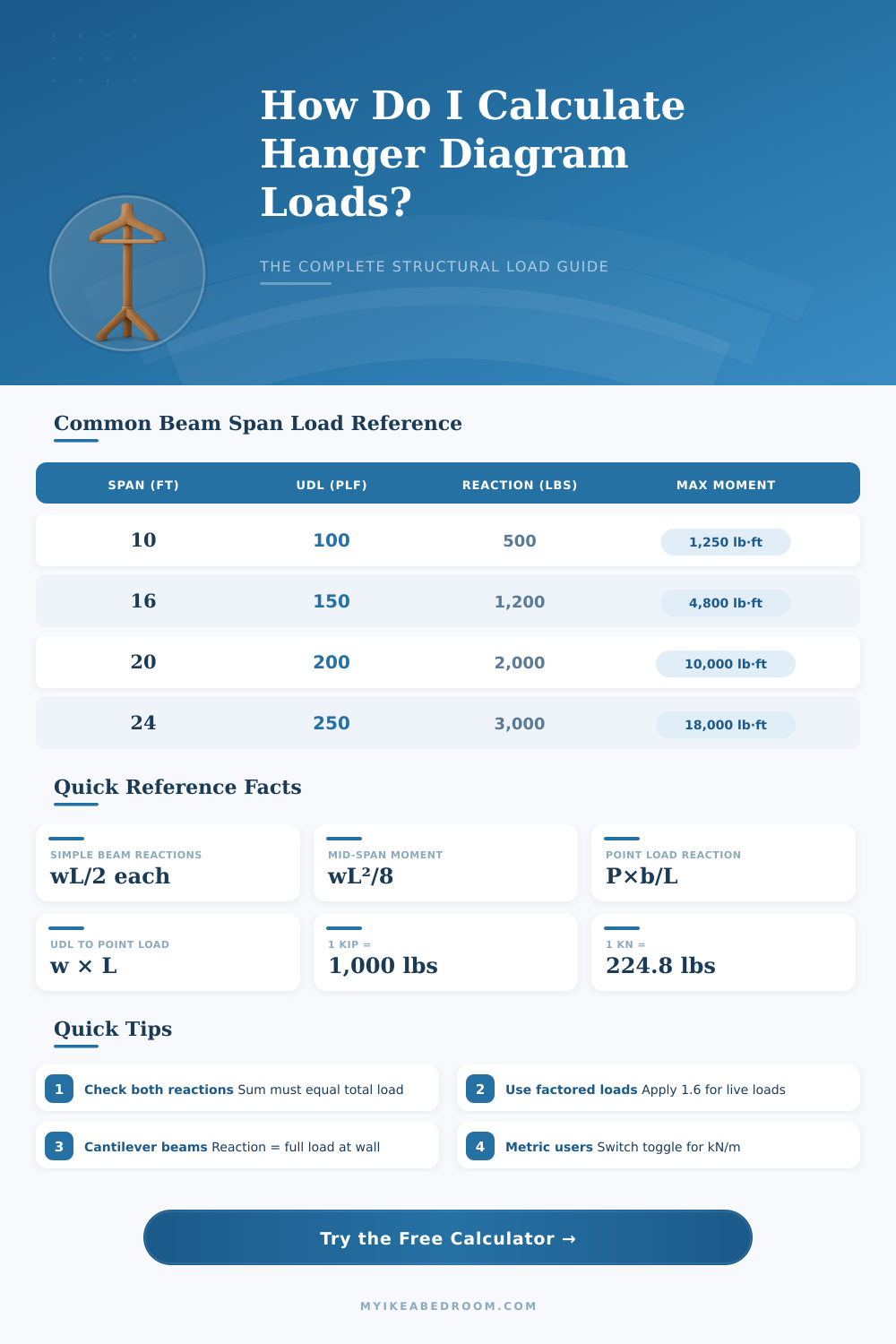
| Span (ft) | Span (m) | Max UDL (plf) — Timber | Max UDL (plf) — Steel | Max Moment (lb·ft) | Typical Use |
|---|---|---|---|---|---|
| 8 | 2.44 | 320 | 1,200 | 2,560 | Short span floor joist |
| 10 | 3.05 | 250 | 950 | 3,125 | Residential floor beam |
| 12 | 3.66 | 200 | 800 | 3,600 | Deck beam / header |
| 16 | 4.88 | 140 | 600 | 4,480 | Garage / basement beam |
| 20 | 6.10 | 100 | 450 | 5,000 | Commercial floor beam |
| 24 | 7.32 | 80 | 350 | 5,760 | Bridge / long span |
| 30 | 9.14 | 55 | 260 | 6,188 | Large open span |
| Material | E (psi) | E (GPa) | Density (lb/ft³) | Yield Strength (psi) | Best Use |
|---|---|---|---|---|---|
| Timber / Wood | 1,700,000 | 11.7 | 30–50 | 1,500 | Residential framing |
| Structural Steel | 29,000,000 | 200 | 490 | 36,000 | Commercial / bridges |
| Glulam / LVL | 1,800,000 | 12.4 | 32–38 | 2,400 | Long-span wood beams |
| Reinforced Concrete | 3,600,000 | 24.8 | 150 | 4,000 (comp.) | Slabs, columns |
| Aluminum | 10,000,000 | 69 | 170 | 35,000 | Lightweight structures |
| Composite / Engineered | 8,000,000 | 55 | 80–110 | 12,000 | Specialty spans |
| Bamboo (Structural) | 2,200,000 | 15.2 | 25–40 | 1,800 | Sustainable framing |
| Steel I-Beam | 29,000,000 | 200 | 490 | 50,000 | Wide flange construction |
| Load Case | Max Shear (V) | Max Moment (M) | Location of Max M | Reaction A | Reaction B |
|---|---|---|---|---|---|
| Simple — UDL (w) | wL/2 | wL²/8 | Mid-span (L/2) | wL/2 | wL/2 |
| Simple — Point at mid (P) | P/2 | PL/4 | Mid-span | P/2 | P/2 |
| Simple — Point at 'a' (P) | Pb/L or Pa/L | Pab/L | At load point | Pb/L | Pa/L |
| Cantilever — UDL (w) | wL | wL²/2 | Fixed end | wL (vertical) | — |
| Cantilever — End Point (P) | P | PL | Fixed end | P (vertical) | — |
| Simple — UDL + Point | (wL+P)/2 | wL²/8 + PL/4 | Near mid-span | (wL+P)/2 | (wL+P)/2 |
| Imperial Unit | Metric Equivalent | Metric Unit | Imperial Equivalent |
|---|---|---|---|
| 1 foot (ft) | 0.3048 m | 1 meter (m) | 3.2808 ft |
| 1 pound (lb) | 4.448 N / 0.4536 kg | 1 kN | 224.81 lbs |
| 1 plf (lb/ft) | 14.594 N/m | 1 kN/m | 68.52 plf |
| 1 lb·ft | 1.3558 N·m | 1 kN·m | 737.6 lb·ft |
| 1 psi | 6,894.76 Pa (6.895 kPa) | 1 MPa | 145.04 psi |
| 1 kip | 4.448 kN | 1 kN | 0.2248 kips |
Hanger diagrams are good for students to show 2-step equations. They make the math more practical and less abstract. The basic idea is simple take a picture of a hanger, like that for hanging clothes, but instead of clothes use shapes or blocks with different weights on the sides
When the hanger is in balance, the weights match on both sides. For instance, one triangle matches three squares. If it does not balance, one side weighs more than the other.
How Hanger Diagrams Help Solve Two-Step Equations
Students observe balanced and unbalanced hangers, and think about what is true or no in those cases. That kind of thought realy helps to build insight.
Students write equations that show the hanger diagrams, and solve one-step equations with them. For instance, if you share one side in three equal parts, every part matches a block with unknown value. Share both sides of the hanger in three parts like dividing the equation by three.
This makes those images so useful.
Some hanger diagrams have labeled bits. For instance, you can have six squares to the left and a mix of crowns, variables and squares to the right. Every bit bears its weight, and the task is to find the unknown value.
There are various kinds of hanger diagrams. Practice with different types and discuss their similarities and differences help to form stronger insight. Some have a total value, which simplifies the resolution of the riddle.
Website SolveMe Mobiles of edc.org is good for practice. It gives riddles with balanced forms. With it you introduce 2-step equations, even those with variables on both sides.
Students can go back to the hanger diagram for help if needed.
The basic idea of those patterns is to understand how they work. Balanced hangers have equal sides. If not, something is off.
That logic applies directly to the solution of equations on paper. The images simply help visualize theprocess during learning.