Hanger Capacity for Closet Calculator
Estimate practical closet rod capacity from rod length, hanger spacing, garment mix, compression buffer, end clearance, and double rod setup.
Your closet hanger capacity
- Usable main rod: 0 in
- Usable lower rod: 0 in
- Adjusted spacing: 0 in per hanger
- Garment mix: balanced everyday mix
- Compression buffer: 10%
- Long garment share: 18%
- Packed theoretical count: 0 hangers
- Rod mode: lower rod same length
| Garment group | Typical spacing | Metric spacing | Best rod setup | Planning note |
|---|---|---|---|---|
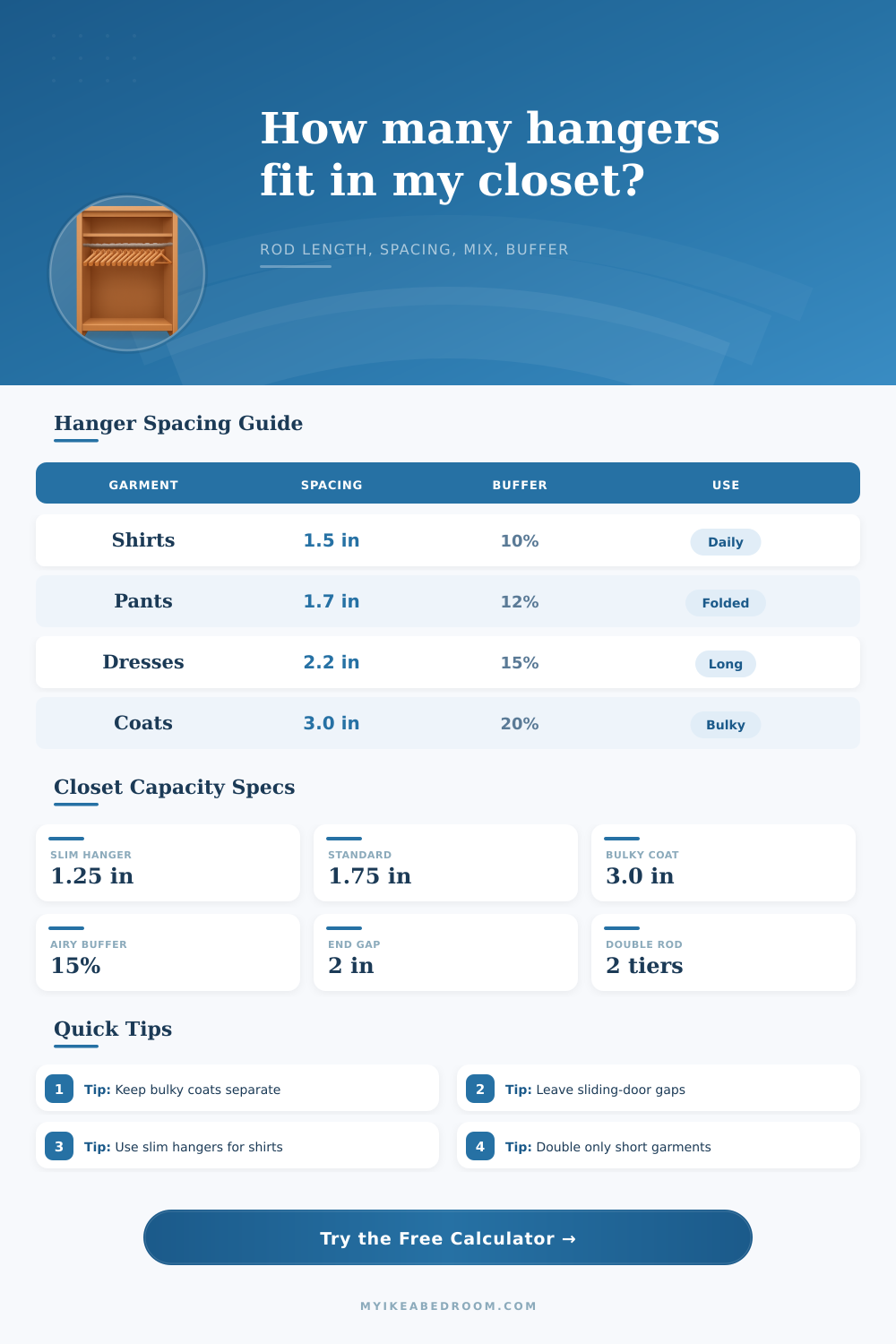
| T-shirts, shirts, blouses | 1.25-1.50 in | 3.2-3.8 cm | Double rod | Highest capacity when hangers are slim and similar. |
| Folded pants, skirts, light layers | 1.50-1.90 in | 3.8-4.8 cm | Single or double | Good everyday default for mixed bedroom closets. |
| Dresses, suits, long cardigans | 2.00-2.50 in | 5.1-6.4 cm | Single rod | Keep clear below long items before counting a lower rod. |
| Coats, bulky sweaters, jackets | 2.75-3.50 in | 7.0-8.9 cm | Single rod | Use a larger buffer so sleeves do not crush together. |
| Mix preset | Spacing used | Long garment share | Suggested buffer | Why it changes capacity |
|---|---|---|---|---|
| Mostly shirts and blouses | 1.45 in | 5% | 10% | Short, thin garments can use both upper and lower rods. |
| Balanced everyday wardrobe | 1.80 in | 18% | 10-15% | Long items reduce the lower tier while mixed thickness increases spacing. |
| Dress and long garment heavy | 2.25 in | 60% | 15% | The lower rod is useful only under the short-garment portion. |
| Coats and bulky layers | 3.10 in | 70% | 20% | Bulk makes counts drop quickly even on long rods. |
| Closet scenario | Rod length | Setup | Good use case | Estimated practical range |
|---|---|---|---|---|
| Small reach-in bay | 30-36 in | Single or short double | Kids clothes, shirts, light layers | 12-42 hangers |
| Standard bedroom closet | 48-72 in | Single with optional double | One everyday wardrobe | 25-85 hangers |
| Wide shared closet | 84-96 in | Double short zones plus long zone | Two-person mixed wardrobe | 70-150 hangers |
| Coat or entry closet | 36-60 in | Single rod | Outerwear and guest coats | 8-24 hangers |
Single rod
Best for dresses, coats, suits, and any closet where vertical clearance matters more than hanger count.
0 hangersDouble rod
Best when most garments are short and the lower rod does not interfere with long pieces above it.
0 hangersCompressed
Shows a packed estimate with no browsing buffer, useful for checking the absolute upper limit.
0 hangersCloset capacity are often not realized until after the purchase of clothing hanger. Many individuals discover after adding there garments that their closet is too small to contain all of there clothes. For instance, individuals may find that their closet rod is too small to contain their winter clothing.
In each of these scenario, the individual is likely not considering the capacity that the rod can take for each individual piece of clothing. Closet capacity is more complex than simple calculation of the length of the closet rod divided by a number that represents the spacing of each garment on the closet rod. Different garments will take up different amounts of space along the rod.
How to Find Out How Many Clothes Your Closet Can Hold
For instance, a long dress will require additional space beneath the dress as the dress will take up that space. Therefore, long dresses will not be able to take up the same space then pants. Each individual closet contains a certain type of clothing.
Therefore, the individual must account for the type of clothing that they have within their closet. Closet hanger spacing will determine the number of pieces of clothing that will be able to reside within the closet. If the individual use narrow hanger spacing, then the closet will only be able to contain clothing that is all of the same thickness.
For instance, the individual may use the same shirts each day. If, however, the individual utilizes coats each day, then the hangers must be spaced further apart to account for the thickness of the coats. In addition to selecting a certain amount of spacing between the hangers, the individual must also select a percentage that represents the amount of space that should remain between the clothing items on the closet rod.
If the individual wants to allow for the clothing to be slid apart from the rod, then a larger percentage will be selected. Most individuals are likely to choose a larger percentage because it will allow for the garments to be quick accessed each weekday morning. Another decision that an individual must make is the amount of clearance that will be provided to the garments.
The rod that is installed in the closet will not extend from one side of the closet to the other. The closet doors, the side panels, and returns will take up some of that space. Therefore, some inches will need to be subtracted from each side of the rod.
By doing so will the individual be able to prevent disappointment when the closet appears to be overflowing with clothing. Closets that include a second rod may include an additional decision for the individual as to the capacity of that second rod. The second rod will only provide additional space for clothing if the clothing on the upper rod is of short lengths.
Long garments will cover the lower rod and prevent the individual from being able to effectively utilize the second rod. By calculating the number of garments of each type, the individual can determine the percentage of garments of each type. That percentage will indicate how the long garments will impact the value of the second rod within the closet.
Closets will change over time as a result of the introduction of new clothing items or the seasonal rotation of clothing within the closet. The purpose of calculating closet capacity is to determine how the current closet and clothing relates to the actual wardrobe items that an individual own. If the closet is near its limit, as a result of the calculation, then the addition of a new garment like a coat will require the individual to purchase a new rod for the closet.
If the closet does have spare spaces within the closet for garments, then the individual will have the space to add new garment to the closet as needed. The tables that are provided on this page will help an individual make decisions regarding the organization of their closets. The tables include information regarding the typical spacing that each type of clothing will require.
These tables can be used to determine whether the closet will require more space or less space than other closets with similar clothing distributions. Common mistakes are made in the organization of closets. One common mistake is that each hanger is treated as if it is the same size and thickness.
The thickness of the hangers will vary. A second common mistake is that individuals make allowances for the second rod in the closet as if it will double the capacity of the closet. That allowance will only be effective if the garments on the upper rod are short in length.
Both of these mistakes will result in an underestimation of the true capacity that the closet has for the garments that an individual owns. By accounting for these mistakes, however, the individual will have a better understanding of the true capacity of the closet with their current garments. Closet capacity may be affected by the consistency of the hangers.
For instance, if some of the garments on a closet rod have thick wooden hangers while other garments use slim velvet hangers, the spacing between the garments will not be even throughout the closet rod. Therefore, such an individual may want to use similar types of hangers throughout each rod section of the closet to ensure that the calculations provide the most accurately calculation of closet capacity. An individual may desire to reach for their garments and not have to shift any of the garments along the closet rod.
A closet that is too restrictive to the retrieval of the items allows for the individual to retrieve their garments quickly and efficient is the most useful type of closet. These trade-offs in the closet organization will ensure that the individual does not have to rely on the trial-and-error approach in the establishment of an efficient system for organizing the closet. Once the individual has determined the capacity of the closet and assigned a number to that capacity, they should test the closet during the first week after the closet is established.
If an individual discovers that the garments do slide easy from one rod to the other, the individual can be assured that their current choice for closet organization is correct. If, however, the individual finds that they have to shift the garments each time they wish to retrieve them from the closet, then the individual should revisit the organization of their closet. Closet organization is a process that will change over time.
For these reasons, the calculations of the potential capacity of the closet are most useful when they are used to make adjustments to the organization of the individuals closet.