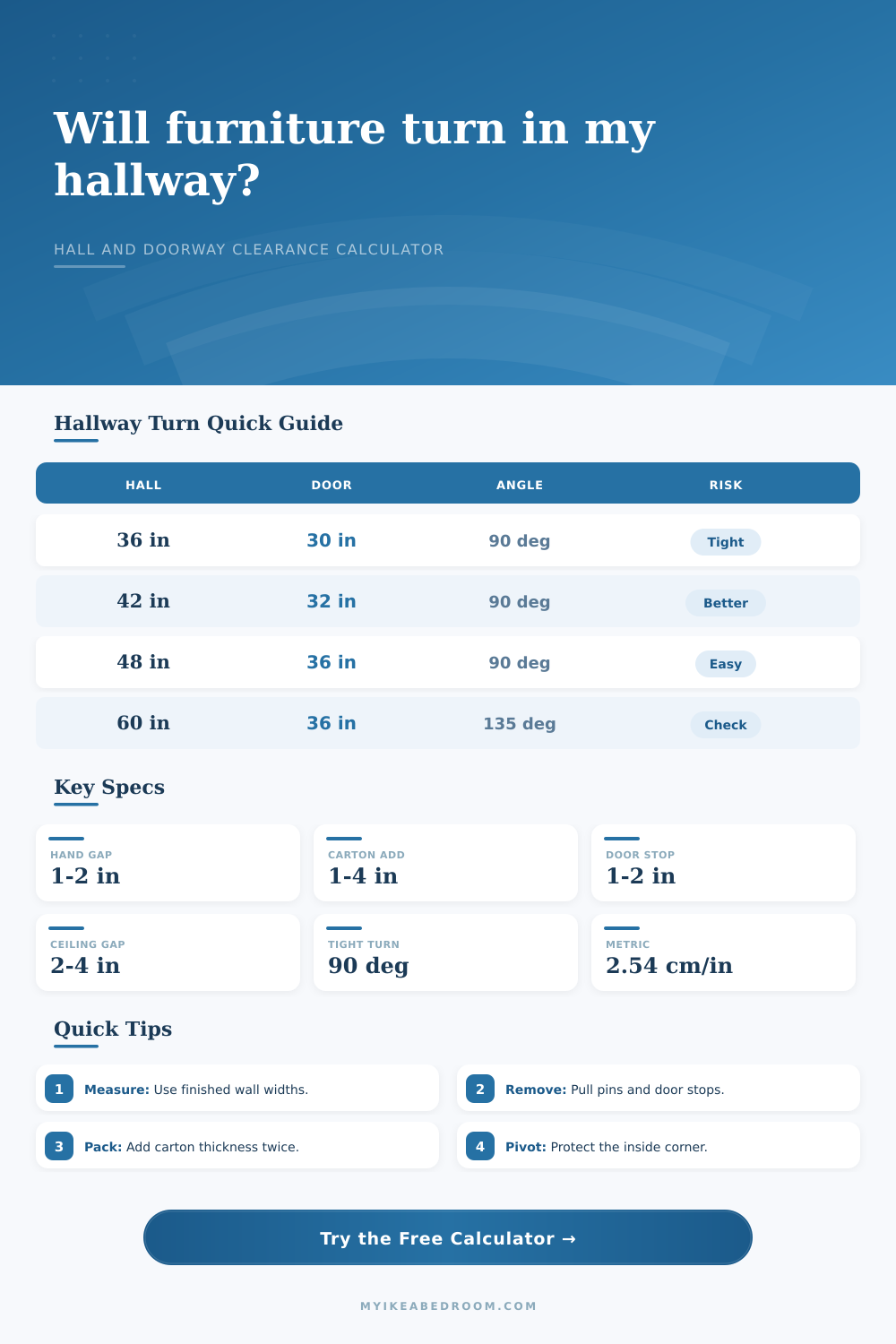
Hallway Furniture Turning Clearance Calculator
Check whether a bed frame, mattress, dresser, cabinet, or boxed flat-pack can pass a doorway and rotate through a hallway corner with packaging, ceiling, and wall clearance included.
Use a preset as a realistic starting point, then replace every field with your measured finished openings and item dimensions.
| Furniture or package | Typical carry size | Usual bottleneck | Planning note |
|---|---|---|---|
| Bed frame carton | 76-83 x 10-14 x 4-7 in | Corner length | Flat-pack turns easier than assembled frames. |
| Foam or hybrid mattress | 75-80 x 12-16 x 39-60 in | Door width | On-edge depth changes when bent or bagged. |
| Wardrobe side panel | 79-93 x 20-25 x 1-3 in | Ceiling and turn | Long panels need a clean pivot path. |
| Dresser assembled | 48-65 x 18-22 x 30-36 in | Hall width | Drawers removed reduce weight, not depth. |
| Bookcase carton | 79-81 x 11-16 x 3-5 in | Corner length | Protect carton corners at the inside wall. |
| Loveseat or sofa-bed | 60-72 x 30-38 x 28-36 in | Door width | Leg removal can change the carried height. |
| Allowance | Use when | Typical add | How calculator applies it |
|---|---|---|---|
| Packaging thickness | Carton, wrap, pads | 1-4 in per side | Added twice to length, depth, and height. |
| Hand clearance | Finished walls or heavy items | 0.5-2 in per side | Added twice to width and pivot footprint. |
| Door stop loss | Door remains on hinges | 1-2 in | Subtracted from clear doorway width. |
| Planning buffer | Rough walls or uncertain tape | 1-3 in | Reserved from the corner length margin. |
| Ceiling safety gap | Tilting long pieces | 2-4 in | Included through packaging and hand clearance. |
| Turn angle | Typical place | Clearance behavior | Best field check |
|---|---|---|---|
| 45 deg | Angled hallway jog | Usually forgiving | Check door pinch before corner. |
| 60 deg | Open landing bend | Moderate sweep | Measure both wall-to-wall widths. |
| 90 deg | Square apartment corner | Classic tight turn | Mark the inside corner protection zone. |
| 120 deg | Stair landing wrap | Needs more length relief | Check ceiling while the far end lifts. |
| 135 deg | Near U-turn hallway | Highest pivot risk | Mock up with tape at full length. |
| Clear opening | What usually fits | Watch point | Practical adjustment |
|---|---|---|---|
| 28-30 in | Flat cartons and panels | Door knob and casing | Remove door slab when possible. |
| 31-34 in | Most bed cartons | Box corner crush | Add pads only where needed. |
| 35-38 in | Dresser on end | Hand space disappears | Use straps instead of side grips. |
| 39-44 in | Mattress on edge | Ceiling at doorway | Angle gradually before the jamb. |
| 45-60 in | Sofas and large frames | Long diagonal sweep | Plan the pivot before entering. |
So there you are standing in the doorway with your big box. Is that going to work? Will it fit through the corner? What about the mattress…is that too tight? Should I just see how it goes? No. No. Because ten minutes of planning saves you from scraping drywall.
This is where geometry come into play. It wasn’t the furnitures size that was the issue. It was your lack of measuring for movement. When you measure, you’re generally measuring for where something sits down. But you should also know its pivot space, how much room it needs to turn in a tight hallway? If a piece of furniture can stand straight up and go through a door, then it will be able to rotate at ninety degrees, right? Nope. People think that since their door is thirty-inches wide, there’s a thirty-inch opening. Not true. There’s an opening for the knob plus the stop plus the hinge side. That’s often as little as twenty-eight inches of usable width. If you don’t subtract that loss, you won’t have best data to work with.
How to Measure for Moving Furniture
So what do you need? You has to provide good information to the calculator. First take measurements of any hallway (wall to wall) with trim up. Next measure clear opening of any doorway in its fully open position. Lastly, if you’re storing something that comes in a box, the box does count (even though cardboard will add an inch on each side). It’s the thing inside itself that’s most difficult to get right. Include packaging thickness in your measurement. An added inch or two can be the difference between a smooth pass through and getting stuck.
That’s not all… It also takes into account height! This is in case you are like me and have low ceilings. Tilt a long wardrobe panel out of the way of a door? Yeah, but then you lose some vertical clearance. Yeah, but then it takes up less space vertically. Can your ceiling take that angle? Does the top hit the ceiling while the bottom is still too high to get around the corner? That check should of save you some knuckle bruises if you’ve got a nine foot board tilted in an eight foot hallway.
Also consider turn angle. If there’s a hall with a shallow (forty-five degree) bend, that’s forgiving. But a sharp (ninety degree) corner in an apartment isn’t going to work as well. In general, the shorter the corner, the longer the arc the thing has to travel; so for instance, a long box like a bookcase carton could just go sliding down a wide hallway, but it would require more space to pivot and could jam up on a tight corner.
The calculator show how much of a corner you’ve got by measuring the length of the pivot against the longest dimension of the thing you’re trying to get through. If the number comes out negative, you’ll be stuck. Don’t ignore the safety buffer. Walls aren’t exactly straight in real life. Corners are uneven. There are light switches. There are radiators. A few extra inches of buffer cost less than renting equipment. It provides a bit of breathing room if you bump the box or get tired.
Moving isn’t rocket science. It’s not some magical thing. It’s patient and careful measuring. So look at your bottleneck and then take your time to examine the reference guide and see what similar things do. A dresser on its side is going to act different than a sofa on its back. One is rigid, the other can be angled. One will angle. The other is rigid. The numbers are only one piece of the puzzle. How it actualy behaves physically is important too.
In the end, it’s all about respecting that space. How much did you pay for the sofa? The hallway doesn’t give a damn. All it asks is “how big are you?” Measure your openings when done. Add the thickness of their packaging. Subtract what they lost because of the doors. Then it naturaly makes sense. There is no more scraping. There will be no more holes in the plaster. You won’t have to look at your new furnitures while sitting on the floor anymore.