Gym Mirror Size Calculator
Plan mirror panel width, height, gaps, mounting position, and wall coverage for strength training, yoga, dance, cardio, and compact home gym layouts.
Mirror Layout Result
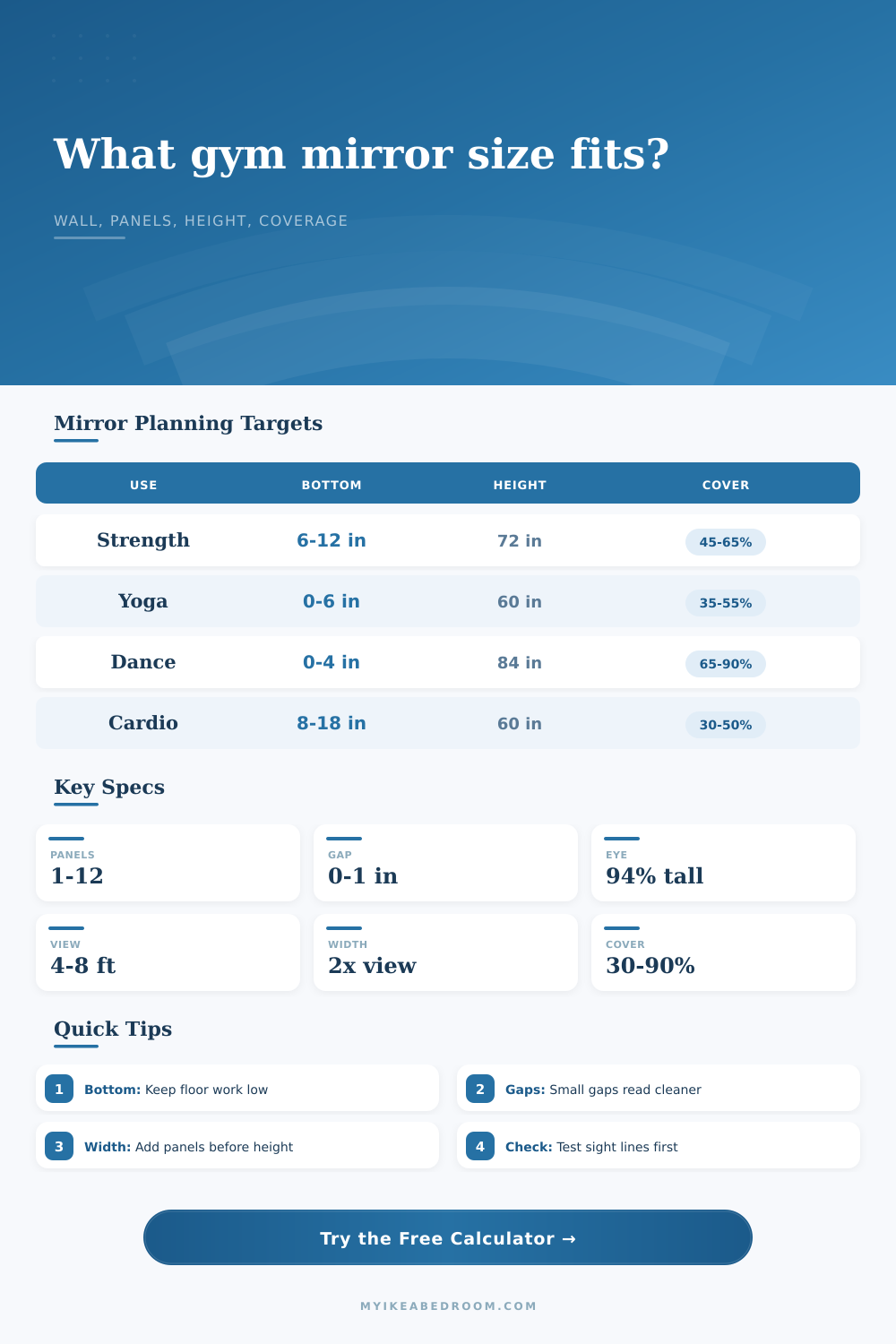
| Exercise type | Useful mirror bottom | Typical panel height | Coverage target |
|---|---|---|---|
| Strength form checks | 6-12 in | 72-84 in | 45-65% |
| Yoga and floor work | 0-6 in | 60-72 in | 35-55% |
| Dance and movement | 0-4 in | 78-96 in | 65-90% |
| Barre and mobility | 4-10 in | 72-84 in | 50-75% |
| Cardio machines | 8-18 in | 60-72 in | 30-50% |
| Shared multi-use gym | 2-8 in | 78-96 in | 60-85% |
| Panel size | 2 panels with 1/8 in gaps | 3 panels with 1/8 in gaps | 4 panels with 1/8 in gaps |
|---|---|---|---|
| 24 x 60 in | 48.1 x 60 in | 72.3 x 60 in | 96.4 x 60 in |
| 30 x 72 in | 60.1 x 72 in | 90.3 x 72 in | 120.4 x 72 in |
| 36 x 72 in | 72.1 x 72 in | 108.3 x 72 in | 144.4 x 72 in |
| 48 x 84 in | 96.1 x 84 in | 144.3 x 84 in | 192.4 x 84 in |
| User height | Eye height estimate | Full-body sight zone | Practical gym bottom |
|---|---|---|---|
| 60 in | 56 in | 28-58 in | 0-10 in |
| 66 in | 62 in | 31-64 in | 0-10 in |
| 72 in | 68 in | 34-70 in | 0-12 in |
| 78 in | 73 in | 37-76 in | 0-12 in |
| Mirror span | Approx visible width | Best viewing distance | Common use |
|---|---|---|---|
| 36 in | 72 in | 4-6 ft | Single lift check |
| 72 in | 144 in | 5-8 ft | Strength or yoga |
| 108 in | 216 in | 6-10 ft | Multi-use wall |
| 144 in | 288 in | 8-12 ft | Dance or studio |
That one sheet won’t cut it when you check depth of your squat. Your gym mirrors is treated as if they were in your bathroom. One is too short and cuts off your feet, another is too narrow so you have to shuffle around to see your shoulders. It’s not about looks, it’s geometry. You’re creating a feedback loop for your body mechanics, this isn’t decoration on a wall.
You’ll only get as many panels as you need to see all of yourself in one shot. You begin by entering your wall width into the calculator. It’s an exact science, you don’t want to guess if a panel size will work or not. You might be lifting some serious weight. To see your body as it is, you want your whole self to appear in one mirror. Splitting your vision among multiple separate mirrors disrupt your ability to maintain focus on your own form. This happens because your eyes jump back and forth from reflection to reflection.
Why Mirror Size Matters for Your Workout
The calculator figures out the total span based off your panel count and gaps between them so you know exactly how many you require to avoid a checkerboard look. And then there’s height. Height is also important, though we generally don’t think about it until we realize it’s too late. What do I mean? Where does bottom edge of the mirror fall? That determines how far up onto floor you will be able to see.
Want to do some floor based strength training? Or maybe some yoga? Then you want the bottom of the mirror low enough so you can sees where your hands/knees is in relation to each other. If the bottom of the mirror begins two feet off the ground, then you’re not going to know if your hands are aligned during a push-up or check your hand placement during yoga. As you can see from the reference table on the page, cardio corners tend to focus on seeing upper body, whereas dance studios focus more on mirroring the floor level. Mounting the mirror at different heights change the whole sight line. And this slight adjustment changes what part of your movements you’ll be able to check.
Another thing that throws people off is how far they stand back from the mirror. If you like to stand farther away, then you need a wider mirror to see more of yourself. To account for this, the calculator uses a rough estimate of how far you normaly stand from the wall. This is based on a rule of thumb that says the mirror should be about one-half your height if you want to see yourself in its entirety. This applies regardless of if you’re five feet four or six feet tall. Why? Because it’s assumed your eyes are approximately ninety-four percent of your height, which is what the standard measurement allows for, keeping your reflection focused on your torso and face. No need to measure yourself; the tool already assumes the average proportion.
There’s psychology to it too: big mirrors gives the illusion of openness and space. But how much do you cover your walls? That depends on your budget and personal preferences. In a bedroom/gym combo, going all the way might be overwhelming, yet you want to find a balance. With the calculator, you can choose a target percentage and see exactly how much square footage of glass you’ll recieve. People tend to underestimate how much a big mirror costs; seeing the square footage upfront helps avoid sticker shock.
Last but not least, think about the space between the panels. Wide seams interrupt the reflection, which also make it hard to judge the straightness of your own posture. Tightening up the seam (often under an eighth of an inch) looks like one big seamless panel. That small gap adds to the overall width that the tool figures out, allowing you to calculate precisely how much wall real estate you’re using. You should ofnt scrimp on the hanging hardware as well; some heavy mirrors needs a firm anchor in the studs. Start with the dimensions; rely on the math.