Greywater Volume Calculator
Estimate household greywater from showers, baths, laundry, and bathroom sinks in gallons per day, gallons per week, and liters. Toilet and blackwater sources are excluded.
🏠Household presets
📏Greywater inputs
Greywater volume result
⚙Included source cards
💧Formula cards
📊Greywater reference tables
| Fixture or source | Reference value | Source note | How this calculator uses it |
|---|---|---|---|
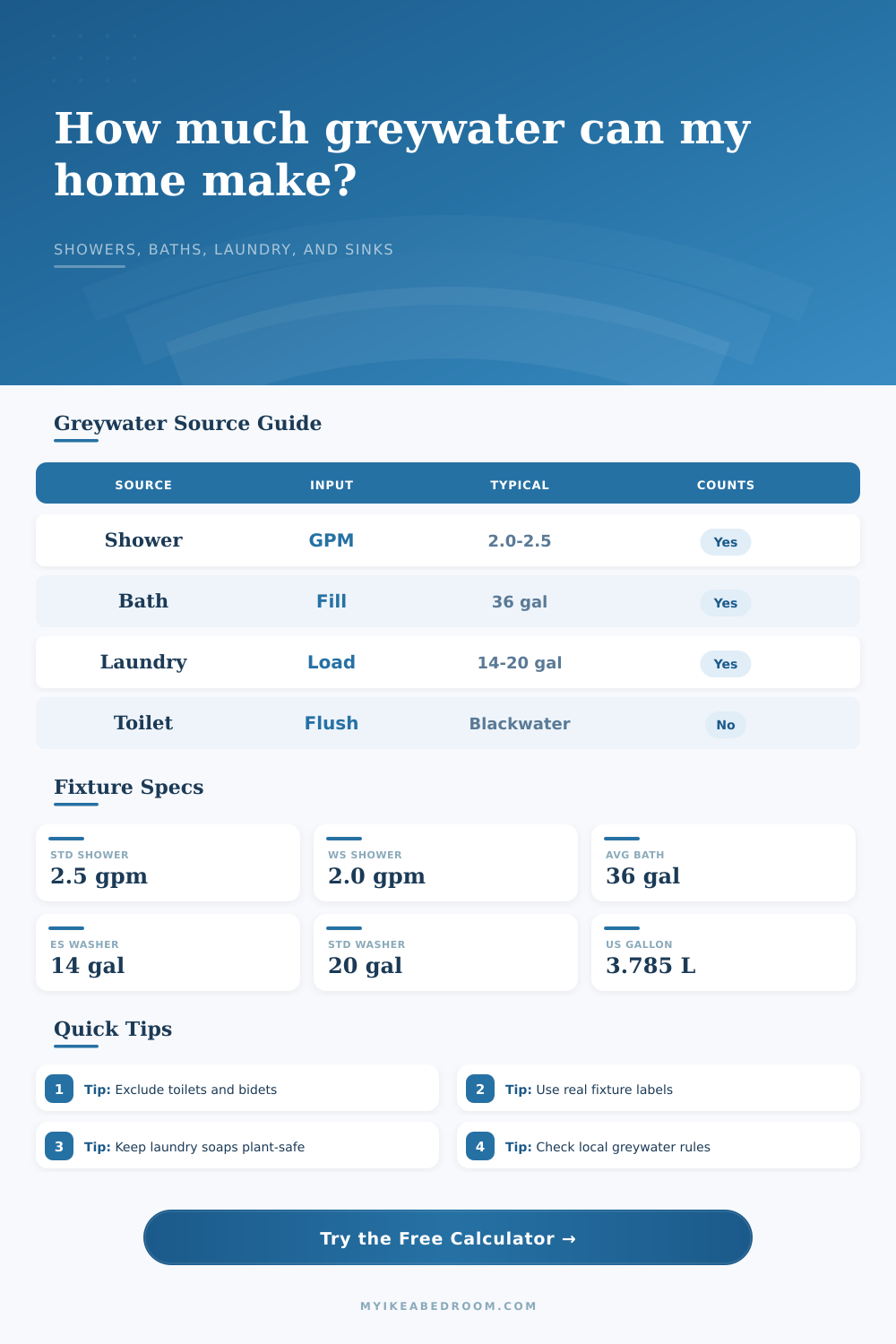
| Standard showerhead | 2.5 gpm | EPA WaterSense standard showerhead reference. | Available as a selectable shower flow value. |
| WaterSense showerhead | 2.0 gpm or less | EPA WaterSense labeled showerhead maximum. | Default efficient shower flow setting. |
| Average full bath | 36 gal / 136 L | USGS household water-use activity reference. | Default filled-bath volume per bath. |
| Bathroom faucet | 1.0 to 2.2 gpm | USGS and EPA faucet planning references. | Sink calculation uses 1.5 gpm planning flow. |
| ENERGY STAR washer | 14 gal / 53 L per load | ENERGY STAR full-sized clothes washer reference. | Default laundry volume per load. |
| Standard washer | 20 gal / 76 L per load | ENERGY STAR standard machine comparison. | Selectable washer reference value. |
| Household source | Greywater status | Typical planning input | Important boundary |
|---|---|---|---|
| Shower water | Included | Flow rate x minutes x showers | Do not include toilet-adjacent plumbing or blackwater. |
| Bath water | Included | Gallons per fill x baths per week | Only count bath water that can be legally routed or collected. |
| Clothes washer | Included with caution | Gallons per load x loads per week | Laundry greywater may depend on detergent, bleach, and local rules. |
| Bathroom sink | Included | Minutes per person x flow rate | Do not mix with toilet, bidet, or contaminated cleanup water. |
| Toilet or bidet | Excluded | 0 gallons counted | Toilet water is blackwater and is not part of this calculator. |
| Kitchen sink or dishwasher | Excluded | 0 gallons counted | Food residue and grease often make these unsuitable for simple greywater estimates. |
| Shower pattern | Flow rate | Gallons per shower | Liters per shower |
|---|---|---|---|
| 5 minute quick rinse | 1.5 gpm | 7.5 gal | 28 L |
| 8 minute efficient shower | 2.0 gpm | 16.0 gal | 61 L |
| 10 minute standard shower | 2.5 gpm | 25.0 gal | 95 L |
| 12 minute older fixture shower | 3.5 gpm | 42.0 gal | 159 L |
| Preset | Main greywater sources | Approx gallons per day | Approx gallons per week |
|---|---|---|---|
| Single low-flow apartment | One short shower, light laundry, light sink use | 20 gal/day | 140 gal/week |
| Couple efficient shower | Two daily showers and three washer loads | 47 gal/day | 329 gal/week |
| Family balanced week | Four showers, one bath, five washer loads | 99 gal/day | 693 gal/week |
| Bath night household | Showers plus several bath fills | 112 gal/day | 786 gal/week |
| Large active household | Five people, longer showers, heavy laundry | 174 gal/day | 1,219 gal/week |
💡Greywater calculation tips
When people think of greywater, they picture a maze of pipes and filtering units, all hidden beneath garden surface. In most cases, it’s far less complicated, and begins by asking one simple question: How much greywater does your house generate?
If you don’t have an answer to that, you can’t calculate the right-size tank… Or distribution system. That means estimating based off your routine. What happens in your own home?
How to Calculate Your Greywater
Here’s a tool to run the numbers for you. But first, understand where the inputs come from, and you’ll see your own home in a new way.
If you’ve ever considered diverting greywater, here’s something important to know. Greywater comes from laundry, showers, baths, and bathroom sinks, but not kitchen or toilet water. The boundary between greywater and other types of wastewater is importent. Why? Because greywater is typically cleaner than blackwater, which includes human waste and associated pathogens.
Kitchen water, in particular, is usually full of food particles, fats, and oils that will quickly clog an irrigation system. Keeping the greywater definition narrow protects against the all-too-common error of over-optimizing your assumptions about what might be safely diverted to your non-potable reuse system. The tool preserves this boundary, and makes sure your output reflects water that’s actualy usable for reuse in most jurisdictions.
The biggest variable for most households are showers. How long do you take them? What’s the flow rate? This all sounds dry until you think about what one fixture change can make. Replacing your old three-and-a-half gallon per minute showerhead with a two-gallon per minute WaterSense version reduces amount of water used by almost forty percent.
That’s not just a number on your water bill; that’s less water your greywater system has to process. And if four people is taking showers each day, that translates into dozens of gallons you’re saving each morning. The table near the top of the page makes that clear; it also shows how those decisions will add up over time.
Baths are another problem since they’re not continuous flow events but instead batch events. Based on size of your tub and how deep you like to get in, you may be using up to 36+ gallons just filling it up. If you bathe maybe once or twice a week, this still represents a pretty big spike in your weekly volume.
To plan with, the calculator smooths out that variation and turns those weekly baths into an average per day. That way you can see the peak load you’ll need to accommodate and make sure your system doesn’t overflow. It will also show you where a bigger view (weekly) might be better than a daily one for sizing distribution or storage components.
But that’s only part of the laundry story. Today’s Energy Star washers consume far fewer gallons of water (sometimes down to only fourteen) per load compared to previous years’ standard models.
But here’s where chemistry of what you put in it also comes into play. Even with a small amount of water, bleach and other heavy softeners is harmful to plants and soil organisms. This makes it off-limits to most greywater uses, though this varies by location. Some jurisdictions don’t allow any laundry greywater at all for this reason; always check local laws.
You’ll customize the tool based on your kind of washing machine, but that provides a realistic starting point, and then you’re free to fret over the chemistry.
The other little bit that always dribbles on is bathroom sinks. Hand washing for three minutes each per day by everyone in the house don’t seem like much, but it adds up quickly throughout the home. Add that into the calculation at the standard planning rate of one-and-a-half gallon per minute and you have another entry in the overall pot to consider.
In rough estimates, it’s easy to forget to add this factor but doing so gives you a better picture of what resources you can work with.
And the output? A number of gallons per day and week (and liters too). You can base your plans on creating a subsurface irrigation setup, a system that flushes toilets, or a rain garden.
This is what helps you know how much water you’re using now. And whether it will match your plan to reuse some portion of it.
Perhaps you realize that your biggest culprit is all those showers, or maybe it’s those extra-large loads of laundry. Now that you have hard facts instead of assumptions, you can begin to plan accordingly. You can go from something that seems like a lofty ideal, conservation, to something concrete. Turn an abstraction into something you can measure.
Water stops being merely a commodity. It becomes a resource with quantity, velocity, and value. And the purpose isn’t saving so much as knowing it.