🪨 Gravel Depth Calculator
Estimate a realistic gravel layer for garden paths, patio bases, driveways, shed pads, and drainage beds by matching project use, stone family, drainage goals, compaction, and subgrade conditions.
📌Project presets
🔧Gravel depth inputs
📈Calculated results
⚖️Gravel family grid
Pea Gravel
Crushed 3/8 in
Crushed 3/4 in
Dense Base
River Rock
Drain Rock
Decomposed Granite
Marble Chips
📊Project comparison grid
Decorative Path
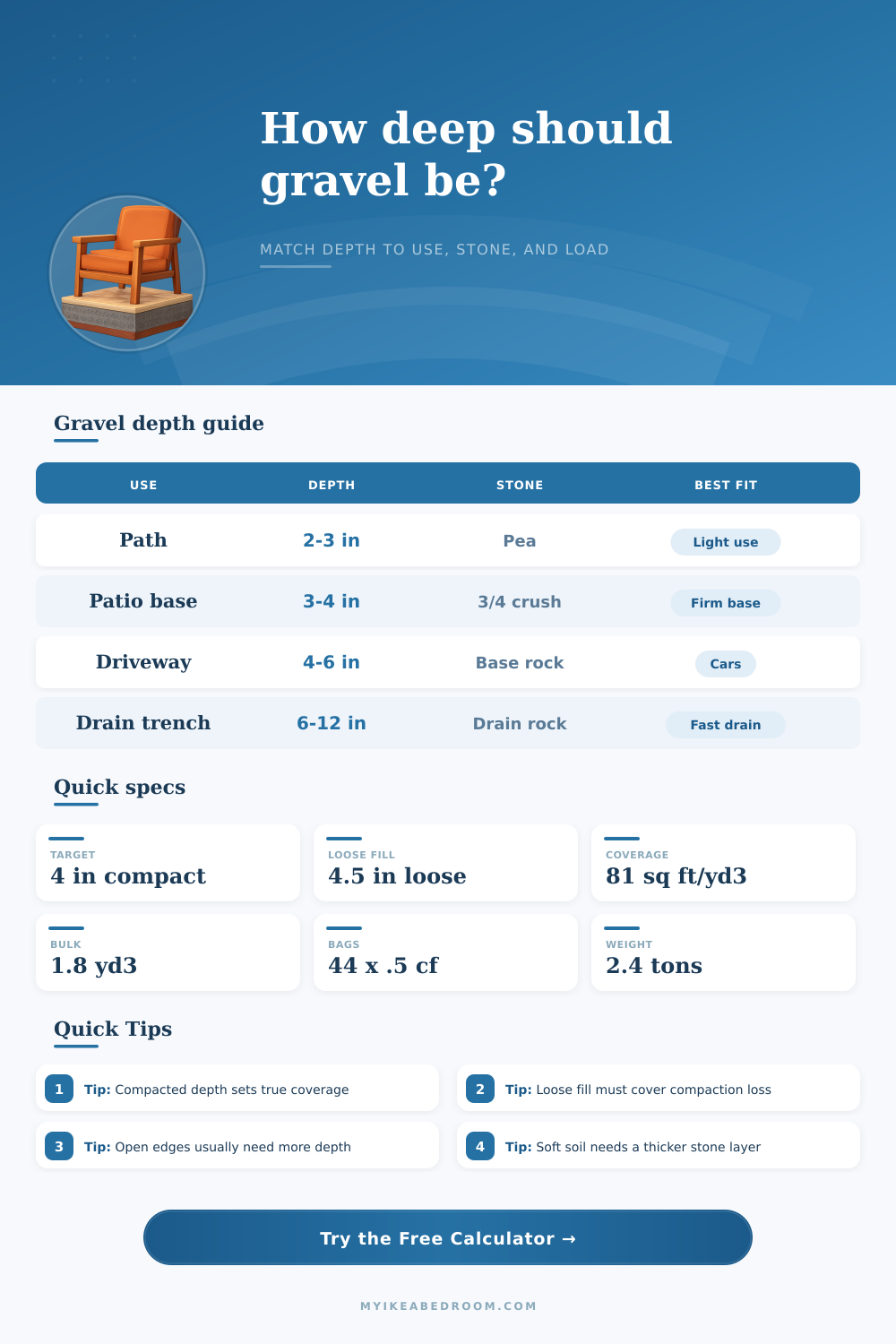
Typical depth: 2 to 3 in compacted.
Best match: pea gravel or decomposed granite.
Watch for migration on open edges.
Patio Base
Typical depth: 3 to 4 in compacted.
Best match: crushed stone 3/8 in or 3/4 in.
Use tight grading for a firmer layer.
Driveway Layer
Typical depth: 4 to 6 in compacted.
Best match: dense grade base gravel.
Soft subgrade pushes the recommendation up.
Drainage Bed
Typical depth: 6 to 12 in compacted.
Best match: drain rock or river rock.
Extra depth improves stormwater storage.
📑Reference tables
| Project use | Compacted depth | Common gravel | Why it changes |
|---|---|---|---|
| Garden path | 2-3 in | Pea gravel or DG | Light foot traffic can stay shallow when edged. |
| Decorative border | 2-4 in | River rock or marble chips | Open edges and coarse stones usually need extra depth. |
| Patio base | 3-4 in | Crushed 3/8 in or 3/4 in | A compacted lock layer supports pavers and furniture. |
| Shed pad | 4-5 in | Crushed 3/4 in or base gravel | Static loads need a deeper layer over average soil. |
| Driveway | 4-6 in | Dense grade base | Vehicles and turning tires increase required thickness. |
| Drainage trench | 6-12 in | Drain rock | Deeper void space stores and moves more water. |
| Compacted depth | Sq ft per yd3 | Sq m per m3 | Typical use |
|---|---|---|---|
| 2 in | 162.0 | 16.2 | Thin path or border refresh |
| 3 in | 108.0 | 10.8 | Decorative path or ring |
| 4 in | 81.0 | 8.1 | Patio base or compacted pad |
| 6 in | 54.0 | 5.4 | Driveway or thick support layer |
| 8 in | 40.5 | 4.1 | Deep drain bed |
| 12 in | 27.0 | 2.7 | Stormwater trench fill |
| Gravel family | Density | Compaction loss | Drain profile |
|---|---|---|---|
| Pea gravel | 96 lb/cu ft | 4-6% | High drainage, lower lock |
| Crushed 3/8 in | 100 lb/cu ft | 6-8% | Balanced drainage and interlock |
| Crushed 3/4 in | 103 lb/cu ft | 7-9% | Good structure for pads |
| Dense base gravel | 108 lb/cu ft | 8-11% | Tight packing, slower drainage |
| Drain rock 1.5 in | 95 lb/cu ft | 3-5% | Very fast drainage, higher voids |
| Decomposed granite | 110 lb/cu ft | 5-8% | Low voids, high compaction |
| Supply format | Volume each | Units per yd3 | Approx coverage at 3 in |
|---|---|---|---|
| 0.5 cu ft bag | 0.50 cu ft | 54 bags | 18 sq ft |
| 0.75 cu ft bag | 0.75 cu ft | 36 bags | 27 sq ft |
| 1 cu yd bulk scoop | 27.00 cu ft | 1 scoop | 108 sq ft |
| 2 cu yd bulk load | 54.00 cu ft | 2 scoops | 216 sq ft |
💡Two quick tips
Determining the correct depth for gravel is a necessary step in any gravel installation projects. The depth of gravel will determine the stability of the gravel driving surfaces. If the depth is too shallow, gravel will shift under the added pressure of driving vehicles or walk on the gravel area.
In contrast, gravel that is too deep will cost too much moneys for the project. The required depth of the gravel is dependent upon the use of that area. Different types of gravel has different characteristics.
How Deep Should You Put Gravel
For instance, round pea stones roll easy and drain water quickly, but require edging to prevent them from moving away from the intended path. Crushed gravel varieties lock together when compacted with a plate compactor and are used for driveways or shed bases. However, crushed gravel varieties may settle more than other types of stone due to the way the smaller particles fill the voids between the larger stones.
Traffic load will dictate the depth of gravel required for the project. For example, light footsteps may be accommodated on thin gravel layers, but vehicle tires will require four to six inch of compacted gravel. Soil conditions will also dictate the depth of gravel to be placed in the area.
Clay soil is firm and can support the placement of gravel to a smaller depth, while gravel will need to be placed to a greater depth in soft or wet soil. Edges will play a critical role in gravel projects. For instance, open edge will cause gravel to move into the surrounding areas.
Therefore, if gravel is to be placed into an area without edging, extra gravel should be built into the project to account for the gravel that will move away from the planned gravel area. Drainage bed will require the use of six to twelve inches of coarse drain rock. Drainage rock creates the void spaces between the rocks that will hold the stormwater.
Compaction will change the depth of gravel. For instance, four inches of gravel may settle by fifteen percent when compacted. Therefore, the depth of gravel that is poured into the site should always be deeper than the target depth of the compacted gravel.
Using a vibratory plate compactor will compact the gravel more effectively than a hand tamper. Finally, you should purchase an overage of gravel beyond the amount that is needed for the site due to the possibility of loss of gravel during the placement process. Different types of stone and projects will require different thickness adjustments.
For example, areas that receive heavy run off will require stones that are one-and-a-half inches in size and will also require a thickness that can handle the run off without creating ponds in the gravel areas. Paths that use decorative rings around the fire pits will be thinner if the stones are fully edged; if the areas are to be bordered with gravel, more stones will be needed to prevent the path from spreading beyond its designate area. Areas that use decomposed granite will compact very tightly, so decomposed granite is the ideal stone for pathways that are meant to look like pavement.
Additionally, areas that use round river rock will shift in relation to the path; thus, it is necessary to increase the depth of the gravel. The volume of gravel needed can be calculated by the number of square feet that are to be covered and the desired depth of the gravel cover. The total area that will be covered by a hundred square feet of gravel to a depth of four inches will require a certain number of cubic yard of gravel.
One yard of gravel will cover twice the area at a depth of two inches than it will at a depth of four inches. Additionally, it is also necessary to consider the weight of the gravel that will be required to be hauled to the project. Base gravel will be denser than drain rock.
Certain types of projects will require specific depths for the gravel. Areas that are to be used as courtyard paths and use pea gravel will require two to three inches of gravel if plastic edging is to be used around the paths. Areas that are to be used as patios will require three to four inches of three-eighths inch crushed gravel that is tapped into the pavers to avoid having the gravel bounce off of the pavers.
Areas that will be used for driveways will require four to six inches of dense base gravel; three or four lifts of gravel are used for driveways. Areas that are to be used for french drains will require deep layers of drain rock to allow for the movement and storage of water within the area. There are a few mistakes that many people make when preparing to install gravel in an area.
One of the most common mistakes is to ignore the reality of settlement. People typically assume that the depth of the gravel when it is loose is the same as the depth when it is compacted. However, this can lead to a shortfall in the amount of gravel that is provided to the project; some may opt for decorative stones that do not lock in with the rest of the stone path; the furniture may tip on the decorative stones.
Additionally, if people opt for gravel but do not install edging around it, or if they choose to use soft soil, their gravel area can fail. Finally, if the soil in which the gravel is to be installed is wet or soft, additional gravel should be added to reinforce the area. When installing gravel, it is important to install it in two lifts if the total depth of the gravel is to be four inches or more in depth.
The first half of the gravel should be spread out in the desired area and compacted. The second half of the gravel will then be added to the area to complete the installation. Additionally, if the soil is sloppy, it is necessary to install geotextile fabric between the gravel and the soil; this will extend the life of the gravel installation.