🪨 Material spread planning
Gravel Coverage Calculator
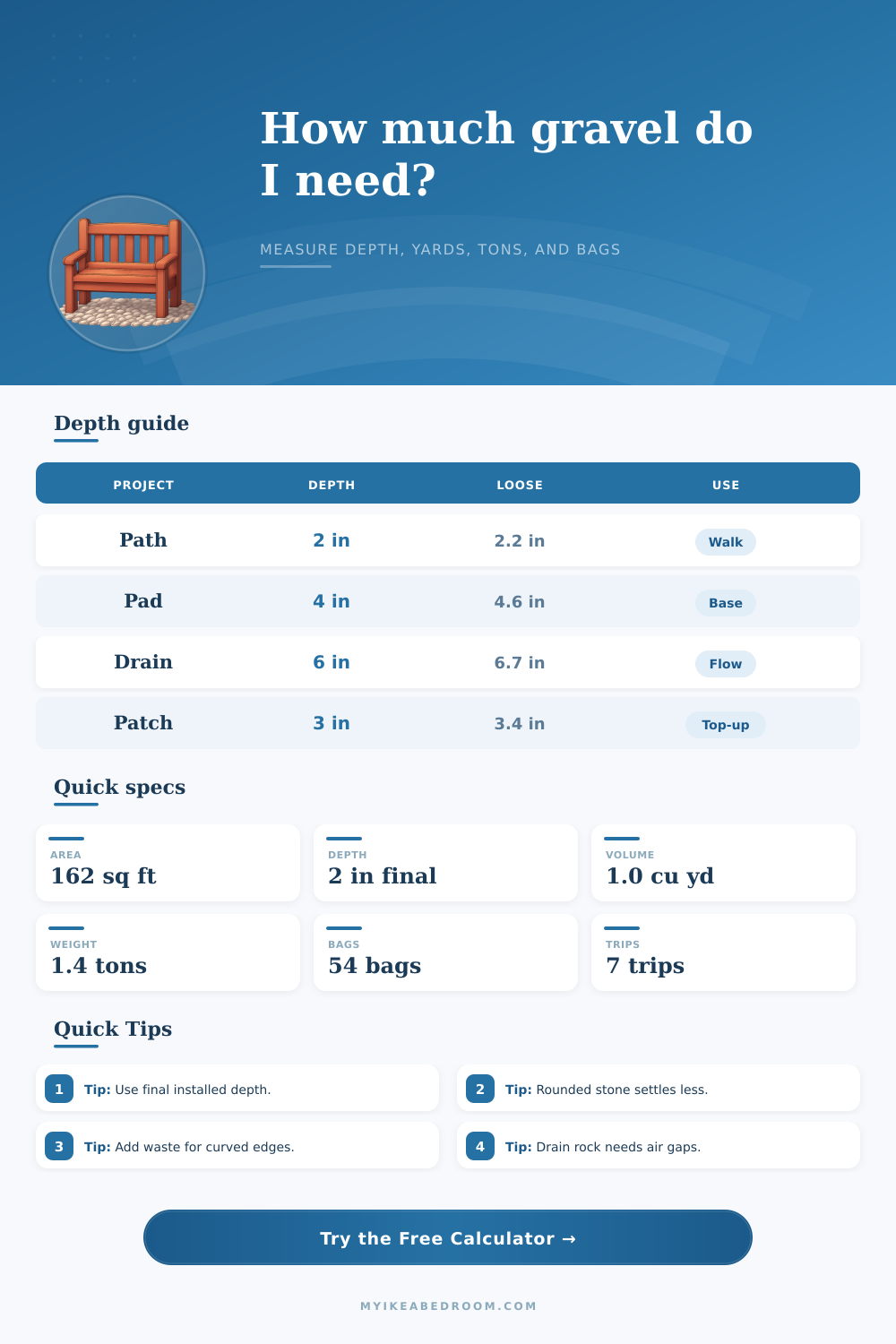
Estimate loose fill, compacted coverage, tonnage, bag count, and wheelbarrow trips for garden paths, driveway touch-ups, shed pads, fire pit rings, and drainage trenches.
Enter final installed depth first. The calculator expands material for compaction and waste before showing order volume.
| Project | Final depth | Loose fill | Stone | Note |
|---|---|---|---|---|
| Garden path | 2 in | 2.2 in | Pea gravel | Foot traffic only |
| Shed pad | 4 in | 4.6 in | Base mix | Compact in lifts |
| Drain trench | 6 in | 6.7 in | Drain rock | Keep flow paths open |
| Drive patch | 3 in | 3.4 in | Crushed stone | Top-up or refresh |
| Stone | lb/yd3 | kg/m3 | Pack | Best use |
|---|---|---|---|---|
| Pea gravel | 2700 | 1602 | Loose | Paths |
| Drain rock | 2900 | 1721 | Open | Drain lines |
| Crushed stone | 3000 | 1780 | Locks | Compact base |
| Decomp granite | 2600 | 1543 | Tight | Firm fines path |
| Final depth | Sq ft | Sq m | Fit | Note |
|---|---|---|---|---|
| 1.5 in | 216 | 20.1 | Top dress | Light refresh layer |
| 2 in | 162 | 15.0 | Path | Common walkway depth |
| 3 in | 108 | 10.0 | Patio | Base over firm soil |
| 4 in | 81 | 7.5 | Pad | Heavier support layer |
| Condition | Compaction | Waste | Order note | Best fit |
|---|---|---|---|---|
| Hand spread | 5% | 5% | Minimal loss | Pea stone |
| Plate compact | 10% | 8% | Standard lift | Base mix |
| Deep trench | 12% | 10% | Add edge loss | Drain rock |
| Curved edge | 8% | 12% | Extra shaping | Borders |
Calculating the correct amount of gravel are a necessary step for any gravel project. If the gravel measurements is incorrect, then there may be a shortage or an excesss of gravel for the project. If there is too little gravel for the project, then there will be an incomplete gravel project.
However, if there is too much gravel for the project, then there will be an excess amount of gravel that cant to be utilized. Unlike concrete, gravel do not settle or compact once its placed into the area for which it is to be used. Therefore, the user must calculate gravel according to the depth of the area that will be filled with gravel and the type of stone that will be use.
How to Calculate the Amount of Gravel You Need
To calculate the amount of gravel that will be needed for a project, the user must first determine the area that will be covered in gravel. The depth of the gravel also must be calculate. The depth that gravel will require will vary with the type of projects that is being performed.
For instance, a depth of two inches may be required for a garden path. However, for projects like a driveway or a pad for a shed, the depth will require four inches of gravel or more. The depth also must be calculate before the user can calculate the amount of gravel for the project since gravel will settle and compact and an amount of gravel must be ordered to allow for this settling.
Additionally, the type of gravel that will be utilized will play a major role in the weight that the gravel will set. For instance, the user may use rounded pea gravel for gravel paths. The benefits of pea gravel include the fact that it allow water to drain through the gravel path.
However, pea gravel isnt stable. Crushed stone gravel will provide a stable subgrade for the area covered in gravel. The crushed stone is different than pea gravel because the angular edge of crushed gravel lock the stones together.
Additionally, the different types of gravel has different densities. For instance, granite gravel will be more denser than gravel made from river rocks. Another factor that must be accounted for when calculating the amount of gravel for a project is the compaction of the gravel.
When the user compacts gravel through tamping, eight to ten percent of the volume of the gravel will compact. This mean that the gravel will shrink when compacted. Therefore, the amount of gravel that is purchased must be more than the amount calculated for the area to be covered in gravel.
Additionally, some of the gravel may be lost during the project when the worker is raking the gravel into place or when some of the gravel is lost in the trenches or curves of the area to be covered. For instance, for a fire pit gravel ring, twelve percent of gravel may need to be ordered for the project. Another factor to consider is whether the gravel will be purchased in bags or in bulk.
If the area to be covered with gravel is small, or if the location of the gravel project is such that a truck cannot reach the site, gravel can be purchased in bags. However, lifting heavy bag of gravel will be necessary. Alternatively, gravel purchased in bulk is often less expensive than gravel purchased in bags.
Additionally, bulk gravel is more efficient to use for projects with a larger area to be covered in gravel. The compacted gravel will be used to calculate the depth of the gravel project once it is establish. However, when gravel is purchased from gravel suppliers, the user should order the volume of gravel according to the loose volume of the gravel.
Some common mistake that should of been avoided when placing a gravel project include placing too much depth for the gravel project. An excess depth for gravel projects can create ruts in the gravel. Another mistake would be to not prepare the subgrade for the gravel project.
Poor preparation of the subgrade will result in sinkholes in the gravel. If the soil in the subgrade is soft, a geotextile fabric will need to be placed beneath the gravel to prevent the gravel from mixing with the soil. Additionally, the gravel needs to slope away from the structure at a rate of two percent to allow water to drain from the gravel.
A few reference guide can assist in planning a gravel project. Depth chart can be used to determine the depth of gravel that may be required for specific project. Tables of the densities of the different types of gravel can be used to determine the weight of the gravel for a gravel project.
Additionally, gravel coverage rate can help determine how much gravel is necessary for a project. For instance, one cubic yard of gravel will cover 162 square feet at a depth of two inches of gravel. However, the same number of cubic yard of gravel will only cover 81 square feet at a depth of four inches of gravel.
By considering each of these factor, gravel projects can be successfully planned and executed.