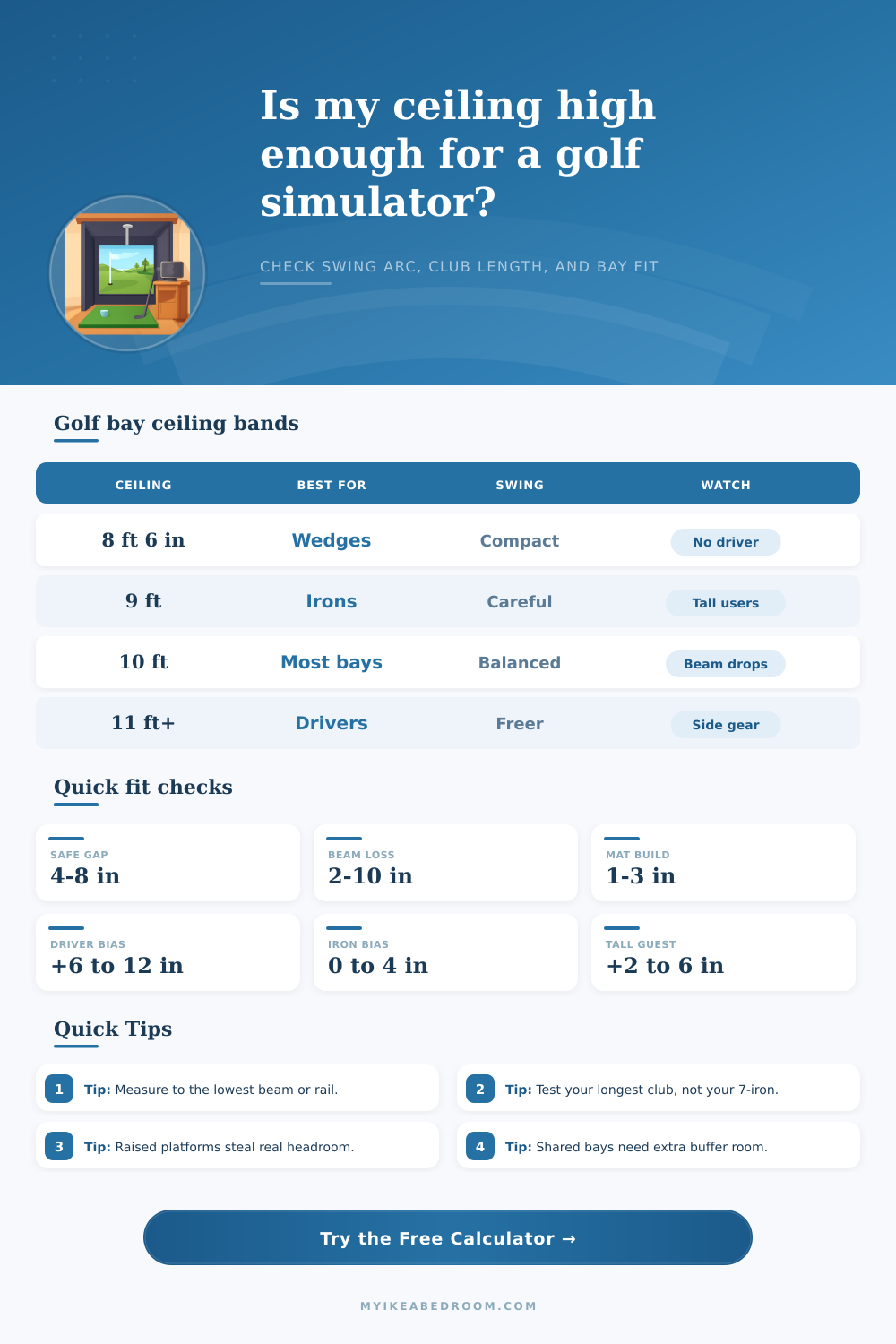
Indoor bay planning for full swings and safe overhead clearance
Golf Simulator Ceiling Height Calculator
Estimate whether your simulator room can safely handle your height, longest club, swing style, platform build-up, and the lowest beam or garage track before you commit to the hitting bay.
| Club family | Typical length | Ceiling pressure | Planning note |
|---|---|---|---|
| Driver | 45-46 in | Highest | The longest club creates the largest overhead arc and usually decides whether a room is truly simulator ready. |
| Fairway wood | 43-43.5 in | High | A fairway-only room can work where a full driver bay still feels tight. |
| Hybrid or long iron | 39-41 in | Medium | Often the turning point for compact rooms that want mixed-bag practice without a full driver commitment. |
| Mid iron | 36-38 in | Moderate | Most 9 ft to 10 ft rooms can handle irons more comfortably than woods if swing style is not too upright. |
| Wedge | 34-36 in | Lowest | Short-game rooms buy the most forgiveness from a low ceiling, basement beam, or garage track drop. |
| Player height | Typical fit | Driver target | Why it changes |
|---|---|---|---|
| Under 5 ft 6 in | Most rooms gain margin | 9 ft 6 in+ | Shorter players usually create a smaller hand-to-club apex at the top of the swing. |
| 5 ft 7 in to 5 ft 11 in | Typical adult range | 10 ft+ | This is the most common sizing band for home simulator planning and shared household use. |
| 6 ft to 6 ft 2 in | Needs more caution | 10 ft 6 in+ | Taller posture and longer arm path increase the space needed above the club at finish. |
| Over 6 ft 2 in | High-clearance room | 11 ft+ | Once the player gets taller, beam drops and raised mats become much more punishing. |
| Element | Typical loss | Where it appears | Why to count it |
|---|---|---|---|
| Low beam or soffit | 3-10 in | Basements and split levels | The beam becomes the real ceiling once the club approaches the high finish zone. |
| Garage door track | 4-8 in | Multi-use garages | Tracks often sit exactly where a right-handed driver follow-through wants to travel. |
| Opener rail or trolley | 6-12 in | Center garage bays | The opener is frequently the single lowest obstruction above the hitting strip. |
| Mat and stance platform | 1-3 in | Portable and framed bays | Every inch you stand higher is one less inch of swing clearance overhead. |
| Room setup | Clear height | Best use | Takeaway |
|---|---|---|---|
| Low spare room | 8 ft 6 in to 9 ft | Wedges and short irons | Keep expectations focused on short clubs and controlled swings rather than full driver speed. |
| Balanced bonus room | 9 ft 6 in to 10 ft | Mixed bag for average heights | This is the practical middle ground where many players can swing freely with careful buffer choices. |
| Tall garage build | 10 ft 6 in to 11 ft | Full driver practice | Comfort improves quickly once the bay clears the beam, track, and raised-floor penalties. |
| Open-joist workshop | 11 ft plus effective | Shared or tall players | The extra pockets between joists can turn a borderline room into a genuinely comfortable driver bay. |
Ceiling height are a critical factor in building a golf simulator, as the ceiling height determine whether an individual is able to swing their golf club without hitting an obstruction. Many individuals that is planning to build a golf simulator may not realize until too late that the ceiling in teh building in which they plan to construct the golf simulator is too low for the individuals that will use the simulator to swing the desired clubs. If the clubs is swung against the ceiling, the individual may be injured.
An individual’s height impact the height of the ceiling required to swing a golf club. Individuals that are taller has to bend less during their swing than individuals that are shorter. An individual’s arm length can also impact the club’s height requirements; individuals with longer arms are capable of swinging their clubs more further from their body than individuals with shorter arms.
How High Should Your Ceiling Be for a Golf Simulator
Finally, the swing style of an individual can impact the height of the ceiling required; some individuals has a low follow through on their swing while others have an upright follow through. The type of clubs that you are going to use in the simulator can also impact the height of the ceiling required. Drivers are long clubs as compare to clubs like wedges.
Clubs like drivers require more height in the ceiling than clubs like wedges; drivers reach higher heights than wedges during a swing. Thus, an individual may be able to swing clubs like wedges in a room with a low ceiling but may not be able to swing drivers in that same room. In addition to the factor discussed above, potential obstructions in the ceiling can also impact the height of the ceiling required for the clubs to be swung.
Beams, garage door tracks, and air ducts is some of the potential ceiling obstructions that may reduce the height of the ceiling in relation to the clubs that are swung. Finally, the floor mat that are located in the area can impact the height of the ceiling; floor mats raise the individual off of the ground such that they are moving more close to the ceiling. The thickness of the mats should of be accounted for in calculating the height of the ceiling.
In addition to accounting for all of the factor mentioned above, it is also important to include a buffer zone in the ceiling above the highest point that the clubs will reach during a swing. This buffer zone will provide additional space for the clubs to swing in case the individual increase the speed or strength with which they swing their clubs. The buffer zone should be between four and eight inches in size to provide insurance against the clubs contacting the ceiling.
Many individuals will make the mistake of only testing the height of the ceiling with mid irons; such testing are not sufficient. The reason for this is that mid irons does not travel as high as clubs like drivers. Thus, it is important to test for ceiling height with drivers as this club will reach the highest point in the swing.
In testing the ceiling for height, the height of the individual and the thickness of the floor mat should also be considered as well as the location of any overhead obstruction in the ceiling. If the height of the ceiling is found to be too low for drivers to be swung in the area, then the clubs that is used in the simulator will have to be shorter clubs or the individual will have to find a building with a higher ceiling.