Gimp Trim Yardage Calculator
Estimate decorative upholstery trim for chair seats, ottomans, headboards, cushions, benches, and skirts using the measured trim path, repeat matching, corner turns, splices, and waste buffer.
Choose a real furniture scenario, then adjust the path and allowances to match the exact seam or edge where the trim will be applied.
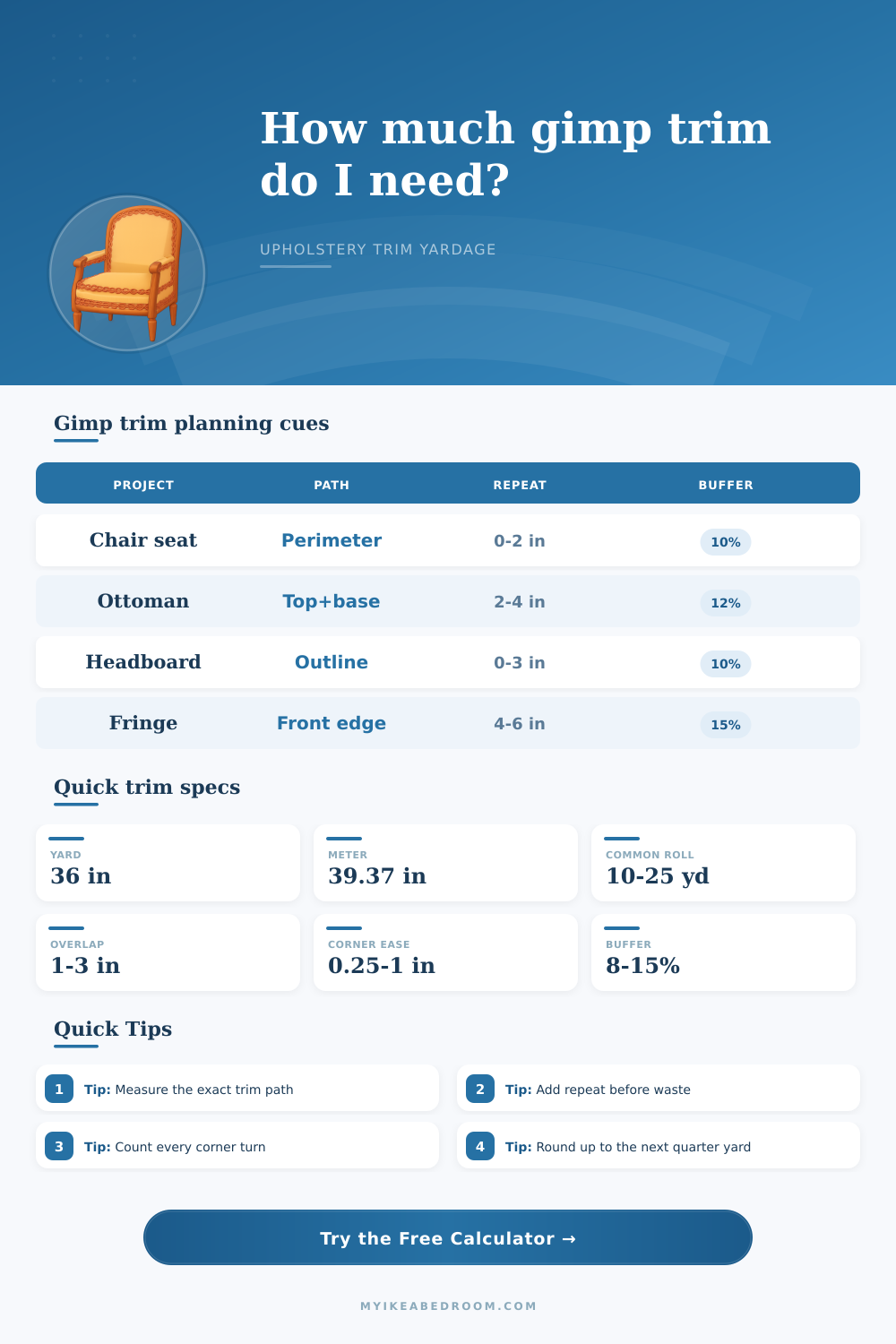
This grid compares common trim families against the current measured path so you can see how repeat and handling buffers change the final order length.
| Trim type | Typical width | Repeat planning | Best buffer |
|---|---|---|---|
| Scroll gimp braid | 3/8 to 5/8 in | Small woven repeat or none | 8% to 12% |
| Flat upholstery braid | 1/2 to 7/8 in | Check directional motifs | 8% to 12% |
| Lip cord and welt | 1/4 to 1/2 in lip | Usually no visible repeat | 5% to 10% |
| Brush or tassel fringe | 1 to 3 in drop | Match direction and end tails | 12% to 20% |
| Nailhead-look braid | 1/2 to 3/4 in | Stud spacing must finish cleanly | 10% to 15% |
| Path type | Rectangle formula | Round formula | Use case |
|---|---|---|---|
| Single full perimeter | 2 x length + 2 x width | Diameter x pi | Seat decks, backs, panels, and cushion tops. |
| Front plus sides | Length + 2 x width | 75% of perimeter | Skirt fronts, open-back chairs, and visible returns. |
| Front edge only | Length | 50% of perimeter | Fringe on sofa fronts or valance lower edges. |
| Top and lower perimeter | 2 x perimeter | 2 x circumference | Ottomans, benches, and thick cushion boxing. |
| Box cushion with vertical seams | 2 x perimeter + 4 x depth | 2 x circumference + 4 x depth | Raised box cushions with trim at both edges. |
| Situation | Repeat input | Overlap input | Planning note |
|---|---|---|---|
| Plain cotton gimp | 0 to 1 in | 1 to 2 in | Most length comes from the actual perimeter and corners. |
| Scroll braid with motif | 2 to 4 in | 2 in | Round each section up to keep motifs aligned. |
| Tassel or brush fringe | 4 to 6 in | 2 to 4 in | Direction and clean end tails usually need more waste. |
| Nailhead-look tape | 1 to 2 in | 1 to 2 in | Place joins where the stud rhythm is least visible. |
| Metallic braid | 2 to 5 in | 2 to 3 in | Extra length helps avoid frayed or stressed cut ends. |
| Furniture project | Typical measured path | Usual sections | Trim note |
|---|---|---|---|
| Dining chair seat | 5 to 7 ft each | 1 per chair | Add more for thick rounded corners or deep padding. |
| Queen headboard outline | 15 to 20 ft | 1 to 3 cuts | Measure the applied border, not the mattress size. |
| Storage ottoman | 18 to 28 ft | 2 to 4 cuts | Top plus lower trim quickly doubles the perimeter. |
| Sofa skirt front fringe | 7 to 10 ft | 1 to 2 cuts | Long fringe needs direction and end finishing allowance. |
| Bench box cushion | 18 to 25 ft | 2 to 4 cuts | Include vertical corner drops if trimmed separately. |
Measure where the trim will sit. Gimp trim yardage follows the visible seam, frame edge, or skirt line. A trim path set inward from the outside frame can be several inches shorter on each side.
Add repeat before the final buffer. Patterned braid, tassel spacing, and nailhead-look tape need each cut rounded to the repeat first, then the waste percentage is applied to the matched length.
Trim measurement for upholstery seem straightforward. Tape measure the item you want covered: trace around, then sum the lengths on the sides and off to the store you go. With certainty. And then back home, you sew… and find yourself three inches short of trim where that final corner is located.
Why? Because real-life fabric doesn’t play by the rules of just measuring around its perimeter. The outer edge stretch while the inner edge compresses at corners. Matching at patterns is required. You must allow for waste so all cut end finish cleanly. Enter the calculator above, which does math for you. Just enter your dimensions. Understanding why you need those extra inches will prevent more trouble then the time you save when figuring out how much yardage to buy.
Why You Need Extra Fabric
Most people measure the outside frame, not the seam line. So if you have half the chair back trimmed, that means exterior dimension is much smaller than the actual wood frame. Where is braid going to fall? Measure there. On the tool, you can specify what type of path you want: Full perimeter, just the front, plus sides. That covers all those different application lines. Those are inches that make a difference in overall yardage for something as big as an ottoman or sofa.
And then there is corners. A corner isn’t honest. Straight line, straight line. Sharp right turn and that outer edge of your trim get stretched out as the inner edge gets compressed. You’ll want some excess material so that turn looks smooth and doesn’t pucker the fabric at all. Your calculator will add a corner ease allowance for each turn you define. Typical upholsterer allow around a half-inch per corner. If you’re dealing with something decorative like a scroll gimp or any stiff metallic braid, you may wish to increase this number. Better a few inches overage than a tight seam pulling the upholstery out of whack.
Then there is the fact that patterns has to match too. Nailhead-look tape or tassel fringe has a beat. Cut them wherever you want and they’ll look fine. You have to account for pattern repeat to ensure symmetry and clean motifs. But plain cotton cord doesn’t have any pattern. You could cut it right down middle and be fine. When you purchase just enough for around the outside, chances are you’ll get an awkward half-tassel hanging out where the two pieces meet. The waste calculator require you to enter how long your pattern repeats and includes this space as part of its calculation. That way each piece finishes on a nice complete motif instead of halfway through. These are telltale signs of patchwork versus good-looking joins.
There’s no wiggle room on waste. Even if your measurements is dead-on, there’s always room for error when it comes to sewing. It only takes a half-second for a slip-stitch (or an unruly cut-edge) to lose you up to six inches of fabric. When working with decorative trim, I typicaly build in ten to fifteen-percent waste. That’s considered normal. The calculator factors in that margin after the waste has been accounted for based off corner and repeat lengths. This is the proper sequence. Otherwise you could of end up short even if you match patterns first, because the waste amount didn’t account for extra length needed to reach the start of next pattern.
Bigger is always better; you’re better off ordering a little more than expected because running back out to buy another roll several weeks down the road will cost you more money. Sometimes (a lot of times) you only have certain color/lot of a fabric available in trims. So while you may have two rolls that match perfectly today, what happens if the manufacturing batch change just a little? You could end up with a sofa skirt that doesn’t match at all. It is not a risk worth taking.
For things that are more standard -like ottomans, dining chairs- use their preset as a baseline, then tweak based off your actual requirements. If you’re sewing a very full fringed item for the sofa skirt, go ahead and bump up the waste percentage accordingly. The number it spits out for you is safe order length. It accounts for mistakes, how fabric moves, and shape of the furnitures. Shears can cut away extra. But you can’t sew something shut when there’s no fabric left.