Generator Wattage Calculator
Estimate steady running watts, starting surge watts, reserve capacity, recommended generator size, load category split, and output amps for outage panels, RV-style loads, shops, pumps, and essential circuits.
Load a realistic backup scenario, then adjust the appliance groups, surge factor, reserve percentage, and voltage for your exact generator plan.
This calculator treats lights and electronics as steady loads and applies the starting surge factor mainly to the largest motor-bearing group.
Refrigerator / Freezer
Running: often 600 to 800 W combined.
Surge: compressor startup may briefly need 2x to 3x.
Sump or Well Pump
Running: commonly 800 to 1,500 W.
Surge: pump startup can be the sizing driver.
Furnace Blower / Fan
Running: often 300 to 900 W.
Surge: smaller than pump startup but still motor-based.
LED Lighting
Running: many rooms fit between 150 and 700 W.
Surge: usually low compared with motors.
Home Office
Running: modem, laptop, monitor, and printer vary widely.
Surge: mostly steady unless laser printing is included.
Workshop Tools
Running: saws and compressors can exceed 1,500 W.
Surge: avoid starting tools at the same time.
RV-Style Load
Running: fridge, converter, fans, and small devices stack up.
Surge: air handling loads raise the peak.
Medical Device Priority
Running: check the nameplate and backup requirements.
Surge: use extra reserve for uninterrupted operation.
| Preset | Running watts | Surge factor | Reserve | Typical category |
|---|---|---|---|---|
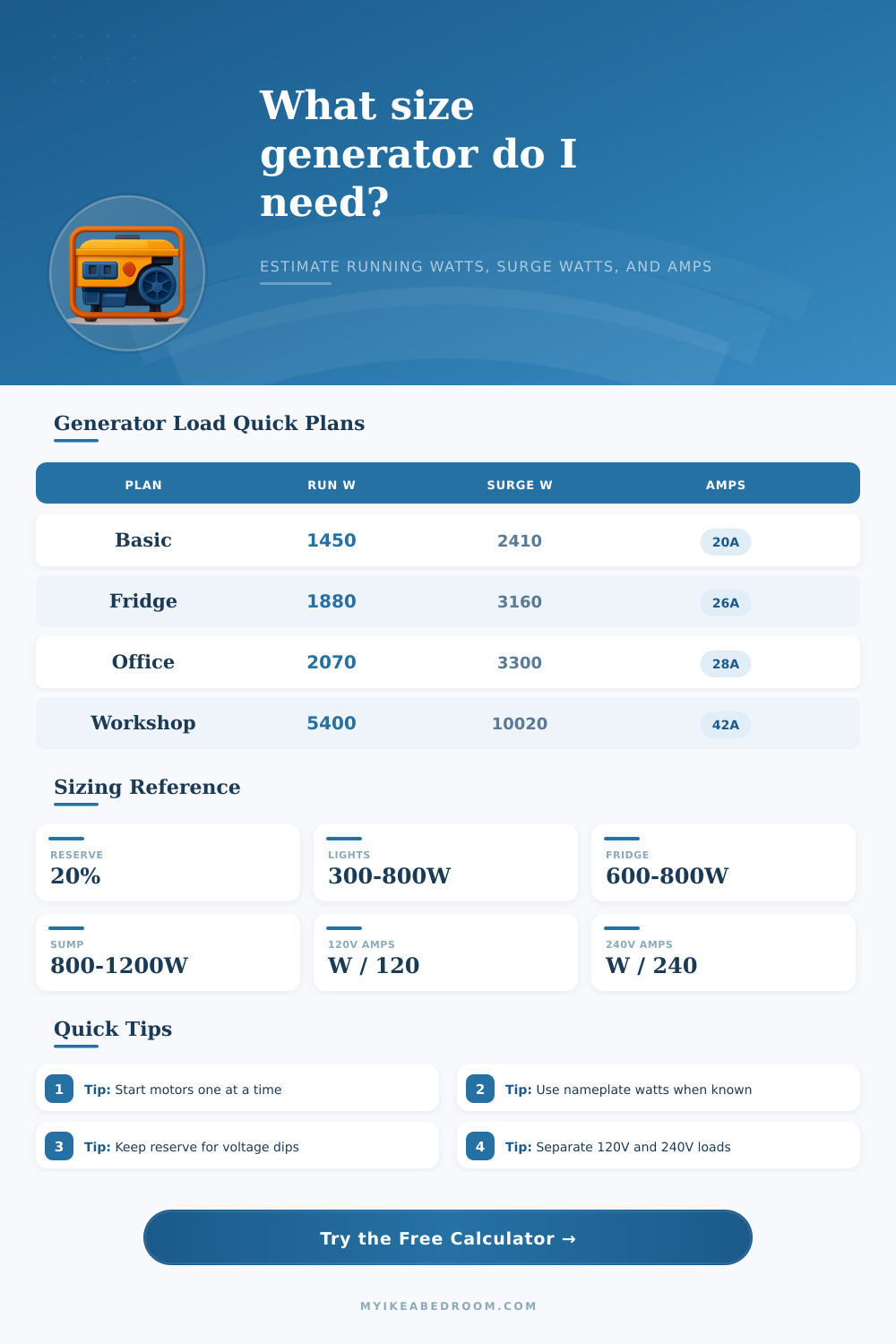
| Basic outage kit | 1,450 W | 2.6x | 15% | Lights, devices, small fan |
| Refrigerator plus lights | 1,980 W | 2.8x | 20% | Cold storage and room circuits |
| Home office backup | 2,070 W | 2.5x | 25% | Electronics with refrigerator |
| Sump pump backup | 2,170 W | 3.2x | 25% | Pump-heavy essential load |
| Workshop load | 5,400 W | 3.1x | 20% | Tools and motor starts |
| Load group | Low running watts | Typical running watts | High running watts | Surge behavior |
|---|---|---|---|---|
| Refrigerator / freezer | 400 W | 700 W | 1,000 W | Compressor startup can be high |
| Sump pump | 600 W | 1,000 W | 1,800 W | Short heavy start |
| Furnace blower | 300 W | 600 W | 1,000 W | Moderate motor start |
| LED lighting group | 100 W | 350 W | 800 W | Usually low surge |
| Home office devices | 150 W | 500 W | 1,200 W | Mostly steady draw |
| Workshop tool group | 1,200 W | 2,500 W | 4,000 W | Large motor start possible |
| Recommended watts | Amps at 120 V | Amps at 208 V | Amps at 230 V | Amps at 240 V |
|---|---|---|---|---|
| 2,000 W | 16.7 A | 9.6 A | 8.7 A | 8.3 A |
| 3,500 W | 29.2 A | 16.8 A | 15.2 A | 14.6 A |
| 5,000 W | 41.7 A | 24.0 A | 21.7 A | 20.8 A |
| 7,500 W | 62.5 A | 36.1 A | 32.6 A | 31.3 A |
| 10,000 W | 83.3 A | 48.1 A | 43.5 A | 41.7 A |
| Reserve setting | Use when | Formula effect | Planning note |
|---|---|---|---|
| 10% | Known loads, low motor use | Peak watts x 1.10 | Best for measured wattage lists |
| 15% | Basic lights and devices | Peak watts x 1.15 | Works for steady essentials |
| 20% | Mixed refrigerator and circuits | Peak watts x 1.20 | Good general setting |
| 25% | Pumps, office loads, uncertain starts | Peak watts x 1.25 | Adds room for cycling loads |
| 30%+ | Large motors or sensitive loads | Peak watts x 1.30+ | Useful when loads change often |
Tuesday night the power goes out. You flip on the generator. It starts up. The lights is back on. The fridge hums. Great. The breaker trips when you run the sump pump or when the shop compressor come on. You didn’t size the generator for starting surge; it can handle steady loads. So what? That’s the difference between making your plan work, or breaking it.
You see most folks glance at wattage label, tally them up and purchase lowest priced unit to cover their sum. Light bulbs don’t work like electric motors. A light bulb pulls current immediately and maintains the draw. Something like a motor on a well pump or a compressor in a fridge require a huge pulse of electricity to begin turning over then settles into a lower draw while running. That start-up pulse is what kills undersized generators. Plan for that spike before purchasing.
How to Choose the Right Generator Size
To make this work, we need to split our load into groups: Lighting, HVAC fans, Refrigeration, Essential Circuits, etc. Each of those categories perform differently on electricity. A fridge might only run at seven hundred watts, but it could demand two thousand for the three seconds it starts up. The device adds a “surge” factor to that highest-demand category to account for start-up peaks. It’s crude but much more accurate then guesstimating and ignoring the peak.
Another thing folks miss is what’s called reserve capacity. In other words, let’s say you figure out you’ll need four thousand watts. Buying that exact same size generator won’t leave you any wiggle room. Voltage drops, cords create resistance, and over time appliances will get old. So if you buy a 20-percent reserve, the engine has breathing room and doesn’t have to run at full-throttle every time someone wants to turn on a hair dryer. That means it burns less gas, runs quieter and lasts longer.
Amp math changes dramatically with a voltage selection since the higher voltage equate to a smaller amperage draw at the same load (wattage). For instance, a five thousand watt load running on one hundred twenty volts will pull more than forty amps whereas that same load running on two hundred forty volts will only pull less than twenty-one amps. That’s why bigger back-up units tend to run higher voltages, lower current translates into less heat in your wires and you can use thinner, less expensive cable as well since the generator is easier on the electrical side of things.
So: How can you save some cash by not having to fire up all of your appliances simultaneously? You can do this by staging your loads. The refrigerator goes on after the router and lights; give it a minute and go for the HVAC fan/sump pump next. You want to avoid having several motors pull too much power at the same time. That’s free headroom you don’t need to buy by getting a bigger machine.
For workshop tools, things get dicey: A thousand watts may be what the label says, but starting up a table saw will cause it to pull three times that. An air compressor is even more difficult, so powering both at once is trouble waiting to happen. Run the saw, make the cut, let the load die down, turn on the compressor. Discipline yourself to plan your work flow based off what the generator can do.
It can work. It is a clean sine wave. Inverter generators produce a cleaner sine wave which protects medical devices and other sensitive electronics. These products require more than raw watts… They require stable power. When preparing to run life-support equipment or critical office data, don’t skimp on cheap capacity; it’s better to spend extra money now for peace of mind later.
LED fixtures draw very little power for lighting. Moddern lights don’t make you choose between saving watts and having a well-lit home like old incandescent bulbs did. You don’t have to skimp on lighting anymore to save watts. It’s one of the only comfort items that won’t break the bank, or the breaker.
When sizing a generator, you’re not just doing math, you’re also managing expectations. You can’t run everything at once, and you shouldn’t try to. Know what’s most important (fridge, sump pump, internet router, a few lights), because that’s what you’ll build around. If there’s room in the math, add on the nice-to-haves. Remember: this is not an attempt to duplicate full grid power; the goal is to save the essentials while waiting for utilities to be back online.
To get you started (not to be taken as gospel), there are the reference tables on the page. These show typical ranges of common appliances. Every home is unique. Every motor is unique. Take what you can measure with a plug-in meter and add an estimate for the rest, being conservative. Add in that reserve buffer and breathe easy; your plan has got some water in it when the grid goes down.
Generator failures test not only equipment but your preparedness. The proper sizing prevents multiple runs to the hardware store during the rain. It keeps your data intact and your cold foods cold. Stage your loads, respect the limits, and plan for the surge. The quiet hum of an appropriately sized generator is the sound of a job well done.