Outdoor shelter footprint planner
Gazebo Size Calculator
Match gazebo footprint, interior clearance, guest count, roof overhang, and support spacing for dining sets, lounge zones, spas, and compact backyard retreats.
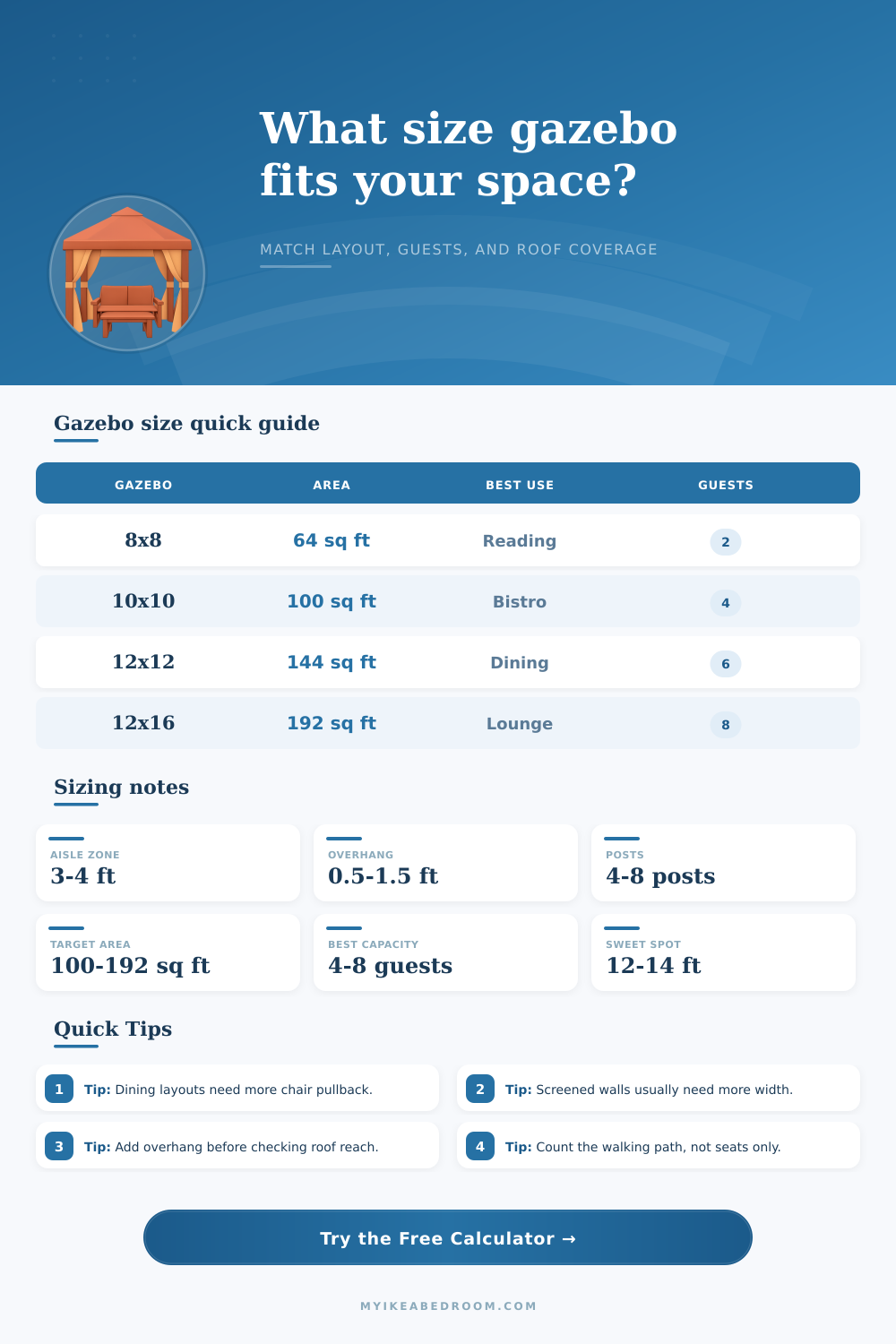
| Footprint | Area | Typical use | Comfort capacity |
|---|---|---|---|
| 8 x 8 | 64 sq ft | Reading nook or pair of chairs | 2 guests |
| 10 x 10 | 100 sq ft | Bistro dining or compact lounge | 4 guests |
| 10 x 12 | 120 sq ft | Loveseat plus accent chairs | 4 to 5 guests |
| 12 x 12 | 144 sq ft | Dining for four to six | 5 to 6 guests |
| 12 x 16 | 192 sq ft | Dining for six or lounge mix | 7 to 8 guests |
| 12 x 20 | 240 sq ft | Entertaining and serving zone | 8 to 10 guests |
| 14 x 16 | 224 sq ft | Daybed retreat or deep seating | 8 guests |
| 14 ft octagon | 162 sq ft | Spa shelter or centered seating | 5 to 6 guests |
| Use case | Base target | Clear aisle | Best first size |
|---|---|---|---|
| Bistro seating | 36 sq ft min | 3 ft | 10 x 10 |
| Dining set | 64 sq ft min | 3.5 to 4 ft | 12 x 12 |
| Conversation lounge | 72 sq ft min | 3 to 4 ft | 10 x 12 |
| Deep sectional | 110 sq ft min | 4 ft | 12 x 16 |
| Spa shelter | 100 sq ft min | 3.5 to 4 ft | 14 ft octagon |
| Grill and prep | 90 sq ft min | 4 ft | 10 x 14 |
| Overhang | 8 x 8 roof | 10 x 12 roof | 12 x 16 roof |
|---|---|---|---|
| 0.5 ft | 81 sq ft | 143 sq ft | 221 sq ft |
| 1.0 ft | 100 sq ft | 168 sq ft | 252 sq ft |
| 1.5 ft | 121 sq ft | 195 sq ft | 285 sq ft |
| 2.0 ft | 144 sq ft | 224 sq ft | 320 sq ft |
| Post count | Typical span | Best size band | Planning note |
|---|---|---|---|
| 4 posts | 8 to 10 ft | 8 x 8 to 10 x 10 | Simple layouts, lighter roofs, and smaller footprints. |
| 6 posts | 6 to 8 ft | 10 x 12 to 12 x 16 | Common for dining layouts and longer rectangular shelters. |
| 8 posts | 5 to 7 ft | 14 ft octagon to 14 x 20 | Helps manage heavier roofs and reduces beam span length. |
| Perimeter check | Perimeter divided by posts | Any shape | Use this as a first pass before structural engineering details. |
When you are planning to build an gazebo, there are many things to consider. One of the first things to consider is the footprint of the gazebo. The footprint of the gazebo is the total amount of ground that the gazebo will cover.
If the gazebo covers too little ground, the gazebo may feel too small for the intended use. If the gazebo covers too much ground, the gazebo may not fit in your backyard. You must account for the furnitures and the necessary walking space around the gazebo.
How to choose the right size and place for your gazebo
To provide walking space for the individuals using the gazebo, you will need to provide walkway clearance. Walkway clearance is the amount of space that will remain empty between the gazebo furniture and the gazebo structure. Individuals needs approximately three to four feet of walking space to move around the gazebo without hitting any of the gazebo furniture.
If there is not enough walkway clearance, the individuals who use the gazebo will feel crowded. You also need to consider how many guests you would like to have at the gazebo when you are determining the footprint of the gazebo. If the gazebo is for two person only, a small gazebo may be suitable.
However, if you would like to have eight guest at the gazebo, a larger gazebo will be necessary. The shape of the gazebo will determine the way in which the gazebo is used in the backyard. Square gazebas provide symmetry in that each side of the gazebo is the same size.
Rectangular gazebas may be more suitable in that they allow you to place a long table in the center of the gazebo. Additionally, octagonal gazebas provide a unique gazebo shape. However, octagonal gazebas require precise measurements in order to account for each corner of the gazebo.
If the gazebo will have sofas in it, you will need to provide more square footage for the gazebo than if the gazebo only had chairs. The roof overhang will play an important role in the design of the gazebo. The roof overhang is the portion of the roof of the gazebo that extends past the gazebo support posts.
The overhang provides shade from the sun for those within the gazebo and sheds the water from the rain away from the individuals within the gazebo. If the roof overhang is too small, the individuals within the gazebo will get wet when it rains. If the roof overhang is too large, the roof will extend to cover more of the backyard but will take up more space for the gazebo all together.
In addition to the footprint and roof overhang of the gazebo, you must also consider the gazebo support posts. If the gazebo is less than ten feet in span, four support posts will be sufficient. However, if the gazebo is larger in dimension, six or eight support posts will be necessary.
More support posts will allow the gazebo to better handle the weight of the gazebo roof and avoid sag of the gazebo beams. You should also consider the enclosure of the gazebo. If the gazebo feature screened walls, more width will be necessary to allow for the screens to not flap in the wind.
Avoid some of the common mistake when you measure your gazebo. One of the most common mistakes is to only measure the size of your patio slab but to ignore the need for chair pullback. When you pull back the chairs to sit in them, the chairs must have space to do that without colliding with the edge of the patio slab.
If you do not allow for chair pullback in your measurement, your chairs will hit the edge of the patio slab. Another common mistake when measuring a gazebo is to ignore the aspect ratio of the gazebo. If the aspect ratio of a gazebo is incorrect, the gazebo may feel too narrow for individuals to have conversations with those sitting on the opposite side of a dining table.
When you are considering the placement of your gazebo in the yard, consider your local building code. Local building codes will dictate the rules regarding the placement of the gazebo in your yard. For instance, most local building codes will require that you maintain a minimum distance between the gazebo and your property line.
This distance is referred to as a setback, and the minimum requirement is typically two feet. Another consideration for gazebas is the wind and shade in your yard. In areas that are prone to high winds, the gazebo support posts must be able to stand up to those high winds.
In areas that receive plenty of shade, you may want to consider building a gazebo with a hardtop roof or a fabric canopy roof. Finally, think about the different season in your yard and the use you would like to make of the gazebo. During the summer, you may prefer an open frame gazebo structure to allow for increased airflow within the gazebo.
During the winter, you may opt for a pavilion gazebo structure that will help to trap the body heat of the individuals within the gazebo. Before you begin to construct your gazebo, use string to mark the footprint of your gazebo on the ground. Placing a gazebo footprint on the ground with string will allow you to walk through your gazebo to ensure that the footprint is to your satisfaction before you purchase the material for your gazebo.