Garland Length Calculator
Size decorative garland for mantels, stair rails, posts, doorways, window frames, tree spirals, canopy rails, and swags with route length, dip depth, wrap spacing, tails, fullness, attachment points, and section count.
Pick a common layout, then adjust the route, swag depth, wrap spacing, fullness, tails, and stock section length for your exact display.
Calculation breakdown
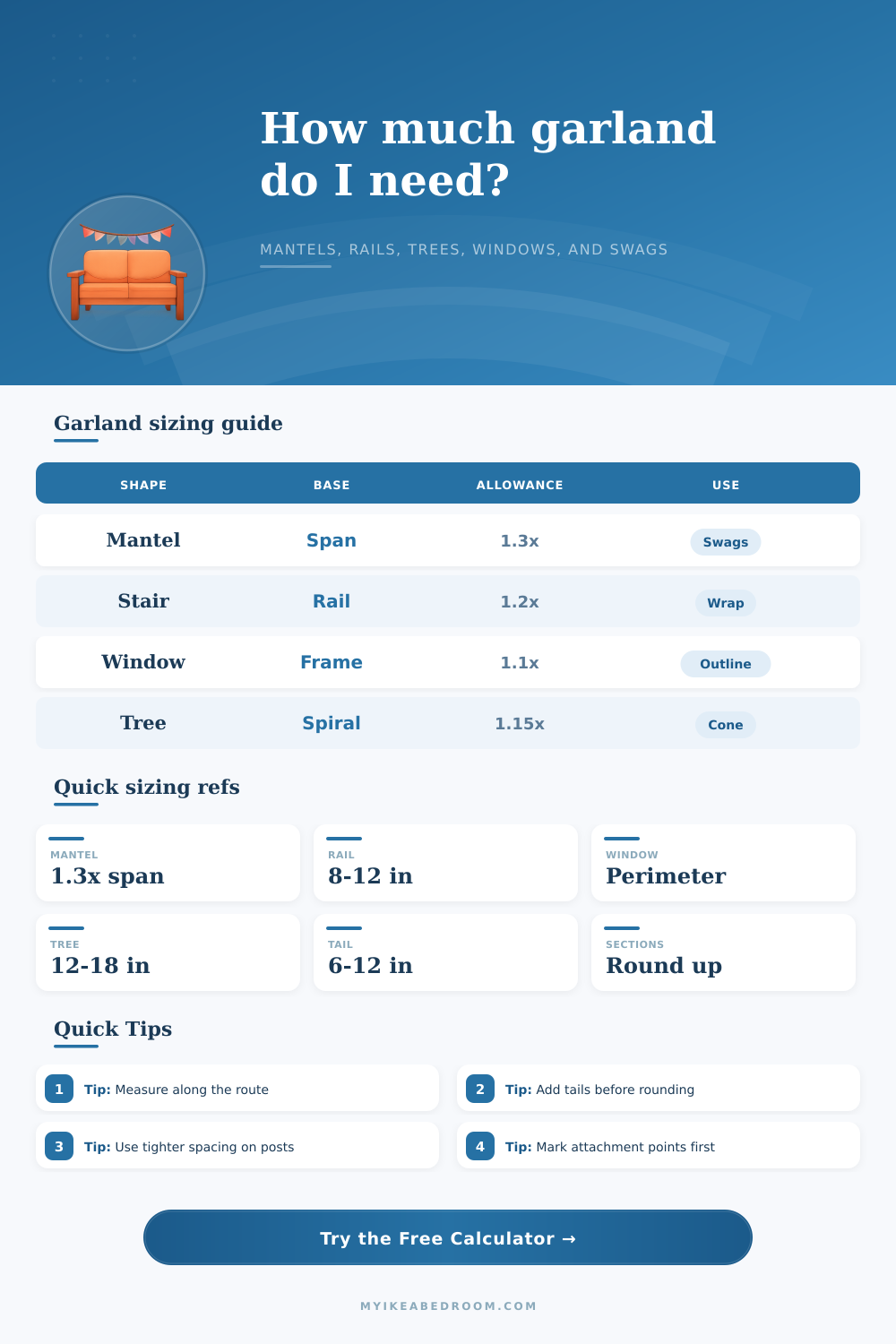
| Shape type | Base route used | Extra allowance | Best use |
|---|---|---|---|
| Straight run | Main span | Fullness, tails, and handling allowance | Shelves, headboards, simple rails, and straight ledges |
| Swagged span | Parabolic arc across each dip | Swag arc allowance plus fullness factor | Mantels, headboards, balcony fronts, and soft rail drapes |
| Frame outline | Two sides plus top span | Corner handling and optional tail allowance | Doorways, windows, mirrors, wardrobes, and room arches |
| Helical wrap | Turn length from circumference and spacing | Wrap turns rounded from run length | Stair rails, posts, columns, and four poster bed uprights |
| Tree spiral | Tapered cone spiral from height and base diameter | Average circumference plus fullness factor | Christmas trees, cone displays, and tiered plant stands |
| Canopy rectangle | Two long sides plus two short sides | Optional swag depth between attachment points | Bed canopy rails, room dividers, and rectangular overhead frames |
| Look | Fullness factor | Swag depth | Result behavior |
|---|---|---|---|
| Taut outline | 1.00 to 1.10 | 0 to 3 in per foot of span | Best for clean frames where the route should stay close to the edge. |
| Soft rail | 1.10 to 1.25 | 3 to 5 in per foot of chord | Adds a gentle hang while keeping attachment spacing predictable. |
| Classic mantel | 1.25 to 1.50 | 5 to 8 in per foot of chord | Creates visible dips and enough length for layered greenery. |
| Deep display | 1.50 to 1.80 | 8 to 12 in per foot of chord | Useful for oversized swags, thick bows, and generous tails. |
| Route | Common spacing | Calculator effect | Watch point |
|---|---|---|---|
| Thin stair rail | 10 to 14 in between turns | Moderate turns with open railing visible | Use the rail diameter, not the baluster diameter. |
| Chunky banister | 8 to 12 in between turns | More garland because each turn has a larger circumference | Increase fullness if greenery is very dense. |
| Bed post or column | 6 to 10 in between turns | Tighter spiral with more total turns | Short posts may need tails more than extra turns. |
| Tree spiral | 12 to 18 in vertical spacing | Length rises with tree height and base diameter | Use a smaller base diameter for a light spiral. |
| Stock section | Good for | Planning rule | Join allowance |
|---|---|---|---|
| 6 ft garland | Mantels, small windows, bed posts | Round up to whole sections after tails | Overlap joins by 3 to 6 in for continuous greenery. |
| 9 ft garland | Doorways, stair rail starts, wide shelves | Often covers one medium doorway side and top | Hide joins near corners or attachment points. |
| 12 ft garland | Long rails, tree spirals, canopy edges | Reduces joins on long routes | Check that the section can be supported at each point. |
| Custom cut | Built-in rails and continuous greenery | Use the calculated total length directly | Add a small overlap if the ends must blend together. |
Mantel swags
Swag depth drives the extra arc length, while fullness controls how lush the greenery feels between hooks.
Best checked with 3 to 5 attachment points across the span.
Stair rail wrap
Wrap spacing and rail diameter decide the turn count and helix length.
Shorter spacing gives a denser rail and uses more garland.
Door and window frames
Perimeter length is the base, then tails and corner allowance keep the outline from looking tight.
Use the visible outside route, not only the glass opening.
Tree spiral
Tree height, base diameter, and vertical spacing estimate the cone spiral path.
Wider trees need much more length than slim trees at the same height.
When decorating a mantel with greenery, it is posible that the greenery are not long enough to reach the corners of the mantel. People measures their homes with straight lines, but greenery often arc. The straight line distance from one point of the mantel to another point is not the same then the arc length of greenery that arcs from one corner of the mantel to the other.
Thus, a straight line measurement will not provide an accurate estimation of the amount of greenery that is required to decorate the mantel. In order to decorate the mantel with greenery with the desired look, the decorator must account for the amount of greenery that will be utilized to provide fullness to the mantel. Greenery that are pulled against the mantel’s rail will provide a look of thin greenery.
How to Measure Greenery for Mantels, Stairs, and Trees
However, if there is an additional length of greenery that accounts for the fullness of the greenery, then the greenery will appear thick on the mantel. Thus, an extra length of greenery should of been accounted for in the measurement of the length of greenery that will be used to decorate the mantel. When placing greenery on a stair rail, the geometry of the stair rail must be accounted for.
The stair rail is a curved structure. Each time the greenery is wrapped around the stair rail, the length of the greenery are consumed. If the greenery is wrapped too tight around the stair rail, the greenery will lose it’s desired softness.
However, if the greenery is wrapped too loosely around the stair rail, the greenery may create an unevenly spiral decoration on the stair rail. People often under-estimate the circumference of a stair banister. Thus, when under-estimating the circumference of the stair banister, people also under-estimate the length of the greenery that will adequately cover the banister.
In addition to the length of the stair banister, the length of the swags must be accounted for. Swags is the greenery that creates curved sections between two attachment points on the banister. The deeper the arc of the greenery swag, the longer the greenery will need to bridge the gap between the two attachment points.
If greenery create deep curves along a banister, the decorator must calculate the arcs created by these deep curves in determining the length of greenery that will be used for the banister decoration. Using a calculator will allow the decorator to accurately calculate the length of greenery for each of the deep greenery dips. The attachment points of the greenery to the banister should be marked prior to decorating the banister with greenery.
By marking the attachment points of the greenery to the banister, the decorator can determine the placement of the peaks and valleys of the greenery decoration. If the attachment points is not marked, the greenery decoration may not be symmetrical around the banister, which will create an uneven and non-professional look to the decoration of the banister with greenery. When purchasing greenery, the greenery comes in fixed lengths.
Thus, there will be joins in the greenery where one piece of greenery is connected to another. The branches of the greenery should be overlapped at the joins to create an invisibly join between the two separate lengths of greenery. If the length of greenery that is purchased does not account for the length that is required for the joins of the greenery, then there will not be enough greenery to complete the decorating project.
Thus, an allowance for error in measuring the length of greenery and waste in cutting the greenery must also be accounted for in the initial purchase of the greenery for the project. In addition to the length of greenery that will be used to decorate a banister, greenery can also be wrapped around a Christmas tree. When decorating a Christmas tree, the greenery will be wrapped around a cone shape.
The circumference of a Christmas tree is large at the base of the tree but narrows as the tree rises to its point. When determining the length of the spiral of greenery around the Christmas tree, the height of the Christmas tree and the diameter of its base can be used. Using these measurements, an individual can calculate how much greenery is needed to decorate the Christmas tree.
In order to adequately decorate a Christmas tree with greenery, the person that performs the decoration must measure the length of the path that the greenery will take. In measuring the length of the path that the greenery will take, the individual should also add the length of greenery that will be used to account for the fullness of the greenery, the length of greenery that will be used to make join between the greenery in separate lengths, and any allowance for errors and waste of the greenery. If the individual takes the time to calculate the length of the path of the greenery, the length required for its fullness, and the length of greenery that is required for its joins, then the individual will have enough greenery to decorate the Christmas tree adequately.