Garden Edging Length Calculator
Estimate border perimeter, adjusted curved length, edging piece count, stake count, overlap loss, gate or opening gaps, waste allowance, and remaining offcut for garden beds, paths, tree rings, patios, and island borders.
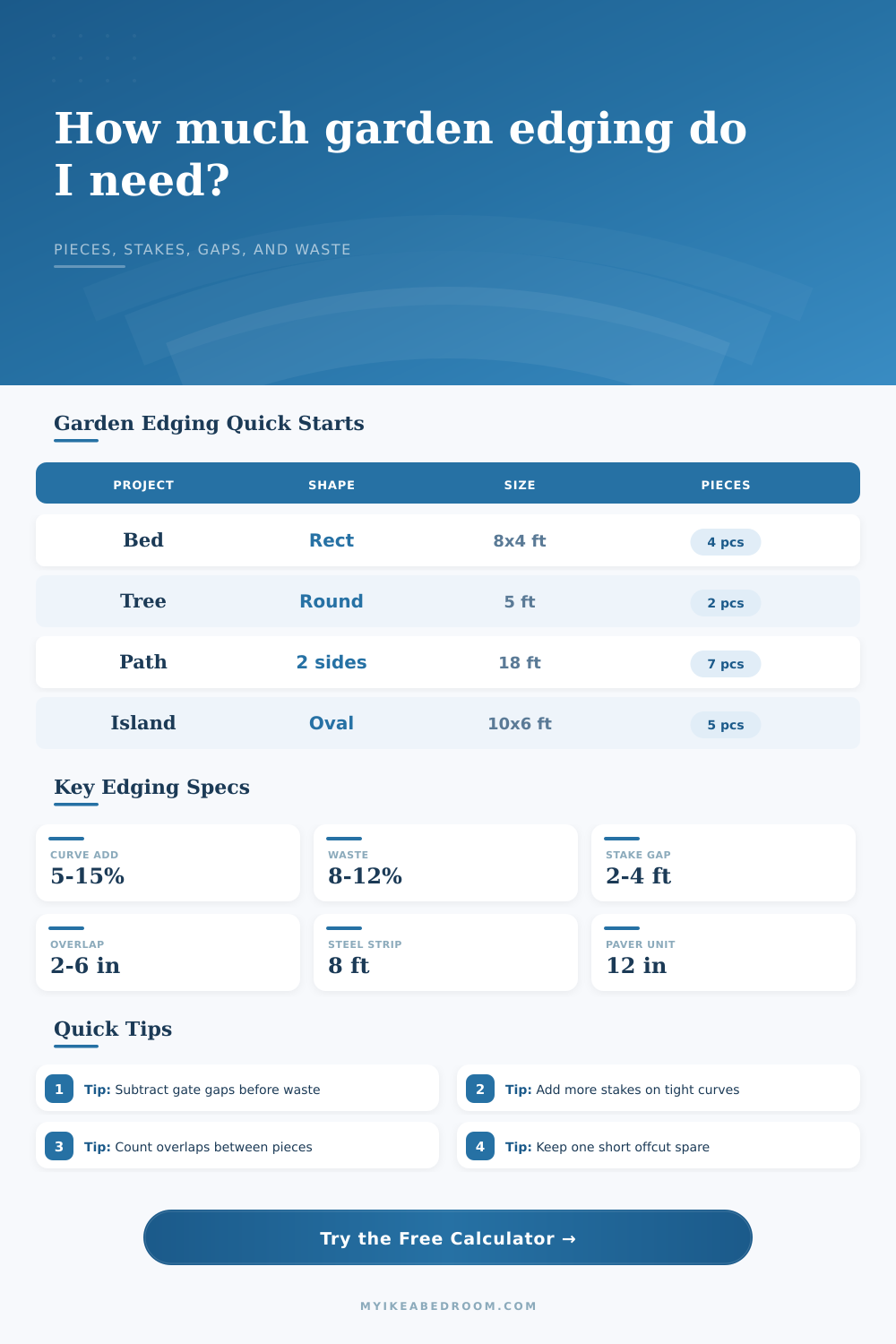
Each preset loads a common bed shape, edging material style, curve allowance, overlap, stake spacing, gaps, and waste percentage.
Calculation breakdown
| Bed shape | Formula before gaps | Best input | Curve allowance guide |
|---|---|---|---|
| Rectangle or square | 2 x (length + width) | Outside bed dimensions | 0% to 5% for straight sides |
| Circle or tree ring | pi x diameter | Average outside diameter | 5% to 10% for circular fitting |
| Oval island bed | Ramanujan oval estimate | Long diameter and short diameter | 8% to 15% for flowing borders |
| Half circle border | (pi x diameter / 2) + diameter | Diameter along straight side | 5% to 12% depending on arc |
| Path edge pair | 2 x path length | One side length | 3% to 10% for wandering paths |
| Custom measured line | Measured perimeter | String, hose, or wheel length | Use the field-measured curve margin |
| Edging type | Nominal piece | Typical overlap | Usable after one joint |
|---|---|---|---|
| Steel landscape strip | 8 ft | 4 in sleeve or lap | About 7 ft 8 in |
| Aluminum edging | 8 ft | 2 in connector | About 7 ft 10 in |
| Flexible plastic roll | 20 ft | 6 in joined lap | About 19 ft 6 in |
| Composite roll section | 16 ft | 4 in joined lap | About 15 ft 8 in |
| Landscape timber | 8 ft | 0 in butt joint | 8 ft, minus saw kerfs |
| Paver or block edging | 12 in unit | 0 in joint loss | One exposed face length |
| Condition | Typical spacing | Use more stakes when | Calculator setting |
|---|---|---|---|
| Straight steel or aluminum | 3 to 4 ft | Soil is loose or grade changes | 3.5 ft |
| Tight flexible curve | 1.5 to 2.5 ft | Radius is small or edging springs back | 2 ft |
| Plastic roll edging | 2 to 3 ft | Long exposed runs need support | 2.5 ft |
| Paver, brick, or stone | 0 stakes | Use pins only with restraints | 999 ft if no stakes |
| Timber edging | 4 to 6 ft | Curves are cut into shorter pieces | 5 ft |
| Project | Starting dimensions | Estimated perimeter | Waste and curve range |
|---|---|---|---|
| Small rectangular herb bed | 6 ft x 3 ft | 18 ft before gaps | 5% to 10% |
| Raised vegetable bed | 8 ft x 4 ft | 24 ft before gaps | 5% to 8% |
| Round tree ring | 5 ft diameter | 15.7 ft before gaps | 8% to 12% |
| Curved foundation border | 28 ft measured line | 28 ft before gaps | 10% to 15% |
| Oval island bed | 10 ft x 6 ft | 25.5 ft before gaps | 10% to 15% |
| Path edging on both sides | 18 ft path length | 36 ft before openings | 8% to 12% |
For curved borders, lay a hose along the exact path and enter that measured perimeter as a custom shape. The curve allowance then becomes a trimming and fitting buffer instead of a guess.
Subtract gates, stepping-stone breaks, and drain openings before adding waste. That keeps the buy quantity from padding sections where no edging will be installed.
There’s a certain kind of frustration that comes from underestimating the task of garden edging. The enthusiasm begins; the diversion in the driveway (with rolls of plastic border still unused) follows. It was never an issue of lack of ambition. It’s nearly always an issue of geometry, those missing inches given away for cuts, curves, and connectors. Most folks figures out the straight-line measurement between two spots… And expect ground to comply. Ground hardly ever complies.
Plug in your bed shape and what material you want to use, and the rest is handled by calculator (above). It takes into account the facts of laying a border so that you don’t waste time trying to guess just how many pieces or stake will fit. If you choose a curved flower bed, the calculator will add a percentage for curve allowance, which is important: While straight edges are straightforward, arcs take more material because they has to bend smoothly. Not kink or snap back.
How to Plan Your Garden Edging Correctly
A five-foot diameter tree ring may seem simple until you attempt to wrap those rigid strips around it. You will need more length then the perimeter implies, since the material has to lap over itself at the joints and also flex slightly to accommodate them. The key to all of this is material selection. Steel will last forever and be nice and crisp. However, it is typically sold as an 8 foot long strip. This means you must either lap the ends over each other or overlap the sleeve sections, which wastes usable length.
The chart on the page explain those variances. For example, flexible plastic comes on a 20 foot long roll. So much better to only have one joint then having to piece together several shorter lengths made from timber. Timber wastes very little to overlap, so there isn’t really anything lost there. But each corner you cut off cost you wasted material. With pavers, you don’t get to use a linear measurement like feet; instead, it’s units wide x number of units. That adds even more waste when needing to make cut pieces to follow a curve.
Beginners also trip over how far apart to space their stakes. The tighter the curve, the greater the pulling force, which means you’ll need one about every couple of feet to maintain the line. With straight runs, you may be able to get away with more widely-spaced ones, perhaps even three or four feet, depending on how loose the soil is. It’s worth noting: Failing to take this into account will mean plants that wave as if drunk once you try to mow over them later.
The tool also use the space you choose between stakes to estimate how many stakes you’ll need for each row, so you don’t run out of hardware mid-project. Before you add waste, you need to subtract the areas of stepping stones or gaps for gates. Most folks do this step in the wrong order (they add ten percent for waste and then subtract the area of their gate), which means they’re paying to throw away stuff they don’t install. First, subtract the width of opening from the total perimeter. Next, calculate the new length by applying the curve allowance and waste percentage to what’s left. Sounds pedantic, but it will keep you in budget and out of the dumpster.
Also good: The rest of the calculation shows how many scraps will remain once the last cut is made. I like having that little bit in reserve for touch-ups and repairs, instead of having to dig around in a box in the garage months from now. If you plan ahead, you can figure out exactly what to buy so there’s no guessing about whether anything might be leftover.
In the end, good edging in the garden isn’t so much something we build as it is something that’s all about precise planning. A well-edged bed pulls the eye in and makes an unruly lawn appear intentional and tended to. When you get those numbers straight ahead of time, wielding the shovel becomes a neat and satisfying project, rather than one that could of stretch into an afternoon of futility. You just go around the yard measuring the line, then checking the number, then watching the edge appeer right where you want it. You won’t be staring down at the driveway with bits and pieces of leftover materials.