Garage Door Opener Horsepower Calculator
Estimate opener horsepower from door size, material, insulation, balance condition, daily cycles, drive type, and safety margin.
Choose a common door setup, then adjust the measurements or balance condition.
Recommended opener
3/4 HP
Good fit for this door and margin.Estimated door weight
231 lb
Based on material, insulation, and hardware.Lift-adjusted load
29 lb
Approximate residual load after spring assist.Drive match
Quiet
Belt drive is suited to attached garages.| Opener class | Typical door fit | Best use | Watch point |
|---|---|---|---|
| 1/3 HP | Very light single doors | Small balanced steel doors | Limited reserve for wide or insulated doors |
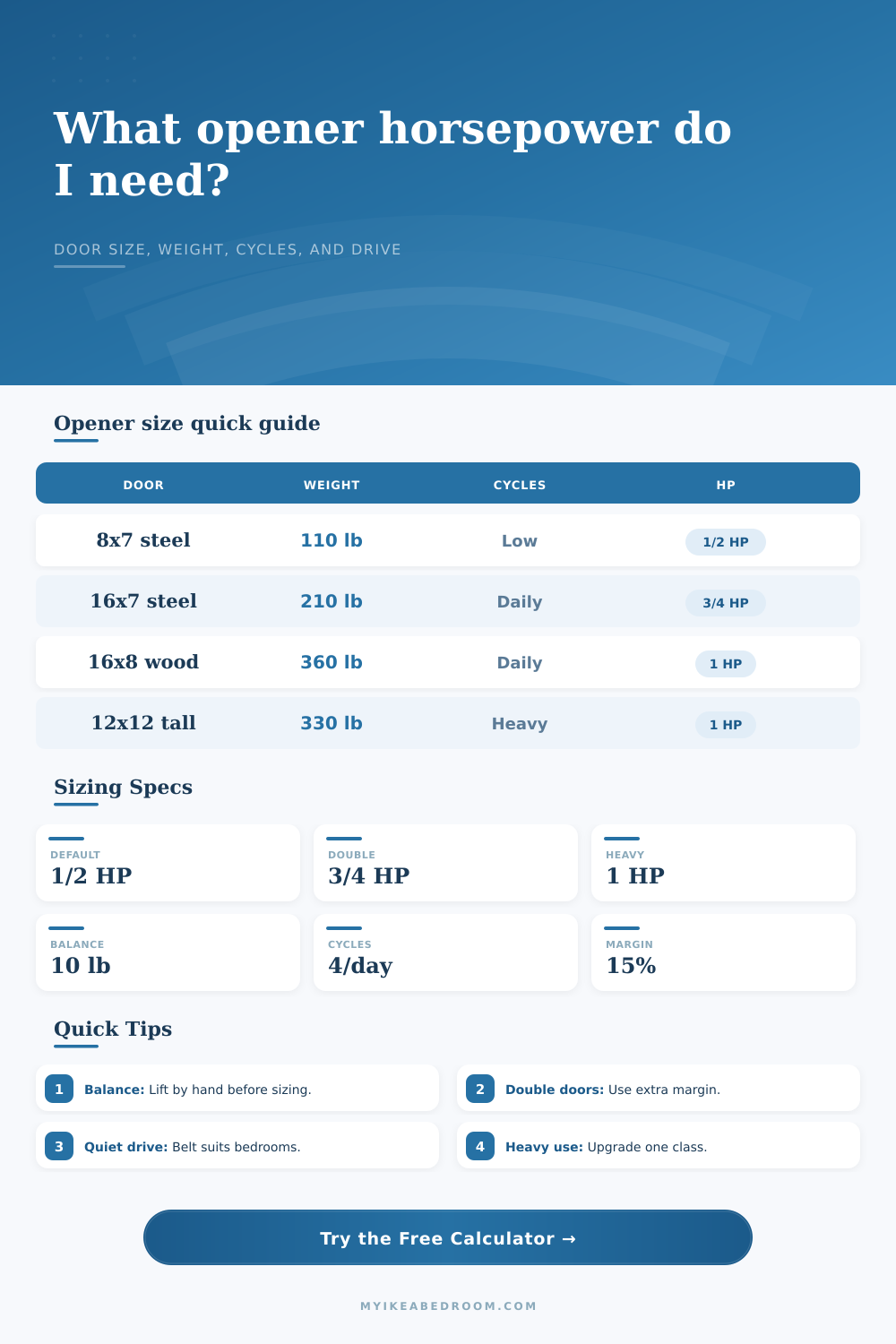
| 1/2 HP | Most standard single doors | 8x7 to 9x8 sectional doors | Use higher class for heavy wood |
| 3/4 HP | Double or insulated doors | 16x7 steel, attached garages | Springs still need proper balance |
| 1 HP | Heavy, tall, or busy doors | Wood, overlay, RV height, frequent cycles | Track and spring condition matter most |
| 1-1/4 HP | Very heavy residential doors | Large overlay or high-cycle doors | Check door hardware rating |
| Input | Light | Moderate | Heavy |
|---|---|---|---|
| Material | Aluminum 1.0 lb/sq ft | Steel 1.5 lb/sq ft | Overlay 3.5 lb/sq ft |
| Insulation add | 0.0 lb/sq ft | 0.35 lb/sq ft | 0.75 lb/sq ft |
| Spring residual | 6% to 10% | 16% to 28% | 45% or more |
| Daily cycles | 1 to 2 | 3 to 12 | 13 or more |
| Scenario | Door size | Estimated weight | Suggested class |
|---|---|---|---|
| Single steel | 8 ft x 7 ft | 95 to 125 lb | 1/2 HP |
| Double steel | 16 ft x 7 ft | 190 to 240 lb | 3/4 HP |
| Insulated double | 16 ft x 8 ft | 250 to 310 lb | 3/4 to 1 HP |
| Wood carriage | 9 ft x 8 ft | 210 to 250 lb | 3/4 HP |
| RV height | 12 ft x 12 ft | 300 to 380 lb | 1 HP |
| Drive type | Strength profile | Noise profile | Best match |
|---|---|---|---|
| Chain | Strong reserve | Louder | Detached garage or heavy doors |
| Belt | Smooth reserve | Quieter | Attached garage near bedrooms |
| Screw | Steady lift | Moderate | Simple sectional doors |
| Wall mount | High torque | Quiet | Tall doors with torsion springs |
| Direct | Smooth motor rail | Very quiet | Balanced residential doors |
Your garage door grinds to halt, then nothing. Now you’re in the dark. What’s wrong? In most cases, homeowner blames the motor. He goes out and purchases a heavy-duty opener. After all, he believes it’s all about horsepower.
But the truth is: It’s not the strength of the motor that’s causing the issue. In nearly every case, it’s the actual mass of the door and/or weight distribution. A broken spring isn’t fixed with a powerful motor. Horsepower won’t help if your door bind in the track. This is the whole system. Instead of converting or guessing at any coefficients, let the calculator do the math.
How to Choose the Right Garage Door Opener
Simply input your door dimensions and your door’s material type. Start by describing in real-world terms the physical nature of the door. Heavy insulated wood carriage doors adds significant weight. The material changes everything. Is it a lightweight steel panel? No problem. But the material does change things. Wood has a lot of weight all on its own. Steel can be kept thin and managed. Polyurethane or polystyrene foam insulation makes for energy efficient doors but it add pounds per square foot. Add those pounds quickly over a double wide door.
The silent killer of garage door openers are balance. Before purchasing a new motor, make sure to disengage the trolley and manually raise the door. If your springs is functioning as they’re supposed to, the door should remain stationary at half-way. If the balance is off, the door will either fly open or slam shut. The tool lets you rate condition of the springs.
The only thing a motor should of be overcoming is the inertia/friction of the door; not the entire weight of the door. Attempting to do so will cause a high-quality industrial motor to burn out. The door has to have its mechanics fixed first before upgrading engine.
Then there’s usage. Twice-a-day use of a one car garage is not the same as an active family home with the door cycling ten times per day. If you operate a light duty unit on heavy schedules, heat will build up in the motor windings. You want to run the right unit for your application. This calculator takes that into account, too. Because it asks how many times a day it will be cycled. And it also factors in drive type. A chain drive is robust but noisy, so great for a detached garage. Belt drives are smooth and quiet, so the obvious choice when bedrooms is over the garage. Screw drives are sorta-in-between.
So what’s left is a recommendation based off residual load. That’s what the motor really sees in addition to what springs can handle. For a typical single door, a half-horsepower opener will be more than adequate. If your garage doors is double, poorly balanced by the springs and heavily insulated, it may put you right at the edge of needing a three-quarter or even a one-horsepower opener.
The reference table on the page show how height and materials affect your needs. So you don’t waste money buying more then needed or too little and making it fail prematurely. Sizing up an opener means matching the tool to the task. It is not about raw power. It is about longevity and efficiency.
Match the motor to the door, and get proper balance. Do that, and you’ve got a door that will serve you well for years. Mismatch? It is a ticking time bomb. Test the balance first. How heavy is it? Let the numbers tell you which class is correct. It is a small thing. But it is important. Keep your garage door out of your hair for a long time to come.