Freezer Capacity Calculator
Estimate chest or upright freezer capacity from household size, months of storage, pounds of frozen food, bulk meat plans, meal prep habits, packing buffer, and liter conversion.
Choose a freezer pattern close to your household, then adjust the food pounds, months, meat factor, meal prep factor, and fill target.
Freezer Size Results
Calculation Breakdown
| Frozen food weight | Raw cubic feet | Liters equivalent | Planning note |
|---|---|---|---|
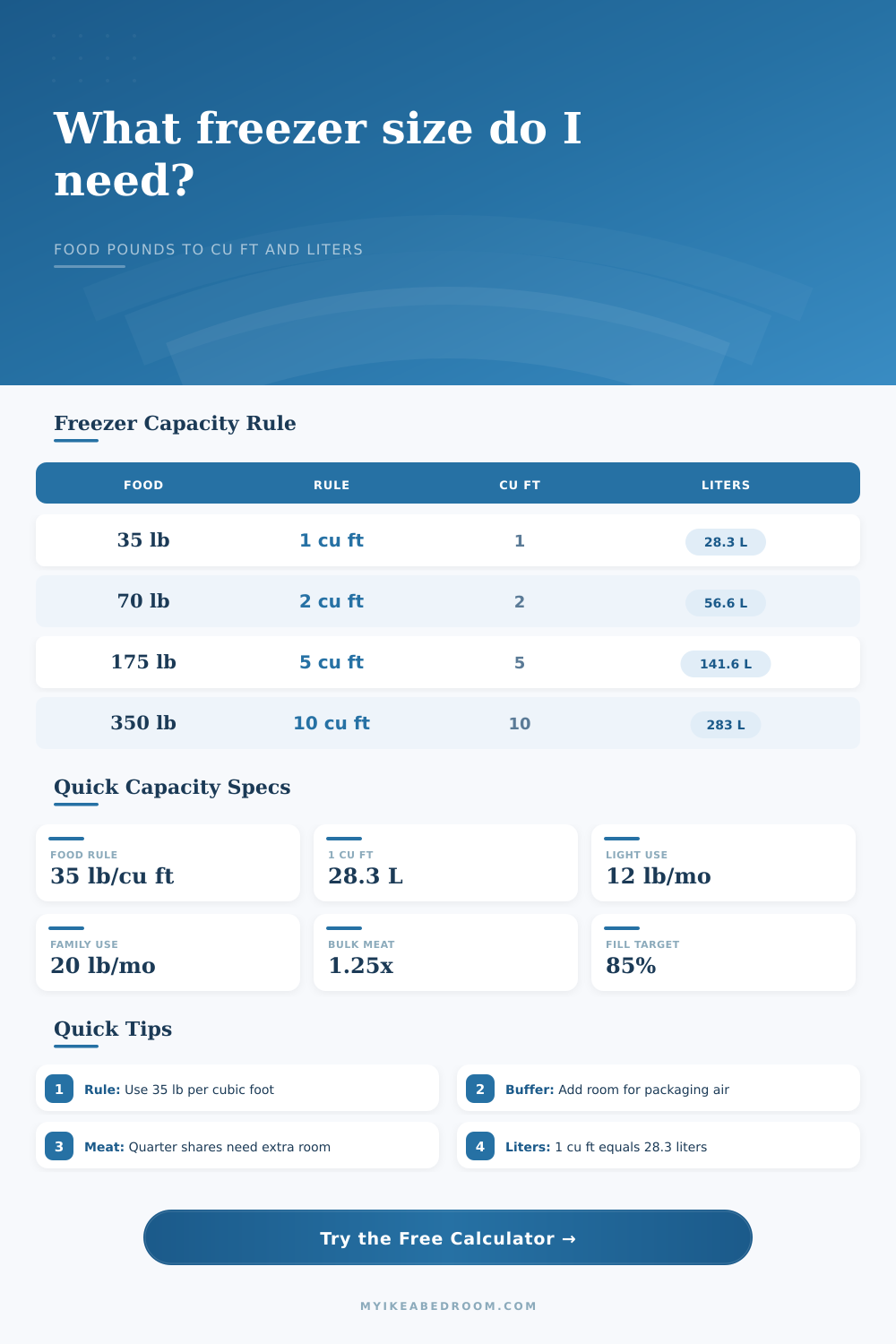
| 35 lb food | 1.0 cu ft | 28.3 L | Rule baseline before packaging or fill target. |
| 70 lb food | 2.0 cu ft | 56.6 L | Small overflow amount for one or two people. |
| 140 lb food | 4.0 cu ft | 113.3 L | Compact chest freezer territory after buffers. |
| 210 lb food | 6.0 cu ft | 169.9 L | Useful for bulk groceries and regular meal prep. |
| 350 lb food | 10.0 cu ft | 283.2 L | Often aligns with larger family or meat-share storage. |
| 525 lb food | 15.0 cu ft | 424.8 L | Large storage plan that needs careful rotation. |
| Household example | Monthly frozen food | Storage months | Raw capacity at 35 lb/cu ft |
|---|---|---|---|
| Single light user | 12 lb/month | 2 months | 0.7 cu ft before buffer. |
| Two-person groceries | 32 lb/month | 3 months | 2.7 cu ft before buffer. |
| Three-person meal prep | 60 lb/month | 3 months | 5.1 cu ft before buffer. |
| Family of four | 80 lb/month | 3 months | 6.9 cu ft before buffer. |
| Family plus meat share | 100 lb/month | 4 months | 11.4 cu ft before buffer. |
| Harvest household | 120 lb/month | 5 months | 17.1 cu ft before buffer. |
| Storage pattern | Suggested factor | Why it changes capacity | Calculator field |
|---|---|---|---|
| Mostly ingredients | 1.00x | Flat packs and basic grocery items are easier to stack. | Meal prep factor. |
| Some prepared meals | 1.08x | Containers and mixed shapes create small gaps. | Meal prep factor. |
| Weekly meal prep | 1.18x | Stacked portions use more space per pound. | Meal prep factor. |
| Large meat buys | 1.25x | Irregular cuts, butcher wrap, and boxes reduce packing efficiency. | Bulk meat factor. |
| Half-share storage | 1.45x | Deep storage often needs more reserve and rotation space. | Bulk meat factor. |
| Nominal freezer size | Approx liters | Food at 35 lb/cu ft | Common use |
|---|---|---|---|
| 3 cu ft | 85 L | 105 lb at full rule volume | Apartment overflow or small meal-prep stash. |
| 5 cu ft | 142 L | 175 lb at full rule volume | Two-person bulk groceries or small chest freezer. |
| 7 cu ft | 198 L | 245 lb at full rule volume | Small family storage with moderate reserve. |
| 10 cu ft | 283 L | 350 lb at full rule volume | Family groceries, meal prep, or partial meat share. |
| 15 cu ft | 425 L | 525 lb at full rule volume | Large household, harvest, or serious bulk storage. |
| 20 cu ft | 566 L | 700 lb at full rule volume | Deep storage requiring labels and rotation zones. |
Use the 35 lb rule: Start with 35 lb of frozen food per cubic foot, then add packaging, reserve, and fill-level adjustments.
Separate dense and bulky foods: Ground meat and flat bags pack differently from boxed meals, trays, bread, and loose containers.
Leave rotation space: A freezer packed to the lid is harder to search, organize, and rotate, even when the math says the food fits.
Convert capacity to liters: Multiply cubic feet by 28.3168 to compare metric freezer labels or compact appliance specs.
And we’re not just talking about volume; there’s also your packing and buying strategy as well as leaving room for rotation. And yes, there’s math here but it’s variable and tricky.
Let’s begin with the thirty-five-pound-per-cubic-foot rule. This is industry standard for mixed frozen goods. If you pack it tightly enough one cubic foot will contain about thirty-five pounds. That’s the baseline. For raw ingredient food stored flat in a freezer. Reality doesn’t get along like that very often. Bulk meat boxes, meal prep containers, awkwardly shaped retail bags: they all shrinks the effective capacity. The calculator do this math for you. It accounts for actual fill target and air in packaging so you don’t end up buying a unit that’s dangerously over-filled or too small.
How to Choose the Right Freezer Size
Consider the rhythm of your home. Is it a single-person with a stash of snack box? Or a family stocking up on half a cow? You’ll need a different box.” The calculator allows you to plug in how many months of food you want to stockpile. This is what most estimates lack. We consider ourselves on a shopping trip to the store, so we plan for a few days or weeks. But when you plan for a season, like prepping for a holiday meal or stashing away harvest vegetable… You need extra space. The tool adjust for this by adding a reserve factor.
The buffer is what makes the difference between having a frozen puzzle that falls apart when you remove one bag and having an organized pantry.
Then there’s the meat. When you order a quarter share of beef, it arrives in irregular, thick hunks. They are dense but bulky. They are full of air. This inefficiency calls for a meat factor: a number your calculator use to scale down how much space you’ll need for its bulkiness. Sure, you can cram two hundred pounds of uniformly frozen peas into your freezer. But try getting one hundred fifty pounds of roasts and steaks in there. Good luck shutting the door; good luck finding what you want when you get around to using it. That’s the cold, hard truth about packing efficiency. Don’t ignore it and you won’t end up with a technically-full-but-actually-useless freezer.
Even the shape matters. Chest freezers rule in capacity. With an open top they can be stacked deeper. Pop a bag of corn on top, then a turkey underneath it, and you’re good to go. But they’re harder on your back; upright freezers is better organized and easier to reach into, but the shelves waste some air space inside. To account for this, the calculator changes its recommendation to match. Since uprights need more space to hold same amount of usable food, it takes that into account. Want to maximize density instead of ease-of-access? No problem: The tool will adjust up to make room for the wasted space between shelves.
Keep the fill target in mind. It is a nightmare to have your freezer jam-packed at ninety-five percent capacity. No rotating, no circulating air, and the food get freezer burned. Eighty-five percent is plenty of room for all of those things: new purchases, thawing space, the occasional impulse buy. This buffer is built into the final number on the calculator. It doesn’t tell you what size would of make you look good in the showroom; it tells you what size you need.
Last but not least, change to liters if you’re purchasing from overseas. One cubic foot is twenty-eight point three liters. The table on the page makes that clear. So no matter which country the appliance is made in, you’re still comparing apples to apples.
The size of your freezer say more about who you are than it does about the appliance itself. Your freezer is a snapshot of your life. When you get the math right, you get peace of mind. When you get it wrong, you get an expensive storage closet that’s cold but full of mystery. Plug in, find your sweet spot with the tool and then trust your instincts to leave a little room for the unexpected. The extra space is where the real convenince lives.