🔨 Framing Nail Calculator
Estimate total nails and pounds needed for wall, floor, roof, deck, and general framing projects.
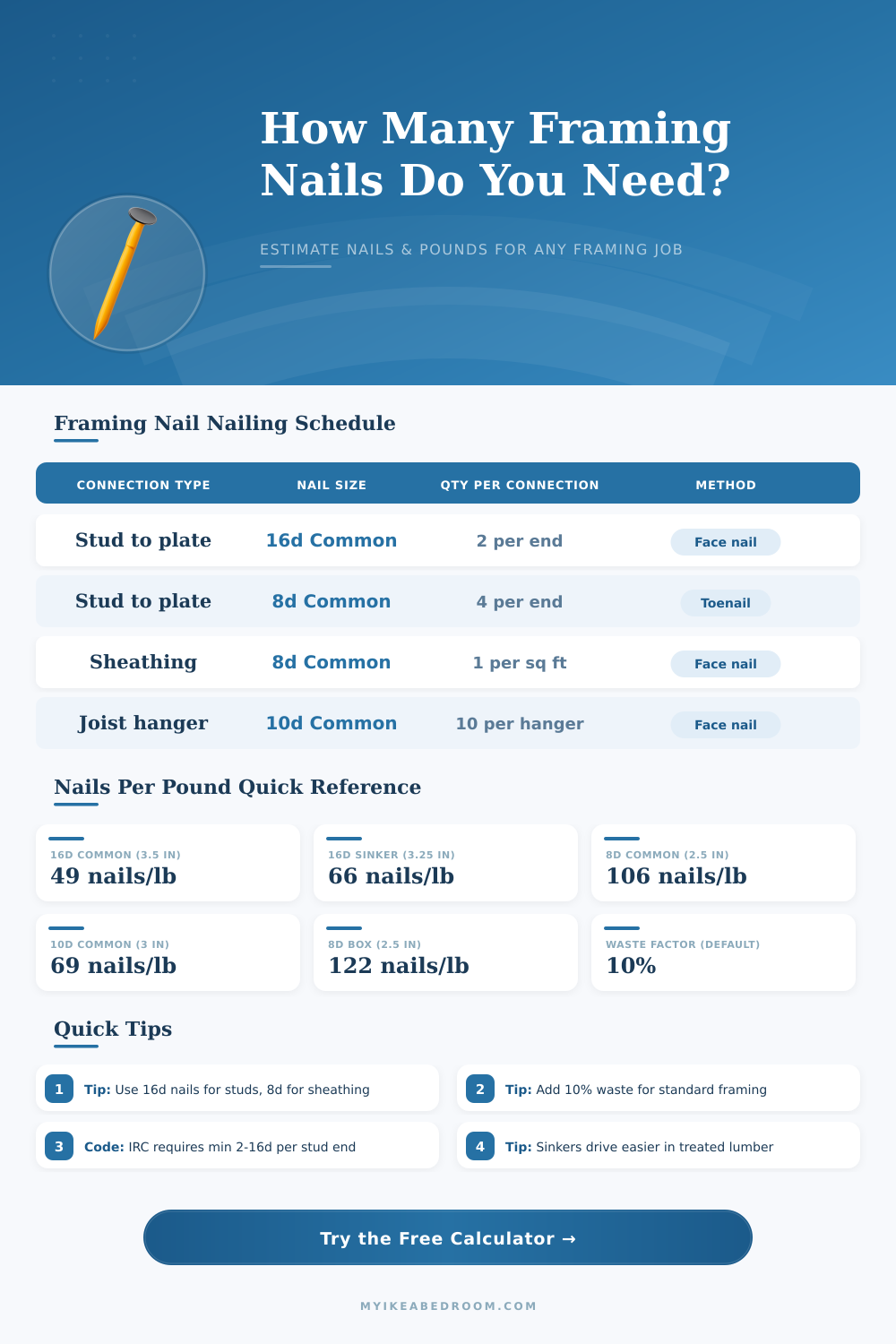
| Connection Type | Nail Size | Qty Per Connection | Method |
|---|---|---|---|
| Stud to top/bottom plate | 16d Common | 2 per end | Face nail |
| Stud to plate (toenail) | 8d Common | 4 per stud end | Toenail |
| Double top plate | 16d Common | 1 per 16 in | Face nail |
| Header to top plate | 16d Common | 3 per end | Face nail |
| Rim board to joist | 16d Common | 2 per joist | Face nail |
| Blocking between joists | 8d Common | 3 per end | Face nail |
| Joist hanger | 10d Common | 10 per hanger | Face nail |
| Wall/roof sheathing | 8d Common | 1 per sq ft | Face nail |
| Rafter to top plate | 16d Common | 2 per end | Toenail |
| Ridge board to rafter | 16d Common | 3 per connection | Face nail |
| Nail Type | Length (in) | Nails Per Lb | Common Uses |
|---|---|---|---|
| 16d Common | 3.5 in | 49 | Structural framing, stud-to-plate |
| 16d Sinker | 3.25 in | 66 | Treated lumber, easier driving |
| 10d Common | 3 in | 69 | Joist hangers, medium framing |
| 8d Common | 2.5 in | 106 | Sheathing, blocking, toenailing |
| 8d Box | 2.5 in | 122 | Light framing, trim, thin stock |
| Framing Element | Nail Size | Spacing / Count | Notes |
|---|---|---|---|
| Studs (16 in OC) | 16d Common | 2 per end x 2 ends | Standard wall framing |
| Studs (24 in OC) | 16d Common | 2 per end x 2 ends | Energy-efficient framing |
| Floor joists (12 in OC) | 16d Common | 2 per joist x 2 ends | Heavy load floors |
| Floor joists (16 in OC) | 16d Common | 2 per joist x 2 ends | Standard floor framing |
| Rafters (16 in OC) | 16d Common | 2 per rafter end | Standard roof pitch |
| Deck joists (16 in OC) | 16d Sinker | 2 per joist x 2 ends | Use galvanized for exterior |
| Sheathing panels | 8d Common | 6 in edge / 12 in field | Panel nailing pattern |
Framing nails are a very important part of any building project. The most common sizes are 16d, 10d and 8d. Nail 12d measure 3 1/4 inches long while 16d are 3 1/2 inches. Both work well for framing work.
You can find framing nails in various grades, lengths, diameters and types of heads or shanks. They are sold in packs of 5,000, which is useful for bigger jobs.
How to Choose and Use Framing Nails
For most framing, 3 1/4 inch nail with full head is the standard. If you use nail gun, that size is most common. You really need only 3 inches, so if you use longer nail at an angle, you must care that it does not proute through the other side.
Be careful when you pin through double 2x-wood about where the peak will end up.
Framing nails usually do not keep the load by themselves. For structural load you use other ways. Nails most commonly serve to keep things in place or back drywall, unless you use shear nails, but that is a whole other theme.
Nails from bright steel are cheap, while galvanized nails offer better resistance against corrosion. Framing nails also can be coated to give additional grip. If you use treated wood, you must choose galvanized nails.
Some prefer them everywhere, using 16d to bind the framing members and 8d with ring shank for the sheathing and subfloor.
For internal framing, it is better to use thicknesses like 10d, 12d or 16d instead of slimmer nails to bind things like joist hangers. Finish nail does not work for framing, because its gauge and length is not strong or long enough to set studs or other structural parts together.
When dealing with guns, check that the nail matches the tool. Use for example Paslode framing nails with Paslode nailer. The RoundDrive nails follow the standards and have a special head for 30 degree nailers.
Some guns accept both 3 1/2 and 3 1/4 inch nails. A gun that can shoot nails with diameter of 0.148 inches is very useful, otherwise you use 0.131 inch nails with an extra nail. Collated strip and coil nails with power tools help to increase the efficiency and pace.
Before use nail gun, look at whether it is set for sequential or bump shooting. You who never used such tool should start with sequential shooting. Always watch where is your other hand.
For little house projects, some prefer to entirely forget the gun and only use drill or screw-driver with right screws.