📐 Framing Angle Calculator
Roof rafters, stair stringers, angled walls & hip rafters — all cuts calculated instantly
Select Calculation Mode
Roof Pitch / Rafter Angle
Stair Stringer Angle
Angled Wall / Miter Angle
Hip / Valley Rafter Angle
Common Roof Pitch Reference
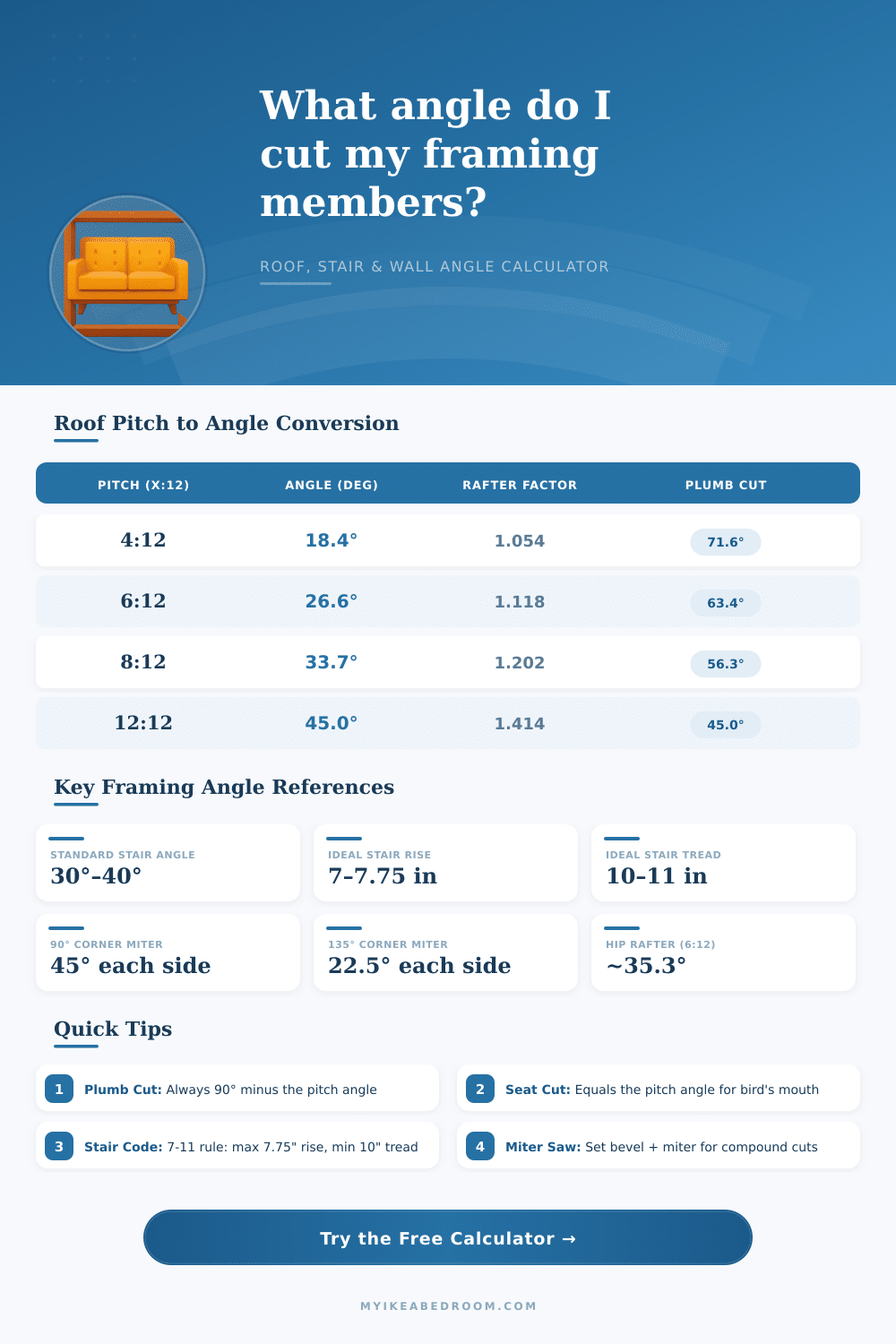
Pitch to Angle Conversion Table
| Pitch (x:12) | Angle (°) | Rafter Length Factor | Plumb Cut (°) | Seat Cut (°) |
|---|---|---|---|---|
| 2:12 | 9.5° | 1.014 | 80.5° | 9.5° |
| 3:12 | 14.0° | 1.031 | 76.0° | 14.0° |
| 4:12 | 18.4° | 1.054 | 71.6° | 18.4° |
| 5:12 | 22.6° | 1.083 | 67.4° | 22.6° |
| 6:12 | 26.6° | 1.118 | 63.4° | 26.6° |
| 7:12 | 30.3° | 1.158 | 59.7° | 30.3° |
| 8:12 | 33.7° | 1.202 | 56.3° | 33.7° |
| 9:12 | 36.9° | 1.250 | 53.1° | 36.9° |
| 10:12 | 39.8° | 1.302 | 50.2° | 39.8° |
| 12:12 | 45.0° | 1.414 | 45.0° | 45.0° |
Common Stair Dimensions Reference
| Riser Height | Tread Depth | Stringer Angle | Code Status |
|---|---|---|---|
| 6.0" | 11.0" | 28.6° | ✅ Ideal (low) |
| 6.5" | 11.0" | 30.5° | ✅ Comfortable |
| 7.0" | 10.5" | 33.7° | ✅ Most common |
| 7.25" | 10.0" | 35.9° | ✅ IRC max / code OK |
| 7.75" | 10.0" | 37.8° | ⚠️ IRC max limit |
| 8.0" | 9.0" | 41.6° | ❌ Above IRC max |
Miter Angle Guide for Wall Corners
| Corner Angle | Miter Cut Each Side | Type | Common Use |
|---|---|---|---|
| 45° | 67.5° | Acute inside | Bay windows, angled rooms |
| 60° | 60.0° | Acute | Hexagonal rooms |
| 90° | 45.0° | Right angle | Standard corners |
| 120° | 30.0° | Obtuse | Octagonal rooms |
| 135° | 22.5° | Obtuse | Angled hallway turns |
| 150° | 15.0° | Wide obtuse | Gentle wall transitions |
Framing angles are L-shaped metal brackets that connect two wooden pieces at 90 degrees. These are useful tools for construction and DIY projects. They not only create stronger joints but also ensure that the corners are straight and permanent.
Like this they help to stop racking what means that walls or frames do not lose their square form
Framing Angles and How to Use Them
A-series angles are connectors of various sizes designed to strengthen 90-degree wooden links in structural works. They work great for general framing construction of terraces and lightweight structures. Those angles give reliable resistance against side forces and lift.
Medium angles are created for standards and to save costs during construction.
One known brand in this field is trusted by builders since 1956. They produce structural connectors, fasteners, anchoring systems and construction products for wood, cold-formed steel and mass timber. The company offers many models of angles in various sizes and thicknesses to finish lightweight jobs or projects where structural tie is necessary.
Some of them can be bent more easily to match the needs of the projcet.
The A35 anchor has a special flexible part that allows fast and precise bends in the field for two and three way ties. That helps against side forces. There is also the model A88 that is a 12-gauge framing angle with 90-degree measures 2-inch length and 8-inch width with a galvanized finish.
It uses 0.148 by 3-inch nail fasteners.
Galvanized framing brackets are available as multi-purpose connections for wooden frames. They work as rafter brackets, joist hangers or boosts for concrete forms. A framing angle or joist clip can be set to the edge of a board during the installation.
Folks commonly ask which bracket to use to bind a 2×4 wall stud to a top or bottom plate in a wall that does not bear weight. For such work, the A34 model would be proper. Another common question is whether you must lay a bracket on every side of the vertical bit or only on one side.
Corner angles are also important. The 1-1/2 inch 10-foot corner is used to connect, strengthen or secure metal framing in various drywall works. The most common uses include lapped framing, soffit frames and installations of floor or ceiling runners.
Walls in 45-degree corners also commonly appear. The bottom and upper plates are simple, whatever is the angle, you only cut it in half. For walls with weird corners, for instance 45 or 30 degrees, that same rule operates.
A framing square can be used to do outer corners for cuts, as for example “birdsmouth” cuts on rafters. That helps to reach perfect level and accuracy in framingwork.