Fountain Pump Flow Rate Calculator
Estimate pump size from basin volume, lift height, tubing friction, spillway width, nozzle demand, loss factors, and pump curve margin.
Choose a starting layout, then adjust the flow details for your basin, tubing, and water feature.
Recommended Pump Size
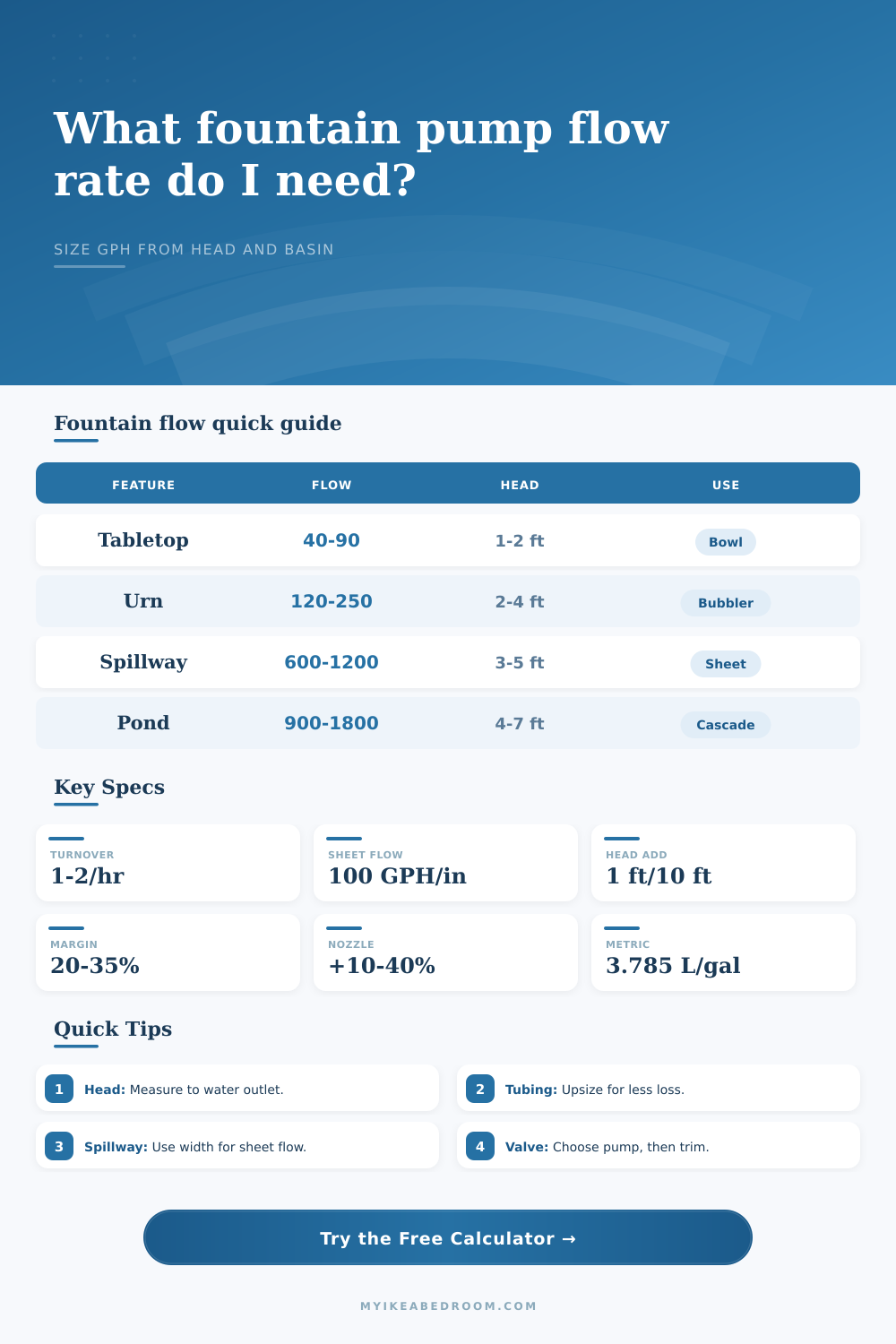
| Feature type | Typical operating flow | Common head range | Sizing note |
|---|---|---|---|
| Tabletop bowl | 40 to 100 GPH | 1 to 2 ft | Keep flow low to avoid splash. |
| Urn bubbler | 120 to 300 GPH | 2 to 4 ft | Nozzle demand often sets the pump size. |
| Wall spout | 250 to 700 GPH | 3 to 6 ft | Account for elbow and valve restriction. |
| Sheet spillway | 75 to 150 GPH per inch | 3 to 7 ft | Width controls the visible water sheet. |
| Pond cascade | 900 to 2400 GPH | 4 to 10 ft | Wide lips need large tubing and margin. |
| Tubing ID | Best flow range | Loss estimate | Best use |
|---|---|---|---|
| 3/8 in | 40 to 120 GPH | High | Small bowls and short lifts. |
| 1/2 in | 80 to 250 GPH | Moderate high | Small patio fountains. |
| 3/4 in | 180 to 650 GPH | Moderate | Medium features and bubblers. |
| 1 in | 400 to 1100 GPH | Low moderate | Spillways and short cascades. |
| 1 1/2 in | 900 to 2500 GPH | Lower | Ponds, waterfalls, and long runs. |
| Spillway look | Rule of thumb | Example width | Flow target |
|---|---|---|---|
| Wet stone trickle | 50 GPH per inch | 12 in | 600 GPH |
| Light sheet | 75 GPH per inch | 18 in | 1350 GPH |
| Solid sheet | 100 GPH per inch | 24 in | 2400 GPH |
| Strong cascade | 150 GPH per inch | 30 in | 4500 GPH |
| Basin volume | 1x turnover | 2x turnover | Metric volume |
|---|---|---|---|
| 25 gal | 25 GPH | 50 GPH | 95 L |
| 75 gal | 75 GPH | 150 GPH | 284 L |
| 150 gal | 150 GPH | 300 GPH | 568 L |
| 400 gal | 400 GPH | 800 GPH | 1514 L |
A new fountain pump can be a letdown. It vibrates, it hums loudly…but there’s no increase in water level. You purchased the right pump; you read the directions…yet the system doesn’t work.
Most likely, the discrepancy lie with the difference between what the pump is rated for and physical load being imposed on it. That difference exists because of head pressure, tubing friction, and nozzle requirements…and none are visible unless they shuts down the flow. The gallons-per-hour rating on the box is what most buyers looks at. It sounds simple enough but it can mislead. A high-rated pump might move only a trickle of water if you try to use it to push liquid uphill through narrow tubing.
How to Choose the Right Fountain Pump
These are calculations that this page’s calculator will make for you. You simply input basin volume and how much lift (height) there is. Don’t bother guessing with coefficients; the tool takes care of all that for you. Next the tool convert your total dynamic head into a sizing recommendation that fits what you want.
So you just give the calculator the vertical distance between water surface and where you’ll have the nozzle. Then tell it how far the tubing runs and how many elbows or other thing create friction. The tool figures out what the flow requirement should of be to prevent the pump from running at its least efficient level.
How much? That depends on the width of the spillway. The amount of water needed per minute is what will hit edge (assuming it’s a stone edge) in a smooth sheet of water. Not enough and you have a broken trickle of water. Too much and it’s a roar drowning out your conversation. As the width changes so does the required flow. This table references the width and the corresponding flow requirements.
So now you can choose between a solid sheet or gentle drip of water. You’re not moving water but controlling its sound and look. Shape the look of fountain.
The diameter of the tubing also make a difference. Running a bunch of small tubing makes for lots of resistance. Pushing water through a thin tube take more energy from the pump than pushing it through a large tube. Making the tubing larger often increases flow better then getting a more moddern, powerful pump. It is a small detail, but it matters.
Most installers neglect that as you add height (head), pumps becomes less efficient. As head height rises, pumps loses power. Sizing the pump to the precise amount you calculate may not be enough in reality. Adding some cushion (20-35%) will assure consistent operation. This cushion can accommodates changes in water level and clogged filters.
The ultimate test is how noisy it is. An undersize pump will run at full capacity and make a high-pitched whine sound. An oversize pump throttled back will create excessive turbulence and cause premature wear. Ideally, the pump will be running in its middle range where it operate best.
Water should rise just enough to remove the spray but not more than that. If set up properly the fountain blends into the background. All you hear is the sound of falling water. You’ll forget the pump exists.