Foot Candles to Lumens Calculator
Convert a target foot-candle level into total fixture lumens using room size, fixture efficiency, light loss factor, reflectance, task type, fixture count, and mounting height.
Choose a starting point for common home and task zones, then adjust the room dimensions, losses, reflectance, and fixture count.
Calculation breakdown
Enter lighting values to calculate a maintained lumen target.
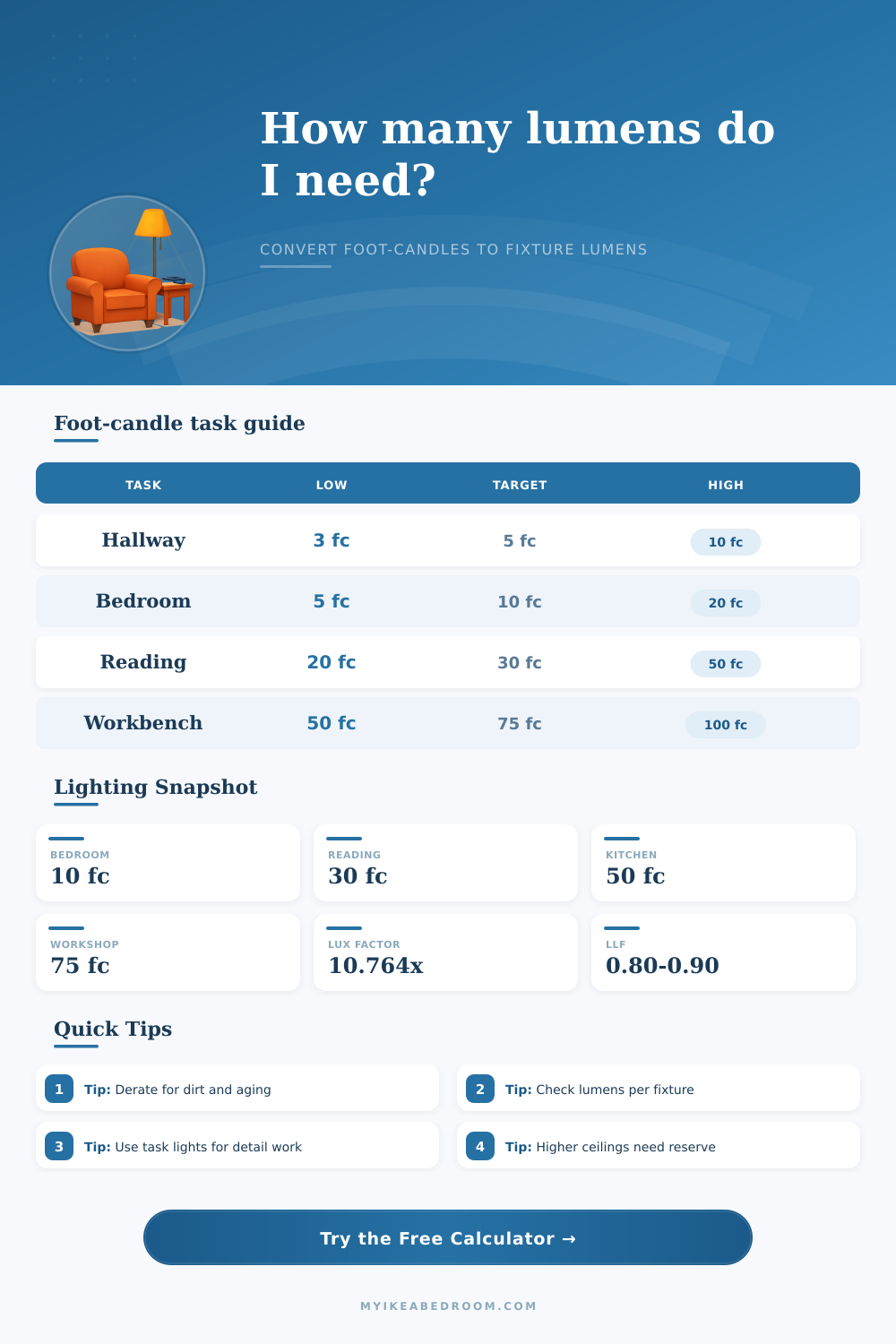
| Room or zone | Low level | Common target | When to raise it |
|---|---|---|---|
| Hallway or circulation | 3 to 5 fc | 5 fc | Use 10 fc for stairs, entries, or visual contrast. |
| Bedroom ambient | 5 to 10 fc | 10 fc | Use 15 to 20 fc when the room has dark finishes. |
| Dining and living room | 10 to 15 fc | 20 fc | Use dimming if the same room also supports reading. |
| Bathroom general light | 20 to 30 fc | 30 fc | Raise vanity zones separately instead of flooding the whole room. |
| Closet and wardrobe | 10 to 15 fc | 15 fc | Use 20 fc for deep shelves or darker clothing storage. |
| Task category | Recommended range | Useful target | Calculator margin meaning |
|---|---|---|---|
| Reading nook | 20 to 50 fc | 30 fc | Margin compares your target to the midpoint of this range. |
| Desk paperwork | 30 to 50 fc | 40 fc | Use a task lamp if ambient lighting falls short. |
| Kitchen counter | 40 to 70 fc | 50 fc | Undercabinet light can carry the work plane without overlighting aisles. |
| Bathroom vanity | 30 to 60 fc | 40 fc | Use balanced side or broad front lighting for faces. |
| Workshop bench | 50 to 100 fc | 75 fc | Reserve matters because tools and hands create shadows. |
| Foot-candles | Lux equivalent | Typical use | Quick lumen rule |
|---|---|---|---|
| 5 fc | 54 lx | Hallways and gentle path lighting | 5 lumens per square foot before adjustments |
| 10 fc | 108 lx | Bedroom ambient and soft general light | 10 lumens per square foot before adjustments |
| 20 fc | 215 lx | Dining, casual living, and general rooms | 20 lumens per square foot before adjustments |
| 50 fc | 538 lx | Kitchen counter and detailed home tasks | 50 lumens per square foot before adjustments |
| 75 fc | 807 lx | Workshop bench and craft tasks | 75 lumens per square foot before adjustments |
| Adjustment | Typical input | Effect on lumens | Use when |
|---|---|---|---|
| Fixture efficiency | 70% to 90% | Lower efficiency raises required fixture lumens. | Shades, lenses, trim, or diffusers absorb output. |
| Light loss factor | 0.75 to 0.90 | Lower LLF raises initial lumens for maintained light. | Dust, lamp aging, and real room maintenance are expected. |
| Reflectance | 0.80 to 1.15 | Darker rooms need more fixture lumens. | Walls, ceilings, or floors absorb a larger share of light. |
| Mounting height reserve | 0% to 12% | Higher fixtures add a modest reserve. | Ceilings or pendants sit high above the work plane. |
| Fixture count | 1 to 48 | Total lumens stay similar; per-fixture lumens change. | Comparing one central fixture to several smaller sources. |
Best for circulation, bedrooms, and low-glare evening light where contrast and comfort matter more than detailed work.
Fits living rooms, dining rooms, laundry spaces, closets, and flexible rooms with moderate visual tasks.
Works for reading, desks, counters, vanity zones, and other areas where the work plane needs reliable light.
Useful for workshop benches, crafts, inspections, and tasks where shadows or low contrast slow the work down.
To effectively plan a lighting layout, you need to understand the relationship between foot-candles and lumens. Foot-candles measures the amount of light that falls on a specific area of a surface. Lumens, on the other hand, measure the total amount of light that a bulb emits.
Since these two variable differ from one another, you have to complete a calculation to convert the foot-candle requirement to a lumen requirement. One foot-candle represent one lumen per square foot. However, rooms do not work like equations.
How to Calculate Lumens from Foot-Candles
Walls will absorb some of the light, light fixture may trap some of that light, and the amount of light that comes from the light fixtures may be less than if the fixtures were clean and free of debris. The first step in calculating lumens is to determine the foot-candle requirement for the activity that will take place in the room. The foot-candle requirement will depend upon the activity that will occur in the room.
For instance, a hallway may only require five foot-candles to light the area for passage, but a reading chair may require thirty foot-candles to light the area for reading fine print. Kitchen countertop may require fifty foot-candles for food preparation activities. If the foot-candle level for the activity is not correctly select, the lighting layout may provide too much or too little light for the designated area.
The next step is to calculate the size of the room in square feet. The size of the room will impact the lighting layout plan because a large room will require more lumens than a small room with the same foot-candle requirement. The foot-candle target will be multiplied by the square footage of the room to calculate the lumen requirement for that area.
The area of the room will impact the lighting plan and the selection of light fixture for that area. Next, it is important to determine the efficiency of the light fixtures that will be installed in the layout plan. The efficiency of a light fixture is the percentage of light that escape the fixture.
The total lumens that a bare bulb produces will be the maximum amount of light that will fall on the area. However, if a shade or diffuser is included on a fixture, that shade will trap some of that light. Fixtures with higher efficiency levels will require less lumens than those with lower efficiency levels.
For this reason, a decorative pendant light fixture will have a higher lumen bulb than a downlight fixture because the pendant will have a lower efficiency. Finally, the light loss factor will be determined. As lamps age, they will naturaly lose some of their lumens.
The same is true of the lenses of the light fixtures; the light will be distributed more effectively if the lenses are free of debris. The light loss factor will decline in situations that are particularly dusty or if the light fixtures is difficult to access and clean. A common light loss factor for residential areas is 0.85 lumens.
This factor indicates that the light fixtures will eventually lose some of their lumens with time, so the light in the area will be less than the amount that the fixtures initially emit. However, the 0.85 factor assumes that the fixtures will be regularly cleaned. A lower light loss factor will be applied to areas that are particularly dusty or where the light fixtures are hard to access for cleaning.
Using a loss factor will force you to purchase additional lumen capacity for the fixtures to ensure that your target foot-candle level is maintained after the lamps have aged. Reflectance is a variable that describes how much light reflect off of the walls and ceilings in a given room. Rooms that have light colored walls and ceilings will reflect the light back into the room, while rooms that have dark walls and ceilings will absorb the light from the fixtures.
Therefore, rooms that have dark finishes will require more lumens than rooms with light finishes because the dark finishes will absorb the light that is emitted from the lamps in the room. Mounting height is a variable that should of been considered because the mounting height of the fixtures will affect how the light spreads into the room. If the fixtures are mounted at a high height above the work plane where the light needs to land, the light will spread lateral across the work plane.
If the mounting height is too high, the fixtures may need to provide more lumens to the room to avoid under-lighting the work plane. The last variable to consider is the fixture count. The fixture count will not change the total lumens that is required for the room.
The fixture count only determines the number of different light sources that will provide that total amount of lumens. For instance, it could use one large light fixture or many different small light fixture, the total light output will be the same. After entering all of the variables into the task lighting calculator, the calculator will provide the total lumens that are required for the room, the lumens per fixture needed to provide that total lumen output, and the lux value for the calculated foot-candles.
Lux is a unit of measurement for light intensity. Lux multiplies the foot-candle target by 10.76. The lux value is provided in case the lighting recommendations for the task are provided in lux instead of foot-candles.
The lumen value can be used to purchase the light fixtures because the light fixtures are often provided in lumens. The reference tables can be used to verify the foot-candle target that was calculated. If the target foot-candles that were calculated are below the range in the table, then the room may be too dim for the specific task that are to be performed in the room.
If the target foot-candles are above the range that is provided in the table, then the room may be too bright or may have too much glare. The task margin indicates how the foot-candle target compare to the tasks in the table. If the task margin is positive, then the lighting will provide a cushion of light for the tasks.
A negative task margin indicates the lighting may not provide enough light for the tasks to be performed. Finally, because no lighting layout will be perfect in a room filled with people and furniture, the lighting calculation is only a starting point for the lighting designer. The calculations should be performed more than once when determining the lighting for a specific task to see how one variable can change the total lumens that is required for the room.
By performing the calculations multiple times, the lighting designer can understand what variables have the most impact on the total lumens required for the room.