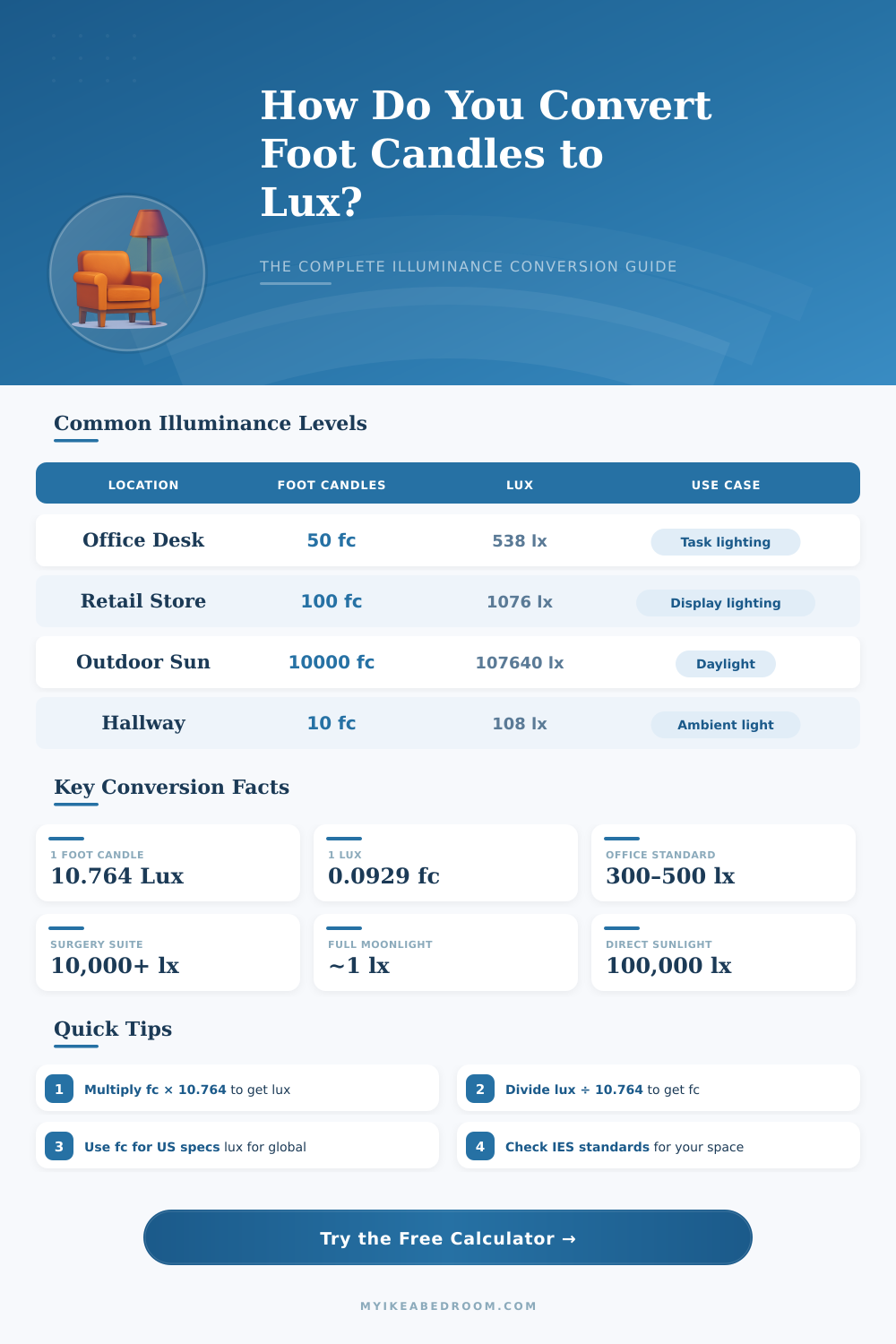
💡 Foot Candle to Lux Calculator
Convert illuminance between foot candles and lux — with multiple values, batch conversions, and reference tables
| Space / Application | Foot Candles (fc) | Lux (lx) | Standard |
|---|---|---|---|
| Storage / Utility Room | 5 – 10 fc | 54 – 108 lx | IES Low |
| Hallway / Corridor | 10 – 20 fc | 108 – 215 lx | IES Residential |
| Living Room (ambient) | 20 – 50 fc | 215 – 538 lx | IES Residential |
| Office General | 30 – 50 fc | 323 – 538 lx | IES Office |
| Reading / Study | 30 – 50 fc | 323 – 538 lx | IES Task |
| Classroom / Library | 30 – 75 fc | 323 – 807 lx | IESNA RP-3 |
| Office Task Lighting | 50 – 100 fc | 538 – 1076 lx | IES Office |
| Retail Display | 50 – 150 fc | 538 – 1614 lx | IES Retail |
| Hospital Patient Room | 30 – 50 fc | 323 – 538 lx | IESNA RP-29 |
| Medical Exam Room | 50 – 200 fc | 538 – 2153 lx | IESNA RP-29 |
| Surgery Suite | 200 – 1000 fc | 2153 – 10764 lx | IESNA RP-29 |
| Outdoor Pathway | 1 – 5 fc | 11 – 54 lx | IES Outdoor |
| Overcast Sky | 100 – 1000 fc | 1076 – 10764 lx | Natural |
| Direct Sunlight | ~10,000 fc | ~107,640 lx | Natural |
| Foot Candles (fc) | Lux (lx) | Lux (rounded) | Typical Use |
|---|---|---|---|
| 1 fc | 10.764 lx | 11 lx | Emergency lighting |
| 5 fc | 53.82 lx | 54 lx | Stairwell |
| 10 fc | 107.64 lx | 108 lx | Corridor |
| 20 fc | 215.28 lx | 215 lx | Living area |
| 30 fc | 322.92 lx | 323 lx | Classroom |
| 50 fc | 538.20 lx | 538 lx | Office desk |
| 75 fc | 807.30 lx | 807 lx | Drafting table |
| 100 fc | 1,076.40 lx | 1,076 lx | Retail display |
| 150 fc | 1,614.60 lx | 1,615 lx | Jewelry display |
| 200 fc | 2,152.80 lx | 2,153 lx | Exam room |
| 500 fc | 5,382.00 lx | 5,382 lx | Sports facility |
| 1,000 fc | 10,764.00 lx | 10,764 lx | Surgery lighting |
| Lux (lx) | Foot Candles (fc) | FC (rounded) | Typical Use |
|---|---|---|---|
| 10 lx | 0.929 fc | 0.93 fc | Moonlit night |
| 50 lx | 4.645 fc | 4.65 fc | Stairwell |
| 100 lx | 9.290 fc | 9.29 fc | Dim corridor |
| 200 lx | 18.58 fc | 18.58 fc | Living space |
| 300 lx | 27.87 fc | 27.87 fc | Reading area |
| 500 lx | 46.45 fc | 46.45 fc | Office (EU) |
| 750 lx | 69.68 fc | 69.68 fc | Drawing office |
| 1,000 lx | 92.90 fc | 92.90 fc | Retail shop |
| 2,000 lx | 185.8 fc | 185.8 fc | TV studio |
| 10,000 lx | 929.0 fc | 929 fc | Overcast sky |
| 100,000 lx | 9,290 fc | 9,290 fc | Direct sunlight |
You may find yourself in a situation where a room is too dim for reading, despite using a bulb with a high lumen count. The lumen count of a bulb describe the amount of light that the bulb emits. However, the amount of light that fall on a surface in a room is called illuminance.
People often confuse the light output of a bulb with the illuminance falling on a surface within the room. The light that bulbs emit is the source light, while the light that falls on a surface is the illuminance. To understand illuminance, one must understand the difference between foot candles and lux.
Why a room can be dim even with bright bulbs
Foot candles and lux is two different units of measurement for illuminance. Foot candles are an imperial unit where one lumen of light falls on one square foot of area. Lux is the metric unit where one lumen of light falls on one square meter of area.
Since a square meter is larger than a square foot, the lux value is always higher than the foot candle value. To convert foot candles into lux, multiply the foot candles by 10.76 to get the illuminance in lux. When using a light meter, the meter reader must decide where to measure the illuminance.
If the meter reader holds the meter at the ceiling, it will measure the light output from the light fixture. However, if the meter reader holds the meter on a kitchen countertop, it will measure the illuminance on the work plane where the work will be performed. Lighting in a room is not for the air in the room or for the empty spaces.
Lighting in a room is for the work plane where the required illuminance falls. Different spaces in a building require different levels of illuminance on the work plane. For instance, hallways require less illuminance than a workshop bench.
The room factor will determine the amount of light that reaches the work plane. As light travels from the fixture, it may hit shades, bounce off the walls, and lose some of it strength as it travels through the room. This loss of light is called beam loss.
For instance, if the light fixture has a frosted lens, it will reduce the amount of light that reaches the work plane. This is an example of beam loss caused by the frosted lens on the light fixture. Additionally, the color of the walls will affect the illuminance falling on the work plane.
If the walls are white, they will reflect most of the light falling on them back into the room, increasing the illuminance on the work plane. If the walls are dark, they will absorb most of the light falling on them, decreasing the illuminance falling on the work plane. If the illuminance falling on the work plane is too low, the room will have a negative margin for illuminance.
Adding more light fixtures to the room or changing the environment of the room can fix the negative margin for illuminance. For example, if the ceiling is dark, painting it to a lighter color will reflect more light into the room. Additionally, if the fixture uses a heavy fabric shade, replacing it with an open lens will reduce the beam loss of the fixture.
A calculator can help determine the number of lumens that is needed for the room or the amount of beam loss that is present in the room. It is also necessary to plan for a design reserve. All light sources will change over time.
For example, LED lights will dim over time after being on for many hour. Additionally, the lenses on the lights will accumulate dust over time. This dust will create a film that will block the light that the bulbs emit.
This blocked light will reduce the illuminance on the work plane. To account for this, designers should plan for a design reserve of ten to fifteen percent. This will allow for the light sources to dim over time while still having enough illuminance on the work plane.
Furthermore, if light dimmers are to be used in the space, plan for a larger design reserve so that there is enough illuminance to see the work plane when the lights are dialed down to a lower level. The goal is to provide the proper amount of illuminance to the work plane for the specific human activity that will be performed in that space. Providing high illuminance for a workshop will not work in a bedroom.
Conversely, providing low illuminance for a bedroom will not work good in a kitchen. If the illuminance falling on the work plane is too high for the activity to be performed in that space, the room is too bright. This might happen if the illuminance of the room is too high for the task that will be performed.
If the illuminance in the room is too dark for the work plane, it is because there is high beam loss or low light reflectance in the room. By measuring the illuminance falling on the work plane and accounting for the room factor, enough light will reach the work plane where it is needed. You may find yourself in a situation where a room is too dim for reading, despite using a bulb with a high lumen count.
The lumen count of a bulb describe the amount of light that the bulb emits. However, the amount of light that fall on a surface in a room is called illuminance. People often confuse the light output of a bulb with the illuminance falling on a surface within the room.
The light that bulbs emit is the source light, while the light that falls on a surface is the illuminance. To understand illuminance, one must understand the difference between foot candles and lux. Foot candles and lux is two different units of measurement for illuminance.
Foot candles are an imperial unit where one lumen of light falls on one square foot of area. Lux is the metric unit where one lumen of light falls on one square meter of area. Since a square meter is larger then a square foot, the lux value is always higher than the foot candle value.
To convert foot candles into lux, multiply the foot candles by 10.76 to get the illuminance in lux. When using a light meter, the meter reader must decide where to measure the illuminance. If the meter reader holds the meter at the ceiling, it will measure the light output from the light fixture.
However, if the meter reader holds the meter on a kitchen countertop, it will measure the illuminance on the work plane where the work will be performed. Lighting in a room is not for the air in the room or for the empty spaces. Lighting in a room is for the work plane where the required illuminance falls.
Different spaces in a building require different levels of illuminance on the work plane. For instance, hallways require less illuminance than a workshop bench. The room factor will determine the amount of light that reaches the work plane.
As light travels from the fixture, it may hit shades, bounce off the walls, and lose some of it strength as it travels through the room. This loss of light is called beam loss. For instance, if the light fixture has a frosted lens, it will reduce the amount of light that reaches the work plane.
This is an example of beam loss caused by the frosted lens on the light fixture. Additionally, the color of the walls will affect the illuminance falling on the work plane. If the walls are white, they will reflect most of the light falling on them back into the room, increasing the illuminance on the work plane.
If the walls are dark, they will absorb most of the light falling on them, decreasing the illuminance falling on the work plane. If the illuminance falling on the work plane is too low, the room will have a negative margin for illuminance. Adding more light fixtures to the room or changing the environment of the room can fix the negative margin for illuminance.
For example, if the ceiling is dark, painting it to a lighter color will reflect more light into the room. Additionally, if the fixture uses a heavy fabric shade, replacing it with an open lens will reduce the beam loss of the fixture. A calculator can help determine the number of lumens that is needed for the room or the amount of beam loss that is present in the room.
It is also necessary to plan for a design reserve. All light sources will change over time. For example, LED lights will dim over time after being on for many hour.
Additionally, the lenses on the lights will accumulate dust over time. This dust will create a film that will block the light that the bulbs emit. This blocked light will reduce the illuminance on the work plane.
To account for this, designers should plan for a design reserve of ten to fifteen percent. This will allow for the light sources to dim over time while still having enough illuminance on the work plane. Furthermore, if light dimmers are to be used in the space, plan for a larger design reserve so that there is enough illuminance to see the work plane when the lights are dialed down to a lower level.
The goal is to provide the proper amount of illuminance to the work plane for the specific human activity that will be performed in that space. Providing high illuminance for a workshop will not work in a bedroom. Conversely, providing low illuminance for a bedroom will not work good in a kitchen.
If the illuminance falling on the work plane is too high for the activity to be performed in that space, the room is too bright. This might happen if the illuminance of the room is too high for the task that will be performed. If the illuminance in the room is too dark for the work plane, it is because there is high beam loss or low light reflectance in the room.
By measuring the illuminance falling on the work plane and accounting for the room factor, enough light will reach the work plane where it is needed. You may find yourself in a situation where a room is too dim for reading, despite using a bulb with a high lumen count. The lumen count of a bulb describe the amount of light that the bulb emits.
However, the amount of light that fall on a surface in a room is called illuminance. People often confuse the light output of a bulb with the illuminance falling on a surface within the room. The light that bulbs emit is the source light, while the light that falls on a surface is the illuminance.
To understand illuminance, one must understand the difference between foot candles and lux. Foot candles and lux is two different units of measurement for illuminance. Foot candles are an imperial unit where one lumen of light falls on one square foot of area.
Lux is the metric unit where one lumen of light falls on one square meter of area. Since a square meter is larger then a square foot, the lux value is always higher than the foot candle value. To convert foot candles into lux, multiply the foot candles by 10.76 to get the illuminance in lux.
When using a light meter, the meter reader must decide where to measure the illuminance. If the meter reader holds the meter at the ceiling, it will measure the light output from the light fixture. However, if the meter reader holds the meter on a kitchen countertop, it will measure the illuminance on the work plane where the work will be performed.
Lighting in a room is not for the air in the room or for the empty spaces. Lighting in a room is for the work plane where the required illuminance falls. Different spaces in a building require different levels of illuminance on the work plane.
For instance, hallways require less illuminance than a workshop bench. The room factor will determine the amount of light that reaches the work plane. As light travels from the fixture, it may hit shades, bounce off the walls, and lose some of it strength as it travels through the room.
This loss of light is called beam loss. For instance, if the light fixture has a frosted lens, it will reduce the amount of light that reaches the work plane. This is an example of beam loss caused by the frosted lens on the light fixture.
Additionally, the color of the walls will affect the illuminance falling on the work plane. If the walls are white, they will reflect most of the light falling on them back into the room, increasing the illuminance on the work plane. If the walls are dark, they will absorb most of the light falling on them, decreasing the illuminance falling on the work plane.
If the illuminance falling on the work plane is too low, the room will have a negative margin for illuminance. Adding more light fixtures to the room or changing the environment of the room can fix the negative margin for illuminance. For example, if the ceiling is dark, painting it to a lighter color will reflect more light into the room.
Additionally, if the fixture uses a heavy fabric shade, replacing it with an open lens will reduce the beam loss of the fixture. A calculator can help determine the number of lumens that is needed for the room or the amount of beam loss that is present in the room. It is also necessary to plan for a design reserve.
All light sources will change over time. For example, LED lights will dim over time after being on for many hour. Additionally, the lenses on the lights will accumulate dust over time.
This dust will create a film that will block the light that the bulbs emit. This blocked light will reduce the illuminance on the work plane. To account for this, designers should plan for a design reserve of ten to fifteen percent.
This will allow for the light sources to dim over time while still having enough illuminance on the work plane. Furthermore, if light dimmers are to be used in the space, plan for a larger design reserve so that there is enough illuminance to see the work plane when the lights are dialed down to a lower level. The goal is to provide the proper amount of illuminance to the work plane for the specific human activity that will be performed in that space.
Providing high illuminance for a workshop will not work in a bedroom. Conversely, providing low illuminance for a bedroom will not work good in a kitchen. If the illuminance falling on the work plane is too high for the activity to be performed in that space, the room is too bright.
This might happen if the illuminance of the room is too high for the task that will be performed. If the illuminance in the room is too dark for the work plane, it is because there is high beam loss or low light reflectance in the room. By measuring the illuminance falling on the work plane and accounting for the room factor, enough light will reach the work plane where it is needed.
You may find yourself in a situation where a room is too dim for reading, despite using a bulb with a high lumen count. The lumen count of a bulb describe the amount of light that the bulb emits. However, the amount of light that fall on a surface in a room is called illuminance.
People often confuse the light output of a bulb with the illuminance falling on a surface within the room. The light that bulbs emit is the source light, while the light that falls on a surface is the illuminance. To understand illuminance, one must understand the difference between foot candles and lux.
Foot candles and lux is two different units of measurement for illuminance. Foot candles are an imperial unit where one lumen of light falls on one square foot of area. Lux is the metric unit where one lumen of light falls on one square meter of area.
Since a square meter is larger then a square foot, the lux value is always higher than the foot candle value. To convert foot candles into lux, multiply the foot candles by 10.76 to get the illuminance in lux. When using a light meter, the meter reader must decide where to measure the illuminance.
If the meter reader holds the meter at the ceiling, it will measure the light output from the light fixture. However, if the meter reader holds the meter on a kitchen countertop, it will measure the illuminance on the work plane where the work will be performed. Lighting in a room is not for the air in the room or for the empty spaces.
Lighting in a room is for the work plane where the required illuminance falls. Different spaces in a building require different levels of illuminance on the work plane. For instance, hallways require less illuminance than a workshop bench.
The room factor will determine the amount of light that reaches the work plane. As light travels from the fixture, it may hit shades, bounce off the walls, and lose some of it strength as it travels through the room. This loss of light is called beam loss.
For instance, if the light fixture has a frosted lens, it will reduce the amount of light that reaches the work plane. This is an example of beam loss caused by the frosted lens on the light fixture. Additionally, the color of the walls will affect the illuminance falling on the work plane.
If the walls are white, they will reflect most of the light falling on them back into the room, increasing the illuminance on the work plane. If the walls are dark, they will absorb most of the light falling on them, decreasing the illuminance falling on the work plane. If the illuminance falling on the work plane is too low, the room will have a negative margin for illuminance.
Adding more light fixtures to the room or changing the environment of the room can fix the negative margin for illuminance. For example, if the ceiling is dark, painting it to a lighter color will reflect more light into the room. Additionally, if the fixture uses a heavy fabric shade, replacing it with an open lens will reduce the beam loss of the fixture.
A calculator can help determine the number of lumens that is needed for the room or the amount of beam loss that is present in the room. It is also necessary to plan for a design reserve. All light sources will change over time.
For example, LED lights will dim over time after being on for many hour. Additionally, the lenses on the lights will accumulate dust over time. This dust will create a film that will block the light that the bulbs emit.
This blocked light will reduce the illuminance on the work plane. To account for this, designers should plan for a design reserve of ten to fifteen percent. This will allow for the light sources to dim over time while still having enough illuminance on the work plane.
Furthermore, if light dimmers are to be used in the space, plan for a larger design reserve so that there is enough illuminance to see the work plane when the lights are dialed down to a lower level. The goal is to provide the proper amount of illuminance to the work plane for the specific human activity that will be performed in that space. Providing high illuminance for a workshop will not work in a bedroom.
Conversely, providing low illuminance for a bedroom will not work good in a kitchen. If the illuminance falling on the work plane is too high for the activity to be performed in that space, the room is too bright. This might happen if the illuminance of the room is too high for the task that will be performed.
If the illuminance in the room is too dark for the work plane, it is because there is high beam loss or low light reflectance in the room. By measuring the illuminance falling on the work plane and accounting for the room factor, enough light will reach the work plane where it is needed. You may find yourself in a situation where a room is too dim for reading, despite using a bulb with a high lumen count.
The lumen count of a bulb describe the amount of light that the bulb emits. However, the amount of light that fall on a surface in a room is called illuminance. People often confuse the light output of a bulb with the illuminance falling on a surface within the room.
The light that bulbs emit is the source light, while the light that falls on a surface is the illuminance. To understand illuminance, one must understand the difference between foot candles and lux. Foot candles and lux is two different units of measurement for illuminance.
Foot candles are an imperial unit where one lumen of light falls on one square foot of area. Lux is the metric unit where one lumen of light falls on one square meter of area. Since a square meter is larger then a square foot, the lux value is always higher than the foot candle value.
To convert foot candles into lux, multiply the foot candles by 10.76 to get the illuminance in lux. When using a light meter, the meter reader must decide where to measure the illuminance. If the meter reader holds the meter at the ceiling, it will measure the light output from the light fixture.
However, if the meter reader holds the meter on a kitchen countertop, it will measure the illuminance on the work plane where the work will be performed. Lighting in a room is not for the air in the room or for the empty spaces. Lighting in a room is for the work plane where the required illuminance falls.
Different spaces in a building require different levels of illuminance on the work plane. For instance, hallways require less illuminance than a workshop bench. The room factor will determine the amount of light that reaches the work plane.
As light travels from the fixture, it may hit shades, bounce off the walls, and lose some of it strength as it travels through the room. This loss of light is called beam loss. For instance, if the light fixture has a frosted lens, it will reduce the amount of light that reaches the work plane.
This is an example of beam loss caused by the frosted lens on the light fixture. Additionally, the color of the walls will affect the illuminance falling on the work plane. If the walls are white, they will reflect most of the light falling on them back into the room, increasing the illuminance on the work plane.
If the walls are dark, they will absorb most of the light falling on them, decreasing the illuminance falling on the work plane. If the illuminance falling on the work plane is too low, the room will have a negative margin for illuminance. Adding more light fixtures to the room or changing the environment of the room can fix the negative margin for illuminance.
For example, if the ceiling is dark, painting it to a lighter color will reflect more light into the room. Additionally, if the fixture uses a heavy fabric shade, replacing it with an open lens will reduce the beam loss of the fixture. A calculator can help determine the number of lumens that is needed for the room or the amount of beam loss that is present in the room.
It is also necessary to plan for a design reserve. All light sources will change over time. For example, LED lights will dim over time after being on for many hour.
Additionally, the lenses on the lights will accumulate dust over time. This dust will create a film that will block the light that the bulbs emit. This blocked light will reduce the illuminance on the work plane.
To account for this, designers should plan for a design reserve of ten to fifteen percent. This will allow for the light sources to dim over time while still having enough illuminance on the work plane. Furthermore, if light dimmers are to be used in the space, plan for a larger design reserve so that there is enough illuminance to see the work plane when the lights are dialed down to a lower level.
The goal is to provide the proper amount of illuminance to the work plane for the specific human activity that will be performed in that space. Providing high illuminance for a workshop will not work in a bedroom. Conversely, providing low illuminance for a bedroom will not work good in a kitchen.
If the illuminance falling on the work plane is too high for the activity to be performed in that space, the room is too bright. This might happen if the illuminance of the room is too high for the task that will be performed. If the illuminance in the room is too dark for the work plane, it is because there is high beam loss or low light reflectance in the room.
By measuring the illuminance falling on the work plane and accounting for the room factor, enough light will reach the work plane where it is needed. You may find yourself in a situation where a room is too dim for reading, despite using a bulb with a high lumen count. The lumen count of a bulb describe the amount of light that the bulb emits.
However, the amount of light that fall on a surface in a room is called illuminance. People often confuse the light output of a bulb with the illuminance falling on a surface within the room. The light that bulbs emit is the source light, while the light that falls on a surface is the illuminance.
To understand illuminance, one must understand the difference between foot candles and lux. Foot candles and lux is two different units of measurement for illuminance. Foot candles are an imperial unit where one lumen of light falls on one square foot of area.
Lux is the metric unit where one lumen of light falls on one square meter of area. Since a square meter is larger then a square foot, the lux value is always higher than the foot candle value. To convert foot candles into lux, multiply the foot candles by 10.76 to get the illuminance in lux.
When using a light meter, the meter reader must decide where to measure the illuminance. If the meter reader holds the meter at the ceiling, it will measure the light output from the light fixture. However, if the meter reader holds the meter on a kitchen countertop, it will measure the illuminance on the work plane where the work will be performed.
Lighting in a room is not for the air in the room or for the empty spaces. Lighting in a room is for the work plane where the required illuminance falls. Different spaces in a building require different levels of illuminance on the work plane.
For instance, hallways require less illuminance than a workshop bench. The room factor will determine the amount of light that reaches the work plane. As light travels from the fixture, it may hit shades, bounce off the walls, and lose some of it strength as it travels through the room.
This loss of light is called beam loss. For instance, if the light fixture has a frosted lens, it will reduce the amount of light that reaches the work plane. This is an example of beam loss caused by the frosted lens on the light fixture.
Additionally, the color of the walls will affect the illuminance falling on the work plane. If the walls are white, they will reflect most of the light falling on them back into the room, increasing the illuminance on the work plane. If the walls are dark, they will absorb most of the light falling on them, decreasing the illuminance falling on the work plane.
If the illuminance falling on the work plane is too low, the room will have a negative margin for illuminance. Adding more light fixtures to the room or changing the environment of the room can fix the negative margin for illuminance. For example, if the ceiling is dark, painting it to a lighter color will reflect more light into the room.
Additionally, if the fixture uses a heavy fabric shade, replacing it with an open lens will reduce the beam loss of the fixture. A calculator can help determine the number of lumens that is needed for the room or the amount of beam loss that is present in the room. It is also necessary to plan for a design reserve.
All light sources will change over time. For example, LED lights will dim over time after being on for many hour. Additionally, the lenses on the lights will accumulate dust over time.
This dust will create a film that will block the light that the bulbs emit. This blocked light will reduce the illuminance on the work plane. To account for this, designers should plan for a design reserve of ten to fifteen percent.
This will allow for the light sources to dim over time while still having enough illuminance on the work plane. Furthermore, if light dimmers are to be used in the space, plan for a larger design reserve so that there is enough illuminance to see the work plane when the lights are dialed down to a lower level. The goal is to provide the proper amount of illuminance to the work plane for the specific human activity that will be performed in that space.
Providing high illuminance for a workshop will not work in a bedroom. Conversely, providing low illuminance for a bedroom will not work good in a kitchen. If the illuminance falling on the work plane is too high for the activity to be performed in that space, the room is too bright.
This might happen if the illuminance of the room is too high for the task that will be performed. If the illuminance in the room is too dark for the work plane, it is because there is high beam loss or low light reflectance in the room. By measuring the illuminance falling on the work plane and accounting for the room factor, enough light will reach the work plane where it is needed.
You may find yourself in a situation where a room is too dim for reading, despite using a bulb with a high lumen count. The lumen count of a bulb describe the amount of light that the bulb emits. However, the amount of light that fall on a surface in a room is called illuminance.
People often confuse the light output of a bulb with the illuminance falling on a surface within the room. The light that bulbs emit is the source light, while the light that falls on a surface is the illuminance. To understand illuminance, one must understand the difference between foot candles and lux.
Foot candles and lux is two different units of measurement for illuminance. Foot candles are an imperial unit where one lumen of light falls on one square foot of area. Lux is the metric unit where one lumen of light falls on one square meter of area.
Since a square meter is larger then a square foot, the lux value is always higher than the foot candle value. To convert foot candles into lux, multiply the foot candles by 10.76 to get the illuminance in lux. When using a light meter, the meter reader must decide where to measure the illuminance.
If the meter reader holds the meter at the ceiling, it will measure the light output from the light fixture. However, if the meter reader holds the meter on a kitchen countertop, it will measure the illuminance on the work plane where the work will be performed. Lighting in a room is not for the air in the room or for the empty spaces.
Lighting in a room is for the work plane where the required illuminance falls. Different spaces in a building require different levels of illuminance on the work plane. For instance, hallways require less illuminance than a workshop bench.
The room factor will determine the amount of light that reaches the work plane. As light travels from the fixture, it may hit shades, bounce off the walls, and lose some of it strength as it travels through the room. This loss of light is called beam loss.
For instance, if the light fixture has a frosted lens, it will reduce the amount of light that reaches the work plane. This is an example of beam loss caused by the frosted lens on the light fixture. Additionally, the color of the walls will affect the illuminance falling on the work plane.
If the walls are white, they will reflect most of the light falling on them back into the room, increasing the illuminance on the work plane. If the walls are dark, they will absorb most of the light falling on them, decreasing the illuminance falling on the work plane. If the illuminance falling on the work plane is too low, the room will have a negative margin for illuminance.
Adding more light fixtures to the room or changing the environment of the room can fix the negative margin for illuminance. For example, if the ceiling is dark, painting it to a lighter color will reflect more light into the room. Additionally, if the fixture uses a heavy fabric shade, replacing it with an open lens will reduce the beam loss of the fixture.
A calculator can help determine the number of lumens that is needed for the room or the amount of beam loss that is present in the room. It is also necessary to plan for a design reserve. All light sources will change over time.
For example, LED lights will dim over time after being on for many hour. Additionally, the lenses on the lights will accumulate dust over time. This dust will create a film that will block the light that the bulbs emit.
This blocked light will reduce the illuminance on the work plane. To account for this, designers should plan for a design reserve of ten to fifteen percent. This will allow for the light sources to dim over time while still having enough illuminance on the work plane.
Furthermore, if light dimmers are to be used in the space, plan for a larger design reserve so that there is enough illuminance to see the work plane when the lights are dialed down to a lower level. The goal is to provide the proper amount of illuminance to the work plane for the specific human activity that will be performed in that space. Providing high illuminance for a workshop will not work in a bedroom.
Conversely, providing low illuminance for a bedroom will not work good in a kitchen. If the illuminance falling on the work plane is too high for the activity to be performed in that space, the room is too bright. This might happen if the illuminance of the room is too high for the task that will be performed.
If the illuminance in the room is too dark for the work plane, it is because there is high beam loss or low light reflectance in the room. By measuring the illuminance falling on the work plane and accounting for the room factor, enough light will reach the work plane where it is needed. You may find yourself in a situation where a room is too dim for reading, despite using a bulb with a high lumen count.
The lumen count of a bulb describe the amount of light that the bulb emits. However, the amount of light that fall on a surface in a room is called illuminance. People often confuse the light output of a bulb with the illuminance falling on a surface within the room.
The light that bulbs emit is the source light, while the light that falls on a surface is the illuminance. To understand illuminance, one must understand the difference between foot candles and lux. Foot candles and lux is two different units of measurement for illuminance.
Foot candles are an imperial unit where one lumen of light falls on one square foot of area. Lux is the metric unit where one lumen of light falls on one square meter of area. Since a square meter is larger then a square foot, the lux value is always higher than the foot candle value.
To convert foot candles into lux, multiply the foot candles by 10.76 to get the illuminance in lux. When using a light meter, the meter reader must decide where to measure the illuminance. If the meter reader holds the meter at the ceiling, it will measure the light output from the light fixture.
However, if the meter reader holds the meter on a kitchen countertop, it will measure the illuminance on the work plane where the work will be performed. Lighting in a room is not for the air in the room or for the empty spaces. Lighting in a room is for the work plane where the required illuminance falls.
Different spaces in a building require different levels of illuminance on the work plane. For instance, hallways require less illuminance than a workshop bench. The room factor will determine the amount of light that reaches the work plane.
As light travels from the fixture, it may hit shades, bounce off the walls, and lose some of it strength as it travels through the room. This loss of light is called beam loss. For instance, if the light fixture has a frosted lens, it will reduce the amount of light that reaches the work plane.
This is an example of beam loss caused by the frosted lens on the light fixture. Additionally, the color of the walls will affect the illuminance falling on the work plane. If the walls are white, they will reflect most of the light falling on them back into the room, increasing the illuminance on the work plane.
If the walls are dark, they will absorb most of the light falling on them, decreasing the illuminance falling on the work plane. If the illuminance falling on the work plane is too low, the room will have a negative margin for illuminance. Adding more light fixtures to the room or changing the environment of the room can fix the negative margin for illuminance.
For example, if the ceiling is dark, painting it to a lighter color will reflect more light into the room. Additionally, if the fixture uses a heavy fabric shade, replacing it with an open lens will reduce the beam loss of the fixture. A calculator can help determine the number of lumens that is needed for the room or the amount of beam loss that is present in the room.
It is also necessary to plan for a design reserve. All light sources will change over time. For example, LED lights will dim over time after being on for many hour.
Additionally, the lenses on the lights will accumulate dust over time. This dust will create a film that will block the light that the bulbs emit. This blocked light will reduce the illuminance on the work plane.
To account for this, designers should plan for a design reserve of ten to fifteen percent. This will allow for the light sources to dim over time while still having enough illuminance on the work plane. Furthermore, if light dimmers are to be used in the space, plan for a larger design reserve so that there is enough illuminance to see the work plane when the lights are dialed down to a lower level.
The goal is to provide the proper amount of illuminance to the work plane for the specific human activity that will be performed in that space. Providing high illuminance for a workshop will not work in a bedroom. Conversely, providing low illuminance for a bedroom will not work good in a kitchen.
If the illuminance falling on the work plane is too high for the activity to be performed in that space, the room is too bright. This might happen if the illuminance of the room is too high for the task that will be performed. If the illuminance in the room is too dark for the work plane, it is because there is high beam loss or low light reflectance in the room.
By measuring the illuminance falling on the work plane and accounting for the room factor, enough light will reach the work plane where it is needed. You may find yourself in a situation where a room is too dim for reading, despite using a bulb with a high lumen count. The lumen count of a bulb describe the amount of light that the bulb emits.
However, the amount of light that fall on a surface in a room is called illuminance. People often confuse the light output of a bulb with the illuminance falling on a surface within the room. The light that bulbs emit is the source light, while the light that falls on a surface is the illuminance.
To understand illuminance, one must understand the difference between foot candles and lux. Foot candles and lux is two different units of measurement for illuminance. Foot candles are an imperial unit where one lumen of light falls on one square foot of area.
Lux is the metric unit where one lumen of light falls on one square meter of area. Since a square meter is larger then a square foot, the lux value is always higher than the foot candle value. To convert foot candles into lux, multiply the foot candles by 10.76 to get the illuminance in lux.
When using a light meter, the meter reader must decide where to measure the illuminance. If the meter reader holds the meter at the ceiling, it will measure the light output from the light fixture. However, if the meter reader holds the meter on a kitchen countertop, it will measure the illuminance on the work plane where the work will be performed.
Lighting in a room is not for the air in the room or for the empty spaces. Lighting in a room is for the work plane where the required illuminance falls. Different spaces in a building require different levels of illuminance on the work plane.
For instance, hallways require less illuminance than a workshop bench. The room factor will determine the amount of light that reaches the work plane. As light travels from the fixture, it may hit shades, bounce off the walls, and lose some of it strength as it travels through the room.
This loss of light is called beam loss. For instance, if the light fixture has a frosted lens, it will reduce the amount of light that reaches the work plane. This is an example of beam loss caused by the frosted lens on the light fixture.
Additionally, the color of the walls will affect the illuminance falling on the work plane. If the walls are white, they will reflect most of the light falling on them back into the room, increasing the illuminance on the work plane. If the walls are dark, they will absorb most of the light falling on them, decreasing the illuminance falling on the work plane.
If the illuminance falling on the work plane is too low, the room will have a negative margin for illuminance. Adding more light fixtures to the room or changing the environment of the room can fix the negative margin for illuminance. For example, if the ceiling is dark, painting it to a lighter color will reflect more light into the room.
Additionally, if the fixture uses a heavy fabric shade, replacing it with an open lens will reduce the beam loss of the fixture. A calculator can help determine the number of lumens that is needed for the room or the amount of beam loss that is present in the room. It is also necessary to plan for a design reserve.
All light sources will change over time. For example, LED lights will dim over time after being on for many hour. Additionally, the lenses on the lights will accumulate dust over time.
This dust will create a film that will block the light that the bulbs emit. This blocked light will reduce the illuminance on the work plane. To account for this, designers should plan for a design reserve of ten to fifteen percent.
This will allow for the light sources to dim over time while still having enough illuminance on the work plane. Furthermore, if light dimmers are to be used in the space, plan for a larger design reserve so that there is enough illuminance to see the work plane when the lights are dialed down to a lower level. The goal is to provide the proper amount of illuminance to the work plane for the specific human activity that will be performed in that space.
Providing high illuminance for a workshop will not work in a bedroom. Conversely, providing low illuminance for a bedroom will not work good in a kitchen. If the illuminance falling on the work plane is too high for the activity to be performed in that space, the room is too bright.
This might happen if the illuminance of the room is too high for the task that will be performed. If the illuminance in the room is too dark for the work plane, it is because there is high beam loss or low light reflectance in the room. By measuring the illuminance falling on the work plane and accounting for the room factor, enough light will reach the work plane where it is needed.
You may find yourself in a situation where a room is too dim for reading, despite using a bulb with a high lumen count. The lumen count of a bulb describe the amount of light that the bulb emits. However, the amount of light that fall on a surface in a room is called illuminance.
People often confuse the light output of a bulb with the illuminance falling on a surface within the room. The light that bulbs emit is the source light, while the light that falls on a surface is the illuminance. To understand illuminance, one must understand the difference between foot candles and lux.
Foot candles and lux is two different units of measurement for illuminance. Foot candles are an imperial unit where one lumen of light falls on one square foot of area. Lux is the metric unit where one lumen of light falls on one square meter of area.
Since a square meter is larger then a square foot, the lux value is always higher than the foot candle value. To convert foot candles into lux, multiply the foot candles by 10.76 to get the illuminance in lux. When using a light meter, the meter reader must decide where to measure the illuminance.
If the meter reader holds the meter at the ceiling, it will measure the light output from the light fixture. However, if the meter reader holds the meter on a kitchen countertop, it will measure the illuminance on the work plane where the work will be performed. Lighting in a room is not for the air in the room or for the empty spaces.
Lighting in a room is for the work plane where the required illuminance falls. Different spaces in a building require different levels of illuminance on the work plane. For instance, hallways require less illuminance than a workshop bench.
The room factor will determine the amount of light that reaches the work plane. As light travels from the fixture, it may hit shades, bounce off the walls, and lose some of it strength as it travels through the room. This loss of light is called beam loss.
For instance, if the light fixture has a frosted lens, it will reduce the amount of light that reaches the work plane. This is an example of beam loss caused by the frosted lens on the light fixture. Additionally, the color of the walls will affect the illuminance falling on the work plane.
If the walls are white, they will reflect most of the light falling on them back into the room, increasing the illuminance on the work plane. If the walls are dark, they will absorb most of the light falling on them, decreasing the illuminance falling on the work plane. If the illuminance falling on the work plane is too low, the room will have a negative margin for illuminance.
Adding more light fixtures to the room or changing the environment of the room can fix the negative margin for illuminance. For example, if the ceiling is dark, painting it to a lighter color will reflect more light into the room. Additionally, if the fixture uses a heavy fabric shade, replacing it with an open lens will reduce the beam loss of the fixture.
A calculator can help determine the number of lumens that is needed for the room or the amount of beam loss that is present in the room. It is also necessary to plan for a design reserve. All light sources will change over time.
For example, LED lights will dim over time after being on for many hour. Additionally, the lenses on the lights will accumulate dust over time. This dust will create a film that will block the light that the bulbs emit.
This blocked light will reduce the illuminance on the work plane. To account for this, designers should plan for a design reserve of ten to fifteen percent. This will allow for the light sources to dim over time while still having enough illuminance on the work plane.
Furthermore, if light dimmers are to be used in the space, plan for a larger design reserve so that there is enough illuminance to see the work plane when the lights are dialed down to a lower level. The goal is to provide the proper amount of illuminance to the work plane for the specific human activity that will be performed in that space. Providing high illuminance for a workshop will not work in a bedroom.
Conversely, providing low illuminance for a bedroom will not work good in a kitchen. If the illuminance falling on the work plane is too high for the activity to be performed in that space, the room is too bright. This might happen if the illuminance of the room is too high for the task that will be performed.
If the illuminance in the room is too dark for the work plane, it is because there is high beam loss or low light reflectance in the room. By measuring the illuminance falling on the work plane and accounting for the room factor, enough light will reach the work plane where it is needed. You may find yourself in a situation where a room is too dim for reading, despite using a bulb with a high lumen count.
The lumen count of a bulb describe the amount of light that the bulb emits. However, the amount of light that fall on a surface in a room is called illuminance. People often confuse the light output of a bulb with the illuminance falling on a surface within the room.
The light that bulbs emit is the source light, while the light that falls on a surface is the illuminance. To understand illuminance, one must understand the difference between foot candles and lux. Foot candles and lux is two different units of measurement for illuminance.
Foot candles are an imperial unit where one lumen of light falls on one square foot of area. Lux is the metric unit where one lumen of light falls on one square meter of area. Since a square meter is larger then a square foot, the lux value is always higher than the foot candle value.
To convert foot candles into lux, multiply the foot candles by 10.76 to get the illuminance in lux. When using a light meter, the meter reader must decide where to measure the illuminance. If the meter reader holds the meter at the ceiling, it will measure the light output from the light fixture.
However, if the meter reader holds the meter on a kitchen countertop, it will measure the illuminance on the work plane where the work will be performed. Lighting in a room is not for the air in the room or for the empty spaces. Lighting in a room is for the work plane where the required illuminance falls.
Different spaces in a building require different levels of illuminance on the work plane. For instance, hallways require less illuminance than a workshop bench. The room factor will determine the amount of light that reaches the work plane.
As light travels from the fixture, it may hit shades, bounce off the walls, and lose some of it strength as it travels through the room. This loss of light is called beam loss. For instance, if the light fixture has a frosted lens, it will reduce the amount of light that reaches the work plane.
This is an example of beam loss caused by the frosted lens on the light fixture. Additionally, the color of the walls will affect the illuminance falling on the work plane. If the walls are white, they will reflect most of the light falling on them back into the room, increasing the illuminance on the work plane.
If the walls are dark, they will absorb most of the light falling on them, decreasing the illuminance falling on the work plane. If the illuminance falling on the work plane is too low, the room will have a negative margin for illuminance. Adding more light fixtures to the room or changing the environment of the room can fix the negative margin for illuminance.
For example, if the ceiling is dark, painting it to a lighter color will reflect more light into the room. Additionally, if the fixture uses a heavy fabric shade, replacing it with an open lens will reduce the beam loss of the fixture. A calculator can help determine the number of lumens that is needed for the room or the amount of beam loss that is present in the room.
It is also necessary to plan for a design reserve. All light sources will change over time. For example, LED lights will dim over time after being on for many hour.
Additionally, the lenses on the lights will accumulate dust over time. This dust will create a film that will block the light that the bulbs emit. This blocked light will reduce the illuminance on the work plane.
To account for this, designers should plan for a design reserve of ten to fifteen percent. This will allow for the light sources to dim over time while still having enough illuminance on the work plane. Furthermore, if light dimmers are to be used in the space, plan for a larger design reserve so that there is enough illuminance to see the work plane when the lights are dialed down to a lower level.
The goal is to provide the proper amount of illuminance to the work plane for the specific human activity that will be performed in that space. Providing high illuminance for a workshop will not work in a bedroom. Conversely, providing low illuminance for a bedroom will not work good in a kitchen.
If the illuminance falling on the work plane is too high for the activity to be performed in that space, the room is too bright. This might happen if the illuminance of the room is too high for the task that will be performed. If the illuminance in the room is too dark for the work plane, it is because there is high beam loss or low light reflectance in the room.
By measuring the illuminance falling on the work plane and accounting for the room factor, enough light will reach the work plane where it is needed. You may find yourself in a situation where a room is too dim for reading, despite using a bulb with a high lumen count. The lumen count of a bulb describe the amount of light that the bulb emits.
However, the amount of light that fall on a surface in a room is called illuminance. People often confuse the light output of a bulb with the illuminance falling on a surface within the room. The light that bulbs emit is the source light, while the light that falls on a surface is the illuminance.
To understand illuminance, one must understand the difference between foot candles and lux. Foot candles and lux is two different units of measurement for illuminance. Foot candles are an imperial unit where one lumen of light falls on one square foot of area.
Lux is the metric unit where one lumen of light falls on one square meter of area. Since a square meter is larger then a square foot, the lux value is always higher than the foot candle value. To convert foot candles into lux, multiply the foot candles by 10.76 to get the illuminance in lux.
When using a light meter, the meter reader must decide where to measure the illuminance. If the meter reader holds the meter at the ceiling, it will measure the light output from the light fixture. However, if the meter reader holds the meter on a kitchen countertop, it will measure the illuminance on the work plane where the work will be performed.
Lighting in a room is not for the air in the room or for the empty spaces. Lighting in a room is for the work plane where the required illuminance falls. Different spaces in a building require different levels of illuminance on the work plane.
For instance, hallways require less illuminance than a workshop bench. The room factor will determine the amount of light that reaches the work plane. As light travels from the fixture, it may hit shades, bounce off the walls, and lose some of it strength as it travels through the room.
This loss of light is called beam loss. For instance, if the light fixture has a frosted lens, it will reduce the amount of light that reaches the work plane. This is an example of beam loss caused by the frosted lens on the light fixture.
Additionally, the color of the walls will affect the illuminance falling on the work plane. If the walls are white, they will reflect most of the light falling on them back into the room, increasing the illuminance on the work plane. If the walls are dark, they will absorb most of the light falling on them, decreasing the illuminance falling on the work plane.
If the illuminance falling on the work plane is too low, the room will have a negative margin for illuminance. Adding more light fixtures to the room or changing the environment of the room can fix the negative margin for illuminance. For example, if the ceiling is dark, painting it to a lighter color will reflect more light into the room.
Additionally, if the fixture uses a heavy fabric shade, replacing it with an open lens will reduce the beam loss of the fixture. A calculator can help determine the number of lumens that is needed for the room or the amount of beam loss that is present in the room. It is also necessary to plan for a design reserve.
All light sources will change over time. For example, LED lights will dim over time after being on for many hour. Additionally, the lenses on the lights will accumulate dust over time.
This dust will create a film that will block the light that the bulbs emit. This blocked light will reduce the illuminance on the work plane. To account for this, designers should plan for a design reserve of ten to fifteen percent.
This will allow for the light sources to dim over time while still having enough illuminance on the work plane. Furthermore, if light dimmers are to be used in the space, plan for a larger design reserve so that there is enough illuminance to see the work plane when the lights are dialed down to a lower level. The goal is to provide the proper amount of illuminance to the work plane for the specific human activity that will be performed in that space.
Providing high illuminance for a workshop will not work in a bedroom. Conversely, providing low illuminance for a bedroom will not work good in a kitchen. If the illuminance falling on the work plane is too high for the activity to be performed in that space, the room is too bright.
This might happen if the illuminance of the room is too high for the task that will be performed. If the illuminance in the room is too dark for the work plane, it is because there is high beam loss or low light reflectance in the room. By measuring the illuminance falling on the work plane and accounting for the room factor, enough light will reach the work plane where it is needed.
You may find yourself in a situation where a room is too dim for reading, despite using a bulb with a high lumen count. The lumen count of a bulb describe the amount of light that the bulb emits. However, the amount of light that fall on a surface in a room is called illuminance.
People often confuse the light output of a bulb with the illuminance falling on a surface within the room. The light that bulbs emit is the source light, while the light that falls on a surface is the illuminance. To understand illuminance, one must understand the difference between foot candles and lux.
Foot candles and lux is two different units of measurement for illuminance. Foot candles are an imperial unit where one lumen of light falls on one square foot of area. Lux is the metric unit where one lumen of light falls on one square meter of area.
Since a square meter is larger then a square foot, the lux value is always higher than the foot candle value. To convert foot candles into lux, multiply the foot candles by 10.76 to get the illuminance in lux. When using a light meter, the meter reader must decide where to measure the illuminance.
If the meter reader holds the meter at the ceiling, it will measure the light output from the light fixture. However, if the meter reader holds the meter on a kitchen countertop, it will measure the illuminance on the work plane where the work will be performed. Lighting in a room is not for the air in the room or for the empty spaces.
Lighting in a room is for the work plane where the required illuminance falls. Different spaces in a building require different levels of illuminance on the work plane. For instance, hallways require less illuminance than a workshop bench.
The room factor will determine the amount of light that reaches the work plane. As light travels from the fixture, it may hit shades, bounce off the walls, and lose some of it strength as it travels through the room. This loss of light is called beam loss.
For instance, if the light fixture has a frosted lens, it will reduce the amount of light that reaches the work plane. This is an example of beam loss caused by the frosted lens on the light fixture. Additionally, the color of the walls will affect the illuminance falling on the work plane.
If the walls are white, they will reflect most of the light falling on them back into the room, increasing the illuminance on the work plane. If the walls are dark, they will absorb most of the light falling on them, decreasing the illuminance falling on the work plane. If the illuminance falling on the work plane is too low, the room will have a negative margin for illuminance.
Adding more light fixtures to the room or changing the environment of the room can fix the negative margin for illuminance. For example, if the ceiling is dark, painting it to a lighter color will reflect more light into the room. Additionally, if the fixture uses a heavy fabric shade, replacing it with an open lens will reduce the beam loss of the fixture.
A calculator can help determine the number of lumens that is needed for the room or the amount of beam loss that is present in the room. It is also necessary to plan for a design reserve. All light sources will change over time.
For example, LED lights will dim over time after being on for many hour. Additionally, the lenses on the lights will accumulate dust over time. This dust will create a film that will block the light that the bulbs emit.
This blocked light will reduce the illuminance on the work plane. To account for this, designers should plan for a design reserve of ten to fifteen percent. This will allow for the light sources to dim over time while still having enough illuminance on the work plane.
Furthermore, if light dimmers are to be used in the space, plan for a larger design reserve so that there is enough illuminance to see the work plane when the lights are dialed down to a lower level. The goal is to provide the proper amount of illuminance to the work plane for the specific human activity that will be performed in that space. Providing high illuminance for a workshop will not work in a bedroom.
Conversely, providing low illuminance for a bedroom will not work good in a kitchen. If the illuminance falling on the work plane is too high for the activity to be performed in that space, the room is too bright. This might happen if the illuminance of the room is too high for the task that will be performed.
If the illuminance in the room is too dark for the work plane, it is because there is high beam loss or low light reflectance in the room. By measuring the illuminance falling on the work plane and accounting for the room factor, enough light will reach the work plane where it is needed. You may find yourself in a situation where a room is too dim for reading, despite using a bulb with a high lumen count.
The lumen count of a bulb describe the amount of light that the bulb emits. However, the amount of light that fall on a surface in a room is called illuminance. People often confuse the light output of a bulb with the illuminance falling on a surface within the room.
The light that bulbs emit is the source light, while the light that falls on a surface is the illuminance. To understand illuminance, one must understand the difference between foot candles and lux. Foot candles and lux is two different units of measurement for illuminance.
Foot candles are an imperial unit where one lumen of light falls on one square foot of area. Lux is the metric unit where one lumen of light falls on one square meter of area. Since a square meter is larger then a square foot, the lux value is always higher than the foot candle value.
To convert foot candles into lux, multiply the foot candles by 10.76 to get the illuminance in lux. When using a light meter, the meter reader must decide where to measure the illuminance. If the meter reader holds the meter at the ceiling, it will measure the light output from the light fixture.
However, if the meter reader holds the meter on a kitchen countertop, it will measure the illuminance on the work plane where the work will be performed. Lighting in a room is not for the air in the room or for the empty spaces. Lighting in a room is for the work plane where the required illuminance falls.
Different spaces in a building require different levels of illuminance on the work plane. For instance, hallways require less illuminance than a workshop bench. The room factor will determine the amount of light that reaches the work plane.
As light travels from the fixture, it may hit shades, bounce off the walls, and lose some of it strength as it travels through the room. This loss of light is called beam loss. For instance, if the light fixture has a frosted lens, it will reduce the amount of light that reaches the work plane.
This is an example of beam loss caused by the frosted lens on the light fixture. Additionally, the color of the walls will affect the illuminance falling on the work plane. If the walls are white, they will reflect most of the light falling on them back into the room, increasing the illuminance on the work plane.
If the walls are dark, they will absorb most of the light falling on them, decreasing the illuminance falling on the work plane. If the illuminance falling on the work plane is too low, the room will have a negative margin for illuminance. Adding more light fixtures to the room or changing the environment of the room can fix the negative margin for illuminance.
For example, if the ceiling is dark, painting it to a lighter color will reflect more light into the room. Additionally, if the fixture uses a heavy fabric shade, replacing it with an open lens will reduce the beam loss of the fixture. A calculator can help determine the number of lumens that is needed for the room or the amount of beam loss that is present in the room.
It is also necessary to plan for a design reserve. All light sources will change over time. For example, LED lights will dim over time after being on for many hour.
Additionally, the lenses on the lights will accumulate dust over time. This dust will create a film that will block the light that the bulbs emit. This blocked light will reduce the illuminance on the work plane.
To account for this, designers should plan for a design reserve of ten to fifteen percent. This will allow for the light sources to dim over time while still having enough illuminance on the work plane. Furthermore, if light dimmers are to be used in the space, plan for a larger design reserve so that there is enough illuminance to see the work plane when the lights are dialed down to a lower level.
The goal is to provide the proper amount of illuminance to the work plane for the specific human activity that will be performed in that space. Providing high illuminance for a workshop will not work in a bedroom. Conversely, providing low illuminance for a bedroom will not work good in a kitchen.
If the illuminance falling on the work plane is too high for the activity to be performed in that space, the room is too bright. This might happen if the illuminance of the room is too high for the task that will be performed. If the illuminance in the room is too dark for the work plane, it is because there is high beam loss or low light reflectance in the room.
By measuring the illuminance falling on the work plane and accounting for the room factor, enough light will reach the work plane where it is needed. You may find yourself in a situation where a room is too dim for reading, despite using a bulb with a high lumen count. The lumen count of a bulb describe the amount of light that the bulb emits.
However, the amount of light that fall on a surface in a room is called illuminance. People often confuse the light output of a bulb with the illuminance falling on a surface within the room. The light that bulbs emit is the source light, while the light that falls on a surface is the illuminance.
To understand illuminance, one must understand the difference between foot candles and lux. Foot candles and lux is two different units of measurement for illuminance. Foot candles are an imperial unit where one lumen of light falls on one square foot of area.
Lux is the metric unit where one lumen of light falls on one square meter of area. Since a square meter is larger then a square foot, the lux value is always higher than the foot candle value. To convert foot candles into lux, multiply the foot candles by 10.76 to get the illuminance in lux.
When using a light meter, the meter reader must decide where to measure the illuminance. If the meter reader holds the meter at the ceiling, it will measure the light output from the light fixture. However, if the meter reader holds the meter on a kitchen countertop, it will measure the illuminance on the work plane where the work will be performed.
Lighting in a room is not for the air in the room or for the empty spaces. Lighting in a room is for the work plane where the required illuminance falls. Different spaces in a building require different levels of illuminance on the work plane.
For instance, hallways require less illuminance than a workshop bench. The room factor will determine the amount of light that reaches the work plane. As light travels from the fixture, it may hit shades, bounce off the walls, and lose some of it strength as it travels through the room.
This loss of light is called beam loss. For instance, if the light fixture has a frosted lens, it will reduce the amount of light that reaches the work plane. This is an example of beam loss caused by the frosted lens on the light fixture.
Additionally, the color of the walls will affect the illuminance falling on the work plane. If the walls are white, they will reflect most of the light falling on them back into the room, increasing the illuminance on the work plane. If the walls are dark, they will absorb most of the light falling on them, decreasing the illuminance falling on the work plane.
If the illuminance falling on the work plane is too low, the room will have a negative margin for illuminance. Adding more light fixtures to the room or changing the environment of the room can fix the negative margin for illuminance. For example, if the ceiling is dark, painting it to a lighter color will reflect more light into the room.
Additionally, if the fixture uses a heavy fabric shade, replacing it with an open lens will reduce the beam loss of the fixture. A calculator can help determine the number of lumens that is needed for the room or the amount of beam loss that is present in the room. It is also necessary to plan for a design reserve.
All light sources will change over time. For example, LED lights will dim over time after being on for many hour. Additionally, the lenses on the lights will accumulate dust over time.
This dust will create a film that will block the light that the bulbs emit. This blocked light will reduce the illuminance on the work plane. To account for this, designers should plan for a design reserve of ten to fifteen percent.
This will allow for the light sources to dim over time while still having enough illuminance on the work plane. Furthermore, if light dimmers are to be used in the space, plan for a larger design reserve so that there is enough illuminance to see the work plane when the lights are dialed down to a lower level. The goal is to provide the proper amount of illuminance to the work plane for the specific human activity that will be performed in that space.
Providing high illuminance for a workshop will not work in a bedroom. Conversely, providing low illuminance for a bedroom will not work good in a kitchen. If the illuminance falling on the work plane is too high for the activity to be performed in that space, the room is too bright.
This might happen if the illuminance of the room is too high for the task that will be performed. If the illuminance in the room is too dark for the work plane, it is because there is high beam loss or low light reflectance in the room. By measuring the illuminance falling on the work plane and accounting for the room factor, enough light will reach the work plane where it is needed.
You may find yourself in a situation where a room is too dim for reading, despite using a bulb with a high lumen count. The lumen count of a bulb describe the amount of light that the bulb emits. However, the amount of light that fall on a surface in a room is called illuminance.
People often confuse the light output of a bulb with the illuminance falling on a surface within the room. The light that bulbs emit is the source light, while the light that falls on a surface is the illuminance. To understand illuminance, one must understand the difference between foot candles and lux.
Foot candles and lux is two different units of measurement for illuminance. Foot candles are an imperial unit where one lumen of light falls on one square foot of area. Lux is the metric unit where one lumen of light falls on one square meter of area.
Since a square meter is larger then a square foot, the lux value is always higher than the foot candle value. To convert foot candles into lux, multiply the foot candles by 10.76 to get the illuminance in lux. When using a light meter, the meter reader must decide where to measure the illuminance.
If the meter reader holds the meter at the ceiling, it will measure the light output from the light fixture. However, if the meter reader holds the meter on a kitchen countertop, it will measure the illuminance on the work plane where the work will be performed. Lighting in a room is not for the air in the room or for the empty spaces.
Lighting in a room is for the work plane where the required illuminance falls. Different spaces in a building require different levels of illuminance on the work plane. For instance, hallways require less illuminance than a workshop bench.
The room factor will determine the amount of light that reaches the work plane. As light travels from the fixture, it may hit shades, bounce off the walls, and lose some of it strength as it travels through the room. This loss of light is called beam loss.
For instance, if the light fixture has a frosted lens, it will reduce the amount of light that reaches the work plane. This is an example of beam loss caused by the frosted lens on the light fixture. Additionally, the color of the walls will affect the illuminance falling on the work plane.
If the walls are white, they will reflect most of the light falling on them back into the room, increasing the illuminance on the work plane. If the walls are dark, they will absorb most of the light falling on them, decreasing the illuminance falling on the work plane. If the illuminance falling on the work plane is too low, the room will have a negative margin for illuminance.
Adding more light fixtures to the room or changing the environment of the room can fix the negative margin for illuminance. For example, if the ceiling is dark, painting it to a lighter color will reflect more light into the room. Additionally, if the fixture uses a heavy fabric shade, replacing it with an open lens will reduce the beam loss of the fixture.
A calculator can help determine the number of lumens that is needed for the room or the amount of beam loss that is present in the room. It is also necessary to plan for a design reserve. All light sources will change over time.
For example, LED lights will dim over time after being on for many hour. Additionally, the lenses on the lights will accumulate dust over time. This dust will create a film that will block the light that the bulbs emit.
This blocked light will reduce the illuminance on the work plane. To account for this, designers should plan for a design reserve of ten to fifteen percent. This will allow for the light sources to dim over time while still having enough illuminance on the work plane.
Furthermore, if light dimmers are to be used in the space, plan for a larger design reserve so that there is enough illuminance to see the work plane when the lights are dialed down to a lower level. The goal is to provide the proper amount of illuminance to the work plane for the specific human activity that will be performed in that space. Providing high illuminance for a workshop will not work in a bedroom.
Conversely, providing low illuminance for a bedroom will not work good in a kitchen. If the illuminance falling on the work plane is too high for the activity to be performed in that space, the room is too bright. This might happen if the illuminance of the room is too high for the task that will be performed.
If the illuminance in the room is too dark for the work plane, it is because there is high beam loss or low light reflectance in the room. By measuring the illuminance falling on the work plane and accounting for the room factor, enough light will reach the work plane where it is needed. You may find yourself in a situation where a room is too dim for reading, despite using a bulb with a high lumen count.
The lumen count of a bulb describe the amount of light that the bulb emits. However, the amount of light that fall on a surface in a room is called illuminance. People often confuse the light output of a bulb with the illuminance falling on a surface within the room.
The light that bulbs emit is the source light, while the light that falls on a surface is the illuminance. To understand illuminance, one must understand the difference between foot candles and lux. Foot candles and lux is two different units of measurement for illuminance.
Foot candles are an imperial unit where one lumen of light falls on one square foot of area. Lux is the metric unit where one lumen of light falls on one square meter of area. Since a square meter is larger then a square foot, the lux value is always higher than the foot candle value.
To convert foot candles into lux, multiply the foot candles by 10.76 to get the illuminance in lux. When using a light meter, the meter reader must decide where to measure the illuminance. If the meter reader holds the meter at the ceiling, it will measure the light output from the light fixture.
However, if the meter reader holds the meter on a kitchen countertop, it will measure the illuminance on the work plane where the work will be performed. Lighting in a room is not for the air in the room or for the empty spaces. Lighting in a room is for the work plane where the required illuminance falls.
Different spaces in a building require different levels of illuminance on the work plane. For instance, hallways require less illuminance than a workshop bench. The room factor will determine the amount of light that reaches the work plane.
As light travels from the fixture, it may hit shades, bounce off the walls, and lose some of it strength as it travels through the room. This loss of light is called beam loss. For instance, if the light fixture has a frosted lens, it will reduce the amount of light that reaches the work plane.
This is an example of beam loss caused by the frosted lens on the light fixture. Additionally, the color of the walls will affect the illuminance falling on the work plane. If the walls are white, they will reflect most of the light falling on them back into the room, increasing the illuminance on the work plane.
If the walls are dark, they will absorb most of the light falling on them, decreasing the illuminance falling on the work plane. If the illuminance falling on the work plane is too low, the room will have a negative margin for illuminance. Adding more light fixtures to the room or changing the environment of the room can fix the negative margin for illuminance.
For example, if the ceiling is dark, painting it to a lighter color will reflect more light into the room. Additionally, if the fixture uses a heavy fabric shade, replacing it with an open lens will reduce the beam loss of the fixture. A calculator can help determine the number of lumens that is needed for the room or the amount of beam loss that is present in the room.
It is also necessary to plan for a design reserve. All light sources will change over time. For example, LED lights will dim over time after being on for many hour.
Additionally, the lenses on the lights will accumulate dust over time. This dust will create a film that will block the light that the bulbs emit. This blocked light will reduce the illuminance on the work plane.
To account for this, designers should plan for a design reserve of ten to fifteen percent. This will allow for the light sources to dim over time while still having enough illuminance on the work plane. Furthermore, if light dimmers are to be used in the space, plan for a larger design reserve so that there is enough illuminance to see the work plane when the lights are dialed down to a lower level.
The goal is to provide the proper amount of illuminance to the work plane for the specific human activity that will be performed in that space. Providing high illuminance for a workshop will not work in a bedroom. Conversely, providing low illuminance for a bedroom will not work good in a kitchen.
If the illuminance falling on the work plane is too high for the activity to be performed in that space, the room is too bright. This might happen if the illuminance of the room is too high for the task that will be performed. If the illuminance in the room is too dark for the work plane, it is because there is high beam loss or low light reflectance in the room.
By measuring the illuminance falling on the work plane and accounting for the room factor, enough light will reach the work plane where it is needed. You may find yourself in a situation where a room is too dim for reading, despite using a bulb with a high lumen count. The lumen count of a bulb describe the amount of light that the bulb emits.
However, the amount of light that fall on a surface in a room is called illuminance. People often confuse the light output of a bulb with the illuminance falling on a surface within the room. The light that bulbs emit is the source light, while the light that falls on a surface is the illuminance.
To understand illuminance, one must understand the difference between foot candles and lux. Foot candles and lux is two different units of measurement for illuminance. Foot candles are an imperial unit where one lumen of light falls on one square foot of area.
Lux is the metric unit where one lumen of light falls on one square meter of area. Since a square meter is larger then a square foot, the lux value is always higher than the foot candle value. To convert foot candles into lux, multiply the foot candles by 10.76 to get the illuminance in lux.
When using a light meter, the meter reader must decide where to measure the illuminance. If the meter reader holds the meter at the ceiling, it will measure the light output from the light fixture. However, if the meter reader holds the meter on a kitchen countertop, it will measure the illuminance on the work plane where the work will be performed.
Lighting in a room is not for the air in the room or for the empty spaces. Lighting in a room is for the work plane where the required illuminance falls. Different spaces in a building require different levels of illuminance on the work plane.
For instance, hallways require less illuminance than a workshop bench. The room factor will determine the amount of light that reaches the work plane. As light travels from the fixture, it may hit shades, bounce off the walls, and lose some of it strength as it travels through the room.
This loss of light is called beam loss. For instance, if the light fixture has a frosted lens, it will reduce the amount of light that reaches the work plane. This is an example of beam loss caused by the frosted lens on the light fixture.
Additionally, the color of the walls will affect the illuminance falling on the work plane. If the walls are white, they will reflect most of the light falling on them back into the room, increasing the illuminance on the work plane. If the walls are dark, they will absorb most of the light falling on them, decreasing the illuminance falling on the work plane.
If the illuminance falling on the work plane is too low, the room will have a negative margin for illuminance. Adding more light fixtures to the room or changing the environment of the room can fix the negative margin for illuminance. For example, if the ceiling is dark, painting it to a lighter color will reflect more light into the room.
Additionally, if the fixture uses a heavy fabric shade, replacing it with an open lens will reduce the beam loss of the fixture. A calculator can help determine the number of lumens that is needed for the room or the amount of beam loss that is present in the room. It is also necessary to plan for a design reserve.
All light sources will change over time. For example, LED lights will dim over time after being on for many hour. Additionally, the lenses on the lights will accumulate dust over time.
This dust will create a film that will block the light that the bulbs emit. This blocked light will reduce the illuminance on the work plane. To account for this, designers should plan for a design reserve of ten to fifteen percent.
This will allow for the light sources to dim over time while still having enough illuminance on the work plane. Furthermore, if light dimmers are to be used in the space, plan for a larger design reserve so that there is enough illuminance to see the work plane when the lights are dialed down to a lower level. The goal is to provide the proper amount of illuminance to the work plane for the specific human activity that will be performed in that space.
Providing high illuminance for a workshop will not work in a bedroom. Conversely, providing low illuminance for a bedroom will not work good in a kitchen. If the illuminance falling on the work plane is too high for the activity to be performed in that space, the room is too bright.
This might happen if the illuminance of the room is too high for the task that will be performed. If the illuminance in the room is too dark for the work plane, it is because there is high beam loss or low light reflectance in the room. By measuring the illuminance falling on the work plane and accounting for the room factor, enough light will reach the work plane where it is needed.
You may find yourself in a situation where a room is too dim for reading, despite using a bulb with a high lumen count. The lumen count of a bulb describe the amount of light that the bulb emits. However, the amount of light that fall on a surface in a room is called illuminance.
People often confuse the light output of a bulb with the illuminance falling on a surface within the room. The light that bulbs emit is the source light, while the light that falls on a surface is the illuminance. To understand illuminance, one must understand the difference between foot candles and lux.
Foot candles and lux is two different units of measurement for illuminance. Foot candles are an imperial unit where one lumen of light falls on one square foot of area. Lux is the metric unit where one lumen of light falls on one square meter of area.
Since a square meter is larger then a square foot, the lux value is always higher than the foot candle value. To convert foot candles into lux, multiply the foot candles by 10.76 to get the illuminance in lux. When using a light meter, the meter reader must decide where to measure the illuminance.
If the meter reader holds the meter at the ceiling, it will measure the light output from the light fixture. However, if the meter reader holds the meter on a kitchen countertop, it will measure the illuminance on the work plane where the work will be performed. Lighting in a room is not for the air in the room or for the empty spaces.
Lighting in a room is for the work plane where the required illuminance falls. Different spaces in a building require different levels of illuminance on the work plane. For instance, hallways require less illuminance than a workshop bench.
The room factor will determine the amount of light that reaches the work plane. As light travels from the fixture, it may hit shades, bounce off the walls, and lose some of it strength as it travels through the room. This loss of light is called beam loss.
For instance, if the light fixture has a frosted lens, it will reduce the amount of light that reaches the work plane. This is an example of beam loss caused by the frosted lens on the light fixture. Additionally, the color of the walls will affect the illuminance falling on the work plane.
If the walls are white, they will reflect most of the light falling on them back into the room, increasing the illuminance on the work plane. If the walls are dark, they will absorb most of the light falling on them, decreasing the illuminance falling on the work plane. If the illuminance falling on the work plane is too low, the room will have a negative margin for illuminance.
Adding more light fixtures to the room or changing the environment of the room can fix the negative margin for illuminance. For example, if the ceiling is dark, painting it to a lighter color will reflect more light into the room. Additionally, if the fixture uses a heavy fabric shade, replacing it with an open lens will reduce the beam loss of the fixture.
A calculator can help determine the number of lumens that is needed for the room or the amount of beam loss that is present in the room. It is also necessary to plan for a design reserve. All light sources will change over time.
For example, LED lights will dim over time after being on for many hour. Additionally, the lenses on the lights will accumulate dust over time. This dust will create a film that will block the light that the bulbs emit.
This blocked light will reduce the illuminance on the work plane. To account for this, designers should plan for a design reserve of ten to fifteen percent. This will allow for the light sources to dim over time while still having enough illuminance on the work plane.
Furthermore, if light dimmers are to be used in the space, plan for a larger design reserve so that there is enough illuminance to see the work plane when the lights are dialed down to a lower level. The goal is to provide the proper amount of illuminance to the work plane for the specific human activity that will be performed in that space. Providing high illuminance for a workshop will not work in a bedroom.
Conversely, providing low illuminance for a bedroom will not work good in a kitchen. If the illuminance falling on the work plane is too high for the activity to be performed in that space, the room is too bright. This might happen if the illuminance of the room is too high for the task that will be performed.
If the illuminance in the room is too dark for the work plane, it is because there is high beam loss or low light reflectance in the room. By measuring the illuminance falling on the work plane and accounting for the room factor, enough light will reach the work plane where it is needed. You may find yourself in a situation where a room is too dim for reading, despite using a bulb with a high lumen count.
The lumen count of a bulb describe the amount of light that the bulb emits. However, the amount of light that fall on a surface in a room is called illuminance. People often confuse the light output of a bulb with the illuminance falling on a surface within the room.
The light that bulbs emit is the source light, while the light that falls on a surface is the illuminance. To understand illuminance, one must understand the difference between foot candles and lux. Foot candles and lux is two different units of measurement for illuminance.
Foot candles are an imperial unit where one lumen of light falls on one square foot of area. Lux is the metric unit where one lumen of light falls on one square meter of area. Since a square meter is larger then a square foot, the lux value is always higher than the foot candle value.
To convert foot candles into lux, multiply the foot candles by 10.76 to get the illuminance in lux. When using a light meter, the meter reader must decide where to measure the illuminance. If the meter reader holds the meter at the ceiling, it will measure the light output from the light fixture.
However, if the meter reader holds the meter on a kitchen countertop, it will measure the illuminance on the work plane where the work will be performed. Lighting in a room is not for the air in the room or for the empty spaces. Lighting in a room is for the work plane where the required illuminance falls.
Different spaces in a building require different levels of illuminance on the work plane. For instance, hallways require less illuminance than a workshop bench. The room factor will determine the amount of light that reaches the work plane.
As light travels from the fixture, it may hit shades, bounce off the walls, and lose some of it strength as it travels through the room. This loss of light is called beam loss. For instance, if the light fixture has a frosted lens, it will reduce the amount of light that reaches the work plane.
This is an example of beam loss caused by the frosted lens on the light fixture. Additionally, the color of the walls will affect the illuminance falling on the work plane. If the walls are white, they will reflect most of the light falling on them back into the room, increasing the illuminance on the work plane.
If the walls are dark, they will absorb most of the light falling on them, decreasing the illuminance falling on the work plane. If the illuminance falling on the work plane is too low, the room will have a negative margin for illuminance. Adding more light fixtures to the room or changing the environment of the room can fix the negative margin for illuminance.
For example, if the ceiling is dark, painting it to a lighter color will reflect more light into the room. Additionally, if the fixture uses a heavy fabric shade, replacing it with an open lens will reduce the beam loss of the fixture. A calculator can help determine the number of lumens that is needed for the room or the amount of beam loss that is present in the room.
It is also necessary to plan for a design reserve. All light sources will change over time. For example, LED lights will dim over time after being on for many hour.
Additionally, the lenses on the lights will accumulate dust over time. This dust will create a film that will block the light that the bulbs emit. This blocked light will reduce the illuminance on the work plane.
To account for this, designers should plan for a design reserve of ten to fifteen percent. This will allow for the light sources to dim over time while still having enough illuminance on the work plane. Furthermore, if light dimmers are to be used in the space, plan for a larger design reserve so that there is enough illuminance to see the work plane when the lights are dialed down to a lower level.
The goal is to provide the proper amount of illuminance to the work plane for the specific human activity that will be performed in that space. Providing high illuminance for a workshop will not work in a bedroom. Conversely, providing low illuminance for a bedroom will not work good in a kitchen.
If the illuminance falling on the work plane is too high for the activity to be performed in that space, the room is too bright. This might happen if the illuminance of the room is too high for the task that will be performed. If the illuminance in the room is too dark for the work plane, it is because there is high beam loss or low light reflectance in the room.
By measuring the illuminance falling on the work plane and accounting for the room factor, enough light will reach the work plane where it is needed. You may find yourself in a situation where a room is too dim for reading, despite using a bulb with a high lumen count. The lumen count of a bulb describe the amount of light that the bulb emits.
However, the amount of light that fall on a surface in a room is called illuminance. People often confuse the light output of a bulb with the illuminance falling on a surface within the room. The light that bulbs emit is the source light, while the light that falls on a surface is the illuminance.
To understand illuminance, one must understand the difference between foot candles and lux. Foot candles and lux is two different units of measurement for illuminance. Foot candles are an imperial unit where one lumen of light falls on one square foot of area.
Lux is the metric unit where one lumen of light falls on one square meter of area. Since a square meter is larger then a square foot, the lux value is always higher than the foot candle value. To convert foot candles into lux, multiply the foot candles by 10.76 to get the illuminance in lux.
When using a light meter, the meter reader must decide where to measure the illuminance. If the meter reader holds the meter at the ceiling, it will measure the light output from the light fixture. However, if the meter reader holds the meter on a kitchen countertop, it will measure the illuminance on the work plane where the work will be performed.
Lighting in a room is not for the air in the room or for the empty spaces. Lighting in a room is for the work plane where the required illuminance falls. Different spaces in a building require different levels of illuminance on the work plane.
For instance, hallways require less illuminance than a workshop bench. The room factor will determine the amount of light that reaches the work plane. As light travels from the fixture, it may hit shades, bounce off the walls, and lose some of it strength as it travels through the room.
This loss of light is called beam loss. For instance, if the light fixture has a frosted lens, it will reduce the amount of light that reaches the work plane. This is an example of beam loss caused by the frosted lens on the light fixture.
Additionally, the color of the walls will affect the illuminance falling on the work plane. If the walls are white, they will reflect most of the light falling on them back into the room, increasing the illuminance on the work plane. If the walls are dark, they will absorb most of the light falling on them, decreasing the illuminance falling on the work plane.
If the illuminance falling on the work plane is too low, the room will have a negative margin for illuminance. Adding more light fixtures to the room or changing the environment of the room can fix the negative margin for illuminance. For example, if the ceiling is dark, painting it to a lighter color will reflect more light into the room.
Additionally, if the fixture uses a heavy fabric shade, replacing it with an open lens will reduce the beam loss of the fixture. A calculator can help determine the number of lumens that is needed for the room or the amount of beam loss that is present in the room. It is also necessary to plan for a design reserve.
All light sources will change over time. For example, LED lights will dim over time after being on for many hour. Additionally, the lenses on the lights will accumulate dust over time.
This dust will create a film that will block the light that the bulbs emit. This blocked light will reduce the illuminance on the work plane. To account for this, designers should plan for a design reserve of ten to fifteen percent.
This will allow for the light sources to dim over time while still having enough illuminance on the work plane. Furthermore, if light dimmers are to be used in the space, plan for a larger design reserve so that there is enough illuminance to see the work plane when the lights are dialed down to a lower level. The goal is to provide the proper amount of illuminance to the work plane for the specific human activity that will be performed in that space.
Providing high illuminance for a workshop will not work in a bedroom. Conversely, providing low illuminance for a bedroom will not work good in a kitchen. If the illuminance falling on the work plane is too high for the activity to be performed in that space, the room is too bright.
This might happen if the illuminance of the room is too high for the task that will be performed. If the illuminance in the room is too dark for the work plane, it is because there is high beam loss or low light reflectance in the room. By measuring the illuminance falling on the work plane and accounting for the room factor, enough light will reach the work plane where it is needed.
You may find yourself in a situation where a room is too dim for reading, despite using a bulb with a high lumen count. The lumen count of a bulb describe the amount of light that the bulb emits. However, the amount of light that fall on a surface in a room is called illuminance.
People often confuse the light output of a bulb with the illuminance falling on a surface within the room. The light that bulbs emit is the source light, while the light that falls on a surface is the illuminance. To understand illuminance, one must understand the difference between foot candles and lux.
Foot candles and lux is two different units of measurement for illuminance. Foot candles are an imperial unit where one lumen of light falls on one square foot of area. Lux is the metric unit where one lumen of light falls on one square meter of area.
Since a square meter is larger then a square foot, the lux value is always higher than the foot candle value. To convert foot candles into lux, multiply the foot candles by 10.76 to get the illuminance in lux. When using a light meter, the meter reader must decide where to measure the illuminance.
If the meter reader holds the meter at the ceiling, it will measure the light output from the light fixture. However, if the meter reader holds the meter on a kitchen countertop, it will measure the illuminance on the work plane where the work will be performed. Lighting in a room is not for the air in the room or for the empty spaces.
Lighting in a room is for the work plane where the required illuminance falls. Different spaces in a building require different levels of illuminance on the work plane. For instance, hallways require less illuminance than a workshop bench.
The room factor will determine the amount of light that reaches the work plane. As light travels from the fixture, it may hit shades, bounce off the walls, and lose some of it strength as it travels through the room. This loss of light is called beam loss.
For instance, if the light fixture has a frosted lens, it will reduce the amount of light that reaches the work plane. This is an example of beam loss caused by the frosted lens on the light fixture. Additionally, the color of the walls will affect the illuminance falling on the work plane.
If the walls are white, they will reflect most of the light falling on them back into the room, increasing the illuminance on the work plane. If the walls are dark, they will absorb most of the light falling on them, decreasing the illuminance falling on the work plane. If the illuminance falling on the work plane is too low, the room will have a negative margin for illuminance.
Adding more light fixtures to the room or changing the environment of the room can fix the negative margin for illuminance. For example, if the ceiling is dark, painting it to a lighter color will reflect more light into the room. Additionally, if the fixture uses a heavy fabric shade, replacing it with an open lens will reduce the beam loss of the fixture.
A calculator can help determine the number of lumens that is needed for the room or the amount of beam loss that is present in the room. It is also necessary to plan for a design reserve. All light sources will change over time.
For example, LED lights will dim over time after being on for many hour. Additionally, the lenses on the lights will accumulate dust over time. This dust will create a film that will block the light that the bulbs emit.
This blocked light will reduce the illuminance on the work plane. To account for this, designers should plan for a design reserve of ten to fifteen percent. This will allow for the light sources to dim over time while still having enough illuminance on the work plane.
Furthermore, if light dimmers are to be used in the space, plan for a larger design reserve so that there is enough illuminance to see the work plane when the lights are dialed down to a lower level. The goal is to provide the proper amount of illuminance to the work plane for the specific human activity that will be performed in that space. Providing high illuminance for a workshop will not work in a bedroom.
Conversely, providing low illuminance for a bedroom will not work good in a kitchen. If the illuminance falling on the work plane is too high for the activity to be performed in that space, the room is too bright. This might happen if the illuminance of the room is too high for the task that will be performed.
If the illuminance in the room is too dark for the work plane, it is because there is high beam loss or low light reflectance in the room. By measuring the illuminance falling on the work plane and accounting for the room factor, enough light will reach the work plane where it is needed. You may find yourself in a situation where a room is too dim for reading, despite using a bulb with a high lumen count.
The lumen count of a bulb describe the amount of light that the bulb emits. However, the amount of light that fall on a surface in a room is called illuminance. People often confuse the light output of a bulb with the illuminance falling on a surface within the room.
The light that bulbs emit is the source light, while the light that falls on a surface is the illuminance. To understand illuminance, one must understand the difference between foot candles and lux. Foot candles and lux is two different units of measurement for illuminance.
Foot candles are an imperial unit where one lumen of light falls on one square foot of area. Lux is the metric unit where one lumen of light falls on one square meter of area. Since a square meter is larger then a square foot, the lux value is always higher than the foot candle value.
To convert foot candles into lux, multiply the foot candles by 10.76 to get the illuminance in lux. When using a light meter, the meter reader must decide where to measure the illuminance. If the meter reader holds the meter at the ceiling, it will measure the light output from the light fixture.
However, if the meter reader holds the meter on a kitchen countertop, it will measure the illuminance on the work plane where the work will be performed. Lighting in a room is not for the air in the room or for the empty spaces. Lighting in a room is for the work plane where the required illuminance falls.
Different spaces in a building require different levels of illuminance on the work plane. For instance, hallways require less illuminance than a workshop bench. The room factor will determine the amount of light that reaches the work plane.
As light travels from the fixture, it may hit shades, bounce off the walls, and lose some of it strength as it travels through the room. This loss of light is called beam loss. For instance, if the light fixture has a frosted lens, it will reduce the amount of light that reaches the work plane.
This is an example of beam loss caused by the frosted lens on the light fixture. Additionally, the color of the walls will affect the illuminance falling on the work plane. If the walls are white, they will reflect most of the light falling on them back into the room, increasing the illuminance on the work plane.
If the walls are dark, they will absorb most of the light falling on them, decreasing the illuminance falling on the work plane. If the illuminance falling on the work plane is too low, the room will have a negative margin for illuminance. Adding more light fixtures to the room or changing the environment of the room can fix the negative margin for illuminance.
For example, if the ceiling is dark, painting it to a lighter color will reflect more light into the room. Additionally, if the fixture uses a heavy fabric shade, replacing it with an open lens will reduce the beam loss of the fixture. A calculator can help determine the number of lumens that is needed for the room or the amount of beam loss that is present in the room.
It is also necessary to plan for a design reserve. All light sources will change over time. For example, LED lights will dim over time after being on for many hour.
Additionally, the lenses on the lights will accumulate dust over time. This dust will create a film that will block the light that the bulbs emit. This blocked light will reduce the illuminance on the work plane.
To account for this, designers should plan for a design reserve of ten to fifteen percent. This will allow for the light sources to dim over time while still having enough illuminance on the work plane. Furthermore, if light dimmers are to be used in the space, plan for a larger design reserve so that there is enough illuminance to see the work plane when the lights are dialed down to a lower level.
The goal is to provide the proper amount of illuminance to the work plane for the specific human activity that will be performed in that space. Providing high illuminance for a workshop will not work in a bedroom. Conversely, providing low illuminance for a bedroom will not work good in a kitchen.
If the illuminance falling on the work plane is too high for the activity to be performed in that space, the room is too bright. This might happen if the illuminance of the room is too high for the task that will be performed. If the illuminance in the room is too dark for the work plane, it is because there is high beam loss or low light reflectance in the room.
By measuring the illuminance falling on the work plane and accounting for the room factor, enough light will reach the work plane where it is needed. You may find yourself in a situation where a room is too dim for reading, despite using a bulb with a high lumen count. The lumen count of a bulb describe the amount of light that the bulb emits.
However, the amount of light that fall on a surface in a room is called illuminance. People often confuse the light output of a bulb with the illuminance falling on a surface within the room. The light that bulbs emit is the source light, while the light that falls on a surface is the illuminance.
To understand illuminance, one must understand the difference between foot candles and lux. Foot candles and lux is two different units of measurement for illuminance. Foot candles are an imperial unit where one lumen of light falls on one square foot of area.
Lux is the metric unit where one lumen of light falls on one square meter of area. Since a square meter is larger then a square foot, the lux value is always higher than the foot candle value. To convert foot candles into lux, multiply the foot candles by 10.76 to get the illuminance in lux.
When using a light meter, the meter reader must decide where to measure the illuminance. If the meter reader holds the meter at the ceiling, it will measure the light output from the light fixture. However, if the meter reader holds the meter on a kitchen countertop, it will measure the illuminance on the work plane where the work will be performed.
Lighting in a room is not for the air in the room or for the empty spaces. Lighting in a room is for the work plane where the required illuminance falls. Different spaces in a building require different levels of illuminance on the work plane.
For instance, hallways require less illuminance than a workshop bench. The room factor will determine the amount of light that reaches the work plane. As light travels from the fixture, it may hit shades, bounce off the walls, and lose some of it strength as it travels through the room.
This loss of light is called beam loss. For instance, if the light fixture has a frosted lens, it will reduce the amount of light that reaches the work plane. This is an example of beam loss caused by the frosted lens on the light fixture.
Additionally, the color of the walls will affect the illuminance falling on the work plane. If the walls are white, they will reflect most of the light falling on them back into the room, increasing the illuminance on the work plane. If the walls are dark, they will absorb most of the light falling on them, decreasing the illuminance falling on the work plane.
If the illuminance falling on the work plane is too low, the room will have a negative margin for illuminance. Adding more light fixtures to the room or changing the environment of the room can fix the negative margin for illuminance. For example, if the ceiling is dark, painting it to a lighter color will reflect more light into the room.
Additionally, if the fixture uses a heavy fabric shade, replacing it with an open lens will reduce the beam loss of the fixture. A calculator can help determine the number of lumens that is needed for the room or the amount of beam loss that is present in the room. It is also necessary to plan for a design reserve.
All light sources will change over time. For example, LED lights will dim over time after being on for many hour. Additionally, the lenses on the lights will accumulate dust over time.
This dust will create a film that will block the light that the bulbs emit. This blocked light will reduce the illuminance on the work plane. To account for this, designers should plan for a design reserve of ten to fifteen percent.
This will allow for the light sources to dim over time while still having enough illuminance on the work plane. Furthermore, if light dimmers are to be used in the space, plan for a larger design reserve so that there is enough illuminance to see the work plane when the lights are dialed down to a lower level. The goal is to provide the proper amount of illuminance to the work plane for the specific human activity that will be performed in that space.
Providing high illuminance for a workshop will not work in a bedroom. Conversely, providing low illuminance for a bedroom will not work good in a kitchen. If the illuminance falling on the work plane is too high for the activity to be performed in that space, the room is too bright.
This might happen if the illuminance of the room is too high for the task that will be performed. If the illuminance in the room is too dark for the work plane, it is because there is high beam loss or low light reflectance in the room. By measuring the illuminance falling on the work plane and accounting for the room factor, enough light will reach the work plane where it is needed.
You may find yourself in a situation where a room is too dim for reading, despite using a bulb with a high lumen count. The lumen count of a bulb describe the amount of light that the bulb emits. However, the amount of light that fall on a surface in a room is called illuminance.
People often confuse the light output of a bulb with the illuminance falling on a surface within the room. The light that bulbs emit is the source light, while the light that falls on a surface is the illuminance. To understand illuminance, one must understand the difference between foot candles and lux.
Foot candles and lux is two different units of measurement for illuminance. Foot candles are an imperial unit where one lumen of light falls on one square foot of area. Lux is the metric unit where one lumen of light falls on one square meter of area.
Since a square meter is larger then a square foot, the lux value is always higher than the foot candle value. To convert foot candles into lux, multiply the foot candles by 10.76 to get the illuminance in lux. When using a light meter, the meter reader must decide where to measure the illuminance.
If the meter reader holds the meter at the ceiling, it will measure the light output from the light fixture. However, if the meter reader holds the meter on a kitchen countertop, it will measure the illuminance on the work plane where the work will be performed. Lighting in a room is not for the air in the room or for the empty spaces.
Lighting in a room is for the work plane where the required illuminance falls. Different spaces in a building require different levels of illuminance on the work plane. For instance, hallways require less illuminance than a workshop bench.
The room factor will determine the amount of light that reaches the work plane. As light travels from the fixture, it may hit shades, bounce off the walls, and lose some of it strength as it travels through the room. This loss of light is called beam loss.
For instance, if the light fixture has a frosted lens, it will reduce the amount of light that reaches the work plane. This is an example of beam loss caused by the frosted lens on the light fixture. Additionally, the color of the walls will affect the illuminance falling on the work plane.
If the walls are white, they will reflect most of the light falling on them back into the room, increasing the illuminance on the work plane. If the walls are dark, they will absorb most of the light falling on them, decreasing the illuminance falling on the work plane. If the illuminance falling on the work plane is too low, the room will have a negative margin for illuminance.
Adding more light fixtures to the room or changing the environment of the room can fix the negative margin for illuminance. For example, if the ceiling is dark, painting it to a lighter color will reflect more light into the room. Additionally, if the fixture uses a heavy fabric shade, replacing it with an open lens will reduce the beam loss of the fixture.
A calculator can help determine the number of lumens that is needed for the room or the amount of beam loss that is present in the room. It is also necessary to plan for a design reserve. All light sources will change over time.
For example, LED lights will dim over time after being on for many hour. Additionally, the lenses on the lights will accumulate dust over time. This dust will create a film that will block the light that the bulbs emit.
This blocked light will reduce the illuminance on the work plane. To account for this, designers should plan for a design reserve of ten to fifteen percent. This will allow for the light sources to dim over time while still having enough illuminance on the work plane.
Furthermore, if light dimmers are to be used in the space, plan for a larger design reserve so that there is enough illuminance to see the work plane when the lights are dialed down to a lower level. The goal is to provide the proper amount of illuminance to the work plane for the specific human activity that will be performed in that space. Providing high illuminance for a workshop will not work in a bedroom.
Conversely, providing low illuminance for a bedroom will not work good in a kitchen. If the illuminance falling on the work plane is too high for the activity to be performed in that space, the room is too bright. This might happen if the illuminance of the room is too high for the task that will be performed.
If the illuminance in the room is too dark for the work plane, it is because there is high beam loss or low light reflectance in the room. By measuring the illuminance falling on the work plane and accounting for the room factor, enough light will reach the work plane where it is needed. You may find yourself in a situation where a room is too dim for reading, despite using a bulb with a high lumen count.
The lumen count of a bulb describe the amount of light that the bulb emits. However, the amount of light that fall on a surface in a room is called illuminance. People often confuse the light output of a bulb with the illuminance falling on a surface within the room.
The light that bulbs emit is the source light, while the light that falls on a surface is the illuminance. To understand illuminance, one must understand the difference between foot candles and lux. Foot candles and lux is two different units of measurement for illuminance.
Foot candles are an imperial unit where one lumen of light falls on one square foot of area. Lux is the metric unit where one lumen of light falls on one square meter of area. Since a square meter is larger then a square foot, the lux value is always higher than the foot candle value.
To convert foot candles into lux, multiply the foot candles by 10.76 to get the illuminance in lux. When using a light meter, the meter reader must decide where to measure the illuminance. If the meter reader holds the meter at the ceiling, it will measure the light output from the light fixture.
However, if the meter reader holds the meter on a kitchen countertop, it will measure the illuminance on the work plane where the work will be performed. Lighting in a room is not for the air in the room or for the empty spaces. Lighting in a room is for the work plane where the required illuminance falls.
Different spaces in a building require different levels of illuminance on the work plane. For instance, hallways require less illuminance than a workshop bench. The room factor will determine the amount of light that reaches the work plane.
As light travels from the fixture, it may hit shades, bounce off the walls, and lose some of it strength as it travels through the room. This loss of light is called beam loss. For instance, if the light fixture has a frosted lens, it will reduce the amount of light that reaches the work plane.
This is an example of beam loss caused by the frosted lens on the light fixture. Additionally, the color of the walls will affect the illuminance falling on the work plane. If the walls are white, they will reflect most of the light falling on them back into the room, increasing the illuminance on the work plane.
If the walls are dark, they will absorb most of the light falling on them, decreasing the illuminance falling on the work plane. If the illuminance falling on the work plane is too low, the room will have a negative margin for illuminance. Adding more light fixtures to the room or changing the environment of the room can fix the negative margin for illuminance.
For example, if the ceiling is dark, painting it to a lighter color will reflect more light into the room. Additionally, if the fixture uses a heavy fabric shade, replacing it with an open lens will reduce the beam loss of the fixture. A calculator can help determine the number of lumens that is needed for the room or the amount of beam loss that is present in the room.
It is also necessary to plan for a design reserve. All light sources will change over time. For example, LED lights will dim over time after being on for many hour.
Additionally, the lenses on the lights will accumulate dust over time. This dust will create a film that will block the light that the bulbs emit. This blocked light will reduce the illuminance on the work plane.
To account for this, designers should plan for a design reserve of ten to fifteen percent. This will allow for the light sources to dim over time while still having enough illuminance on the work plane. Furthermore, if light dimmers are to be used in the space, plan for a larger design reserve so that there is enough illuminance to see the work plane when the lights are dialed down to a lower level.
The goal is to provide the proper amount of illuminance to the work plane for the specific human activity that will be performed in that space. Providing high illuminance for a workshop will not work in a bedroom. Conversely, providing low illuminance for a bedroom will not work good in a kitchen.
If the illuminance falling on the work plane is too high for the activity to be performed in that space, the room is too bright. This might happen if the illuminance of the room is too high for the task that will be performed. If the illuminance in the room is too dark for the work plane, it is because there is high beam loss or low light reflectance in the room.
By measuring the illuminance falling on the work plane and accounting for the room factor, enough light will reach the work plane where it is needed. You may find yourself in a situation where a room is too dim for reading, despite using a bulb with a high lumen count. The lumen count of a bulb describe the amount of light that the bulb emits.
However, the amount of light that fall on a surface in a room is called illuminance. People often confuse the light output of a bulb with the illuminance falling on a surface within the room. The light that bulbs emit is the source light, while the light that falls on a surface is the illuminance.
To understand illuminance, one must understand the difference between foot candles and lux. Foot candles and lux is two different units of measurement for illuminance. Foot candles are an imperial unit where one lumen of light falls on one square foot of area.
Lux is the metric unit where one lumen of light falls on one square meter of area. Since a square meter is larger then a square foot, the lux value is always higher than the foot candle value. To convert foot candles into lux, multiply the foot candles by 10.76 to get the illuminance in lux.
When using a light meter, the meter reader must decide where to measure the illuminance. If the meter reader holds the meter at the ceiling, it will measure the light output from the light fixture. However, if the meter reader holds the meter on a kitchen countertop, it will measure the illuminance on the work plane where the work will be performed.
Lighting in a room is not for the air in the room or for the empty spaces. Lighting in a room is for the work plane where the required illuminance falls. Different spaces in a building require different levels of illuminance on the work plane.
For instance, hallways require less illuminance than a workshop bench. The room factor will determine the amount of light that reaches the work plane. As light travels from the fixture, it may hit shades, bounce off the walls, and lose some of it strength as it travels through the room.
This loss of light is called beam loss. For instance, if the light fixture has a frosted lens, it will reduce the amount of light that reaches the work plane. This is an example of beam loss caused by the frosted lens on the light fixture.
Additionally, the color of the walls will affect the illuminance falling on the work plane. If the walls are white, they will reflect most of the light falling on them back into the room, increasing the illuminance on the work plane. If the walls are dark, they will absorb most of the light falling on them, decreasing the illuminance falling on the work plane.
If the illuminance falling on the work plane is too low, the room will have a negative margin for illuminance. Adding more light fixtures to the room or changing the environment of the room can fix the negative margin for illuminance. For example, if the ceiling is dark, painting it to a lighter color will reflect more light into the room.
Additionally, if the fixture uses a heavy fabric shade, replacing it with an open lens will reduce the beam loss of the fixture. A calculator can help determine the number of lumens that is needed for the room or the amount of beam loss that is present in the room. It is also necessary to plan for a design reserve.
All light sources will change over time. For example, LED lights will dim over time after being on for many hour. Additionally, the lenses on the lights will accumulate dust over time.
This dust will create a film that will block the light that the bulbs emit. This blocked light will reduce the illuminance on the work plane. To account for this, designers should plan for a design reserve of ten to fifteen percent.
This will allow for the light sources to dim over time while still having enough illuminance on the work plane. Furthermore, if light dimmers are to be used in the space, plan for a larger design reserve so that there is enough illuminance to see the work plane when the lights are dialed down to a lower level. The goal is to provide the proper amount of illuminance to the work plane for the specific human activity that will be performed in that space.
Providing high illuminance for a workshop will not work in a bedroom. Conversely, providing low illuminance for a bedroom will not work good in a kitchen. If the illuminance falling on the work plane is too high for the activity to be performed in that space, the room is too bright.
This might happen if the illuminance of the room is too high for the task that will be performed. If the illuminance in the room is too dark for the work plane, it is because there is high beam loss or low light reflectance in the room. By measuring the illuminance falling on the work plane and accounting for the room factor, enough light will reach the work plane where it is needed.
You may find yourself in a situation where a room is too dim for reading, despite using a bulb with a high lumen count. The lumen count of a bulb describe the amount of light that the bulb emits. However, the amount of light that fall on a surface in a room is called illuminance.
People often confuse the light output of a bulb with the illuminance falling on a surface within the room. The light that bulbs emit is the source light, while the light that falls on a surface is the illuminance. To understand illuminance, one must understand the difference between foot candles and lux.
Foot candles and lux is two different units of measurement for illuminance. Foot candles are an imperial unit where one lumen of light falls on one square foot of area. Lux is the metric unit where one lumen of light falls on one square meter of area.
Since a square meter is larger then a square foot, the lux value is always higher than the foot candle value. To convert foot candles into lux, multiply the foot candles by 10.76 to get the illuminance in lux. When using a light meter, the meter reader must decide where to measure the illuminance.
If the meter reader holds the meter at the ceiling, it will measure the light output from the light fixture. However, if the meter reader holds the meter on a kitchen countertop, it will measure the illuminance on the work plane where the work will be performed. Lighting in a room is not for the air in the room or for the empty spaces.
Lighting in a room is for the work plane where the required illuminance falls. Different spaces in a building require different levels of illuminance on the work plane. For instance, hallways require less illuminance than a workshop bench.
The room factor will determine the amount of light that reaches the work plane. As light travels from the fixture, it may hit shades, bounce off the walls, and lose some of it strength as it travels through the room. This loss of light is called beam loss.
For instance, if the light fixture has a frosted lens, it will reduce the amount of light that reaches the work plane. This is an example of beam loss caused by the frosted lens on the light fixture. Additionally, the color of the walls will affect the illuminance falling on the work plane.
If the walls are white, they will reflect most of the light falling on them back into the room, increasing the illuminance on the work plane. If the walls are dark, they will absorb most of the light falling on them, decreasing the illuminance falling on the work plane. If the illuminance falling on the work plane is too low, the room will have a negative margin for illuminance.
Adding more light fixtures to the room or changing the environment of the room can fix the negative margin for illuminance. For example, if the ceiling is dark, painting it to a lighter color will reflect more light into the room. Additionally, if the fixture uses a heavy fabric shade, replacing it with an open lens will reduce the beam loss of the fixture.
A calculator can help determine the number of lumens that is needed for the room or the amount of beam loss that is present in the room. It is also necessary to plan for a design reserve. All light sources will change over time.
For example, LED lights will dim over time after being on for many hour. Additionally, the lenses on the lights will accumulate dust over time. This dust will create a film that will block the light that the bulbs emit.
This blocked light will reduce the illuminance on the work plane. To account for this, designers should plan for a design reserve of ten to fifteen percent. This will allow for the light sources to dim over time while still having enough illuminance on the work plane.
Furthermore, if light dimmers are to be used in the space, plan for a larger design reserve so that there is enough illuminance to see the work plane when the lights are dialed down to a lower level. The goal is to provide the proper amount of illuminance to the work plane for the specific human activity that will be performed in that space. Providing high illuminance for a workshop will not work in a bedroom.
Conversely, providing low illuminance for a bedroom will not work good in a kitchen. If the illuminance falling on the work plane is too high for the activity to be performed in that space, the room is too bright. This might happen if the illuminance of the room is too high for the task that will be performed.
If the illuminance in the room is too dark for the work plane, it is because there is high beam loss or low light reflectance in the room. By measuring the illuminance falling on the work plane and accounting for the room factor, enough light will reach the work plane where it is needed. You may find yourself in a situation where a room is too dim for reading, despite using a bulb with a high lumen count.
The lumen count of a bulb describe the amount of light that the bulb emits. However, the amount of light that fall on a surface in a room is called illuminance. People often confuse the light output of a bulb with the illuminance falling on a surface within the room.
The light that bulbs emit is the source light, while the light that falls on a surface is the illuminance. To understand illuminance, one must understand the difference between foot candles and lux. Foot candles and lux is two different units of measurement for illuminance.
Foot candles are an imperial unit where one lumen of light falls on one square foot of area. Lux is the metric unit where one lumen of light falls on one square meter of area. Since a square meter is larger then a square foot, the lux value is always higher than the foot candle value.
To convert foot candles into lux, multiply the foot candles by 10.76 to get the illuminance in lux. When using a light meter, the meter reader must decide where to measure the illuminance. If the meter reader holds the meter at the ceiling, it will measure the light output from the light fixture.
However, if the meter reader holds the meter on a kitchen countertop, it will measure the illuminance on the work plane where the work will be performed. Lighting in a room is not for the air in the room or for the empty spaces. Lighting in a room is for the work plane where the required illuminance falls.
Different spaces in a building require different levels of illuminance on the work plane. For instance, hallways require less illuminance than a workshop bench. The room factor will determine the amount of light that reaches the work plane.
As light travels from the fixture, it may hit shades, bounce off the walls, and lose some of it strength as it travels through the room. This loss of light is called beam loss. For instance, if the light fixture has a frosted lens, it will reduce the amount of light that reaches the work plane.
This is an example of beam loss caused by the frosted lens on the light fixture. Additionally, the color of the walls will affect the illuminance falling on the work plane. If the walls are white, they will reflect most of the light falling on them back into the room, increasing the illuminance on the work plane.
If the walls are dark, they will absorb most of the light falling on them, decreasing the illuminance falling on the work plane. If the illuminance falling on the work plane is too low, the room will have a negative margin for illuminance. Adding more light fixtures to the room or changing the environment of the room can fix the negative margin for illuminance.
For example, if the ceiling is dark, painting it to a lighter color will reflect more light into the room. Additionally, if the fixture uses a heavy fabric shade, replacing it with an open lens will reduce the beam loss of the fixture. A calculator can help determine the number of lumens that is needed for the room or the amount of beam loss that is present in the room.
It is also necessary to plan for a design reserve. All light sources will change over time. For example, LED lights will dim over time after being on for many hour.
Additionally, the lenses on the lights will accumulate dust over time. This dust will create a film that will block the light that the bulbs emit. This blocked light will reduce the illuminance on the work plane.
To account for this, designers should plan for a design reserve of ten to fifteen percent. This will allow for the light sources to dim over time while still having enough illuminance on the work plane. Furthermore, if light dimmers are to be used in the space, plan for a larger design reserve so that there is enough illuminance to see the work plane when the lights are dialed down to a lower level.
The goal is to provide the proper amount of illuminance to the work plane for the specific human activity that will be performed in that space. Providing high illuminance for a workshop will not work in a bedroom. Conversely, providing low illuminance for a bedroom will not work good in a kitchen.
If the illuminance falling on the work plane is too high for the activity to be performed in that space, the room is too bright. This might happen if the illuminance of the room is too high for the task that will be performed. If the illuminance in the room is too dark for the work plane, it is because there is high beam loss or low light reflectance in the room.
By measuring the illuminance falling on the work plane and accounting for the room factor, enough light will reach the work plane where it is needed. You may find yourself in a situation where a room is too dim for reading, despite using a bulb with a high lumen count. The lumen count of a bulb describe the amount of light that the bulb emits.
However, the amount of light that fall on a surface in a room is called illuminance. People often confuse the light output of a bulb with the illuminance falling on a surface within the room. The light that bulbs emit is the source light, while the light that falls on a surface is the illuminance.
To understand illuminance, one must understand the difference between foot candles and lux. Foot candles and lux is two different units of measurement for illuminance. Foot candles are an imperial unit where one lumen of light falls on one square foot of area.
Lux is the metric unit where one lumen of light falls on one square meter of area. Since a square meter is larger then a square foot, the lux value is always higher than the foot candle value. To convert foot candles into lux, multiply the foot candles by 10.76 to get the illuminance in lux.
When using a light meter, the meter reader must decide where to measure the illuminance. If the meter reader holds the meter at the ceiling, it will measure the light output from the light fixture. However, if the meter reader holds the meter on a kitchen countertop, it will measure the illuminance on the work plane where the work will be performed.
Lighting in a room is not for the air in the room or for the empty spaces. Lighting in a room is for the work plane where the required illuminance falls. Different spaces in a building require different levels of illuminance on the work plane.
For instance, hallways require less illuminance than a workshop bench. The room factor will determine the amount of light that reaches the work plane. As light travels from the fixture, it may hit shades, bounce off the walls, and lose some of it strength as it travels through the room.
This loss of light is called beam loss. For instance, if the light fixture has a frosted lens, it will reduce the amount of light that reaches the work plane. This is an example of beam loss caused by the frosted lens on the light fixture.
Additionally, the color of the walls will affect the illuminance falling on the work plane. If the walls are white, they will reflect most of the light falling on them back into the room, increasing the illuminance on the work plane. If the walls are dark, they will absorb most of the light falling on them, decreasing the illuminance falling on the work plane.
If the illuminance falling on the work plane is too low, the room will have a negative margin for illuminance. Adding more light fixtures to the room or changing the environment of the room can fix the negative margin for illuminance. For example, if the ceiling is dark, painting it to a lighter color will reflect more light into the room.
Additionally, if the fixture uses a heavy fabric shade, replacing it with an open lens will reduce the beam loss of the fixture. A calculator can help determine the number of lumens that is needed for the room or the amount of beam loss that is present in the room. It is also necessary to plan for a design reserve.
All light sources will change over time. For example, LED lights will dim over time after being on for many hour. Additionally, the lenses on the lights will accumulate dust over time.
This dust will create a film that will block the light that the bulbs emit. This blocked light will reduce the illuminance on the work plane. To account for this, designers should plan for a design reserve of ten to fifteen percent.
This will allow for the light sources to dim over time while still having enough illuminance on the work plane. Furthermore, if light dimmers are to be used in the space, plan for a larger design reserve so that there is enough illuminance to see the work plane when the lights are dialed down to a lower level. The goal is to provide the proper amount of illuminance to the work plane for the specific human activity that will be performed in that space.
Providing high illuminance for a workshop will not work in a bedroom. Conversely, providing low illuminance for a bedroom will not work good in a kitchen. If the illuminance falling on the work plane is too high for the activity to be performed in that space, the room is too bright.
This might happen if the illuminance of the room is too high for the task that will be performed. If the illuminance in the room is too dark for the work plane, it is because there is high beam loss or low light reflectance in the room. By measuring the illuminance falling on the work plane and accounting for the room factor, enough light will reach the work plane where it is needed.
You may find yourself in a situation where a room is too dim for reading, despite using a bulb with a high lumen count. The lumen count of a bulb describe the amount of light that the bulb emits. However, the amount of light that fall on a surface in a room is called illuminance.
People often confuse the light output of a bulb with the illuminance falling on a surface within the room. The light that bulbs emit is the source light, while the light that falls on a surface is the illuminance. To understand illuminance, one must understand the difference between foot candles and lux.
Foot candles and lux is two different units of measurement for illuminance. Foot candles are an imperial unit where one lumen of light falls on one square foot of area. Lux is the metric unit where one lumen of light falls on one square meter of area.
Since a square meter is larger then a square foot, the lux value is always higher than the foot candle value. To convert foot candles into lux, multiply the foot candles by 10.76 to get the illuminance in lux. When using a light meter, the meter reader must decide where to measure the illuminance.
If the meter reader holds the meter at the ceiling, it will measure the light output from the light fixture. However, if the meter reader holds the meter on a kitchen countertop, it will measure the illuminance on the work plane where the work will be performed. Lighting in a room is not for the air in the room or for the empty spaces.
Lighting in a room is for the work plane where the required illuminance falls. Different spaces in a building require different levels of illuminance on the work plane. For instance, hallways require less illuminance than a workshop bench.
The room factor will determine the amount of light that reaches the work plane. As light travels from the fixture, it may hit shades, bounce off the walls, and lose some of it strength as it travels through the room. This loss of light is called beam loss.
For instance, if the light fixture has a frosted lens, it will reduce the amount of light that reaches the work plane. This is an example of beam loss caused by the frosted lens on the light fixture. Additionally, the color of the walls will affect the illuminance falling on the work plane.
If the walls are white, they will reflect most of the light falling on them back into the room, increasing the illuminance on the work plane. If the walls are dark, they will absorb most of the light falling on them, decreasing the illuminance falling on the work plane. If the illuminance falling on the work plane is too low, the room will have a negative margin for illuminance.
Adding more light fixtures to the room or changing the environment of the room can fix the negative margin for illuminance. For example, if the ceiling is dark, painting it to a lighter color will reflect more light into the room. Additionally, if the fixture uses a heavy fabric shade, replacing it with an open lens will reduce the beam loss of the fixture.
A calculator can help determine the number of lumens that is needed for the room or the amount of beam loss that is present in the room. It is also necessary to plan for a design reserve. All light sources will change over time.
For example, LED lights will dim over time after being on for many hour. Additionally, the lenses on the lights will accumulate dust over time. This dust will create a film that will block the light that the bulbs emit.
This blocked light will reduce the illuminance on the work plane. To account for this, designers should plan for a design reserve of ten to fifteen percent. This will allow for the light sources to dim over time while still having enough illuminance on the work plane.
Furthermore, if light dimmers are to be used in the space, plan for a larger design reserve so that there is enough illuminance to see the work plane when the lights are dialed down to a lower level. The goal is to provide the proper amount of illuminance to the work plane for the specific human activity that will be performed in that space. Providing high illuminance for a workshop will not work in a bedroom.
Conversely, providing low illuminance for a bedroom will not work good in a kitchen. If the illuminance falling on the work plane is too high for the activity to be performed in that space, the room is too bright. This might happen if the illuminance of the room is too high for the task that will be performed.
If the illuminance in the room is too dark for the work plane, it is because there is high beam loss or low light reflectance in the room. By measuring the illuminance falling on the work plane and accounting for the room factor, enough light will reach the work plane where it is needed. You may find yourself in a situation where a room is too dim for reading, despite using a bulb with a high lumen count.
The lumen count of a bulb describe the amount of light that the bulb emits. However, the amount of light that fall on a surface in a room is called illuminance. People often confuse the light output of a bulb with the illuminance falling on a surface within the room.
The light that bulbs emit is the source light, while the light that falls on a surface is the illuminance. To understand illuminance, one must understand the difference between foot candles and lux. Foot candles and lux is two different units of measurement for illuminance.
Foot candles are an imperial unit where one lumen of light falls on one square foot of area. Lux is the metric unit where one lumen of light falls on one square meter of area. Since a square meter is larger then a square foot, the lux value is always higher than the foot candle value.
To convert foot candles into lux, multiply the foot candles by 10.76 to get the illuminance in lux. When using a light meter, the meter reader must decide where to measure the illuminance. If the meter reader holds the meter at the ceiling, it will measure the light output from the light fixture.
However, if the meter reader holds the meter on a kitchen countertop, it will measure the illuminance on the work plane where the work will be performed. Lighting in a room is not for the air in the room or for the empty spaces. Lighting in a room is for the work plane where the required illuminance falls.
Different spaces in a building require different levels of illuminance on the work plane. For instance, hallways require less illuminance than a workshop bench. The room factor will determine the amount of light that reaches the work plane.
As light travels from the fixture, it may hit shades, bounce off the walls, and lose some of it strength as it travels through the room. This loss of light is called beam loss. For instance, if the light fixture has a frosted lens, it will reduce the amount of light that reaches the work plane.
This is an example of beam loss caused by the frosted lens on the light fixture. Additionally, the color of the walls will affect the illuminance falling on the work plane. If the walls are white, they will reflect most of the light falling on them back into the room, increasing the illuminance on the work plane.
If the walls are dark, they will absorb most of the light falling on them, decreasing the illuminance falling on the work plane. If the illuminance falling on the work plane is too low, the room will have a negative margin for illuminance. Adding more light fixtures to the room or changing the environment of the room can fix the negative margin for illuminance.
For example, if the ceiling is dark, painting it to a lighter color will reflect more light into the room. Additionally, if the fixture uses a heavy fabric shade, replacing it with an open lens will reduce the beam loss of the fixture. A calculator can help determine the number of lumens that is needed for the room or the amount of beam loss that is present in the room.
It is also necessary to plan for a design reserve. All light sources will change over time. For example, LED lights will dim over time after being on for many hour.
Additionally, the lenses on the lights will accumulate dust over time. This dust will create a film that will block the light that the bulbs emit. This blocked light will reduce the illuminance on the work plane.
To account for this, designers should plan for a design reserve of ten to fifteen percent. This will allow for the light sources to dim over time while still having enough illuminance on the work plane. Furthermore, if light dimmers are to be used in the space, plan for a larger design reserve so that there is enough illuminance to see the work plane when the lights are dialed down to a lower level.
The goal is to provide the proper amount of illuminance to the work plane for the specific human activity that will be performed in that space. Providing high illuminance for a workshop will not work in a bedroom. Conversely, providing low illuminance for a bedroom will not work good in a kitchen.
If the illuminance falling on the work plane is too high for the activity to be performed in that space, the room is too bright. This might happen if the illuminance of the room is too high for the task that will be performed. If the illuminance in the room is too dark for the work plane, it is because there is high beam loss or low light reflectance in the room.
By measuring the illuminance falling on the work plane and accounting for the room factor, enough light will reach the work plane where it is needed. You may find yourself in a situation where a room is too dim for reading, despite using a bulb with a high lumen count. The lumen count of a bulb describe the amount of light that the bulb emits.
However, the amount of light that fall on a surface in a room is called illuminance. People often confuse the light output of a bulb with the illuminance falling on a surface within the room. The light that bulbs emit is the source light, while the light that falls on a surface is the illuminance.
To understand illuminance, one must understand the difference between foot candles and lux. Foot candles and lux is two different units of measurement for illuminance. Foot candles are an imperial unit where one lumen of light falls on one square foot of area.
Lux is the metric unit where one lumen of light falls on one square meter of area. Since a square meter is larger then a square foot, the lux value is always higher than the foot candle value. To convert foot candles into lux, multiply the foot candles by 10.76 to get the illuminance in lux.
When using a light meter, the meter reader must decide where to measure the illuminance. If the meter reader holds the meter at the ceiling, it will measure the light output from the light fixture. However, if the meter reader holds the meter on a kitchen countertop, it will measure the illuminance on the work plane where the work will be performed.
Lighting in a room is not for the air in the room or for the empty spaces. Lighting in a room is for the work plane where the required illuminance falls. Different spaces in a building require different levels of illuminance on the work plane.
For instance, hallways require less illuminance than a workshop bench. The room factor will determine the amount of light that reaches the work plane. As light travels from the fixture, it may hit shades, bounce off the walls, and lose some of it strength as it travels through the room.
This loss of light is called beam loss. For instance, if the light fixture has a frosted lens, it will reduce the amount of light that reaches the work plane. This is an example of beam loss caused by the frosted lens on the light fixture.
Additionally, the color of the walls will affect the illuminance falling on the work plane. If the walls are white, they will reflect most of the light falling on them back into the room, increasing the illuminance on the work plane. If the walls are dark, they will absorb most of the light falling on them, decreasing the illuminance falling on the work plane.
If the illuminance falling on the work plane is too low, the room will have a negative margin for illuminance. Adding more light fixtures to the room or changing the environment of the room can fix the negative margin for illuminance. For example, if the ceiling is dark, painting it to a lighter color will reflect more light into the room.
Additionally, if the fixture uses a heavy fabric shade, replacing it with an open lens will reduce the beam loss of the fixture. A calculator can help determine the number of lumens that is needed for the room or the amount of beam loss that is present in the room. It is also necessary to plan for a design reserve.
All light sources will change over time. For example, LED lights will dim over time after being on for many hour. Additionally, the lenses on the lights will accumulate dust over time.
This dust will create a film that will block the light that the bulbs emit. This blocked light will reduce the illuminance on the work plane. To account for this, designers should plan for a design reserve of ten to fifteen percent.
This will allow for the light sources to dim over time while still having enough illuminance on the work plane. Furthermore, if light dimmers are to be used in the space, plan for a larger design reserve so that there is enough illuminance to see the work plane when the lights are dialed down to a lower level. The goal is to provide the proper amount of illuminance to the work plane for the specific human activity that will be performed in that space.
Providing high illuminance for a workshop will not work in a bedroom. Conversely, providing low illuminance for a bedroom will not work good in a kitchen. If the illuminance falling on the work plane is too high for the activity to be performed in that space, the room is too bright.
This might happen if the illuminance of the room is too high for the task that will be performed. If the illuminance in the room is too dark for the work plane, it is because there is high beam loss or low light reflectance in the room. By measuring the illuminance falling on the work plane and accounting for the room factor, enough light will reach the work plane where it is needed.
You may find yourself in a situation where a room is too dim for reading, despite using a bulb with a high lumen count. The lumen count of a bulb describe the amount of light that the bulb emits. However, the amount of light that fall on a surface in a room is called illuminance.
People often confuse the light output of a bulb with the illuminance falling on a surface within the room. The light that bulbs emit is the source light, while the light that falls on a surface is the illuminance. To understand illuminance, one must understand the difference between foot candles and lux.
Foot candles and lux is two different units of measurement for illuminance. Foot candles are an imperial unit where one lumen of light falls on one square foot of area. Lux is the metric unit where one lumen of light falls on one square meter of area.
Since a square meter is larger then a square foot, the lux value is always higher than the foot candle value. To convert foot candles into lux, multiply the foot candles by 10.76 to get the illuminance in lux. When using a light meter, the meter reader must decide where to measure the illuminance.
If the meter reader holds the meter at the ceiling, it will measure the light output from the light fixture. However, if the meter reader holds the meter on a kitchen countertop, it will measure the illuminance on the work plane where the work will be performed. Lighting in a room is not for the air in the room or for the empty spaces.
Lighting in a room is for the work plane where the required illuminance falls. Different spaces in a building require different levels of illuminance on the work plane. For instance, hallways require less illuminance than a workshop bench.
The room factor will determine the amount of light that reaches the work plane. As light travels from the fixture, it may hit shades, bounce off the walls, and lose some of it strength as it travels through the room. This loss of light is called beam loss.
For instance, if the light fixture has a frosted lens, it will reduce the amount of light that reaches the work plane. This is an example of beam loss caused by the frosted lens on the light fixture. Additionally, the color of the walls will affect the illuminance falling on the work plane.
If the walls are white, they will reflect most of the light falling on them back into the room, increasing the illuminance on the work plane. If the walls are dark, they will absorb most of the light falling on them, decreasing the illuminance falling on the work plane. If the illuminance falling on the work plane is too low, the room will have a negative margin for illuminance.
Adding more light fixtures to the room or changing the environment of the room can fix the negative margin for illuminance. For example, if the ceiling is dark, painting it to a lighter color will reflect more light into the room. Additionally, if the fixture uses a heavy fabric shade, replacing it with an open lens will reduce the beam loss of the fixture.
A calculator can help determine the number of lumens that is needed for the room or the amount of beam loss that is present in the room. It is also necessary to plan for a design reserve. All light sources will change over time.
For example, LED lights will dim over time after being on for many hour. Additionally, the lenses on the lights will accumulate dust over time. This dust will create a film that will block the light that the bulbs emit.
This blocked light will reduce the illuminance on the work plane. To account for this, designers should plan for a design reserve of ten to fifteen percent. This will allow for the light sources to dim over time while still having enough illuminance on the work plane.
Furthermore, if light dimmers are to be used in the space, plan for a larger design reserve so that there is enough illuminance to see the work plane when the lights are dialed down to a lower level. The goal is to provide the proper amount of illuminance to the work plane for the specific human activity that will be performed in that space. Providing high illuminance for a workshop will not work in a bedroom.
Conversely, providing low illuminance for a bedroom will not work good in a kitchen. If the illuminance falling on the work plane is too high for the activity to be performed in that space, the room is too bright. This might happen if the illuminance of the room is too high for the task that will be performed.
If the illuminance in the room is too dark for the work plane, it is because there is high beam loss or low light reflectance in the room. By measuring the illuminance falling on the work plane and accounting for the room factor, enough light will reach the work plane where it is needed. You may find yourself in a situation where a room is too dim for reading, despite using a bulb with a high lumen count.
The lumen count of a bulb describe the amount of light that the bulb emits. However, the amount of light that fall on a surface in a room is called illuminance. People often confuse the light output of a bulb with the illuminance falling on a surface within the room.
The light that bulbs emit is the source light, while the light that falls on a surface is the illuminance. To understand illuminance, one must understand the difference between foot candles and lux. Foot candles and lux is two different units of measurement for illuminance.
Foot candles are an imperial unit where one lumen of light falls on one square foot of area. Lux is the metric unit where one lumen of light falls on one square meter of area. Since a square meter is larger then a square foot, the lux value is always higher than the foot candle value.
To convert foot candles into lux, multiply the foot candles by 10.76 to get the illuminance in lux. When using a light meter, the meter reader must decide where to measure the illuminance. If the meter reader holds the meter at the ceiling, it will measure the light output from the light fixture.
However, if the meter reader holds the meter on a kitchen countertop, it will measure the illuminance on the work plane where the work will be performed. Lighting in a room is not for the air in the room or for the empty spaces. Lighting in a room is for the work plane where the required illuminance falls.
Different spaces in a building require different levels of illuminance on the work plane. For instance, hallways require less illuminance than a workshop bench. The room factor will determine the amount of light that reaches the work plane.
As light travels from the fixture, it may hit shades, bounce off the walls, and lose some of it strength as it travels through the room. This loss of light is called beam loss. For instance, if the light fixture has a frosted lens, it will reduce the amount of light that reaches the work plane.
This is an example of beam loss caused by the frosted lens on the light fixture. Additionally, the color of the walls will affect the illuminance falling on the work plane. If the walls are white, they will reflect most of the light falling on them back into the room, increasing the illuminance on the work plane.
If the walls are dark, they will absorb most of the light falling on them, decreasing the illuminance falling on the work plane. If the illuminance falling on the work plane is too low, the room will have a negative margin for illuminance. Adding more light fixtures to the room or changing the environment of the room can fix the negative margin for illuminance.
For example, if the ceiling is dark, painting it to a lighter color will reflect more light into the room. Additionally, if the fixture uses a heavy fabric shade, replacing it with an open lens will reduce the beam loss of the fixture. A calculator can help determine the number of lumens that is needed for the room or the amount of beam loss that is present in the room.
It is also necessary to plan for a design reserve. All light sources will change over time. For example, LED lights will dim over time after being on for many hour.
Additionally, the lenses on the lights will accumulate dust over time. This dust will create a film that will block the light that the bulbs emit. This blocked light will reduce the illuminance on the work plane.
To account for this, designers should plan for a design reserve of ten to fifteen percent. This will allow for the light sources to dim over time while still having enough illuminance on the work plane. Furthermore, if light dimmers are to be used in the space, plan for a larger design reserve so that there is enough illuminance to see the work plane when the lights are dialed down to a lower level.
The goal is to provide the proper amount of illuminance to the work plane for the specific human activity that will be performed in that space. Providing high illuminance for a workshop will not work in a bedroom. Conversely, providing low illuminance for a bedroom will not work good in a kitchen.
If the illuminance falling on the work plane is too high for the activity to be performed in that space, the room is too bright. This might happen if the illuminance of the room is too high for the task that will be performed. If the illuminance in the room is too dark for the work plane, it is because there is high beam loss or low light reflectance in the room.
By measuring the illuminance falling on the work plane and accounting for the room factor, enough light will reach the work plane where it is needed. You may find yourself in a situation where a room is too dim for reading, despite using a bulb with a high lumen count. The lumen count of a bulb describe the amount of light that the bulb emits.
However, the amount of light that fall on a surface in a room is called illuminance. People often confuse the light output of a bulb with the illuminance falling on a surface within the room. The light that bulbs emit is the source light, while the light that falls on a surface is the illuminance.
To understand illuminance, one must understand the difference between foot candles and lux. Foot candles and lux is two different units of measurement for illuminance. Foot candles are an imperial unit where one lumen of light falls on one square foot of area.
Lux is the metric unit where one lumen of light falls on one square meter of area. Since a square meter is larger then a square foot, the lux value is always higher than the foot candle value. To convert foot candles into lux, multiply the foot candles by 10.76 to get the illuminance in lux.
When using a light meter, the meter reader must decide where to measure the illuminance. If the meter reader holds the meter at the ceiling, it will measure the light output from the light fixture. However, if the meter reader holds the meter on a kitchen countertop, it will measure the illuminance on the work plane where the work will be performed.
Lighting in a room is not for the air in the room or for the empty spaces. Lighting in a room is for the work plane where the required illuminance falls. Different spaces in a building require different levels of illuminance on the work plane.
For instance, hallways require less illuminance than a workshop bench. The room factor will determine the amount of light that reaches the work plane. As light travels from the fixture, it may hit shades, bounce off the walls, and lose some of it strength as it travels through the room.
This loss of light is called beam loss. For instance, if the light fixture has a frosted lens, it will reduce the amount of light that reaches the work plane. This is an example of beam loss caused by the frosted lens on the light fixture.
Additionally, the color of the walls will affect the illuminance falling on the work plane. If the walls are white, they will reflect most of the light falling on them back into the room, increasing the illuminance on the work plane. If the walls are dark, they will absorb most of the light falling on them, decreasing the illuminance falling on the work plane.
If the illuminance falling on the work plane is too low, the room will have a negative margin for illuminance. Adding more light fixtures to the room or changing the environment of the room can fix the negative margin for illuminance. For example, if the ceiling is dark, painting it to a lighter color will reflect more light into the room.
Additionally, if the fixture uses a heavy fabric shade, replacing it with an open lens will reduce the beam loss of the fixture. A calculator can help determine the number of lumens that is needed for the room or the amount of beam loss that is present in the room. It is also necessary to plan for a design reserve.
All light sources will change over time. For example, LED lights will dim over time after being on for many hour. Additionally, the lenses on the lights will accumulate dust over time.
This dust will create a film that will block the light that the bulbs emit. This blocked light will reduce the illuminance on the work plane. To account for this, designers should plan for a design reserve of ten to fifteen percent.
This will allow for the light sources to dim over time while still having enough illuminance on the work plane. Furthermore, if light dimmers are to be used in the space, plan for a larger design reserve so that there is enough illuminance to see the work plane when the lights are dialed down to a lower level. The goal is to provide the proper amount of illuminance to the work plane for the specific human activity that will be performed in that space.
Providing high illuminance for a workshop will not work in a bedroom. Conversely, providing low illuminance for a bedroom will not work good in a kitchen. If the illuminance falling on the work plane is too high for the activity to be performed in that space, the room is too bright.
This might happen if the illuminance of the room is too high for the task that will be performed. If the illuminance in the room is too dark for the work plane, it is because there is high beam loss or low light reflectance in the room. By measuring the illuminance falling on the work plane and accounting for the room factor, enough light will reach the work plane where it is needed.
You may find yourself in a situation where a room is too dim for reading, despite using a bulb with a high lumen count. The lumen count of a bulb describe the amount of light that the bulb emits. However, the amount of light that fall on a surface in a room is called illuminance.
People often confuse the light output of a bulb with the illuminance falling on a surface within the room. The light that bulbs emit is the source light, while the light that falls on a surface is the illuminance. To understand illuminance, one must understand the difference between foot candles and lux.
Foot candles and lux is two different units of measurement for illuminance. Foot candles are an imperial unit where one lumen of light falls on one square foot of area. Lux is the metric unit where one lumen of light falls on one square meter of area.
Since a square meter is larger then a square foot, the lux value is always higher than the foot candle value. To convert foot candles into lux, multiply the foot candles by 10.76 to get the illuminance in lux. When using a light meter, the meter reader must decide where to measure the illuminance.
If the meter reader holds the meter at the ceiling, it will measure the light output from the light fixture. However, if the meter reader holds the meter on a kitchen countertop, it will measure the illuminance on the work plane where the work will be performed. Lighting in a room is not for the air in the room or for the empty spaces.
Lighting in a room is for the work plane where the required illuminance falls. Different spaces in a building require different levels of illuminance on the work plane. For instance, hallways require less illuminance than a workshop bench.
The room factor will determine the amount of light that reaches the work plane. As light travels from the fixture, it may hit shades, bounce off the walls, and lose some of it strength as it travels through the room. This loss of light is called beam loss.
For instance, if the light fixture has a frosted lens, it will reduce the amount of light that reaches the work plane. This is an example of beam loss caused by the frosted lens on the light fixture. Additionally, the color of the walls will affect the illuminance falling on the work plane.
If the walls are white, they will reflect most of the light falling on them back into the room, increasing the illuminance on the work plane. If the walls are dark, they will absorb most of the light falling on them, decreasing the illuminance falling on the work plane. If the illuminance falling on the work plane is too low, the room will have a negative margin for illuminance.
Adding more light fixtures to the room or changing the environment of the room can fix the negative margin for illuminance. For example, if the ceiling is dark, painting it to a lighter color will reflect more light into the room. Additionally, if the fixture uses a heavy fabric shade, replacing it with an open lens will reduce the beam loss of the fixture.
A calculator can help determine the number of lumens that is needed for the room or the amount of beam loss that is present in the room. It is also necessary to plan for a design reserve. All light sources will change over time.
For example, LED lights will dim over time after being on for many hour. Additionally, the lenses on the lights will accumulate dust over time. This dust will create a film that will block the light that the bulbs emit.
This blocked light will reduce the illuminance on the work plane. To account for this, designers should plan for a design reserve of ten to fifteen percent. This will allow for the light sources to dim over time while still having enough illuminance on the work plane.
Furthermore, if light dimmers are to be used in the space, plan for a larger design reserve so that there is enough illuminance to see the work plane when the lights are dialed down to a lower level. The goal is to provide the proper amount of illuminance to the work plane for the specific human activity that will be performed in that space. Providing high illuminance for a workshop will not work in a bedroom.
Conversely, providing low illuminance for a bedroom will not work good in a kitchen. If the illuminance falling on the work plane is too high for the activity to be performed in that space, the room is too bright. This might happen if the illuminance of the room is too high for the task that will be performed.
If the illuminance in the room is too dark for the work plane, it is because there is high beam loss or low light reflectance in the room. By measuring the illuminance falling on the work plane and accounting for the room factor, enough light will reach the work plane where it is needed. You may find yourself in a situation where a room is too dim for reading, despite using a bulb with a high lumen count.
The lumen count of a bulb describe the amount of light that the bulb emits. However, the amount of light that fall on a surface in a room is called illuminance. People often confuse the light output of a bulb with the illuminance falling on a surface within the room.
The light that bulbs emit is the source light, while the light that falls on a surface is the illuminance. To understand illuminance, one must understand the difference between foot candles and lux. Foot candles and lux is two different units of measurement for illuminance.
Foot candles are an imperial unit where one lumen of light falls on one square foot of area. Lux is the metric unit where one lumen of light falls on one square meter of area. Since a square meter is larger then a square foot, the lux value is always higher than the foot candle value.
To convert foot candles into lux, multiply the foot candles by 10.76 to get the illuminance in lux. When using a light meter, the meter reader must decide where to measure the illuminance. If the meter reader holds the meter at the ceiling, it will measure the light output from the light fixture.
However, if the meter reader holds the meter on a kitchen countertop, it will measure the illuminance on the work plane where the work will be performed. Lighting in a room is not for the air in the room or for the empty spaces. Lighting in a room is for the work plane where the required illuminance falls.
Different spaces in a building require different levels of illuminance on the work plane. For instance, hallways require less illuminance than a workshop bench. The room factor will determine the amount of light that reaches the work plane.
As light travels from the fixture, it may hit shades, bounce off the walls, and lose some of it strength as it travels through the room. This loss of light is called beam loss. For instance, if the light fixture has a frosted lens, it will reduce the amount of light that reaches the work plane.
This is an example of beam loss caused by the frosted lens on the light fixture. Additionally, the color of the walls will affect the illuminance falling on the work plane. If the walls are white, they will reflect most of the light falling on them back into the room, increasing the illuminance on the work plane.
If the walls are dark, they will absorb most of the light falling on them, decreasing the illuminance falling on the work plane. If the illuminance falling on the work plane is too low, the room will have a negative margin for illuminance. Adding more light fixtures to the room or changing the environment of the room can fix the negative margin for illuminance.
For example, if the ceiling is dark, painting it to a lighter color will reflect more light into the room. Additionally, if the fixture uses a heavy fabric shade, replacing it with an open lens will reduce the beam loss of the fixture. A calculator can help determine the number of lumens that is needed for the room or the amount of beam loss that is present in the room.
It is also necessary to plan for a design reserve. All light sources will change over time. For example, LED lights will dim over time after being on for many hour.
Additionally, the lenses on the lights will accumulate dust over time. This dust will create a film that will block the light that the bulbs emit. This blocked light will reduce the illuminance on the work plane.
To account for this, designers should plan for a design reserve of ten to fifteen percent. This will allow for the light sources to dim over time while still having enough illuminance on the work plane. Furthermore, if light dimmers are to be used in the space, plan for a larger design reserve so that there is enough illuminance to see the work plane when the lights are dialed down to a lower level.
The goal is to provide the proper amount of illuminance to the work plane for the specific human activity that will be performed in that space. Providing high illuminance for a workshop will not work in a bedroom. Conversely, providing low illuminance for a bedroom will not work good in a kitchen.
If the illuminance falling on the work plane is too high for the activity to be performed in that space, the room is too bright. This might happen if the illuminance of the room is too high for the task that will be performed. If the illuminance in the room is too dark for the work plane, it is because there is high beam loss or low light reflectance in the room.
By measuring the illuminance falling on the work plane and accounting for the room factor, enough light will reach the work plane where it is needed. You may find yourself in a situation where a room is too dim for reading, despite using a bulb with a high lumen count. The lumen count of a bulb describe the amount of light that the bulb emits.
However, the amount of light that fall on a surface in a room is called illuminance. People often confuse the light output of a bulb with the illuminance falling on a surface within the room. The light that bulbs emit is the source light, while the light that falls on a surface is the illuminance.
To understand illuminance, one must understand the difference between foot candles and lux. Foot candles and lux is two different units of measurement for illuminance. Foot candles are an imperial unit where one lumen of light falls on one square foot of area.
Lux is the metric unit where one lumen of light falls on one square meter of area. Since a square meter is larger then a square foot, the lux value is always higher than the foot candle value. To convert foot candles into lux, multiply the foot candles by 10.76 to get the illuminance in lux.
When using a light meter, the meter reader must decide where to measure the illuminance. If the meter reader holds the meter at the ceiling, it will measure the light output from the light fixture. However, if the meter reader holds the meter on a kitchen countertop, it will measure the illuminance on the work plane where the work will be performed.
Lighting in a room is not for the air in the room or for the empty spaces. Lighting in a room is for the work plane where the required illuminance falls. Different spaces in a building require different levels of illuminance on the work plane.
For instance, hallways require less illuminance than a workshop bench. The room factor will determine the amount of light that reaches the work plane. As light travels from the fixture, it may hit shades, bounce off the walls, and lose some of it strength as it travels through the room.
This loss of light is called beam loss. For instance, if the light fixture has a frosted lens, it will reduce the amount of light that reaches the work plane. This is an example of beam loss caused by the frosted lens on the light fixture.
Additionally, the color of the walls will affect the illuminance falling on the work plane. If the walls are white, they will reflect most of the light falling on them back into the room, increasing the illuminance on the work plane. If the walls are dark, they will absorb most of the light falling on them, decreasing the illuminance falling on the work plane.
If the illuminance falling on the work plane is too low, the room will have a negative margin for illuminance. Adding more light fixtures to the room or changing the environment of the room can fix the negative margin for illuminance. For example, if the ceiling is dark, painting it to a lighter color will reflect more light into the room.
Additionally, if the fixture uses a heavy fabric shade, replacing it with an open lens will reduce the beam loss of the fixture. A calculator can help determine the number of lumens that is needed for the room or the amount of beam loss that is present in the room. It is also necessary to plan for a design reserve.
All light sources will change over time. For example, LED lights will dim over time after being on for many hour. Additionally, the lenses on the lights will accumulate dust over time.
This dust will create a film that will block the light that the bulbs emit. This blocked light will reduce the illuminance on the work plane. To account for this, designers should plan for a design reserve of ten to fifteen percent.
This will allow for the light sources to dim over time while still having enough illuminance on the work plane. Furthermore, if light dimmers are to be used in the space, plan for a larger design reserve so that there is enough illuminance to see the work plane when the lights are dialed down to a lower level. The goal is to provide the proper amount of illuminance to the work plane for the specific human activity that will be performed in that space.
Providing high illuminance for a workshop will not work in a bedroom. Conversely, providing low illuminance for a bedroom will not work good in a kitchen. If the illuminance falling on the work plane is too high for the activity to be performed in that space, the room is too bright.
This might happen if the illuminance of the room is too high for the task that will be performed. If the illuminance in the room is too dark for the work plane, it is because there is high beam loss or low light reflectance in the room. By measuring the illuminance falling on the work plane and accounting for the room factor, enough light will reach the work plane where it is needed.
You may find yourself in a situation where a room is too dim for reading, despite using a bulb with a high lumen count. The lumen count of a bulb describe the amount of light that the bulb emits. However, the amount of light that fall on a surface in a room is called illuminance.
People often confuse the light output of a bulb with the illuminance falling on a surface within the room. The light that bulbs emit is the source light, while the light that falls on a surface is the illuminance. To understand illuminance, one must understand the difference between foot candles and lux.
Foot candles and lux is two different units of measurement for illuminance. Foot candles are an imperial unit where one lumen of light falls on one square foot of area. Lux is the metric unit where one lumen of light falls on one square meter of area.
Since a square meter is larger then a square foot, the lux value is always higher than the foot candle value. To convert foot candles into lux, multiply the foot candles by 10.76 to get the illuminance in lux. When using a light meter, the meter reader must decide where to measure the illuminance.
If the meter reader holds the meter at the ceiling, it will measure the light output from the light fixture. However, if the meter reader holds the meter on a kitchen countertop, it will measure the illuminance on the work plane where the work will be performed. Lighting in a room is not for the air in the room or for the empty spaces.
Lighting in a room is for the work plane where the required illuminance falls. Different spaces in a building require different levels of illuminance on the work plane. For instance, hallways require less illuminance than a workshop bench.
The room factor will determine the amount of light that reaches the work plane. As light travels from the fixture, it may hit shades, bounce off the walls, and lose some of it strength as it travels through the room. This loss of light is called beam loss.
For instance, if the light fixture has a frosted lens, it will reduce the amount of light that reaches the work plane. This is an example of beam loss caused by the frosted lens on the light fixture. Additionally, the color of the walls will affect the illuminance falling on the work plane.
If the walls are white, they will reflect most of the light falling on them back into the room, increasing the illuminance on the work plane. If the walls are dark, they will absorb most of the light falling on them, decreasing the illuminance falling on the work plane. If the illuminance falling on the work plane is too low, the room will have a negative margin for illuminance.
Adding more light fixtures to the room or changing the environment of the room can fix the negative margin for illuminance. For example, if the ceiling is dark, painting it to a lighter color will reflect more light into the room. Additionally, if the fixture uses a heavy fabric shade, replacing it with an open lens will reduce the beam loss of the fixture.
A calculator can help determine the number of lumens that is needed for the room or the amount of beam loss that is present in the room. It is also necessary to plan for a design reserve. All light sources will change over time.
For example, LED lights will dim over time after being on for many hour. Additionally, the lenses on the lights will accumulate dust over time. This dust will create a film that will block the light that the bulbs emit.
This blocked light will reduce the illuminance on the work plane. To account for this, designers should plan for a design reserve of ten to fifteen percent. This will allow for the light sources to dim over time while still having enough illuminance on the work plane.
Furthermore, if light dimmers are to be used in the space, plan for a larger design reserve so that there is enough illuminance to see the work plane when the lights are dialed down to a lower level. The goal is to provide the proper amount of illuminance to the work plane for the specific human activity that will be performed in that space. Providing high illuminance for a workshop will not work in a bedroom.
Conversely, providing low illuminance for a bedroom will not work good in a kitchen. If the illuminance falling on the work plane is too high for the activity to be performed in that space, the room is too bright. This might happen if the illuminance of the room is too high for the task that will be performed.
If the illuminance in the room is too dark for the work plane, it is because there is high beam loss or low light reflectance in the room. By measuring the illuminance falling on the work plane and accounting for the room factor, enough light will reach the work plane where it is needed. You may find yourself in a situation where a room is too dim for reading, despite using a bulb with a high lumen count.
The lumen count of a bulb describe the amount of light that the bulb emits. However, the amount of light that fall on a surface in a room is called illuminance. People often confuse the light output of a bulb with the illuminance falling on a surface within the room.
The light that bulbs emit is the source light, while the light that falls on a surface is the illuminance. To understand illuminance, one must understand the difference between foot candles and lux. Foot candles and lux is two different units of measurement for illuminance.
Foot candles are an imperial unit where one lumen of light falls on one square foot of area. Lux is the metric unit where one lumen of light falls on one square meter of area. Since a square meter is larger then a square foot, the lux value is always higher than the foot candle value.
To convert foot candles into lux, multiply the foot candles by 10.76 to get the illuminance in lux. When using a light meter, the meter reader must decide where to measure the illuminance. If the meter reader holds the meter at the ceiling, it will measure the light output from the light fixture.
However, if the meter reader holds the meter on a kitchen countertop, it will measure the illuminance on the work plane where the work will be performed. Lighting in a room is not for the air in the room or for the empty spaces. Lighting in a room is for the work plane where the required illuminance falls.
Different spaces in a building require different levels of illuminance on the work plane. For instance, hallways require less illuminance than a workshop bench. The room factor will determine the amount of light that reaches the work plane.
As light travels from the fixture, it may hit shades, bounce off the walls, and lose some of it strength as it travels through the room. This loss of light is called beam loss. For instance, if the light fixture has a frosted lens, it will reduce the amount of light that reaches the work plane.
This is an example of beam loss caused by the frosted lens on the light fixture. Additionally, the color of the walls will affect the illuminance falling on the work plane. If the walls are white, they will reflect most of the light falling on them back into the room, increasing the illuminance on the work plane.
If the walls are dark, they will absorb most of the light falling on them, decreasing the illuminance falling on the work plane. If the illuminance falling on the work plane is too low, the room will have a negative margin for illuminance. Adding more light fixtures to the room or changing the environment of the room can fix the negative margin for illuminance.
For example, if the ceiling is dark, painting it to a lighter color will reflect more light into the room. Additionally, if the fixture uses a heavy fabric shade, replacing it with an open lens will reduce the beam loss of the fixture. A calculator can help determine the number of lumens that is needed for the room or the amount of beam loss that is present in the room.
It is also necessary to plan for a design reserve. All light sources will change over time. For example, LED lights will dim over time after being on for many hour.
Additionally, the lenses on the lights will accumulate dust over time. This dust will create a film that will block the light that the bulbs emit. This blocked light will reduce the illuminance on the work plane.
To account for this, designers should plan for a design reserve of ten to fifteen percent. This will allow for the light sources to dim over time while still having enough illuminance on the work plane. Furthermore, if light dimmers are to be used in the space, plan for a larger design reserve so that there is enough illuminance to see the work plane when the lights are dialed down to a lower level.
The goal is to provide the proper amount of illuminance to the work plane for the specific human activity that will be performed in that space. Providing high illuminance for a workshop will not work in a bedroom. Conversely, providing low illuminance for a bedroom will not work good in a kitchen.
If the illuminance falling on the work plane is too high for the activity to be performed in that space, the room is too bright. This might happen if the illuminance of the room is too high for the task that will be performed. If the illuminance in the room is too dark for the work plane, it is because there is high beam loss or low light reflectance in the room.
By measuring the illuminance falling on the work plane and accounting for the room factor, enough light will reach the work plane where it is needed. You may find yourself in a situation where a room is too dim for reading, despite using a bulb with a high lumen count. The lumen count of a bulb describe the amount of light that the bulb emits.
However, the amount of light that fall on a surface in a room is called illuminance. People often confuse the light output of a bulb with the illuminance falling on a surface within the room. The light that bulbs emit is the source light, while the light that falls on a surface is the illuminance.
To understand illuminance, one must understand the difference between foot candles and lux. Foot candles and lux is two different units of measurement for illuminance. Foot candles are an imperial unit where one lumen of light falls on one square foot of area.
Lux is the metric unit where one lumen of light falls on one square meter of area. Since a square meter is larger then a square foot, the lux value is always higher than the foot candle value. To convert foot candles into lux, multiply the foot candles by 10.76 to get the illuminance in lux.
When using a light meter, the meter reader must decide where to measure the illuminance. If the meter reader holds the meter at the ceiling, it will measure the light output from the light fixture. However, if the meter reader holds the meter on a kitchen countertop, it will measure the illuminance on the work plane where the work will be performed.
Lighting in a room is not for the air in the room or for the empty spaces. Lighting in a room is for the work plane where the required illuminance falls. Different spaces in a building require different levels of illuminance on the work plane.
For instance, hallways require less illuminance than a workshop bench. The room factor will determine the amount of light that reaches the work plane. As light travels from the fixture, it may hit shades, bounce off the walls, and lose some of it strength as it travels through the room.
This loss of light is called beam loss. For instance, if the light fixture has a frosted lens, it will reduce the amount of light that reaches the work plane. This is an example of beam loss caused by the frosted lens on the light fixture.
Additionally, the color of the walls will affect the illuminance falling on the work plane. If the walls are white, they will reflect most of the light falling on them back into the room, increasing the illuminance on the work plane. If the walls are dark, they will absorb most of the light falling on them, decreasing the illuminance falling on the work plane.
If the illuminance falling on the work plane is too low, the room will have a negative margin for illuminance. Adding more light fixtures to the room or changing the environment of the room can fix the negative margin for illuminance. For example, if the ceiling is dark, painting it to a lighter color will reflect more light into the room.
Additionally, if the fixture uses a heavy fabric shade, replacing it with an open lens will reduce the beam loss of the fixture. A calculator can help determine the number of lumens that is needed for the room or the amount of beam loss that is present in the room. It is also necessary to plan for a design reserve.
All light sources will change over time. For example, LED lights will dim over time after being on for many hour. Additionally, the lenses on the lights will accumulate dust over time.
This dust will create a film that will block the light that the bulbs emit. This blocked light will reduce the illuminance on the work plane. To account for this, designers should plan for a design reserve of ten to fifteen percent.
This will allow for the light sources to dim over time while still having enough illuminance on the work plane. Furthermore, if light dimmers are to be used in the space, plan for a larger design reserve so that there is enough illuminance to see the work plane when the lights are dialed down to a lower level. The goal is to provide the proper amount of illuminance to the work plane for the specific human activity that will be performed in that space.
Providing high illuminance for a workshop will not work in a bedroom. Conversely, providing low illuminance for a bedroom will not work good in a kitchen. If the illuminance falling on the work plane is too high for the activity to be performed in that space, the room is too bright.
This might happen if the illuminance of the room is too high for the task that will be performed. If the illuminance in the room is too dark for the work plane, it is because there is high beam loss or low light reflectance in the room. By measuring the illuminance falling on the work plane and accounting for the room factor, enough light will reach the work plane where it is needed.
You may find yourself in a situation where a room is too dim for reading, despite using a bulb with a high lumen count. The lumen count of a bulb describe the amount of light that the bulb emits. However, the amount of light that fall on a surface in a room is called illuminance.
People often confuse the light output of a bulb with the illuminance falling on a surface within the room. The light that bulbs emit is the source light, while the light that falls on a surface is the illuminance. To understand illuminance, one must understand the difference between foot candles and lux.
Foot candles and lux is two different units of measurement for illuminance. Foot candles are an imperial unit where one lumen of light falls on one square foot of area. Lux is the metric unit where one lumen of light falls on one square meter of area.
Since a square meter is larger then a square foot, the lux value is always higher than the foot candle value. To convert foot candles into lux, multiply the foot candles by 10.76 to get the illuminance in lux. When using a light meter, the meter reader must decide where to measure the illuminance.
If the meter reader holds the meter at the ceiling, it will measure the light output from the light fixture. However, if the meter reader holds the meter on a kitchen countertop, it will measure the illuminance on the work plane where the work will be performed. Lighting in a room is not for the air in the room or for the empty spaces.
Lighting in a room is for the work plane where the required illuminance falls. Different spaces in a building require different levels of illuminance on the work plane. For instance, hallways require less illuminance than a workshop bench.
The room factor will determine the amount of light that reaches the work plane. As light travels from the fixture, it may hit shades, bounce off the walls, and lose some of it strength as it travels through the room. This loss of light is called beam loss.
For instance, if the light fixture has a frosted lens, it will reduce the amount of light that reaches the work plane. This is an example of beam loss caused by the frosted lens on the light fixture. Additionally, the color of the walls will affect the illuminance falling on the work plane.
If the walls are white, they will reflect most of the light falling on them back into the room, increasing the illuminance on the work plane. If the walls are dark, they will absorb most of the light falling on them, decreasing the illuminance falling on the work plane. If the illuminance falling on the work plane is too low, the room will have a negative margin for illuminance.
Adding more light fixtures to the room or changing the environment of the room can fix the negative margin for illuminance. For example, if the ceiling is dark, painting it to a lighter color will reflect more light into the room. Additionally, if the fixture uses a heavy fabric shade, replacing it with an open lens will reduce the beam loss of the fixture.
A calculator can help determine the number of lumens that is needed for the room or the amount of beam loss that is present in the room. It is also necessary to plan for a design reserve. All light sources will change over time.
For example, LED lights will dim over time after being on for many hour. Additionally, the lenses on the lights will accumulate dust over time. This dust will create a film that will block the light that the bulbs emit.
This blocked light will reduce the illuminance on the work plane. To account for this, designers should plan for a design reserve of ten to fifteen percent. This will allow for the light sources to dim over time while still having enough illuminance on the work plane.
Furthermore, if light dimmers are to be used in the space, plan for a larger design reserve so that there is enough illuminance to see the work plane when the lights are dialed down to a lower level. The goal is to provide the proper amount of illuminance to the work plane for the specific human activity that will be performed in that space. Providing high illuminance for a workshop will not work in a bedroom.
Conversely, providing low illuminance for a bedroom will not work good in a kitchen. If the illuminance falling on the work plane is too high for the activity to be performed in that space, the room is too bright. This might happen if the illuminance of the room is too high for the task that will be performed.
If the illuminance in the room is too dark for the work plane, it is because there is high beam loss or low light reflectance in the room. By measuring the illuminance falling on the work plane and accounting for the room factor, enough light will reach the work plane where it is needed. You may find yourself in a situation where a room is too dim for reading, despite using a bulb with a high lumen count.
The lumen count of a bulb describe the amount of light that the bulb emits. However, the amount of light that fall on a surface in a room is called illuminance. People often confuse the light output of a bulb with the illuminance falling on a surface within the room.
The light that bulbs emit is the source light, while the light that falls on a surface is the illuminance. To understand illuminance, one must understand the difference between foot candles and lux. Foot candles and lux is two different units of measurement for illuminance.
Foot candles are an imperial unit where one lumen of light falls on one square foot of area. Lux is the metric unit where one lumen of light falls on one square meter of area. Since a square meter is larger then a square foot, the lux value is always higher than the foot candle value.
To convert foot candles into lux, multiply the foot candles by 10.76 to get the illuminance in lux. When using a light meter, the meter reader must decide where to measure the illuminance. If the meter reader holds the meter at the ceiling, it will measure the light output from the light fixture.
However, if the meter reader holds the meter on a kitchen countertop, it will measure the illuminance on the work plane where the work will be performed. Lighting in a room is not for the air in the room or for the empty spaces. Lighting in a room is for the work plane where the required illuminance falls.
Different spaces in a building require different levels of illuminance on the work plane. For instance, hallways require less illuminance than a workshop bench. The room factor will determine the amount of light that reaches the work plane.
As light travels from the fixture, it may hit shades, bounce off the walls, and lose some of it strength as it travels through the room. This loss of light is called beam loss. For instance, if the light fixture has a frosted lens, it will reduce the amount of light that reaches the work plane.
This is an example of beam loss caused by the frosted lens on the light fixture. Additionally, the color of the walls will affect the illuminance falling on the work plane. If the walls are white, they will reflect most of the light falling on them back into the room, increasing the illuminance on the work plane.
If the walls are dark, they will absorb most of the light falling on them, decreasing the illuminance falling on the work plane. If the illuminance falling on the work plane is too low, the room will have a negative margin for illuminance. Adding more light fixtures to the room or changing the environment of the room can fix the negative margin for illuminance.
For example, if the ceiling is dark, painting it to a lighter color will reflect more light into the room. Additionally, if the fixture uses a heavy fabric shade, replacing it with an open lens will reduce the beam loss of the fixture. A calculator can help determine the number of lumens that is needed for the room or the amount of beam loss that is present in the room.
It is also necessary to plan for a design reserve. All light sources will change over time. For example, LED lights will dim over time after being on for many hour.
Additionally, the lenses on the lights will accumulate dust over time. This dust will create a film that will block the light that the bulbs emit. This blocked light will reduce the illuminance on the work plane.
To account for this, designers should plan for a design reserve of ten to fifteen percent. This will allow for the light sources to dim over time while still having enough illuminance on the work plane. Furthermore, if light dimmers are to be used in the space, plan for a larger design reserve so that there is enough illuminance to see the work plane when the lights are dialed down to a lower level.
The goal is to provide the proper amount of illuminance to the work plane for the specific human activity that will be performed in that space. Providing high illuminance for a workshop will not work in a bedroom. Conversely, providing low illuminance for a bedroom will not work good in a kitchen.
If the illuminance falling on the work plane is too high for the activity to be performed in that space, the room is too bright. This might happen if the illuminance of the room is too high for the task that will be performed. If the illuminance in the room is too dark for the work plane, it is because there is high beam loss or low light reflectance in the room.
By measuring the illuminance falling on the work plane and accounting for the room factor, enough light will reach the work plane where it is needed. You may find yourself in a situation where a room is too dim for reading, despite using a bulb with a high lumen count. The lumen count of a bulb describe the amount of light that the bulb emits.
However, the amount of light that fall on a surface in a room is called illuminance. People often confuse the light output of a bulb with the illuminance falling on a surface within the room. The light that bulbs emit is the source light, while the light that falls on a surface is the illuminance.
To understand illuminance, one must understand the difference between foot candles and lux. Foot candles and lux is two different units of measurement for illuminance. Foot candles are an imperial unit where one lumen of light falls on one square foot of area.
Lux is the metric unit where one lumen of light falls on one square meter of area. Since a square meter is larger then a square foot, the lux value is always higher than the foot candle value. To convert foot candles into lux, multiply the foot candles by 10.76 to get the illuminance in lux.
When using a light meter, the meter reader must decide where to measure the illuminance. If the meter reader holds the meter at the ceiling, it will measure the light output from the light fixture. However, if the meter reader holds the meter on a kitchen countertop, it will measure the illuminance on the work plane where the work will be performed.
Lighting in a room is not for the air in the room or for the empty spaces. Lighting in a room is for the work plane where the required illuminance falls. Different spaces in a building require different levels of illuminance on the work plane.
For instance, hallways require less illuminance than a workshop bench. The room factor will determine the amount of light that reaches the work plane. As light travels from the fixture, it may hit shades, bounce off the walls, and lose some of it strength as it travels through the room.
This loss of light is called beam loss. For instance, if the light fixture has a frosted lens, it will reduce the amount of light that reaches the work plane. This is an example of beam loss caused by the frosted lens on the light fixture.
Additionally, the color of the walls will affect the illuminance falling on the work plane. If the walls are white, they will reflect most of the light falling on them back into the room, increasing the illuminance on the work plane. If the walls are dark, they will absorb most of the light falling on them, decreasing the illuminance falling on the work plane.
If the illuminance falling on the work plane is too low, the room will have a negative margin for illuminance. Adding more light fixtures to the room or changing the environment of the room can fix the negative margin for illuminance. For example, if the ceiling is dark, painting it to a lighter color will reflect more light into the room.
Additionally, if the fixture uses a heavy fabric shade, replacing it with an open lens will reduce the beam loss of the fixture. A calculator can help determine the number of lumens that is needed for the room or the amount of beam loss that is present in the room. It is also necessary to plan for a design reserve.
All light sources will change over time. For example, LED lights will dim over time after being on for many hour. Additionally, the lenses on the lights will accumulate dust over time.
This dust will create a film that will block the light that the bulbs emit. This blocked light will reduce the illuminance on the work plane. To account for this, designers should plan for a design reserve of ten to fifteen percent.
This will allow for the light sources to dim over time while still having enough illuminance on the work plane. Furthermore, if light dimmers are to be used in the space, plan for a larger design reserve so that there is enough illuminance to see the work plane when the lights are dialed down to a lower level. The goal is to provide the proper amount of illuminance to the work plane for the specific human activity that will be performed in that space.
Providing high illuminance for a workshop will not work in a bedroom. Conversely, providing low illuminance for a bedroom will not work good in a kitchen. If the illuminance falling on the work plane is too high for the activity to be performed in that space, the room is too bright.
This might happen if the illuminance of the room is too high for the task that will be performed. If the illuminance in the room is too dark for the work plane, it is because there is high beam loss or low light reflectance in the room. By measuring the illuminance falling on the work plane and accounting for the room factor, enough light will reach the work plane where it is needed.
You may find yourself in a situation where a room is too dim for reading, despite using a bulb with a high lumen count. The lumen count of a bulb describe the amount of light that the bulb emits. However, the amount of light that fall on a surface in a room is called illuminance.
People often confuse the light output of a bulb with the illuminance falling on a surface within the room. The light that bulbs emit is the source light, while the light that falls on a surface is the illuminance. To understand illuminance, one must understand the difference between foot candles and lux.
Foot candles and lux is two different units of measurement for illuminance. Foot candles are an imperial unit where one lumen of light falls on one square foot of area. Lux is the metric unit where one lumen of light falls on one square meter of area.
Since a square meter is larger then a square foot, the lux value is always higher than the foot candle value. To convert foot candles into lux, multiply the foot candles by 10.76 to get the illuminance in lux. When using a light meter, the meter reader must decide where to measure the illuminance.
If the meter reader holds the meter at the ceiling, it will measure the light output from the light fixture. However, if the meter reader holds the meter on a kitchen countertop, it will measure the illuminance on the work plane where the work will be performed. Lighting in a room is not for the air in the room or for the empty spaces.
Lighting in a room is for the work plane where the required illuminance falls. Different spaces in a building require different levels of illuminance on the work plane. For instance, hallways require less illuminance than a workshop bench.
The room factor will determine the amount of light that reaches the work plane. As light travels from the fixture, it may hit shades, bounce off the walls, and lose some of it strength as it travels through the room. This loss of light is called beam loss.
For instance, if the light fixture has a frosted lens, it will reduce the amount of light that reaches the work plane. This is an example of beam loss caused by the frosted lens on the light fixture. Additionally, the color of the walls will affect the illuminance falling on the work plane.
If the walls are white, they will reflect most of the light falling on them back into the room, increasing the illuminance on the work plane. If the walls are dark, they will absorb most of the light falling on them, decreasing the illuminance falling on the work plane. If the illuminance falling on the work plane is too low, the room will have a negative margin for illuminance.
Adding more light fixtures to the room or changing the environment of the room can fix the negative margin for illuminance. For example, if the ceiling is dark, painting it to a lighter color will reflect more light into the room. Additionally, if the fixture uses a heavy fabric shade, replacing it with an open lens will reduce the beam loss of the fixture.
A calculator can help determine the number of lumens that is needed for the room or the amount of beam loss that is present in the room. It is also necessary to plan for a design reserve. All light sources will change over time.
For example, LED lights will dim over time after being on for many hour. Additionally, the lenses on the lights will accumulate dust over time. This dust will create a film that will block the light that the bulbs emit.
This blocked light will reduce the illuminance on the work plane. To account for this, designers should plan for a design reserve of ten to fifteen percent. This will allow for the light sources to dim over time while still having enough illuminance on the work plane.
Furthermore, if light dimmers are to be used in the space, plan for a larger design reserve so that there is enough illuminance to see the work plane when the lights are dialed down to a lower level. The goal is to provide the proper amount of illuminance to the work plane for the specific human activity that will be performed in that space. Providing high illuminance for a workshop will not work in a bedroom.
Conversely, providing low illuminance for a bedroom will not work good in a kitchen. If the illuminance falling on the work plane is too high for the activity to be performed in that space, the room is too bright. This might happen if the illuminance of the room is too high for the task that will be performed.
If the illuminance in the room is too dark for the work plane, it is because there is high beam loss or low light reflectance in the room. By measuring the illuminance falling on the work plane and accounting for the room factor, enough light will reach the work plane where it is needed. You may find yourself in a situation where a room is too dim for reading, despite using a bulb with a high lumen count.
The lumen count of a bulb describe the amount of light that the bulb emits. However, the amount of light that fall on a surface in a room is called illuminance. People often confuse the light output of a bulb with the illuminance falling on a surface within the room.
The light that bulbs emit is the source light, while the light that falls on a surface is the illuminance. To understand illuminance, one must understand the difference between foot candles and lux. Foot candles and lux is two different units of measurement for illuminance.
Foot candles are an imperial unit where one lumen of light falls on one square foot of area. Lux is the metric unit where one lumen of light falls on one square meter of area. Since a square meter is larger then a square foot, the lux value is always higher than the foot candle value.
To convert foot candles into lux, multiply the foot candles by 10.76 to get the illuminance in lux. When using a light meter, the meter reader must decide where to measure the illuminance. If the meter reader holds the meter at the ceiling, it will measure the light output from the light fixture.
However, if the meter reader holds the meter on a kitchen countertop, it will measure the illuminance on the work plane where the work will be performed. Lighting in a room is not for the air in the room or for the empty spaces. Lighting in a room is for the work plane where the required illuminance falls.
Different spaces in a building require different levels of illuminance on the work plane. For instance, hallways require less illuminance than a workshop bench. The room factor will determine the amount of light that reaches the work plane.
As light travels from the fixture, it may hit shades, bounce off the walls, and lose some of it strength as it travels through the room. This loss of light is called beam loss. For instance, if the light fixture has a frosted lens, it will reduce the amount of light that reaches the work plane.
This is an example of beam loss caused by the frosted lens on the light fixture. Additionally, the color of the walls will affect the illuminance falling on the work plane. If the walls are white, they will reflect most of the light falling on them back into the room, increasing the illuminance on the work plane.
If the walls are dark, they will absorb most of the light falling on them, decreasing the illuminance falling on the work plane. If the illuminance falling on the work plane is too low, the room will have a negative margin for illuminance. Adding more light fixtures to the room or changing the environment of the room can fix the negative margin for illuminance.
For example, if the ceiling is dark, painting it to a lighter color will reflect more light into the room. Additionally, if the fixture uses a heavy fabric shade, replacing it with an open lens will reduce the beam loss of the fixture. A calculator can help determine the number of lumens that is needed for the room or the amount of beam loss that is present in the room.
It is also necessary to plan for a design reserve. All light sources will change over time. For example, LED lights will dim over time after being on for many hour.
Additionally, the lenses on the lights will accumulate dust over time. This dust will create a film that will block the light that the bulbs emit. This blocked light will reduce the illuminance on the work plane.
To account for this, designers should plan for a design reserve of ten to fifteen percent. This will allow for the light sources to dim over time while still having enough illuminance on the work plane. Furthermore, if light dimmers are to be used in the space, plan for a larger design reserve so that there is enough illuminance to see the work plane when the lights are dialed down to a lower level.
The goal is to provide the proper amount of illuminance to the work plane for the specific human activity that will be performed in that space. Providing high illuminance for a workshop will not work in a bedroom. Conversely, providing low illuminance for a bedroom will not work good in a kitchen.
If the illuminance falling on the work plane is too high for the activity to be performed in that space, the room is too bright. This might happen if the illuminance of the room is too high for the task that will be performed. If the illuminance in the room is too dark for the work plane, it is because there is high beam loss or low light reflectance in the room.
By measuring the illuminance falling on the work plane and accounting for the room factor, enough light will reach the work plane where it is needed. You may find yourself in a situation where a room is too dim for reading, despite using a bulb with a high lumen count. The lumen count of a bulb describe the amount of light that the bulb emits.
However, the amount of light that fall on a surface in a room is called illuminance. People often confuse the light output of a bulb with the illuminance falling on a surface within the room. The light that bulbs emit is the source light, while the light that falls on a surface is the illuminance.
To understand illuminance, one must understand the difference between foot candles and lux. Foot candles and lux is two different units of measurement for illuminance. Foot candles are an imperial unit where one lumen of light falls on one square foot of area.
Lux is the metric unit where one lumen of light falls on one square meter of area. Since a square meter is larger then a square foot, the lux value is always higher than the foot candle value. To convert foot candles into lux, multiply the foot candles by 10.76 to get the illuminance in lux.
When using a light meter, the meter reader must decide where to measure the illuminance. If the meter reader holds the meter at the ceiling, it will measure the light output from the light fixture. However, if the meter reader holds the meter on a kitchen countertop, it will measure the illuminance on the work plane where the work will be performed.
Lighting in a room is not for the air in the room or for the empty spaces. Lighting in a room is for the work plane where the required illuminance falls. Different spaces in a building require different levels of illuminance on the work plane.
For instance, hallways require less illuminance than a workshop bench. The room factor will determine the amount of light that reaches the work plane. As light travels from the fixture, it may hit shades, bounce off the walls, and lose some of it strength as it travels through the room.
This loss of light is called beam loss. For instance, if the light fixture has a frosted lens, it will reduce the amount of light that reaches the work plane. This is an example of beam loss caused by the frosted lens on the light fixture.
Additionally, the color of the walls will affect the illuminance falling on the work plane. If the walls are white, they will reflect most of the light falling on them back into the room, increasing the illuminance on the work plane. If the walls are dark, they will absorb most of the light falling on them, decreasing the illuminance falling on the work plane.
If the illuminance falling on the work plane is too low, the room will have a negative margin for illuminance. Adding more light fixtures to the room or changing the environment of the room can fix the negative margin for illuminance. For example, if the ceiling is dark, painting it to a lighter color will reflect more light into the room.
Additionally, if the fixture uses a heavy fabric shade, replacing it with an open lens will reduce the beam loss of the fixture. A calculator can help determine the number of lumens that is needed for the room or the amount of beam loss that is present in the room. It is also necessary to plan for a design reserve.
All light sources will change over time. For example, LED lights will dim over time after being on for many hour. Additionally, the lenses on the lights will accumulate dust over time.
This dust will create a film that will block the light that the bulbs emit. This blocked light will reduce the illuminance on the work plane. To account for this, designers should plan for a design reserve of ten to fifteen percent.
This will allow for the light sources to dim over time while still having enough illuminance on the work plane. Furthermore, if light dimmers are to be used in the space, plan for a larger design reserve so that there is enough illuminance to see the work plane when the lights are dialed down to a lower level. The goal is to provide the proper amount of illuminance to the work plane for the specific human activity that will be performed in that space.
Providing high illuminance for a workshop will not work in a bedroom. Conversely, providing low illuminance for a bedroom will not work good in a kitchen. If the illuminance falling on the work plane is too high for the activity to be performed in that space, the room is too bright.
This might happen if the illuminance of the room is too high for the task that will be performed. If the illuminance in the room is too dark for the work plane, it is because there is high beam loss or low light reflectance in the room. By measuring the illuminance falling on the work plane and accounting for the room factor, enough light will reach the work plane where it is needed.
You may find yourself in a situation where a room is too dim for reading, despite using a bulb with a high lumen count. The lumen count of a bulb describe the amount of light that the bulb emits. However, the amount of light that fall on a surface in a room is called illuminance.
People often confuse the light output of a bulb with the illuminance falling on a surface within the room. The light that bulbs emit is the source light, while the light that falls on a surface is the illuminance. To understand illuminance, one must understand the difference between foot candles and lux.
Foot candles and lux is two different units of measurement for illuminance. Foot candles are an imperial unit where one lumen of light falls on one square foot of area. Lux is the metric unit where one lumen of light falls on one square meter of area.
Since a square meter is larger then a square foot, the lux value is always higher than the foot candle value. To convert foot candles into lux, multiply the foot candles by 10.76 to get the illuminance in lux. When using a light meter, the meter reader must decide where to measure the illuminance.
If the meter reader holds the meter at the ceiling, it will measure the light output from the light fixture. However, if the meter reader holds the meter on a kitchen countertop, it will measure the illuminance on the work plane where the work will be performed. Lighting in a room is not for the air in the room or for the empty spaces.
Lighting in a room is for the work plane where the required illuminance falls. Different spaces in a building require different levels of illuminance on the work plane. For instance, hallways require less illuminance than a workshop bench.
The room factor will determine the amount of light that reaches the work plane. As light travels from the fixture, it may hit shades, bounce off the walls, and lose some of it strength as it travels through the room. This loss of light is called beam loss.
For instance, if the light fixture has a frosted lens, it will reduce the amount of light that reaches the work plane. This is an example of beam loss caused by the frosted lens on the light fixture. Additionally, the color of the walls will affect the illuminance falling on the work plane.
If the walls are white, they will reflect most of the light falling on them back into the room, increasing the illuminance on the work plane. If the walls are dark, they will absorb most of the light falling on them, decreasing the illuminance falling on the work plane. If the illuminance falling on the work plane is too low, the room will have a negative margin for illuminance.
Adding more light fixtures to the room or changing the environment of the room can fix the negative margin for illuminance. For example, if the ceiling is dark, painting it to a lighter color will reflect more light into the room. Additionally, if the fixture uses a heavy fabric shade, replacing it with an open lens will reduce the beam loss of the fixture.
A calculator can help determine the number of lumens that is needed for the room or the amount of beam loss that is present in the room. It is also necessary to plan for a design reserve. All light sources will change over time.
For example, LED lights will dim over time after being on for many hour. Additionally, the lenses on the lights will accumulate dust over time. This dust will create a film that will block the light that the bulbs emit.
This blocked light will reduce the illuminance on the work plane. To account for this, designers should plan for a design reserve of ten to fifteen percent. This will allow for the light sources to dim over time while still having enough illuminance on the work plane.
Furthermore, if light dimmers are to be used in the space, plan for a larger design reserve so that there is enough illuminance to see the work plane when the lights are dialed down to a lower level. The goal is to provide the proper amount of illuminance to the work plane for the specific human activity that will be performed in that space. Providing high illuminance for a workshop will not work in a bedroom.
Conversely, providing low illuminance for a bedroom will not work good in a kitchen. If the illuminance falling on the work plane is too high for the activity to be performed in that space, the room is too bright. This might happen if the illuminance of the room is too high for the task that will be performed.
If the illuminance in the room is too dark for the work plane, it is because there is high beam loss or low light reflectance in the room. By measuring the illuminance falling on the work plane and accounting for the room factor, enough light will reach the work plane where it is needed. You may find yourself in a situation where a room is too dim for reading, despite using a bulb with a high lumen count.
The lumen count of a bulb describe the amount of light that the bulb emits. However, the amount of light that fall on a surface in a room is called illuminance. People often confuse the light output of a bulb with the illuminance falling on a surface within the room.
The light that bulbs emit is the source light, while the light that falls on a surface is the illuminance. To understand illuminance, one must understand the difference between foot candles and lux. Foot candles and lux is two different units of measurement for illuminance.
Foot candles are an imperial unit where one lumen of light falls on one square foot of area. Lux is the metric unit where one lumen of light falls on one square meter of area. Since a square meter is larger then a square foot, the lux value is always higher than the foot candle value.
To convert foot candles into lux, multiply the foot candles by 10.76 to get the illuminance in lux. When using a light meter, the meter reader must decide where to measure the illuminance. If the meter reader holds the meter at the ceiling, it will measure the light output from the light fixture.
However, if the meter reader holds the meter on a kitchen countertop, it will measure the illuminance on the work plane where the work will be performed. Lighting in a room is not for the air in the room or for the empty spaces. Lighting in a room is for the work plane where the required illuminance falls.
Different spaces in a building require different levels of illuminance on the work plane. For instance, hallways require less illuminance than a workshop bench. The room factor will determine the amount of light that reaches the work plane.
As light travels from the fixture, it may hit shades, bounce off the walls, and lose some of it strength as it travels through the room. This loss of light is called beam loss. For instance, if the light fixture has a frosted lens, it will reduce the amount of light that reaches the work plane.
This is an example of beam loss caused by the frosted lens on the light fixture. Additionally, the color of the walls will affect the illuminance falling on the work plane. If the walls are white, they will reflect most of the light falling on them back into the room, increasing the illuminance on the work plane.
If the walls are dark, they will absorb most of the light falling on them, decreasing the illuminance falling on the work plane. If the illuminance falling on the work plane is too low, the room will have a negative margin for illuminance. Adding more light fixtures to the room or changing the environment of the room can fix the negative margin for illuminance.
For example, if the ceiling is dark, painting it to a lighter color will reflect more light into the room. Additionally, if the fixture uses a heavy fabric shade, replacing it with an open lens will reduce the beam loss of the fixture. A calculator can help determine the number of lumens that is needed for the room or the amount of beam loss that is present in the room.
It is also necessary to plan for a design reserve. All light sources will change over time. For example, LED lights will dim over time after being on for many hour.
Additionally, the lenses on the lights will accumulate dust over time. This dust will create a film that will block the light that the bulbs emit. This blocked light will reduce the illuminance on the work plane.
To account for this, designers should plan for a design reserve of ten to fifteen percent. This will allow for the light sources to dim over time while still having enough illuminance on the work plane. Furthermore, if light dimmers are to be used in the space, plan for a larger design reserve so that there is enough illuminance to see the work plane when the lights are dialed down to a lower level.
The goal is to provide the proper amount of illuminance to the work plane for the specific human activity that will be performed in that space. Providing high illuminance for a workshop will not work in a bedroom. Conversely, providing low illuminance for a bedroom will not work good in a kitchen.
If the illuminance falling on the work plane is too high for the activity to be performed in that space, the room is too bright. This might happen if the illuminance of the room is too high for the task that will be performed. If the illuminance in the room is too dark for the work plane, it is because there is high beam loss or low light reflectance in the room.
By measuring the illuminance falling on the work plane and accounting for the room factor, enough light will reach the work plane where it is needed. You may find yourself in a situation where a room is too dim for reading, despite using a bulb with a high lumen count. The lumen count of a bulb describe the amount of light that the bulb emits.
However, the amount of light that fall on a surface in a room is called illuminance. People often confuse the light output of a bulb with the illuminance falling on a surface within the room. The light that bulbs emit is the source light, while the light that falls on a surface is the illuminance.
To understand illuminance, one must understand the difference between foot candles and lux. Foot candles and lux is two different units of measurement for illuminance. Foot candles are an imperial unit where one lumen of light falls on one square foot of area.
Lux is the metric unit where one lumen of light falls on one square meter of area. Since a square meter is larger then a square foot, the lux value is always higher than the foot candle value. To convert foot candles into lux, multiply the foot candles by 10.76 to get the illuminance in lux.
When using a light meter, the meter reader must decide where to measure the illuminance. If the meter reader holds the meter at the ceiling, it will measure the light output from the light fixture. However, if the meter reader holds the meter on a kitchen countertop, it will measure the illuminance on the work plane where the work will be performed.
Lighting in a room is not for the air in the room or for the empty spaces. Lighting in a room is for the work plane where the required illuminance falls. Different spaces in a building require different levels of illuminance on the work plane.
For instance, hallways require less illuminance than a workshop bench. The room factor will determine the amount of light that reaches the work plane. As light travels from the fixture, it may hit shades, bounce off the walls, and lose some of it strength as it travels through the room.
This loss of light is called beam loss. For instance, if the light fixture has a frosted lens, it will reduce the amount of light that reaches the work plane. This is an example of beam loss caused by the frosted lens on the light fixture.
Additionally, the color of the walls will affect the illuminance falling on the work plane. If the walls are white, they will reflect most of the light falling on them back into the room, increasing the illuminance on the work plane. If the walls are dark, they will absorb most of the light falling on them, decreasing the illuminance falling on the work plane.
If the illuminance falling on the work plane is too low, the room will have a negative margin for illuminance. Adding more light fixtures to the room or changing the environment of the room can fix the negative margin for illuminance. For example, if the ceiling is dark, painting it to a lighter color will reflect more light into the room.
Additionally, if the fixture uses a heavy fabric shade, replacing it with an open lens will reduce the beam loss of the fixture. A calculator can help determine the number of lumens that is needed for the room or the amount of beam loss that is present in the room. It is also necessary to plan for a design reserve.
All light sources will change over time. For example, LED lights will dim over time after being on for many hour. Additionally, the lenses on the lights will accumulate dust over time.
This dust will create a film that will block the light that the bulbs emit. This blocked light will reduce the illuminance on the work plane. To account for this, designers should plan for a design reserve of ten to fifteen percent.
This will allow for the light sources to dim over time while still having enough illuminance on the work plane. Furthermore, if light dimmers are to be used in the space, plan for a larger design reserve so that there is enough illuminance to see the work plane when the lights are dialed down to a lower level. The goal is to provide the proper amount of illuminance to the work plane for the specific human activity that will be performed in that space.
Providing high illuminance for a workshop will not work in a bedroom. Conversely, providing low illuminance for a bedroom will not work good in a kitchen. If the illuminance falling on the work plane is too high for the activity to be performed in that space, the room is too bright.
This might happen if the illuminance of the room is too high for the task that will be performed. If the illuminance in the room is too dark for the work plane, it is because there is high beam loss or low light reflectance in the room. By measuring the illuminance falling on the work plane and accounting for the room factor, enough light will reach the work plane where it is needed.
You may find yourself in a situation where a room is too dim for reading, despite using a bulb with a high lumen count. The lumen count of a bulb describe the amount of light that the bulb emits. However, the amount of light that fall on a surface in a room is called illuminance.
People often confuse the light output of a bulb with the illuminance falling on a surface within the room. The light that bulbs emit is the source light, while the light that falls on a surface is the illuminance. To understand illuminance, one must understand the difference between foot candles and lux.
Foot candles and lux is two different units of measurement for illuminance. Foot candles are an imperial unit where one lumen of light falls on one square foot of area. Lux is the metric unit where one lumen of light falls on one square meter of area.
Since a square meter is larger then a square foot, the lux value is always higher than the foot candle value. To convert foot candles into lux, multiply the foot candles by 10.76 to get the illuminance in lux. When using a light meter, the meter reader must decide where to measure the illuminance.
If the meter reader holds the meter at the ceiling, it will measure the light output from the light fixture. However, if the meter reader holds the meter on a kitchen countertop, it will measure the illuminance on the work plane where the work will be performed. Lighting in a room is not for the air in the room or for the empty spaces.
Lighting in a room is for the work plane where the required illuminance falls. Different spaces in a building require different levels of illuminance on the work plane. For instance, hallways require less illuminance than a workshop bench.
The room factor will determine the amount of light that reaches the work plane. As light travels from the fixture, it may hit shades, bounce off the walls, and lose some of it strength as it travels through the room. This loss of light is called beam loss.
For instance, if the light fixture has a frosted lens, it will reduce the amount of light that reaches the work plane. This is an example of beam loss caused by the frosted lens on the light fixture. Additionally, the color of the walls will affect the illuminance falling on the work plane.
If the walls are white, they will reflect most of the light falling on them back into the room, increasing the illuminance on the work plane. If the walls are dark, they will absorb most of the light falling on them, decreasing the illuminance falling on the work plane. If the illuminance falling on the work plane is too low, the room will have a negative margin for illuminance.
Adding more light fixtures to the room or changing the environment of the room can fix the negative margin for illuminance. For example, if the ceiling is dark, painting it to a lighter color will reflect more light into the room. Additionally, if the fixture uses a heavy fabric shade, replacing it with an open lens will reduce the beam loss of the fixture.
A calculator can help determine the number of lumens that is needed for the room or the amount of beam loss that is present in the room. It is also necessary to plan for a design reserve. All light sources will change over time.
For example, LED lights will dim over time after being on for many hour. Additionally, the lenses on the lights will accumulate dust over time. This dust will create a film that will block the light that the bulbs emit.
This blocked light will reduce the illuminance on the work plane. To account for this, designers should plan for a design reserve of ten to fifteen percent. This will allow for the light sources to dim over time while still having enough illuminance on the work plane.
Furthermore, if light dimmers are to be used in the space, plan for a larger design reserve so that there is enough illuminance to see the work plane when the lights are dialed down to a lower level. The goal is to provide the proper amount of illuminance to the work plane for the specific human activity that will be performed in that space. Providing high illuminance for a workshop will not work in a bedroom.
Conversely, providing low illuminance for a bedroom will not work good in a kitchen. If the illuminance falling on the work plane is too high for the activity to be performed in that space, the room is too bright. This might happen if the illuminance of the room is too high for the task that will be performed.
If the illuminance in the room is too dark for the work plane, it is because there is high beam loss or low light reflectance in the room. By measuring the illuminance falling on the work plane and accounting for the room factor, enough light will reach the work plane where it is needed. You may find yourself in a situation where a room is too dim for reading, despite using a bulb with a high lumen count.
The lumen count of a bulb describe the amount of light that the bulb emits. However, the amount of light that fall on a surface in a room is called illuminance. People often confuse the light output of a bulb with the illuminance falling on a surface within the room.
The light that bulbs emit is the source light, while the light that falls on a surface is the illuminance. To understand illuminance, one must understand the difference between foot candles and lux. Foot candles and lux is two different units of measurement for illuminance.
Foot candles are an imperial unit where one lumen of light falls on one square foot of area. Lux is the metric unit where one lumen of light falls on one square meter of area. Since a square meter is larger then a square foot, the lux value is always higher than the foot candle value.
To convert foot candles into lux, multiply the foot candles by 10.76 to get the illuminance in lux. When using a light meter, the meter reader must decide where to measure the illuminance. If the meter reader holds the meter at the ceiling, it will measure the light output from the light fixture.
However, if the meter reader holds the meter on a kitchen countertop, it will measure the illuminance on the work plane where the work will be performed. Lighting in a room is not for the air in the room or for the empty spaces. Lighting in a room is for the work plane where the required illuminance falls.
Different spaces in a building require different levels of illuminance on the work plane. For instance, hallways require less illuminance than a workshop bench. The room factor will determine the amount of light that reaches the work plane.
As light travels from the fixture, it may hit shades, bounce off the walls, and lose some of it strength as it travels through the room. This loss of light is called beam loss. For instance, if the light fixture has a frosted lens, it will reduce the amount of light that reaches the work plane.
This is an example of beam loss caused by the frosted lens on the light fixture. Additionally, the color of the walls will affect the illuminance falling on the work plane. If the walls are white, they will reflect most of the light falling on them back into the room, increasing the illuminance on the work plane.
If the walls are dark, they will absorb most of the light falling on them, decreasing the illuminance falling on the work plane. If the illuminance falling on the work plane is too low, the room will have a negative margin for illuminance. Adding more light fixtures to the room or changing the environment of the room can fix the negative margin for illuminance.
For example, if the ceiling is dark, painting it to a lighter color will reflect more light into the room. Additionally, if the fixture uses a heavy fabric shade, replacing it with an open lens will reduce the beam loss of the fixture. A calculator can help determine the number of lumens that is needed for the room or the amount of beam loss that is present in the room.
It is also necessary to plan for a design reserve. All light sources will change over time. For example, LED lights will dim over time after being on for many hour.
Additionally, the lenses on the lights will accumulate dust over time. This dust will create a film that will block the light that the bulbs emit. This blocked light will reduce the illuminance on the work plane.
To account for this, designers should plan for a design reserve of ten to fifteen percent. This will allow for the light sources to dim over time while still having enough illuminance on the work plane. Furthermore, if light dimmers are to be used in the space, plan for a larger design reserve so that there is enough illuminance to see the work plane when the lights are dialed down to a lower level.
The goal is to provide the proper amount of illuminance to the work plane for the specific human activity that will be performed in that space. Providing high illuminance for a workshop will not work in a bedroom. Conversely, providing low illuminance for a bedroom will not work good in a kitchen.
If the illuminance falling on the work plane is too high for the activity to be performed in that space, the room is too bright. This might happen if the illuminance of the room is too high for the task that will be performed. If the illuminance in the room is too dark for the work plane, it is because there is high beam loss or low light reflectance in the room.
By measuring the illuminance falling on the work plane and accounting for the room factor, enough light will reach the work plane where it is needed. You may find yourself in a situation where a room is too dim for reading, despite using a bulb with a high lumen count. The lumen count of a bulb describe the amount of light that the bulb emits.
However, the amount of light that fall on a surface in a room is called illuminance. People often confuse the light output of a bulb with the illuminance falling on a surface within the room. The light that bulbs emit is the source light, while the light that falls on a surface is the illuminance.
To understand illuminance, one must understand the difference between foot candles and lux. Foot candles and lux is two different units of measurement for illuminance. Foot candles are an imperial unit where one lumen of light falls on one square foot of area.
Lux is the metric unit where one lumen of light falls on one square meter of area. Since a square meter is larger then a square foot, the lux value is always higher than the foot candle value. To convert foot candles into lux, multiply the foot candles by 10.76 to get the illuminance in lux.
When using a light meter, the meter reader must decide where to measure the illuminance. If the meter reader holds the meter at the ceiling, it will measure the light output from the light fixture. However, if the meter reader holds the meter on a kitchen countertop, it will measure the illuminance on the work plane where the work will be performed.
Lighting in a room is not for the air in the room or for the empty spaces. Lighting in a room is for the work plane where the required illuminance falls. Different spaces in a building require different levels of illuminance on the work plane.
For instance, hallways require less illuminance than a workshop bench. The room factor will determine the amount of light that reaches the work plane. As light travels from the fixture, it may hit shades, bounce off the walls, and lose some of it strength as it travels through the room.
This loss of light is called beam loss. For instance, if the light fixture has a frosted lens, it will reduce the amount of light that reaches the work plane. This is an example of beam loss caused by the frosted lens on the light fixture.
Additionally, the color of the walls will affect the illuminance falling on the work plane. If the walls are white, they will reflect most of the light falling on them back into the room, increasing the illuminance on the work plane. If the walls are dark, they will absorb most of the light falling on them, decreasing the illuminance falling on the work plane.
If the illuminance falling on the work plane is too low, the room will have a negative margin for illuminance. Adding more light fixtures to the room or changing the environment of the room can fix the negative margin for illuminance. For example, if the ceiling is dark, painting it to a lighter color will reflect more light into the room.
Additionally, if the fixture uses a heavy fabric shade, replacing it with an open lens will reduce the beam loss of the fixture. A calculator can help determine the number of lumens that is needed for the room or the amount of beam loss that is present in the room. It is also necessary to plan for a design reserve.
All light sources will change over time. For example, LED lights will dim over time after being on for many hour. Additionally, the lenses on the lights will accumulate dust over time.
This dust will create a film that will block the light that the bulbs emit. This blocked light will reduce the illuminance on the work plane. To account for this, designers should plan for a design reserve of ten to fifteen percent.
This will allow for the light sources to dim over time while still having enough illuminance on the work plane. Furthermore, if light dimmers are to be used in the space, plan for a larger design reserve so that there is enough illuminance to see the work plane when the lights are dialed down to a lower level. The goal is to provide the proper amount of illuminance to the work plane for the specific human activity that will be performed in that space.
Providing high illuminance for a workshop will not work in a bedroom. Conversely, providing low illuminance for a bedroom will not work good in a kitchen. If the illuminance falling on the work plane is too high for the activity to be performed in that space, the room is too bright.
This might happen if the illuminance of the room is too high for the task that will be performed. If the illuminance in the room is too dark for the work plane, it is because there is high beam loss or low light reflectance in the room. By measuring the illuminance falling on the work plane and accounting for the room factor, enough light will reach the work plane where it is needed.
You may find yourself in a situation where a room is too dim for reading, despite using a bulb with a high lumen count. The lumen count of a bulb describe the amount of light that the bulb emits. However, the amount of light that fall on a surface in a room is called illuminance.
People often confuse the light output of a bulb with the illuminance falling on a surface within the room. The light that bulbs emit is the source light, while the light that falls on a surface is the illuminance. To understand illuminance, one must understand the difference between foot candles and lux.
Foot candles and lux is two different units of measurement for illuminance. Foot candles are an imperial unit where one lumen of light falls on one square foot of area. Lux is the metric unit where one lumen of light falls on one square meter of area.
Since a square meter is larger then a square foot, the lux value is always higher than the foot candle value. To convert foot candles into lux, multiply the foot candles by 10.76 to get the illuminance in lux. When using a light meter, the meter reader must decide where to measure the illuminance.
If the meter reader holds the meter at the ceiling, it will measure the light output from the light fixture. However, if the meter reader holds the meter on a kitchen countertop, it will measure the illuminance on the work plane where the work will be performed. Lighting in a room is not for the air in the room or for the empty spaces.
Lighting in a room is for the work plane where the required illuminance falls. Different spaces in a building require different levels of illuminance on the work plane. For instance, hallways require less illuminance than a workshop bench.
The room factor will determine the amount of light that reaches the work plane. As light travels from the fixture, it may hit shades, bounce off the walls, and lose some of it strength as it travels through the room. This loss of light is called beam loss.
For instance, if the light fixture has a frosted lens, it will reduce the amount of light that reaches the work plane. This is an example of beam loss caused by the frosted lens on the light fixture. Additionally, the color of the walls will affect the illuminance falling on the work plane.
If the walls are white, they will reflect most of the light falling on them back into the room, increasing the illuminance on the work plane. If the walls are dark, they will absorb most of the light falling on them, decreasing the illuminance falling on the work plane. If the illuminance falling on the work plane is too low, the room will have a negative margin for illuminance.
Adding more light fixtures to the room or changing the environment of the room can fix the negative margin for illuminance. For example, if the ceiling is dark, painting it to a lighter color will reflect more light into the room. Additionally, if the fixture uses a heavy fabric shade, replacing it with an open lens will reduce the beam loss of the fixture.
A calculator can help determine the number of lumens that is needed for the room or the amount of beam loss that is present in the room. It is also necessary to plan for a design reserve. All light sources will change over time.
For example, LED lights will dim over time after being on for many hour. Additionally, the lenses on the lights will accumulate dust over time. This dust will create a film that will block the light that the bulbs emit.
This blocked light will reduce the illuminance on the work plane. To account for this, designers should plan for a design reserve of ten to fifteen percent. This will allow for the light sources to dim over time while still having enough illuminance on the work plane.
Furthermore, if light dimmers are to be used in the space, plan for a larger design reserve so that there is enough illuminance to see the work plane when the lights are dialed down to a lower level. The goal is to provide the proper amount of illuminance to the work plane for the specific human activity that will be performed in that space. Providing high illuminance for a workshop will not work in a bedroom.
Conversely, providing low illuminance for a bedroom will not work good in a kitchen. If the illuminance falling on the work plane is too high for the activity to be performed in that space, the room is too bright. This might happen if the illuminance of the room is too high for the task that will be performed.
If the illuminance in the room is too dark for the work plane, it is because there is high beam loss or low light reflectance in the room. By measuring the illuminance falling on the work plane and accounting for the room factor, enough light will reach the work plane where it is needed. You may find yourself in a situation where a room is too dim for reading, despite using a bulb with a high lumen count.
The lumen count of a bulb describe the amount of light that the bulb emits. However, the amount of light that fall on a surface in a room is called illuminance. People often confuse the light output of a bulb with the illuminance falling on a surface within the room.
The light that bulbs emit is the source light, while the light that falls on a surface is the illuminance. To understand illuminance, one must understand the difference between foot candles and lux. Foot candles and lux is two different units of measurement for illuminance.
Foot candles are an imperial unit where one lumen of light falls on one square foot of area. Lux is the metric unit where one lumen of light falls on one square meter of area. Since a square meter is larger then a square foot, the lux value is always higher than the foot candle value.
To convert foot candles into lux, multiply the foot candles by 10.76 to get the illuminance in lux. When using a light meter, the meter reader must decide where to measure the illuminance. If the meter reader holds the meter at the ceiling, it will measure the light output from the light fixture.
However, if the meter reader holds the meter on a kitchen countertop, it will measure the illuminance on the work plane where the work will be performed. Lighting in a room is not for the air in the room or for the empty spaces. Lighting in a room is for the work plane where the required illuminance falls.
Different spaces in a building require different levels of illuminance on the work plane. For instance, hallways require less illuminance than a workshop bench. The room factor will determine the amount of light that reaches the work plane.
As light travels from the fixture, it may hit shades, bounce off the walls, and lose some of it strength as it travels through the room. This loss of light is called beam loss. For instance, if the light fixture has a frosted lens, it will reduce the amount of light that reaches the work plane.
This is an example of beam loss caused by the frosted lens on the light fixture. Additionally, the color of the walls will affect the illuminance falling on the work plane. If the walls are white, they will reflect most of the light falling on them back into the room, increasing the illuminance on the work plane.
If the walls are dark, they will absorb most of the light falling on them, decreasing the illuminance falling on the work plane. If the illuminance falling on the work plane is too low, the room will have a negative margin for illuminance. Adding more light fixtures to the room or changing the environment of the room can fix the negative margin for illuminance.
For example, if the ceiling is dark, painting it to a lighter color will reflect more light into the room. Additionally, if the fixture uses a heavy fabric shade, replacing it with an open lens will reduce the beam loss of the fixture. A calculator can help determine the number of lumens that is needed for the room or the amount of beam loss that is present in the room.
It is also necessary to plan for a design reserve. All light sources will change over time. For example, LED lights will dim over time after being on for many hour.
Additionally, the lenses on the lights will accumulate dust over time. This dust will create a film that will block the light that the bulbs emit. This blocked light will reduce the illuminance on the work plane.
To account for this, designers should plan for a design reserve of ten to fifteen percent. This will allow for the light sources to dim over time while still having enough illuminance on the work plane. Furthermore, if light dimmers are to be used in the space, plan for a larger design reserve so that there is enough illuminance to see the work plane when the lights are dialed down to a lower level.
The goal is to provide the proper amount of illuminance to the work plane for the specific human activity that will be performed in that space. Providing high illuminance for a workshop will not work in a bedroom. Conversely, providing low illuminance for a bedroom will not work good in a kitchen.
If the illuminance falling on the work plane is too high for the activity to be performed in that space, the room is too bright. This might happen if the illuminance of the room is too high for the task that will be performed. If the illuminance in the room is too dark for the work plane, it is because there is high beam loss or low light reflectance in the room.
By measuring the illuminance falling on the work plane and accounting for the room factor, enough light will reach the work plane where it is needed. You may find yourself in a situation where a room is too dim for reading, despite using a bulb with a high lumen count. The lumen count of a bulb describe the amount of light that the bulb emits.
However, the amount of light that fall on a surface in a room is called illuminance. People often confuse the light output of a bulb with the illuminance falling on a surface within the room. The light that bulbs emit is the source light, while the light that falls on a surface is the illuminance.
To understand illuminance, one must understand the difference between foot candles and lux. Foot candles and lux is two different units of measurement for illuminance. Foot candles are an imperial unit where one lumen of light falls on one square foot of area.
Lux is the metric unit where one lumen of light falls on one square meter of area. Since a square meter is larger then a square foot, the lux value is always higher than the foot candle value. To convert foot candles into lux, multiply the foot candles by 10.76 to get the illuminance in lux.
When using a light meter, the meter reader must decide where to measure the illuminance. If the meter reader holds the meter at the ceiling, it will measure the light output from the light fixture. However, if the meter reader holds the meter on a kitchen countertop, it will measure the illuminance on the work plane where the work will be performed.
Lighting in a room is not for the air in the room or for the empty spaces. Lighting in a room is for the work plane where the required illuminance falls. Different spaces in a building require different levels of illuminance on the work plane.
For instance, hallways require less illuminance than a workshop bench. The room factor will determine the amount of light that reaches the work plane. As light travels from the fixture, it may hit shades, bounce off the walls, and lose some of it strength as it travels through the room.
This loss of light is called beam loss. For instance, if the light fixture has a frosted lens, it will reduce the amount of light that reaches the work plane. This is an example of beam loss caused by the frosted lens on the light fixture.
Additionally, the color of the walls will affect the illuminance falling on the work plane. If the walls are white, they will reflect most of the light falling on them back into the room, increasing the illuminance on the work plane. If the walls are dark, they will absorb most of the light falling on them, decreasing the illuminance falling on the work plane.
If the illuminance falling on the work plane is too low, the room will have a negative margin for illuminance. Adding more light fixtures to the room or changing the environment of the room can fix the negative margin for illuminance. For example, if the ceiling is dark, painting it to a lighter color will reflect more light into the room.
Additionally, if the fixture uses a heavy fabric shade, replacing it with an open lens will reduce the beam loss of the fixture. A calculator can help determine the number of lumens that is needed for the room or the amount of beam loss that is present in the room. It is also necessary to plan for a design reserve.
All light sources will change over time. For example, LED lights will dim over time after being on for many hour. Additionally, the lenses on the lights will accumulate dust over time.
This dust will create a film that will block the light that the bulbs emit. This blocked light will reduce the illuminance on the work plane. To account for this, designers should plan for a design reserve of ten to fifteen percent.
This will allow for the light sources to dim over time while still having enough illuminance on the work plane. Furthermore, if light dimmers are to be used in the space, plan for a larger design reserve so that there is enough illuminance to see the work plane when the lights are dialed down to a lower level. The goal is to provide the proper amount of illuminance to the work plane for the specific human activity that will be performed in that space.
Providing high illuminance for a workshop will not work in a bedroom. Conversely, providing low illuminance for a bedroom will not work good in a kitchen. If the illuminance falling on the work plane is too high for the activity to be performed in that space, the room is too bright.
This might happen if the illuminance of the room is too high for the task that will be performed. If the illuminance in the room is too dark for the work plane, it is because there is high beam loss or low light reflectance in the room. By measuring the illuminance falling on the work plane and accounting for the room factor, enough light will reach the work plane where it is needed.
You may find yourself in a situation where a room is too dim for reading, despite using a bulb with a high lumen count. The lumen count of a bulb describe the amount of light that the bulb emits. However, the amount of light that fall on a surface in a room is called illuminance.
People often confuse the light output of a bulb with the illuminance falling on a surface within the room. The light that bulbs emit is the source light, while the light that falls on a surface is the illuminance. To understand illuminance, one must understand the difference between foot candles and lux.
Foot candles and lux is two different units of measurement for illuminance. Foot candles are an imperial unit where one lumen of light falls on one square foot of area. Lux is the metric unit where one lumen of light falls on one square meter of area.
Since a square meter is larger then a square foot, the lux value is always higher than the foot candle value. To convert foot candles into lux, multiply the foot candles by 10.76 to get the illuminance in lux. When using a light meter, the meter reader must decide where to measure the illuminance.
If the meter reader holds the meter at the ceiling, it will measure the light output from the light fixture. However, if the meter reader holds the meter on a kitchen countertop, it will measure the illuminance on the work plane where the work will be performed. Lighting in a room is not for the air in the room or for the empty spaces.
Lighting in a room is for the work plane where the required illuminance falls. Different spaces in a building require different levels of illuminance on the work plane. For instance, hallways require less illuminance than a workshop bench.
The room factor will determine the amount of light that reaches the work plane. As light travels from the fixture, it may hit shades, bounce off the walls, and lose some of it strength as it travels through the room. This loss of light is called beam loss.
For instance, if the light fixture has a frosted lens, it will reduce the amount of light that reaches the work plane. This is an example of beam loss caused by the frosted lens on the light fixture. Additionally, the color of the walls will affect the illuminance falling on the work plane.
If the walls are white, they will reflect most of the light falling on them back into the room, increasing the illuminance on the work plane. If the walls are dark, they will absorb most of the light falling on them, decreasing the illuminance falling on the work plane. If the illuminance falling on the work plane is too low, the room will have a negative margin for illuminance.
Adding more light fixtures to the room or changing the environment of the room can fix the negative margin for illuminance. For example, if the ceiling is dark, painting it to a lighter color will reflect more light into the room. Additionally, if the fixture uses a heavy fabric shade, replacing it with an open lens will reduce the beam loss of the fixture.
A calculator can help determine the number of lumens that is needed for the room or the amount of beam loss that is present in the room. It is also necessary to plan for a design reserve. All light sources will change over time.
For example, LED lights will dim over time after being on for many hour. Additionally, the lenses on the lights will accumulate dust over time. This dust will create a film that will block the light that the bulbs emit.
This blocked light will reduce the illuminance on the work plane. To account for this, designers should plan for a design reserve of ten to fifteen percent. This will allow for the light sources to dim over time while still having enough illuminance on the work plane.
Furthermore, if light dimmers are to be used in the space, plan for a larger design reserve so that there is enough illuminance to see the work plane when the lights are dialed down to a lower level. The goal is to provide the proper amount of illuminance to the work plane for the specific human activity that will be performed in that space. Providing high illuminance for a workshop will not work in a bedroom.
Conversely, providing low illuminance for a bedroom will not work good in a kitchen. If the illuminance falling on the work plane is too high for the activity to be performed in that space, the room is too bright. This might happen if the illuminance of the room is too high for the task that will be performed.
If the illuminance in the room is too dark for the work plane, it is because there is high beam loss or low light reflectance in the room. By measuring the illuminance falling on the work plane and accounting for the room factor, enough light will reach the work plane where it is needed. You may find yourself in a situation where a room is too dim for reading, despite using a bulb with a high lumen count.
The lumen count of a bulb describe the amount of light that the bulb emits. However, the amount of light that fall on a surface in a room is called illuminance. People often confuse the light output of a bulb with the illuminance falling on a surface within the room.
The light that bulbs emit is the source light, while the light that falls on a surface is the illuminance. To understand illuminance, one must understand the difference between foot candles and lux. Foot candles and lux is two different units of measurement for illuminance.
Foot candles are an imperial unit where one lumen of light falls on one square foot of area. Lux is the metric unit where one lumen of light falls on one square meter of area. Since a square meter is larger then a square foot, the lux value is always higher than the foot candle value.
To convert foot candles into lux, multiply the foot candles by 10.76 to get the illuminance in lux. When using a light meter, the meter reader must decide where to measure the illuminance. If the meter reader holds the meter at the ceiling, it will measure the light output from the light fixture.
However, if the meter reader holds the meter on a kitchen countertop, it will measure the illuminance on the work plane where the work will be performed. Lighting in a room is not for the air in the room or for the empty spaces. Lighting in a room is for the work plane where the required illuminance falls.
Different spaces in a building require different levels of illuminance on the work plane. For instance, hallways require less illuminance than a workshop bench. The room factor will determine the amount of light that reaches the work plane.
As light travels from the fixture, it may hit shades, bounce off the walls, and lose some of it strength as it travels through the room. This loss of light is called beam loss. For instance, if the light fixture has a frosted lens, it will reduce the amount of light that reaches the work plane.
This is an example of beam loss caused by the frosted lens on the light fixture. Additionally, the color of the walls will affect the illuminance falling on the work plane. If the walls are white, they will reflect most of the light falling on them back into the room, increasing the illuminance on the work plane.
If the walls are dark, they will absorb most of the light falling on them, decreasing the illuminance falling on the work plane. If the illuminance falling on the work plane is too low, the room will have a negative margin for illuminance. Adding more light fixtures to the room or changing the environment of the room can fix the negative margin for illuminance.
For example, if the ceiling is dark, painting it to a lighter color will reflect more light into the room. Additionally, if the fixture uses a heavy fabric shade, replacing it with an open lens will reduce the beam loss of the fixture. A calculator can help determine the number of lumens that is needed for the room or the amount of beam loss that is present in the room.
It is also necessary to plan for a design reserve. All light sources will change over time. For example, LED lights will dim over time after being on for many hour.
Additionally, the lenses on the lights will accumulate dust over time. This dust will create a film that will block the light that the bulbs emit. This blocked light will reduce the illuminance on the work plane.
To account for this, designers should plan for a design reserve of ten to fifteen percent. This will allow for the light sources to dim over time while still having enough illuminance on the work plane. Furthermore, if light dimmers are to be used in the space, plan for a larger design reserve so that there is enough illuminance to see the work plane when the lights are dialed down to a lower level.
The goal is to provide the proper amount of illuminance to the work plane for the specific human activity that will be performed in that space. Providing high illuminance for a workshop will not work in a bedroom. Conversely, providing low illuminance for a bedroom will not work good in a kitchen.
If the illuminance falling on the work plane is too high for the activity to be performed in that space, the room is too bright. This might happen if the illuminance of the room is too high for the task that will be performed. If the illuminance in the room is too dark for the work plane, it is because there is high beam loss or low light reflectance in the room.
By measuring the illuminance falling on the work plane and accounting for the room factor, enough light will reach the work plane where it is needed. You may find yourself in a situation where a room is too dim for reading, despite using a bulb with a high lumen count. The lumen count of a bulb describe the amount of light that the bulb emits.
However, the amount of light that fall on a surface in a room is called illuminance. People often confuse the light output of a bulb with the illuminance falling on a surface within the room. The light that bulbs emit is the source light, while the light that falls on a surface is the illuminance.
To understand illuminance, one must understand the difference between foot candles and lux. Foot candles and lux is two different units of measurement for illuminance. Foot candles are an imperial unit where one lumen of light falls on one square foot of area.
Lux is the metric unit where one lumen of light falls on one square meter of area. Since a square meter is larger then a square foot, the lux value is always higher than the foot candle value. To convert foot candles into lux, multiply the foot candles by 10.76 to get the illuminance in lux.
When using a light meter, the meter reader must decide where to measure the illuminance. If the meter reader holds the meter at the ceiling, it will measure the light output from the light fixture. However, if the meter reader holds the meter on a kitchen countertop, it will measure the illuminance on the work plane where the work will be performed.
Lighting in a room is not for the air in the room or for the empty spaces. Lighting in a room is for the work plane where the required illuminance falls. Different spaces in a building require different levels of illuminance on the work plane.
For instance, hallways require less illuminance than a workshop bench. The room factor will determine the amount of light that reaches the work plane. As light travels from the fixture, it may hit shades, bounce off the walls, and lose some of it strength as it travels through the room.
This loss of light is called beam loss. For instance, if the light fixture has a frosted lens, it will reduce the amount of light that reaches the work plane. This is an example of beam loss caused by the frosted lens on the light fixture.
Additionally, the color of the walls will affect the illuminance falling on the work plane. If the walls are white, they will reflect most of the light falling on them back into the room, increasing the illuminance on the work plane. If the walls are dark, they will absorb most of the light falling on them, decreasing the illuminance falling on the work plane.
If the illuminance falling on the work plane is too low, the room will have a negative margin for illuminance. Adding more light fixtures to the room or changing the environment of the room can fix the negative margin for illuminance. For example, if the ceiling is dark, painting it to a lighter color will reflect more light into the room.
Additionally, if the fixture uses a heavy fabric shade, replacing it with an open lens will reduce the beam loss of the fixture. A calculator can help determine the number of lumens that is needed for the room or the amount of beam loss that is present in the room. It is also necessary to plan for a design reserve.
All light sources will change over time. For example, LED lights will dim over time after being on for many hour. Additionally, the lenses on the lights will accumulate dust over time.
This dust will create a film that will block the light that the bulbs emit. This blocked light will reduce the illuminance on the work plane. To account for this, designers should plan for a design reserve of ten to fifteen percent.
This will allow for the light sources to dim over time while still having enough illuminance on the work plane. Furthermore, if light dimmers are to be used in the space, plan for a larger design reserve so that there is enough illuminance to see the work plane when the lights are dialed down to a lower level. The goal is to provide the proper amount of illuminance to the work plane for the specific human activity that will be performed in that space.
Providing high illuminance for a workshop will not work in a bedroom. Conversely, providing low illuminance for a bedroom will not work good in a kitchen. If the illuminance falling on the work plane is too high for the activity to be performed in that space, the room is too bright.
This might happen if the illuminance of the room is too high for the task that will be performed. If the illuminance in the room is too dark for the work plane, it is because there is high beam loss or low light reflectance in the room. By measuring the illuminance falling on the work plane and accounting for the room factor, enough light will reach the work plane where it is needed.
You may find yourself in a situation where a room is too dim for reading, despite using a bulb with a high lumen count. The lumen count of a bulb describe the amount of light that the bulb emits. However, the amount of light that fall on a surface in a room is called illuminance.
People often confuse the light output of a bulb with the illuminance falling on a surface within the room. The light that bulbs emit is the source light, while the light that falls on a surface is the illuminance. To understand illuminance, one must understand the difference between foot candles and lux.
Foot candles and lux is two different units of measurement for illuminance. Foot candles are an imperial unit where one lumen of light falls on one square foot of area. Lux is the metric unit where one lumen of light falls on one square meter of area.
Since a square meter is larger then a square foot, the lux value is always higher than the foot candle value. To convert foot candles into lux, multiply the foot candles by 10.76 to get the illuminance in lux. When using a light meter, the meter reader must decide where to measure the illuminance.
If the meter reader holds the meter at the ceiling, it will measure the light output from the light fixture. However, if the meter reader holds the meter on a kitchen countertop, it will measure the illuminance on the work plane where the work will be performed. Lighting in a room is not for the air in the room or for the empty spaces.
Lighting in a room is for the work plane where the required illuminance falls. Different spaces in a building require different levels of illuminance on the work plane. For instance, hallways require less illuminance than a workshop bench.
The room factor will determine the amount of light that reaches the work plane. As light travels from the fixture, it may hit shades, bounce off the walls, and lose some of it strength as it travels through the room. This loss of light is called beam loss.
For instance, if the light fixture has a frosted lens, it will reduce the amount of light that reaches the work plane. This is an example of beam loss caused by the frosted lens on the light fixture. Additionally, the color of the walls will affect the illuminance falling on the work plane.
If the walls are white, they will reflect most of the light falling on them back into the room, increasing the illuminance on the work plane. If the walls are dark, they will absorb most of the light falling on them, decreasing the illuminance falling on the work plane. If the illuminance falling on the work plane is too low, the room will have a negative margin for illuminance.
Adding more light fixtures to the room or changing the environment of the room can fix the negative margin for illuminance. For example, if the ceiling is dark, painting it to a lighter color will reflect more light into the room. Additionally, if the fixture uses a heavy fabric shade, replacing it with an open lens will reduce the beam loss of the fixture.
A calculator can help determine the number of lumens that is needed for the room or the amount of beam loss that is present in the room. It is also necessary to plan for a design reserve. All light sources will change over time.
For example, LED lights will dim over time after being on for many hour. Additionally, the lenses on the lights will accumulate dust over time. This dust will create a film that will block the light that the bulbs emit.
This blocked light will reduce the illuminance on the work plane. To account for this, designers should plan for a design reserve of ten to fifteen percent. This will allow for the light sources to dim over time while still having enough illuminance on the work plane.
Furthermore, if light dimmers are to be used in the space, plan for a larger design reserve so that there is enough illuminance to see the work plane when the lights are dialed down to a lower level. The goal is to provide the proper amount of illuminance to the work plane for the specific human activity that will be performed in that space. Providing high illuminance for a workshop will not work in a bedroom.
Conversely, providing low illuminance for a bedroom will not work good in a kitchen. If the illuminance falling on the work plane is too high for the activity to be performed in that space, the room is too bright. This might happen if the illuminance of the room is too high for the task that will be performed.
If the illuminance in the room is too dark for the work plane, it is because there is high beam loss or low light reflectance in the room. By measuring the illuminance falling on the work plane and accounting for the room factor, enough light will reach the work plane where it is needed. You may find yourself in a situation where a room is too dim for reading, despite using a bulb with a high lumen count.
The lumen count of a bulb describe the amount of light that the bulb emits. However, the amount of light that fall on a surface in a room is called illuminance. People often confuse the light output of a bulb with the illuminance falling on a surface within the room.
The light that bulbs emit is the source light, while the light that falls on a surface is the illuminance. To understand illuminance, one must understand the difference between foot candles and lux. Foot candles and lux is two different units of measurement for illuminance.
Foot candles are an imperial unit where one lumen of light falls on one square foot of area. Lux is the metric unit where one lumen of light falls on one square meter of area. Since a square meter is larger then a square foot, the lux value is always higher than the foot candle value.
To convert foot candles into lux, multiply the foot candles by 10.76 to get the illuminance in lux. When using a light meter, the meter reader must decide where to measure the illuminance. If the meter reader holds the meter at the ceiling, it will measure the light output from the light fixture.
However, if the meter reader holds the meter on a kitchen countertop, it will measure the illuminance on the work plane where the work will be performed. Lighting in a room is not for the air in the room or for the empty spaces. Lighting in a room is for the work plane where the required illuminance falls.
Different spaces in a building require different levels of illuminance on the work plane. For instance, hallways require less illuminance than a workshop bench. The room factor will determine the amount of light that reaches the work plane.
As light travels from the fixture, it may hit shades, bounce off the walls, and lose some of it strength as it travels through the room. This loss of light is called beam loss. For instance, if the light fixture has a frosted lens, it will reduce the amount of light that reaches the work plane.
This is an example of beam loss caused by the frosted lens on the light fixture. Additionally, the color of the walls will affect the illuminance falling on the work plane. If the walls are white, they will reflect most of the light falling on them back into the room, increasing the illuminance on the work plane.
If the walls are dark, they will absorb most of the light falling on them, decreasing the illuminance falling on the work plane. If the illuminance falling on the work plane is too low, the room will have a negative margin for illuminance. Adding more light fixtures to the room or changing the environment of the room can fix the negative margin for illuminance.
For example, if the ceiling is dark, painting it to a lighter color will reflect more light into the room. Additionally, if the fixture uses a heavy fabric shade, replacing it with an open lens will reduce the beam loss of the fixture. A calculator can help determine the number of lumens that is needed for the room or the amount of beam loss that is present in the room.
It is also necessary to plan for a design reserve. All light sources will change over time. For example, LED lights will dim over time after being on for many hour.
Additionally, the lenses on the lights will accumulate dust over time. This dust will create a film that will block the light that the bulbs emit. This blocked light will reduce the illuminance on the work plane.
To account for this, designers should plan for a design reserve of ten to fifteen percent. This will allow for the light sources to dim over time while still having enough illuminance on the work plane. Furthermore, if light dimmers are to be used in the space, plan for a larger design reserve so that there is enough illuminance to see the work plane when the lights are dialed down to a lower level.
The goal is to provide the proper amount of illuminance to the work plane for the specific human activity that will be performed in that space. Providing high illuminance for a workshop will not work in a bedroom. Conversely, providing low illuminance for a bedroom will not work good in a kitchen.
If the illuminance falling on the work plane is too high for the activity to be performed in that space, the room is too bright. This might happen if the illuminance of the room is too high for the task that will be performed. If the illuminance in the room is too dark for the work plane, it is because there is high beam loss or low light reflectance in the room.
By measuring the illuminance falling on the work plane and accounting for the room factor, enough light will reach the work plane where it is needed. You may find yourself in a situation where a room is too dim for reading, despite using a bulb with a high lumen count. The lumen count of a bulb describe the amount of light that the bulb emits.
However, the amount of light that fall on a surface in a room is called illuminance. People often confuse the light output of a bulb with the illuminance falling on a surface within the room. The light that bulbs emit is the source light, while the light that falls on a surface is the illuminance.
To understand illuminance, one must understand the difference between foot candles and lux. Foot candles and lux is two different units of measurement for illuminance. Foot candles are an imperial unit where one lumen of light falls on one square foot of area.
Lux is the metric unit where one lumen of light falls on one square meter of area. Since a square meter is larger then a square foot, the lux value is always higher than the foot candle value. To convert foot candles into lux, multiply the foot candles by 10.76 to get the illuminance in lux.
When using a light meter, the meter reader must decide where to measure the illuminance. If the meter reader holds the meter at the ceiling, it will measure the light output from the light fixture. However, if the meter reader holds the meter on a kitchen countertop, it will measure the illuminance on the work plane where the work will be performed.
Lighting in a room is not for the air in the room or for the empty spaces. Lighting in a room is for the work plane where the required illuminance falls. Different spaces in a building require different levels of illuminance on the work plane.
For instance, hallways require less illuminance than a workshop bench. The room factor will determine the amount of light that reaches the work plane. As light travels from the fixture, it may hit shades, bounce off the walls, and lose some of it strength as it travels through the room.
This loss of light is called beam loss. For instance, if the light fixture has a frosted lens, it will reduce the amount of light that reaches the work plane. This is an example of beam loss caused by the frosted lens on the light fixture.
Additionally, the color of the walls will affect the illuminance falling on the work plane. If the walls are white, they will reflect most of the light falling on them back into the room, increasing the illuminance on the work plane. If the walls are dark, they will absorb most of the light falling on them, decreasing the illuminance falling on the work plane.
If the illuminance falling on the work plane is too low, the room will have a negative margin for illuminance. Adding more light fixtures to the room or changing the environment of the room can fix the negative margin for illuminance. For example, if the ceiling is dark, painting it to a lighter color will reflect more light into the room.
Additionally, if the fixture uses a heavy fabric shade, replacing it with an open lens will reduce the beam loss of the fixture. A calculator can help determine the number of lumens that is needed for the room or the amount of beam loss that is present in the room. It is also necessary to plan for a design reserve.
All light sources will change over time. For example, LED lights will dim over time after being on for many hour. Additionally, the lenses on the lights will accumulate dust over time.
This dust will create a film that will block the light that the bulbs emit. This blocked light will reduce the illuminance on the work plane. To account for this, designers should plan for a design reserve of ten to fifteen percent.
This will allow for the light sources to dim over time while still having enough illuminance on the work plane. Furthermore, if light dimmers are to be used in the space, plan for a larger design reserve so that there is enough illuminance to see the work plane when the lights are dialed down to a lower level. The goal is to provide the proper amount of illuminance to the work plane for the specific human activity that will be performed in that space.
Providing high illuminance for a workshop will not work in a bedroom. Conversely, providing low illuminance for a bedroom will not work good in a kitchen. If the illuminance falling on the work plane is too high for the activity to be performed in that space, the room is too bright.
This might happen if the illuminance of the room is too high for the task that will be performed. If the illuminance in the room is too dark for the work plane, it is because there is high beam loss or low light reflectance in the room. By measuring the illuminance falling on the work plane and accounting for the room factor, enough light will reach the work plane where it is needed.
You may find yourself in a situation where a room is too dim for reading, despite using a bulb with a high lumen count. The lumen count of a bulb describe the amount of light that the bulb emits. However, the amount of light that fall on a surface in a room is called illuminance.
People often confuse the light output of a bulb with the illuminance falling on a surface within the room. The light that bulbs emit is the source light, while the light that falls on a surface is the illuminance. To understand illuminance, one must understand the difference between foot candles and lux.
Foot candles and lux is two different units of measurement for illuminance. Foot candles are an imperial unit where one lumen of light falls on one square foot of area. Lux is the metric unit where one lumen of light falls on one square meter of area.
Since a square meter is larger then a square foot, the lux value is always higher than the foot candle value. To convert foot candles into lux, multiply the foot candles by 10.76 to get the illuminance in lux. When using a light meter, the meter reader must decide where to measure the illuminance.
If the meter reader holds the meter at the ceiling, it will measure the light output from the light fixture. However, if the meter reader holds the meter on a kitchen countertop, it will measure the illuminance on the work plane where the work will be performed. Lighting in a room is not for the air in the room or for the empty spaces.
Lighting in a room is for the work plane where the required illuminance falls. Different spaces in a building require different levels of illuminance on the work plane. For instance, hallways require less illuminance than a workshop bench.
The room factor will determine the amount of light that reaches the work plane. As light travels from the fixture, it may hit shades, bounce off the walls, and lose some of it strength as it travels through the room. This loss of light is called beam loss.
For instance, if the light fixture has a frosted lens, it will reduce the amount of light that reaches the work plane. This is an example of beam loss caused by the frosted lens on the light fixture. Additionally, the color of the walls will affect the illuminance falling on the work plane.
If the walls are white, they will reflect most of the light falling on them back into the room, increasing the illuminance on the work plane. If the walls are dark, they will absorb most of the light falling on them, decreasing the illuminance falling on the work plane. If the illuminance falling on the work plane is too low, the room will have a negative margin for illuminance.
Adding more light fixtures to the room or changing the environment of the room can fix the negative margin for illuminance. For example, if the ceiling is dark, painting it to a lighter color will reflect more light into the room. Additionally, if the fixture uses a heavy fabric shade, replacing it with an open lens will reduce the beam loss of the fixture.
A calculator can help determine the number of lumens that is needed for the room or the amount of beam loss that is present in the room. It is also necessary to plan for a design reserve. All light sources will change over time.
For example, LED lights will dim over time after being on for many hour. Additionally, the lenses on the lights will accumulate dust over time. This dust will create a film that will block the light that the bulbs emit.
This blocked light will reduce the illuminance on the work plane. To account for this, designers should plan for a design reserve of ten to fifteen percent. This will allow for the light sources to dim over time while still having enough illuminance on the work plane.
Furthermore, if light dimmers are to be used in the space, plan for a larger design reserve so that there is enough illuminance to see the work plane when the lights are dialed down to a lower level. The goal is to provide the proper amount of illuminance to the work plane for the specific human activity that will be performed in that space. Providing high illuminance for a workshop will not work in a bedroom.
Conversely, providing low illuminance for a bedroom will not work good in a kitchen. If the illuminance falling on the work plane is too high for the activity to be performed in that space, the room is too bright. This might happen if the illuminance of the room is too high for the task that will be performed.
If the illuminance in the room is too dark for the work plane, it is because there is high beam loss or low light reflectance in the room. By measuring the illuminance falling on the work plane and accounting for the room factor, enough light will reach the work plane where it is needed. You may find yourself in a situation where a room is too dim for reading, despite using a bulb with a high lumen count.
The lumen count of a bulb describe the amount of light that the bulb emits. However, the amount of light that fall on a surface in a room is called illuminance. People often confuse the light output of a bulb with the illuminance falling on a surface within the room.
The light that bulbs emit is the source light, while the light that falls on a surface is the illuminance. To understand illuminance, one must understand the difference between foot candles and lux. Foot candles and lux is two different units of measurement for illuminance.
Foot candles are an imperial unit where one lumen of light falls on one square foot of area. Lux is the metric unit where one lumen of light falls on one square meter of area. Since a square meter is larger then a square foot, the lux value is always higher than the foot candle value.
To convert foot candles into lux, multiply the foot candles by 10.76 to get the illuminance in lux. When using a light meter, the meter reader must decide where to measure the illuminance. If the meter reader holds the meter at the ceiling, it will measure the light output from the light fixture.
However, if the meter reader holds the meter on a kitchen countertop, it will measure the illuminance on the work plane where the work will be performed. Lighting in a room is not for the air in the room or for the empty spaces. Lighting in a room is for the work plane where the required illuminance falls.
Different spaces in a building require different levels of illuminance on the work plane. For instance, hallways require less illuminance than a workshop bench. The room factor will determine the amount of light that reaches the work plane.
As light travels from the fixture, it may hit shades, bounce off the walls, and lose some of it strength as it travels through the room. This loss of light is called beam loss. For instance, if the light fixture has a frosted lens, it will reduce the amount of light that reaches the work plane.
This is an example of beam loss caused by the frosted lens on the light fixture. Additionally, the color of the walls will affect the illuminance falling on the work plane. If the walls are white, they will reflect most of the light falling on them back into the room, increasing the illuminance on the work plane.
If the walls are dark, they will absorb most of the light falling on them, decreasing the illuminance falling on the work plane. If the illuminance falling on the work plane is too low, the room will have a negative margin for illuminance. Adding more light fixtures to the room or changing the environment of the room can fix the negative margin for illuminance.
For example, if the ceiling is dark, painting it to a lighter color will reflect more light into the room. Additionally, if the fixture uses a heavy fabric shade, replacing it with an open lens will reduce the beam loss of the fixture. A calculator can help determine the number of lumens that is needed for the room or the amount of beam loss that is present in the room.
It is also necessary to plan for a design reserve. All light sources will change over time. For example, LED lights will dim over time after being on for many hour.
Additionally, the lenses on the lights will accumulate dust over time. This dust will create a film that will block the light that the bulbs emit. This blocked light will reduce the illuminance on the work plane.
To account for this, designers should plan for a design reserve of ten to fifteen percent. This will allow for the light sources to dim over time while still having enough illuminance on the work plane. Furthermore, if light dimmers are to be used in the space, plan for a larger design reserve so that there is enough illuminance to see the work plane when the lights are dialed down to a lower level.
The goal is to provide the proper amount of illuminance to the work plane for the specific human activity that will be performed in that space. Providing high illuminance for a workshop will not work in a bedroom. Conversely, providing low illuminance for a bedroom will not work good in a kitchen.
If the illuminance falling on the work plane is too high for the activity to be performed in that space, the room is too bright. This might happen if the illuminance of the room is too high for the task that will be performed. If the illuminance in the room is too dark for the work plane, it is because there is high beam loss or low light reflectance in the room.
By measuring the illuminance falling on the work plane and accounting for the room factor, enough light will reach the work plane where it is needed. You may find yourself in a situation where a room is too dim for reading, despite using a bulb with a high lumen count. The lumen count of a bulb describe the amount of light that the bulb emits.
However, the amount of light that fall on a surface in a room is called illuminance. People often confuse the light output of a bulb with the illuminance falling on a surface within the room. The light that bulbs emit is the source light, while the light that falls on a surface is the illuminance.
To understand illuminance, one must understand the difference between foot candles and lux. Foot candles and lux is two different units of measurement for illuminance. Foot candles are an imperial unit where one lumen of light falls on one square foot of area.
Lux is the metric unit where one lumen of light falls on one square meter of area. Since a square meter is larger then a square foot, the lux value is always higher than the foot candle value. To convert foot candles into lux, multiply the foot candles by 10.76 to get the illuminance in lux.
When using a light meter, the meter reader must decide where to measure the illuminance. If the meter reader holds the meter at the ceiling, it will measure the light output from the light fixture. However, if the meter reader holds the meter on a kitchen countertop, it will measure the illuminance on the work plane where the work will be performed.
Lighting in a room is not for the air in the room or for the empty spaces. Lighting in a room is for the work plane where the required illuminance falls. Different spaces in a building require different levels of illuminance on the work plane.
For instance, hallways require less illuminance than a workshop bench. The room factor will determine the amount of light that reaches the work plane. As light travels from the fixture, it may hit shades, bounce off the walls, and lose some of it strength as it travels through the room.
This loss of light is called beam loss. For instance, if the light fixture has a frosted lens, it will reduce the amount of light that reaches the work plane. This is an example of beam loss caused by the frosted lens on the light fixture.
Additionally, the color of the walls will affect the illuminance falling on the work plane. If the walls are white, they will reflect most of the light falling on them back into the room, increasing the illuminance on the work plane. If the walls are dark, they will absorb most of the light falling on them, decreasing the illuminance falling on the work plane.
If the illuminance falling on the work plane is too low, the room will have a negative margin for illuminance. Adding more light fixtures to the room or changing the environment of the room can fix the negative margin for illuminance. For example, if the ceiling is dark, painting it to a lighter color will reflect more light into the room.
Additionally, if the fixture uses a heavy fabric shade, replacing it with an open lens will reduce the beam loss of the fixture. A calculator can help determine the number of lumens that is needed for the room or the amount of beam loss that is present in the room. It is also necessary to plan for a design reserve.
All light sources will change over time. For example, LED lights will dim over time after being on for many hour. Additionally, the lenses on the lights will accumulate dust over time.
This dust will create a film that will block the light that the bulbs emit. This blocked light will reduce the illuminance on the work plane. To account for this, designers should plan for a design reserve of ten to fifteen percent.
This will allow for the light sources to dim over time while still having enough illuminance on the work plane. Furthermore, if light dimmers are to be used in the space, plan for a larger design reserve so that there is enough illuminance to see the work plane when the lights are dialed down to a lower level. The goal is to provide the proper amount of illuminance to the work plane for the specific human activity that will be performed in that space.
Providing high illuminance for a workshop will not work in a bedroom. Conversely, providing low illuminance for a bedroom will not work good in a kitchen. If the illuminance falling on the work plane is too high for the activity to be performed in that space, the room is too bright.
This might happen if the illuminance of the room is too high for the task that will be performed. If the illuminance in the room is too dark for the work plane, it is because there is high beam loss or low light reflectance in the room. By measuring the illuminance falling on the work plane and accounting for the room factor, enough light will reach the work plane where it is needed.
You may find yourself in a situation where a room is too dim for reading, despite using a bulb with a high lumen count. The lumen count of a bulb describe the amount of light that the bulb emits. However, the amount of light that fall on a surface in a room is called illuminance.
People often confuse the light output of a bulb with the illuminance falling on a surface within the room. The light that bulbs emit is the source light, while the light that falls on a surface is the illuminance. To understand illuminance, one must understand the difference between foot candles and lux.
Foot candles and lux is two different units of measurement for illuminance. Foot candles are an imperial unit where one lumen of light falls on one square foot of area. Lux is the metric unit where one lumen of light falls on one square meter of area.
Since a square meter is larger then a square foot, the lux value is always higher than the foot candle value. To convert foot candles into lux, multiply the foot candles by 10.76 to get the illuminance in lux. When using a light meter, the meter reader must decide where to measure the illuminance.
If the meter reader holds the meter at the ceiling, it will measure the light output from the light fixture. However, if the meter reader holds the meter on a kitchen countertop, it will measure the illuminance on the work plane where the work will be performed. Lighting in a room is not for the air in the room or for the empty spaces.
Lighting in a room is for the work plane where the required illuminance falls. Different spaces in a building require different levels of illuminance on the work plane. For instance, hallways require less illuminance than a workshop bench.
The room factor will determine the amount of light that reaches the work plane. As light travels from the fixture, it may hit shades, bounce off the walls, and lose some of it strength as it travels through the room. This loss of light is called beam loss.
For instance, if the light fixture has a frosted lens, it will reduce the amount of light that reaches the work plane. This is an example of beam loss caused by the frosted lens on the light fixture. Additionally, the color of the walls will affect the illuminance falling on the work plane.
If the walls are white, they will reflect most of the light falling on them back into the room, increasing the illuminance on the work plane. If the walls are dark, they will absorb most of the light falling on them, decreasing the illuminance falling on the work plane. If the illuminance falling on the work plane is too low, the room will have a negative margin for illuminance.
Adding more light fixtures to the room or changing the environment of the room can fix the negative margin for illuminance. For example, if the ceiling is dark, painting it to a lighter color will reflect more light into the room. Additionally, if the fixture uses a heavy fabric shade, replacing it with an open lens will reduce the beam loss of the fixture.
A calculator can help determine the number of lumens that is needed for the room or the amount of beam loss that is present in the room. It is also necessary to plan for a design reserve. All light sources will change over time.
For example, LED lights will dim over time after being on for many hour. Additionally, the lenses on the lights will accumulate dust over time. This dust will create a film that will block the light that the bulbs emit.
This blocked light will reduce the illuminance on the work plane. To account for this, designers should plan for a design reserve of ten to fifteen percent. This will allow for the light sources to dim over time while still having enough illuminance on the work plane.
Furthermore, if light dimmers are to be used in the space, plan for a larger design reserve so that there is enough illuminance to see the work plane when the lights are dialed down to a lower level. The goal is to provide the proper amount of illuminance to the work plane for the specific human activity that will be performed in that space. Providing high illuminance for a workshop will not work in a bedroom.
Conversely, providing low illuminance for a bedroom will not work good in a kitchen. If the illuminance falling on the work plane is too high for the activity to be performed in that space, the room is too bright. This might happen if the illuminance of the room is too high for the task that will be performed.
If the illuminance