Folded Clothes per Drawer Calculator
Estimate how many folded clothing items fit in a drawer using clear width, usable depth, stack height, folding method, item thickness, dividers, and compression allowance.
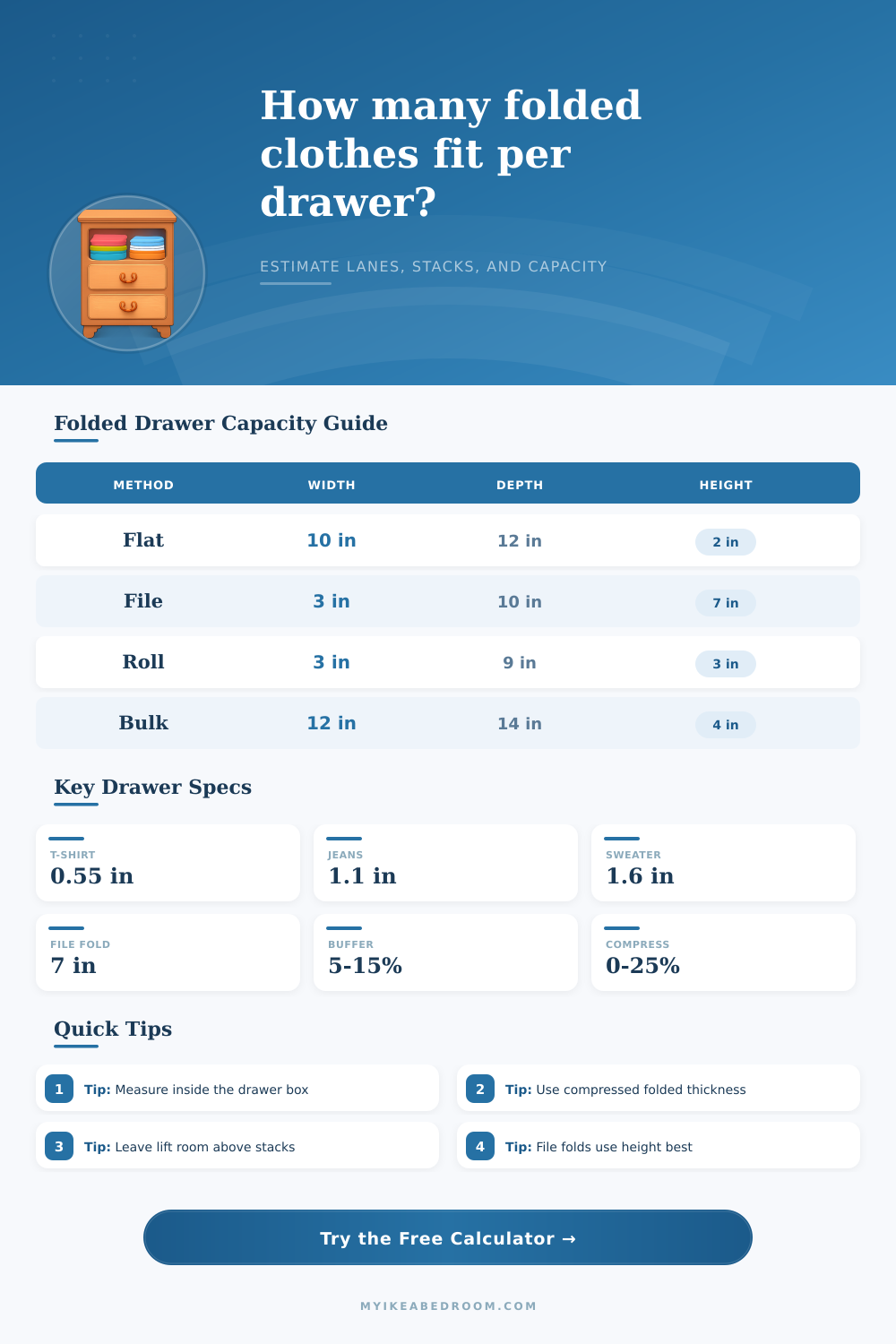
File fold
Uses the drawer height well and makes each item visible from above. Capacity depends mainly on item thickness across each lane.
Flat fold
Creates simple piles with fewer dividers. It is easy to stack, but tall piles need more lift room and can hide lower items.
Rolled fold
Works for socks, underwear, gym tops, and kids clothing. Rolls pack well in shallow drawers but need depth checks.
Bulky fold
Best for sweaters and hoodies when fewer wide lanes are better than forcing tight compartments or high stacks.
| Clothing type | Typical thickness | Fold footprint | Capacity note |
|---|---|---|---|
| Underwear or socks | 0.25 to 0.4 in | 2.5 x 4 to 4 x 6 in | Rolls or small file folds fit narrow cells |
| Kids shirts or leggings | 0.35 to 0.55 in | 2.5 x 7 to 7 x 9 in | Small folded widths make divider grids useful |
| T-shirts or light tops | 0.45 to 0.7 in | 3 x 10 to 8 x 10 in | File folding usually raises visible capacity |
| Pajamas or soft sets | 0.7 to 1 in | 3.5 x 11 to 9 x 12 in | Soft fabric compresses but needs lift room |
| Jeans or heavy pants | 0.9 to 1.3 in | 9 x 12 to 10 x 14 in | Flat stacks often work better than many lanes |
| Sweaters or hoodies | 1.3 to 2 in | 11 x 13 to 13 x 15 in | Use fewer stacks and lower compression |
| Method | Width driver | Depth driver | Height driver |
|---|---|---|---|
| File fold | Thickness of each folded item | Folded garment depth | Standing folded height |
| Compact standing fold | Compressed item thickness | Shorter folded depth | Drawer height minus lift room |
| Flat fold | Folded garment width | Folded garment depth | Stack height divided by thickness |
| Roll fold | Roll diameter or row width | Roll length along drawer depth | One layer unless stacked gently |
| Bulky fold | Wide folded footprint | Long folded footprint | Few layers to avoid crushed fabric |
| Packing cube | Insert cell width | Insert cell depth | Cube wall height and fill level |
| Drawer scenario | Inside size | Best fold style | Typical capacity |
|---|---|---|---|
| Small nightstand drawer | 15 x 13 x 4 in | Socks or roll fold | 18 to 36 small items |
| Shallow dresser drawer | 25 x 15 x 5 in | Compact file fold | 16 to 28 light tops |
| Medium dresser drawer | 28 x 17 x 7 in | File fold rows | 24 to 42 T-shirts |
| Deep dresser drawer | 31 x 19 x 8 in | File or soft sets | 30 to 50 light items |
| Wide sweater drawer | 34 x 18 x 8 in | Bulky flat fold | 6 to 12 sweaters |
| Allowance | Use level | Best for | Planning effect |
|---|---|---|---|
| 0% compression | Loose and exact | Sweaters, delicate fabric | Lowest capacity, easiest removal |
| 5% compression | Light touch | Jeans, pants, stable folds | Small capacity increase |
| 10% compression | Everyday drawer | T-shirts, pajamas, soft cotton | Balanced capacity and access |
| 15% compression | Snug organized | Soft knits and kids clothes | Higher count with careful rows |
| 20% to 25% | Firm packing | Seasonal overflow only | May make drawers harder to use |
To calculates how many folded clothes will fit in the dresser drawer, you must take measurement of the dresser drawer and account for several different variable. The variables of interest include the width, depth, height, and thickness of the dresser drawer, as well as the thickness of the clothes and the use of dividers within the dresser drawer. The width of the dresser drawer will determines how many lanes of folded clothes will fit within the dresser drawer.
If the clothes is folded into files (such as shirts standing on there edges), the width of the dresser drawer will be divided by the thickness of each shirt to determine the number of lanes of folded clothes. If the shirts is folded into flat stacks, the width of the dresser drawer will be divided by the width of each folded shirt. Each folding method will impact the way in which the dresser drawer utilize the width, so a preferred folding method should of be select before performing the calculation.
How Many Folded Clothes Fit in a Drawer
The depth of the dresser drawer will determines the length of each row of folded clothes. The depth of the dresser drawer should not be measured from the outside edge of the dresser drawer to the outside edges of the dresser drawer. Instead, you should measure the depth from the inside front wall of the dresser drawer to the inside back wall of the dresser drawer.
It is also important to subtract some amount from the depth of the dresser drawer to allow for the folded clothes to be pull out of the dresser drawer. A buffer should be subtracted from the depth of the dresser drawer to ensure that the drawer can be pulled out smooth. The height of the dresser drawer will determine how high the clothes can be stack within the dresser drawer.
The height of the clothes should be less than the usable height of the dresser drawer; if the height of the clothes are greater than the usable height of the dresser drawer, then the clothes will not fit in the dresser drawer. The usable height of the dresser drawer is less than the total inside height of the dresser drawer due to the need for lift clearance. Lift clearance is the space between the folded clothes and the top of the dresser drawer; this space allow for the clothes to be removed from the dresser drawer.
The thickness of each type of clothing will change when the clothes are compress when folded. For instance, a shirt may have a certain thickness when new, but the thickness of that folded shirt will decrease when the shirt settle into the dresser drawer. The thickness of each shirt should be determine with compression in mind in order to ensure that the calculated number of shirt will actualy fit within the dresser drawer.
If the thickness of the clothes is account for when performing the calculation, the amount of clothes that can be stored in the dresser drawer will be accurate reflected. Within the dresser drawer, dividers can be use to keep the fold of clothes straight. However, the dividers will take up some of the width within the dresser drawer.
To account for the use of dividers, the total thickness of the dividers should be subtracted from the width of the dresser drawer prior to divide the width by the thickness of the folded clothes. Adding more dividers to the dresser drawer will decrease the amount of clothes that can be store within the dresser drawer. The calculation will provide a number that indicates whether or not the number of clothes that are to be store within the dresser drawer is realistic.
If the calculation indicate that the number of clothes that will be stored in the dresser drawer is close to the maximum number of clothes that will fit within the dresser drawer, then it may be necessary to either change the folding method for the clothes or reduce the number of clothes to store within the dresser drawer. The comfort fill percentage can be alter to make the dresser drawer easy to use; however, a higher comfort fill percentage will allow for more clothes to be store within the dresser drawer, but will make it more difficultly to use the dresser drawer. There are a variety of different factor that may impact how many clothes can fit within the dresser drawer over time.
For instance, clothes of different thicknesses made of different types of fabric may have an impact upon the number of clothes that can be store within the dresser drawer. The weight and thickness of the different types of clothes may impact the way in which they settle into the dresser drawer and how many clothes can fit within the dresser drawer. While the calculation is useful in determining a baseline figure for the amount of clothes that can be stored in the dresser drawer, the way in which the clothes fit within the dresser drawer during use is an important factor to consider.
If the clothes fit well within the dresser drawer, and if the dresser drawer is easy to use with the clothes in various state of folding, then the measurements of the dresser drawer is accurate and the folding method for the clothes is appropriate.