Flying Geese Quilt Block Calculator
Calculate flying geese cut sizes, unfinished trim targets, no-waste batches, stitch-and-flip pieces, oversize trim allowances, fabric yardage, and block layout counts from one finished unit size.
Choose a common quilting layout, then adjust the finished goose size, count, method, fabric width, and test-unit allowance.
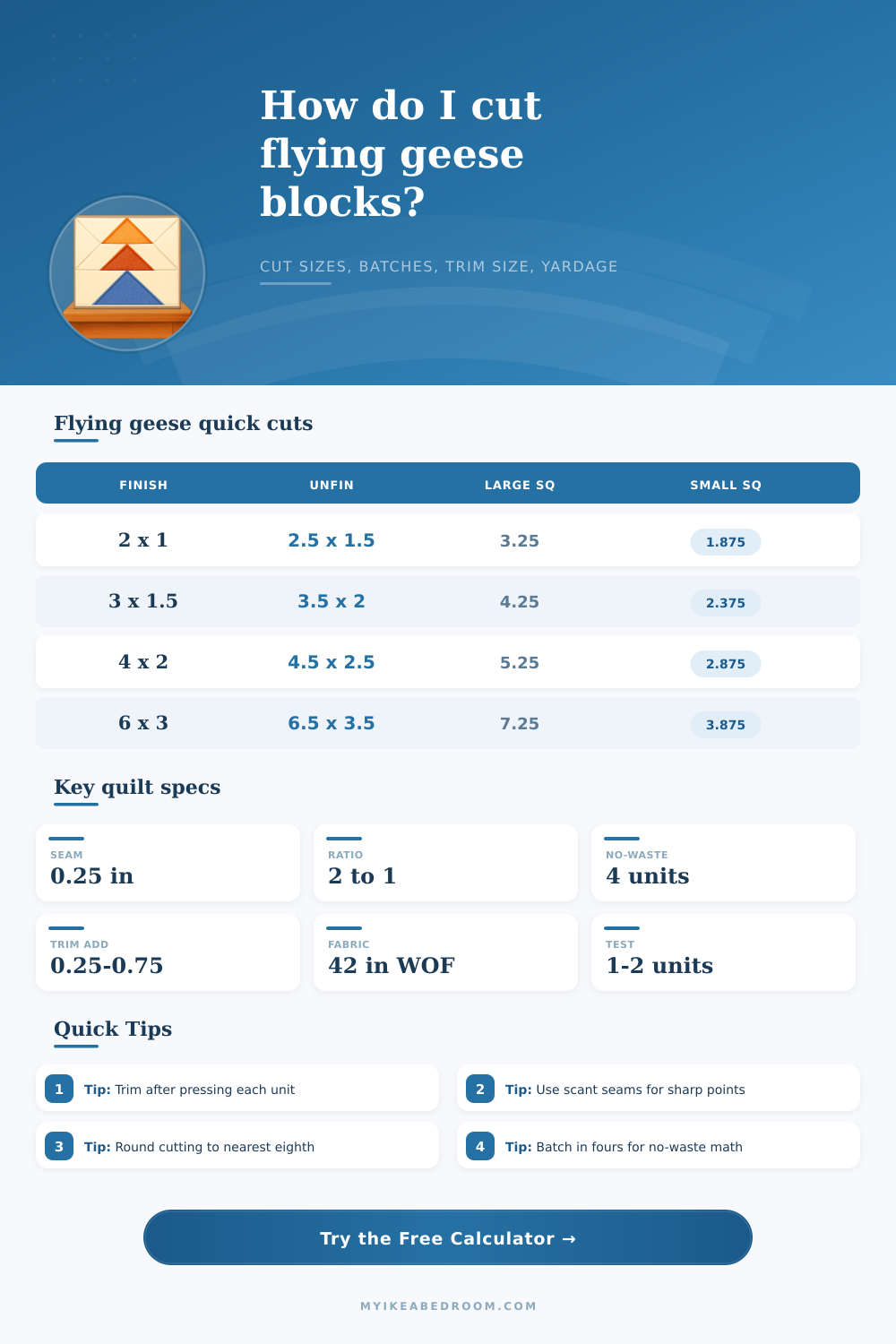
Formula: large square = finished width + 1.25 in; small squares = finished height + 0.875 in.
Best when each batch can use four identical geese with the same goose and sky fabrics.
Formula: no-waste cut sizes plus your trim buffer, then trim to unfinished width and height.
Best for very sharp points, bias control, and slightly generous cutting before squaring.
Formula: one rectangle at unfinished size plus two sky squares equal to unfinished height.
Best for directional prints, scrappy geese, fussy-cut centers, or single replacement units.
| Finished unit | Unfinished trim | No-waste large square | No-waste small squares | One-at-a-time rectangle | One-at-a-time sky squares |
|---|---|---|---|---|---|
| 1 in x 0.5 in | 1.5 in x 1 in | 2.25 in | 1.375 in | 1.5 in x 1 in | 1 in |
| 2 in x 1 in | 2.5 in x 1.5 in | 3.25 in | 1.875 in | 2.5 in x 1.5 in | 1.5 in |
| 3 in x 1.5 in | 3.5 in x 2 in | 4.25 in | 2.375 in | 3.5 in x 2 in | 2 in |
| 4 in x 2 in | 4.5 in x 2.5 in | 5.25 in | 2.875 in | 4.5 in x 2.5 in | 2.5 in |
| 5 in x 2.5 in | 5.5 in x 3 in | 6.25 in | 3.375 in | 5.5 in x 3 in | 3 in |
| 6 in x 3 in | 6.5 in x 3.5 in | 7.25 in | 3.875 in | 6.5 in x 3.5 in | 3.5 in |
| Finished unit | No-waste units per batch | Large squares per strip | Small squares per strip | Good use case |
|---|---|---|---|---|
| 2 in x 1 in | 4 geese | 12 per 3.25 in strip | 22 per 1.875 in strip | Mini stars, tiny borders, labels |
| 3 in x 1.5 in | 4 geese | 9 per 4.25 in strip | 17 per 2.375 in strip | Sampler blocks, narrow sashing |
| 4 in x 2 in | 4 geese | 8 per 5.25 in strip | 14 per 2.875 in strip | Sawtooth stars, pillow fronts |
| 6 in x 3 in | 4 geese | 5 per 7.25 in strip | 10 per 3.875 in strip | Modern rows, bold borders |
| 8 in x 4 in | 4 geese | 4 per 9.25 in strip | 8 per 4.875 in strip | Large-scale throws, medallions |
| Layout | Geese per block | Typical finished goose | Finished block clue | Calculator setup |
|---|---|---|---|---|
| Sawtooth star | 8 | 2 x 1, 4 x 2, 6 x 3 | Star block often equals 2 goose widths | Set units per block to 8 |
| Star corner group | 4 | 2 x 1 or 3 x 1.5 | Four points around one center square | Set units per block to 4 |
| Border chain | Variable | 3 x 1.5 or 4 x 2 | Count each goose along border path | Enter total geese directly |
| Chevron row | 2 per peak | 4 x 2, 5 x 2.5 | Pair geese in mirrored directions | Add extras for directional repeats |
| Scrappy sampler | 1 to 8 | Any pattern size | Each block may use different fabrics | Use one-at-a-time method |
Point allowance: The calculator reports the unfinished trim size as finished width plus 0.5 in by finished height plus 0.5 in. Trim with the point centered and leave a quarter-inch seam allowance above the point.
Fabric direction: Four-at-a-time units rotate fabric grain and print direction. If every goose must face the same way, compare the one-at-a-time result before cutting.
Batch rounding: No-waste batches always round up to full sets of four. Extra units are counted separately so you can use them for labels, test seams, or replacements.
Ruler precision: When a formula lands on a sixteenth or eighth, cut consistently across all pieces. A small change in the sky square can shift the final point placement.
Flying geese are a type of quilt unit that consist of a large triangle and two smaller triangles. Flying geese can be found in many type of quilt designs. Flying geese can be used in borders and in the center of quilts in the form of star blocks.
The shape of a flying geese are a triangle. However, the math for cutting the fabric to create the units in the quilt can be difficult for many individual. A flying geese calculator can assist in determine the fabric measurements that is needed for each unit.
How to Use a Flying Geese Calculator
Additionally, the calculator can estimate an amount of fabric that will be needed for the project. The finished width and finished height of the flying geese units is two of the most important measurements for quilting. Flying geese units are typicaly made using a two to one ratio.
Any other measurements for width to height will change the way that the points of the geese will lie and how the seam allowances will look when the geese is sewn together. However, a flying geese calculator will account for this two to one ratio automatic for the individual. The construction methods for the units can include the four-at-a-time method that result in very little fabric waste, the oversize trim-down method that allow for trimming of the units to create sharp points for the geese, or the one-at-a-time stitch and flip method that offers individuals more control over the grain of the fabric.
Each method will require different fabric cutting size in relation to the number of units that is to be created. In addition to the width and length of the flying geese units, there are additional measurements for sewing the units together. The standard seam allowance is one-quarter of an inch, but any alteration to this measurement will change the cutting of the flying geese units.
The trim buffer is used only in the oversize trim-down method and allow for cutting of the geese units to a precise size after they are sewn together. The width of the fabric that the quilter will use in the project and the percentage of the buffer will have an impact on the total yardage of fabric that will be needed for the project. The usable width of the fabric is typically less than 42 inch because of the selvage on the fabric that must be removed.
If fussy cutting is to be used, the usable width of the fabric may be even more smaller. Adding a percentage of buffer to the yardage will ensure that there is enough fabric to account for cutting the fabric to size and aligning the fabric pieces. Include this buffer in the yardage estimation the calculator provide to the individual.
Reference tables will show the size of the finished flying geese units to cutting sizes for different construction methods for the units. Additionally, reference tables can indicate how many unit can be cut from a strip of fabric. These tables will allow the individual to determine if the flying geese units will fit within the desired quilt layout.
Many individuals will make mistake when sewing their flying geese units. One of the most common is forgetting to account for the seam allowances in the unfinished size of the units. Other errors may be underestimating the number of units for the quilt.
Always check the total number of unit required for the quilt. When the numbers are run through a calculator, individuals may discover trade-offs between the different construction methods for the units. For instance, an individual may find that the four-at-a-time method will save the most fabric, but the identical flying geese units will not allow for fussy cutting of the fabric.
Additionally, using the oversize trim-down method will require more yardage for the fabric, but allow for more forgiveness in sewing the units to create sharp points for the geese. These types of trade-offs are easier to analyze with a calculator that has performed the math for the individual. The flying geese calculator will remove uncertainty from the sewing of the units.
The calculator will provide the exact measurements for the individual to use in their project. However, no amount of sewing machines will accompany the calculator to sew the flying geese units for the individual. However, the calculator will ensure that the amount of fabric that is cut will result in the size of the geese that the individual desire.