Flower Stem Quantity for Vase Calculator
Estimate how many flower, filler, and greenery stems to buy for a vase by matching the opening size, neck capacity, bloom diameter, arrangement style, and bunch size.
Start from a familiar vase, then adjust the measurements and floral recipe for your actual stems.
Suggested stem recipe
Neck capacity check
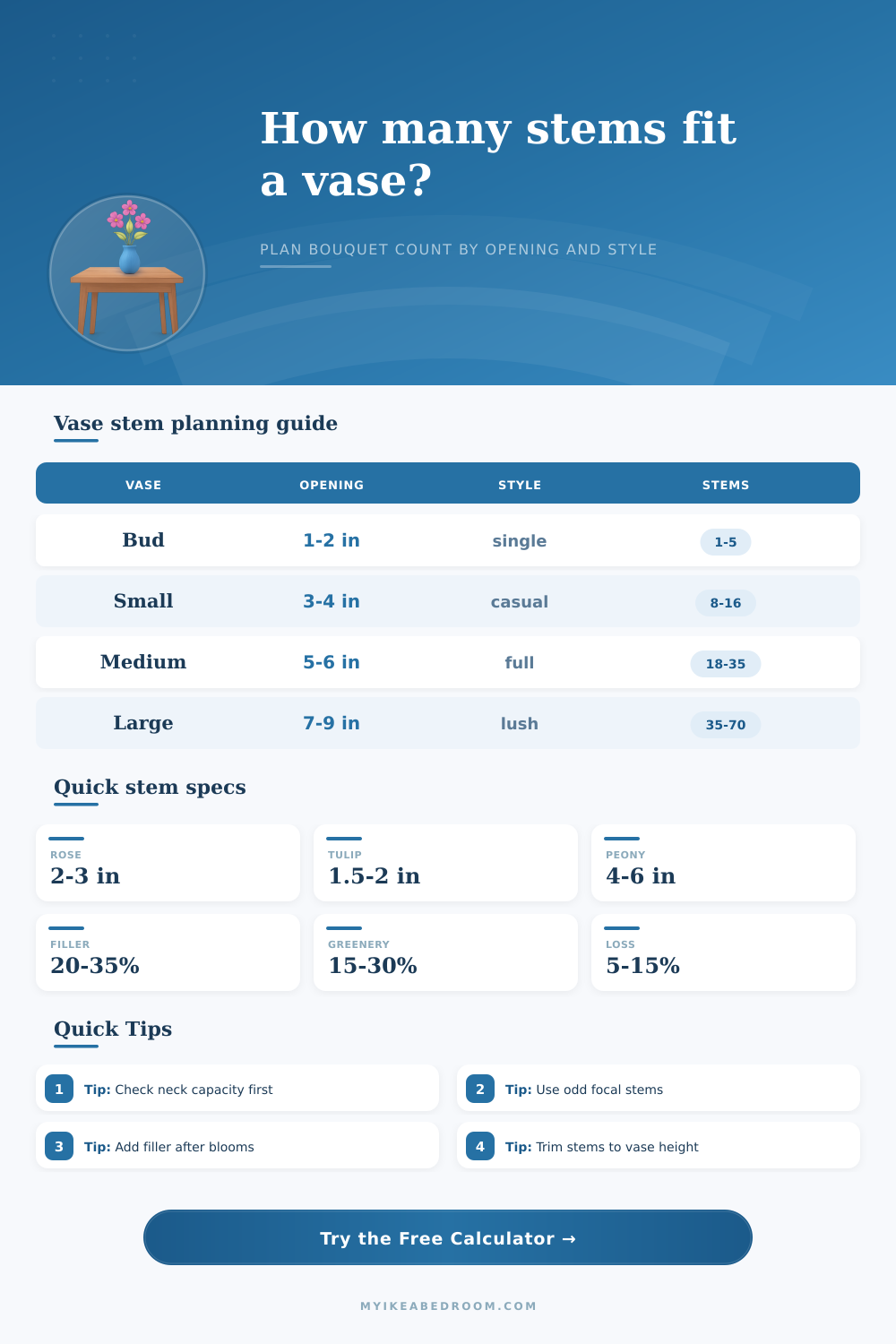
| Vase opening | Loose minimal | Casual full | Lush arrangement |
|---|---|---|---|
| 1 to 2 inches | 1 to 3 stems | 3 to 5 stems | 5 to 8 slim stems |
| 3 to 4 inches | 5 to 9 stems | 10 to 18 stems | 18 to 28 stems |
| 5 to 6 inches | 10 to 18 stems | 18 to 35 stems | 35 to 55 stems |
| 7 to 9 inches | 18 to 35 stems | 35 to 70 stems | 70 to 110 stems |
| Flower type | Bloom diameter | Stem diameter | Planning note |
|---|---|---|---|
| Rose or spray rose | 2.5 in | 0.18 in | Use odd focal counts and fill gaps with small filler stems. |
| Tulip | 1.8 in | 0.14 in | Allow space because tulips continue to grow and curve. |
| Peony | 5.0 in | 0.24 in | Large blooms need fewer stems but a stronger neck capacity check. |
| Hydrangea | 6.5 in | 0.30 in | Count heads as main blooms; add only light supporting stems. |
| Daisy or mum | 2.0 in | 0.13 in | Works well for casual jars and mixed bunches. |
| Lily or line flower | 4.0 in | 0.28 in | Use fewer stems with taller finished height. |
| Style | Coverage target | Stem angle | Best use |
|---|---|---|---|
| Minimal | 45% filled top | Low | Bud vases, single-variety stems, small side tables. |
| Casual gathered | 65% filled top | Medium | Everyday table vases and mixed market bouquets. |
| Balanced florist | 78% filled top | Medium high | Entry tables, guest rooms, and symmetrical arrangements. |
| Lush full | 92% filled top | High | Events, centerpieces, and wide vessels. |
| Airy garden | 58% filled top | High | Branchy stems, soft spacing, and loose silhouettes. |
| Ikebana inspired | 28% filled top | Low | Asymmetric arrangements with strong negative space. |
| Needed stems | 5-stem bunch | 10-stem bunch | 25-stem bunch |
|---|---|---|---|
| 8 stems | 2 bunches | 1 bunch | 1 bunch |
| 18 stems | 4 bunches | 2 bunches | 1 bunch |
| 36 stems | 8 bunches | 4 bunches | 2 bunches |
| 64 stems | 13 bunches | 7 bunches | 3 bunches |
Check the neck, not just the rim. A wide top with a narrow throat can look roomy but physically limit how many stems can sit in water.
Separate visible fullness from stem bulk. Big blooms such as hydrangea and peony fill visual space with fewer stems, while filler adds texture without much bloom coverage.
To determine an appropriate number of flower stem for a vase, one must ensure that the flowers that are arranged within the vase have the proper appearance of being full of flowers yet not too crowded together by too many stem of flowers. Most individuals who purchase flower from markets dont calculate the number of stems that they will need for there vase arrangement. As a result, many find that the flowers that they purchase do not fit within the vase correctly when they arrive at their home.
Should an individual purchase too many stem of flowers for their vase, those stems may become too crowded near the neck of the vase. In contrast, if they purchase too few stems of flowers, the arrangement may appear thin and lacking in fullness. The shape of the vase will play a role in the number of stems that can be used in the vase based off the shape of the vase.
How Many Flower Stems for a Vase
Vases with narrow necks will limit the number of stems that you can add to the vase due to the shape of the vase. Vases with wide bowl, in contrast, allow for the stems to angle outward from the vase which allow for the flowers to appear more numerous yet take up the same amount of space as a wider number of stems would in a narrow neck vase. Calculating the number of stems to use in a vase also require consideration of the size of the blooms of each of the flowers.
Blooms that is large, such as peonies, will take up more space within the vase than blooms that are of smaller sizes, such as tulips. Within any floral arrangement are necessary component in the form of filler stems and greenery stems. These types of stems may serve to hide the mechanics of the flower arrangement, as well as to provide soft edge to the flower arrangement.
Using too little of these stems may lead to a flower arrangement that appears too mechanical, but using too many of these stems may make the main flowers within the arrangement appear to be lost within the bouquet. Thus, adjustment of the number of these stems in relation to the main flowers within the arrangement allow for the main flowers to be the focus of the floral arrangement. In calculating the number of stems for a flower arrangement within a vase, it is also important to include a buffer percentage into that calculation.
Factors such as the stems breaking during transport, or the flowers opening beyond the size that was originally calculated for the number of stems to be used, requires some extra stem to be accounted for in the arrangement. Similary, it is also necessary to plan for the possibility of having to trim some of the stems to shorter length than those originally calculated for the flower arrangement to account for potential transport dificulties. If an individual already have some flowers in their possession, the number of stems that is calculated for the flower arrangement should of be adjusted to account for these flowers.
The number of flowers that are already in possession can be subtracted from the calculated total number of stems to be purchased. However, not all flower behave in the same way when they are arranged in a vase. Flowers such as lilies will not behave in the same way as flowers like ranunculus when they are arranged in a vase.
Therefore, the calculation for the number of stems to be purchased can help an individual to avoid dissapearing disappointment in purchasing flowers that cant be contained within the vase.