Floor Leveling Compound Calculator
Estimate self-leveling underlayment bags, mixed volume, pour depth, primer quantity, water range, and load from room dimensions and real compound planning profiles.
Load a common room and a real leveling-compound profile, then refine the depth map, substrate, primer, bag yield, and waste allowance.
Your Floor Leveling Estimate
| Compound profile | Bag weight | Planning yield | Water range | Depth range used |
|---|---|---|---|---|
| Henry 555 LevelPro | 40 lb | 0.43 cu ft | 4.5 to 5 qt | 1/8 in to 1 1/2 in |
| Custom LevelQuik RS | 50 lb | 0.50 cu ft | 5.25 to 5.75 qt | 1/16 in to 1 1/2 in |
| MAPEI Self-Leveler Plus | 50 lb | 0.50 cu ft | 5 to 5.5 qt | 1/8 in to 1 in |
| Sika Level-125 | 50 lb | 0.48 cu ft | 4.75 to 5.25 qt | 1/8 in to 1 1/4 in |
| TEC Level Set 500 HF | 50 lb | 0.50 cu ft | 5 to 5.5 qt | 1/8 in to 1 in |
| Laticrete NXT Level | 55 lb | 0.55 cu ft | 5 to 5.5 qt | 1/8 in to 1 1/4 in |
| ARDEX K 15 | 55 lb | 0.50 cu ft | 5.25 to 5.75 qt | 1/8 in to 1 1/2 in |
| Rapid Set LevelFlor | 50 lb | 0.48 cu ft | 4.5 to 5 qt | 1/8 in to 1 in |
| Schonox AP | 55 lb | 0.52 cu ft | 5.25 to 5.75 qt | 1/8 in to 1 1/2 in |
| Schluter Level | 50 lb | 0.50 cu ft | 5 to 5.5 qt | 1/8 in to 1 in |
| Average depth | Volume per 100 sq ft | 0.50 cu ft bag coverage | 0.43 cu ft bag coverage |
|---|---|---|---|
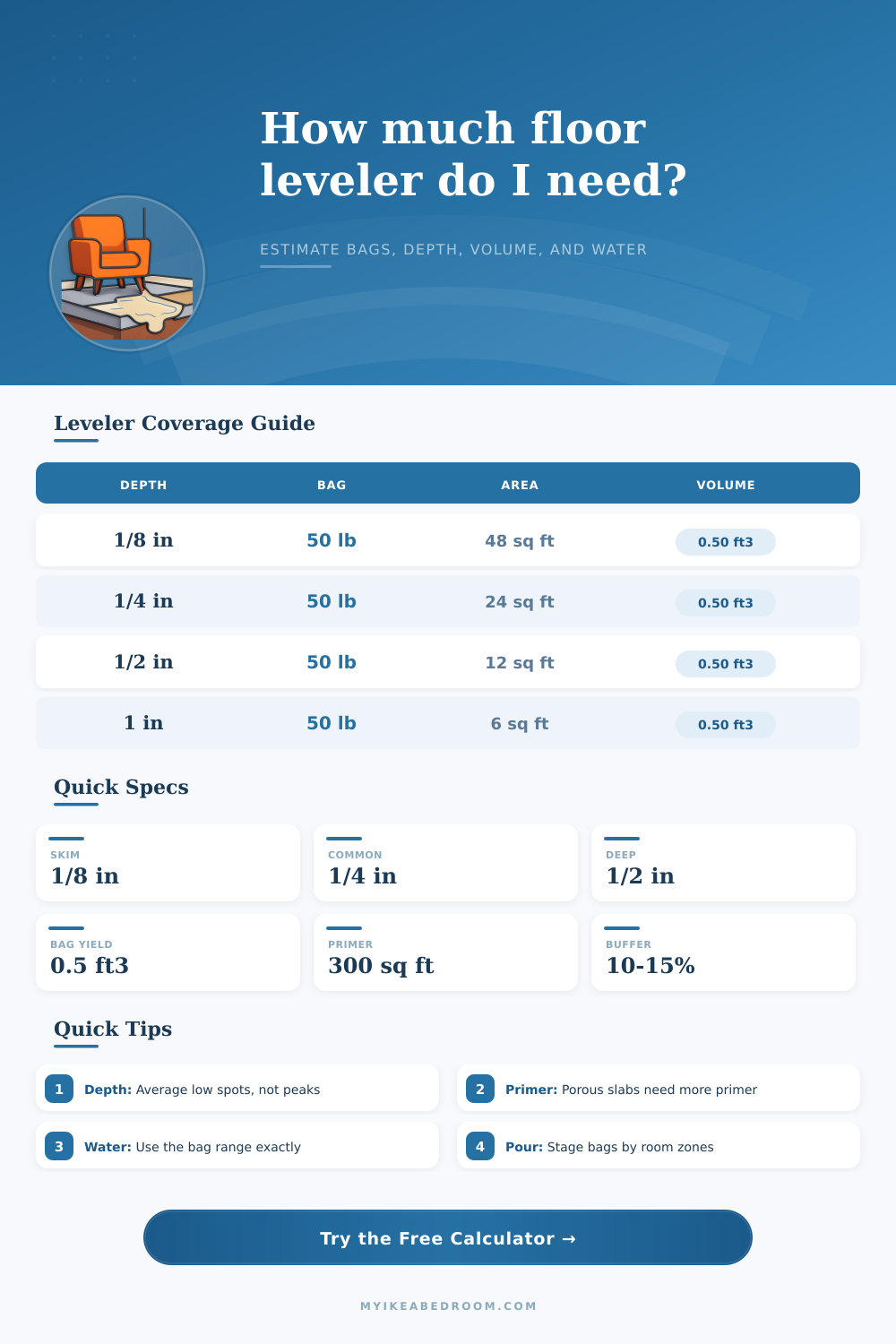
| 1/16 in | 0.52 cu ft | 96 sq ft per bag | 82.6 sq ft per bag |
| 1/8 in | 1.04 cu ft | 48 sq ft per bag | 41.3 sq ft per bag |
| 3/16 in | 1.56 cu ft | 32 sq ft per bag | 27.5 sq ft per bag |
| 1/4 in | 2.08 cu ft | 24 sq ft per bag | 20.6 sq ft per bag |
| 1/2 in | 4.17 cu ft | 12 sq ft per bag | 10.3 sq ft per bag |
| 1 in | 8.33 cu ft | 6 sq ft per bag | 5.2 sq ft per bag |
| Bag and volume item | Imperial value | Metric value | How the calculator uses it |
|---|---|---|---|
| 1 cubic foot | 1 cu ft | 0.0283 cubic m | Base mixed volume unit |
| 1 cubic yard | 27 cu ft | 0.7646 cubic m | Large-pour comparison only |
| 40 lb bag | 40 lb dry load | 18.1 kg | Dry material weight estimate |
| 50 lb bag | 50 lb dry load | 22.7 kg | Common self-leveler bag |
| 55 lb bag | 55 lb dry load | 24.9 kg | Higher bag-weight profiles |
| 1 quart water | 1 qt | 0.946 L | Water range conversion |
| Room scenario | Area | Typical average depth | Planning note |
|---|---|---|---|
| Small bathroom | 45 to 80 sq ft | 1/8 in to 1/4 in | Deep corners can dominate bag count. |
| Bedroom | 120 to 180 sq ft | 3/16 in to 1/4 in | Measure dips across the whole walking area. |
| Kitchen | 100 to 180 sq ft | 1/8 in to 3/8 in | Exclude fixed cabinets if they stay in place. |
| Living room | 220 to 350 sq ft | 1/8 in to 1/4 in | Break the pour into zones before mixing. |
| Basement slab | 300 to 600 sq ft | 1/4 in to 1/2 in | Porous concrete can need more primer and buffer. |
Sawhorses supports fresh vinyl planks in a room, and then you notice the floor isn’t level. It looks fine from the doorway; there’s just that dip next to the closet where your toe caught. Oops! An imperfect install can be ruined by uneven floor. The solution is self-leveling compound.
Another common mistake DIYers make? They guess at how much material they’ll need and pay big bucks for too much. A word about math. Our calculator does it for you. Just feed it product yield and room dimensions, and it spits out a number of bag needed. No guessing equals no wasted money on leftover bags, or running short halfway through your pour.
How to Use Our Calculator for Self-Leveling Compound
People make the same mistake thinking “depth” has one number. No, floors is never exactly flat. Yes, there is a general sag over the main walkway; it can be corrected with just a sixteenth of an inch. But, there’s also a deep corner where water are pooling. That calls for another approach. This tool handles it by allowing you to tell the difference between average fill depth versus localized low spots. You set the base depth as your starting place to cover the big canvas, then add a percentage for deeper area to determine how much thicker they should of be than the rest.
The reason why this makes a difference is that self-leveler are expensive and heavy. If you do the math using the deepest part anywhere in the entire room, you’ll end up buying three-times more then what you realy need. It’s about the average of the low spots, not high ones. That’s before it even starts leveling out, which depends entirely on what surface you’re working with.
Does concrete breathe? Yes. If you’ve got an old basement or garage floor, chances are it’s porous or dusty, acting like a sponge unless you use a sealer, or primer, as the first coat. Since this affects how much each bag covers, the calculator prompts you to enter the substrate. A smooth slab requires very little, if any primer. However, a dusty, old concrete floor will soak up everything you put down in the primer mixture if you don’t apply it first. This shifts effective yield per bag, so what would go forty square feet on a slick surface might only go thirty on a thirsty one. Either way, it’s important to include this loss in your math, or else the compound will get hard and pull back off the walls before settling.
Another thing that will throw off estimates more than you’d imagine: Water. To get the right viscosity, most products has a specific range in which they work with water. If there isn’t enough water, it won’t flow. And if there’s too much, as it cures it shrinks which can cause loss of strength or even cracking. On the page, there is a reference table that lays out those water ranges for several common brands and how many quarts goes into each bag. That’ll help you plan your logistical mixing. Not only do you need to know how many bags to buy, but how much water to have ready. Toting buckets of water back-and-forth are tedious work.
Now we have a number: the total amount of volume (after adding the waste buffer). This is the number you can’t go under in reality. In reality, you’ll spill some, drop some on your trowel, and drop some on the side of the bucket as you’re mixing. Most guys use a ten percent buffer for most rooms, and more like fifteen to twenty percent if there are a lot of structural breaks or dips in your slab. Load that into the back of your truck with full bags and now we know how many whole bag we need. It rounds UP, you don’t buy half-bags; and it takes the total dry weight into account so you can feel confident about how heavy you’ll be moving.
Leveling is part science, part logistics. You want plenty of material to cover everything at once so you don’t end up with any “cold joints” (where two batches of material meet). If you get these numbers right beforehand, then even though your subfloor might not be level, your floor will still be flat.