Floor Cleaner Dilution Calculator
Calculate floor cleaner concentrate, water volume, final solution volume, mop bucket fill, and area coverage with oz, ml, cups, and gallon conversions.
🧼Cleaning presets
⚙Dilution and coverage inputs
Your floor cleaner dilution result
📌Quick dilution facts
🔢Formula used
final solution = concentrate + water
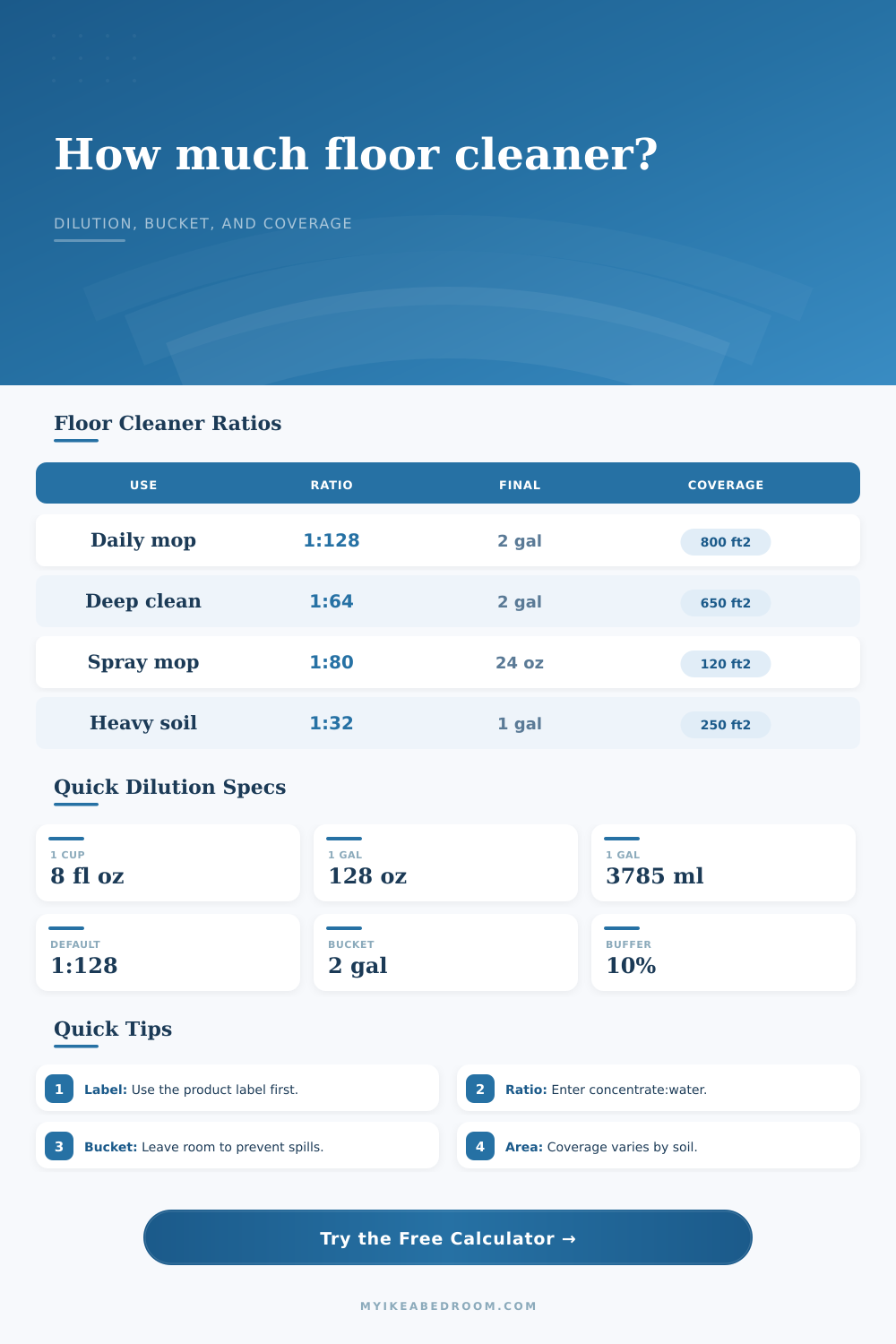
📊Common floor cleaner dilution presets
| Cleaning use | Planning ratio | Typical batch | Coverage planning note |
|---|---|---|---|
| Daily tile mop | 1:128 concentrate:water | 2 gal final solution | Broad routine pass with normal mop wetness. |
| Sealed wood care | 1:160 concentrate:water | 1 gal final solution | Lower-liquid damp mop planning for sealed surfaces. |
| Laminate refresh | 1:128 concentrate:water | 1 gal final solution | Smaller batch and controlled mop moisture. |
| Bathroom floor | 1:96 concentrate:water | 1 gal final solution | Compact area, moderate wetness, label first. |
| Kitchen grease pass | 1:64 concentrate:water | 2 gal final solution | Lower coverage rate for soil and repeated strokes. |
| Deep clean pass | 1:48 concentrate:water | 2 gal final solution | More solution per square foot for slower cleaning. |
| Spray mop bottle | 1:80 concentrate:water | 24 fl oz final solution | Small bottle batch with fine measuring increments. |
| Robot mop tank | 1:200 concentrate:water | 300 ml final solution | Only use if the machine and product label allow it. |
| Large bucket fill | 1:128 concentrate:water | 4 gal final solution | Large-room batch with bucket headroom checked. |
| Heavy soil pass | 1:32 concentrate:water | 1 gal final solution | Small stronger batch only when label permits. |
📏Volume conversion reference
| Unit | Milliliters | US fluid ounces | Use in dilution math |
|---|---|---|---|
| 1 teaspoon | 4.9289 ml | 0.1667 fl oz | Very small concentrate adjustments. |
| 1 tablespoon | 14.7868 ml | 0.5 fl oz | Small spray bottle measuring. |
| 1 US fluid ounce | 29.5735 ml | 1 fl oz | Common bottle or cap reference. |
| 1 US cup | 236.588 ml | 8 fl oz | Larger bucket concentrate measure. |
| 1 liter | 1000 ml | 33.814 fl oz | Metric bucket and bottle batches. |
| 1 US gallon | 3785.41 ml | 128 fl oz | Common mop bucket fill reference. |
🪣Mop bucket fill examples
| Final solution | 1:128 concentrate | 1:64 concentrate | Bucket fill note |
|---|---|---|---|
| 24 fl oz spray bottle | 0.19 fl oz / 5.5 ml | 0.37 fl oz / 11 ml | Bottle batch, use fine measuring. |
| 0.5 gallon pail | 0.5 fl oz / 15 ml | 0.98 fl oz / 29 ml | Small room or spot mop batch. |
| 1 gallon bucket | 0.99 fl oz / 30 ml | 1.97 fl oz / 58 ml | Leaves headroom in most small buckets. |
| 2 gallon bucket | 1.98 fl oz / 59 ml | 3.94 fl oz / 117 ml | Common whole-room mop bucket batch. |
| 3 gallon bucket | 2.98 fl oz / 88 ml | 5.91 fl oz / 175 ml | Check bucket capacity before carrying. |
| 4 gallon bucket | 3.97 fl oz / 117 ml | 7.88 fl oz / 233 ml | Large fill, leave splash headroom. |
🏠Area coverage reference
| Floor condition | Planning coverage | 2 gal covers | Adjustment note |
|---|---|---|---|
| Smooth sealed floor, light soil | 450 to 550 sq ft/gal | 900 to 1100 sq ft | High coverage when mop stays damp, not wet. |
| Routine tile or vinyl | 350 to 450 sq ft/gal | 700 to 900 sq ft | Balanced default for normal home floors. |
| Textured tile or grout | 250 to 350 sq ft/gal | 500 to 700 sq ft | Lower coverage because surface holds liquid. |
| Kitchen or entry soil | 200 to 300 sq ft/gal | 400 to 600 sq ft | Use slower passes and change solution sooner. |
| Heavy soil planning | 150 to 250 sq ft/gal | 300 to 500 sq ft | Small batches help keep the bucket cleaner. |
💡Practical dilution tips
⚠Label-following note
Most folks believe that using more is better when it comes to floor cleaner. It’s a common misconception and an expensive one at that. Concentrated cleaners are concentrated for a reason, they’re strong. Dilute them properly and a small bottle will last you dozens of bucketful.
But using a regular old measuring cup to measure tiny quantities of goopy goop just doesn’t work, it gets messy and inaccurate. Before long, your floor becomes a gunky mess that only attracts more grime. This sticky floor make your mop useless. Oh yeah, and it’ll shrink your wallet sooner then later too.
How to Mix Floor Cleaner Correctly
The solution isn’t chemistry so much as it is getting the math correct in terms of volume relationships. You don’t need to run those numbers through your mind. Use the calculator (above) to do the math for you.
Simply enter what’s stated on the back of label… Typically it will be something like one part cleaner to one hundred twenty-eight parts water. Then let it turn that ratio into a real number of ounces or milliliters that you can actualy measure out.
The tool accounts for the final mixture volume rather than just adding water to the concentrate. It doesn’t just add the concentrate and the water. Instead, it subtracts from total volume. Why? Because the concentrate displaces water. Add an ounce of cleaner to a full bucket and you’ll find yourself trying to mop up the floor. The calculator corrects for this by subtracting the total volume of whatever you are mixing. You’ll end up filling your bucket to the appropriate line…no overflow.
The calculator also looks at real world variables such as soil level and the floor area. Not every floor will get the same coverage. For example, a lightly soiled vinyl floor may give you five hundred square feet per gallon of solution while a heavily soiled kitchen tile floor with baked on grease may only yield two hundred square feet per gallon. You can adjust that number in the calc.
Then it takes into account your mop’s retention. Does your floor have texture? How about your mop? A flat microfiber pad retain less liquid than a string mop does. Textured tile absorbs more liquid different than smooth hardwood. Add a percentage for absorption and waste and the tool tells you exactly how much total solution you’ll need to mix or buy for the job. This avoids the all too common problem of running out of clean water halfway through the livig room.
Another option here: use the preset to make this easier. A weak mixture is what you want when doing daily maintenance mopping. You’re not really breaking down any stain, just pushing around some dust. A strong mixture are better if you need something deeper. For both of those, the calculator has presets available.
And it will even handle unit conversion for you. Maybe your cleaner bottle says milliliters but you think in cups and gallons? That’s no problem. Two hundred thirty seven milliliters is about one cup or eight fluid ounces, and the tool can show you that. You won’t have to mess with math in your head, which always leads to mistakes.
Finally, there are safety and surface care. Diluting too much can be bad for your floors and leave residue, damaging them over time. Too little dilution can result in strips left on the floor that attract dirt as soon as you mop it up. The calculator keeps you inside of the label guidelines.
In fact, it forces you to enter in the ratio first, anchoring the whole calculation into what the manufacturer recommends. It is a good guard rail. It help keep us from guessing and pouring.
In short, this is how to clean floors efficiently. To do it right, you need the right amount of product for the right amount of cleaning. Is it more than necessary? It is wasteful and maybe bad for your floors. Is it less then necessary? It is not very effective at all. The calculator provides an exact target. It uses measurement instead of a messy guessing game.
Measure. Mix. Mop. Don’t worry about the math.