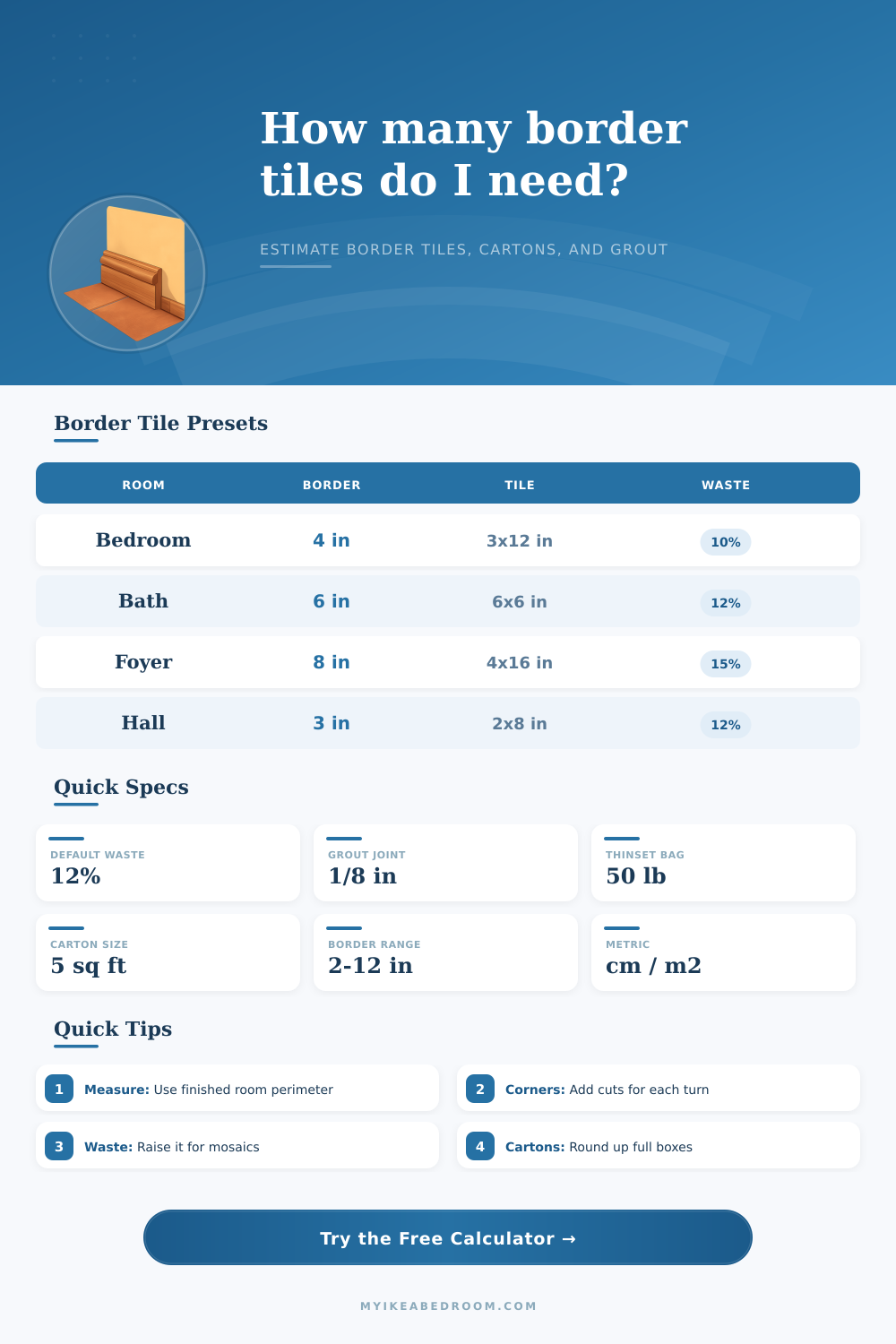
Floor tile border material planner
Floor Border Tile Calculator
Estimate decorative floor border tile area, pieces, cartons, corner cuts, thinset, grout, perimeter balance, and metric equivalents from room size and tile format.
| Border tile profile | Nominal size | Typical carton | Best planning use |
|---|---|---|---|
| Ceramic pencil border | 3 x 12 in | 5 sq ft | Narrow bedroom or living room perimeter bands |
| Porcelain mosaic sheets | 2 x 2 in on sheets | 10 sq ft | Bath frames and curved or corner-heavy borders |
| Marble strip border | 4 x 16 in | 8 sq ft | Foyers where shade sorting and miter cuts need more reserve |
| Quarry threshold strip | 3 x 6 in | 6 sq ft | Laundry, mudroom, and utility floor edges |
| Wood-look plank border | 3 x 18 in | 9 sq ft | Inset frames around larger field tile layouts |
| Border width | Area per 10 linear ft | Area per 3 m | Common use |
|---|---|---|---|
| 2 in strip | 1.67 sq ft | 0.15 sq m | Accent line or pencil border |
| 3 in strip | 2.50 sq ft | 0.23 sq m | Small room perimeter band |
| 4 in strip | 3.33 sq ft | 0.31 sq m | Standard decorative frame |
| 6 in strip | 5.00 sq ft | 0.46 sq m | Bath, foyer, and rug-frame borders |
| 8 in strip | 6.67 sq ft | 0.62 sq m | Large entry or stone band |
| Waste condition | Suggested reserve | Why it changes | Calculator field |
|---|---|---|---|
| Straight ceramic border | 8% to 10% | Mostly full tiles with simple end cuts | Waste and attic stock |
| Mitered picture frame | 12% to 15% | Corner angles create short unusable offcuts | Layout multiplier |
| Natural stone border | 15% to 20% | Shade sorting, veining, and breakage need extras | Tile profile plus waste |
| Mosaic sheet border | 15% to 20% | Sheet alignment and partial rows raise trimming | Mosaic layout factor |
| Common project | Approx border run | Usual border width | Planning note |
|---|---|---|---|
| 12 x 14 bedroom | 49 linear ft after one door | 3 to 4 in | Usually driven by perimeter pieces, not carton area |
| 5 x 8 bath | 20 to 24 linear ft | 4 to 6 in | Mosaics often need extra corner reserve |
| 8 x 10 foyer | 33 to 36 linear ft | 6 to 8 in | Stone borders benefit from shade-sorted extras |
| 4 x 18 hallway | 39 to 44 linear ft | 2 to 3 in | Long narrow borders are sensitive to tile length |
When planning to tile a floor, most of us think we need to just measure the square feet, order however many boxes are required to fill the space and then go at it. That plan of attack will work fine with field tile, but what if there’s a border? What happens if there is a decorative edge involve? Suddenly, instead of an area problem, you’ve got a perimeter puzzle on your hands.
Once you know your room shape and the width of your border, the rest of math is left up to the calculator. You won’t have to guess whether or not you’ll have enough piece to finish off the frame. Most folks greatly underestimate the amount of waste they’ll incur during corner cuts, etc. It’s not as simple as just covering the ground (it’s about fitting shapes together).
How to Plan Your Tile Border
First up: Decide on the look you want your layout to create. Are you going to place an inset rug frame within main field? Or do you want to simply lay a straight band alongside the wall? The tool gives you this option. It adjusts the number of tiles accordingly.)
If you’re placing an inset border, that means taking exact offset measurements and potentially doing some more cutting around inside edge of where the inset portion meets the main field tiles. You’ll also notice it includes inputs for room size (width/length) and any skipped edges or doorways. Why? Because if you’ve got a built-in cabinet or closet that cuts across the border run, you don’t want tile there. So leaving those gaps in your calculation ensures you aren’t purchasing extra carton that you’ll never unpack.
Next is the waste factor: the Achilles’ heel of most DIY projects. Five to eight percent waste is tolerable if you’re making a straight ceramic border. But increase that to mitered corners or mosaics or natural stone, and it goes up. Natural stone has shade variations and veins; there are always pieces that do not matches the rest of the band, so you have to cut them out. Mosaics on sheets need to be aligned, generating even more offcuts.
You can change this percentage in the calculator depending on how complicated the project is and what kind of materials you’re using. Bump it up to fifteen or twenty percent if you’re doing something complex, rather then having to run to the store for a half-box week later.
The other sneaky cost comes in corners. Each time you make a corner in your room, you have to cut at least one tile. Some designs use multiple corners (such as mitered frames), which create smaller tiles that can’t necessarily be used for something else. This is where the corner reserve are added by the tool to your total number of pieces. It is a little bit extra, but it would of been worth it if you want the whole job to match and not have a noticeable hole in the grout.
Also take into account how your border tile arrives: loose in boxes or on a carton? Because no supplier will ship you half a box, the calculator round all the way up to full boxes. This will help you budget out storage space in advance.
On the page there are some handy reference tables that allow you to quickly check out what to expect in terms of area consumed (a four-inch border consumes more area per linear foot than a two-inch strip). This can help you get an idea of scale ahead of time before placing an order. You can also compare to their suggested reserve amounts based off waste percentages which is helpful if you’re not sure what to expect.
But remember, this is all a guideline. Depending on the condition of your subfloor and your cutting precision, your needs may vary. The number of materials used will depend on what you’re setting too. If your border area is small you’ll need less thinset and grout. According to typical coverages, the calculator can estimate how many bag are required. That way, you won’t run out of adhesive once all your tile arrives.
Choosing the look of your tile pattern is an aesthetic consideration, but you also have to consider the logistics of installing it. From the weight of the stone to the width of the grout joint, each variable is considered in a well-planned order. But, in the end, a border is just a frame for your room. It is a frame that defines your space, draws the eye, and ultimately makes a statement. When you get the amount correct then you have an intact and continuous frame. We don’t want mismatched batches or missing pieces to interrupt the design and make it seem like there was no intention behind it.
Using the tool removes the guesswork from the process by mapping out what is needed, such as perimeter, material, and waste. This lets you see clearly how much math are involved. The result is a finished floor, which is the goal of any good renovation.