Flat Sheet Size for Bed Calculator
Calculate a practical flat sheet width and length from mattress size, depth, topper height, side drop, foot tuck, pillow fold, shrinkage, and hem allowance.
Choose a bed setup, then adjust the exact mattress, tuck, fold, shrinkage, and sewing allowance values.
| Bed size | Mattress top | Common flat sheet | Best use |
|---|---|---|---|
| Crib | 28 x 52 in / 71 x 132 cm | 45 x 67 in / 114 x 170 cm | Toddler or crib top layer |
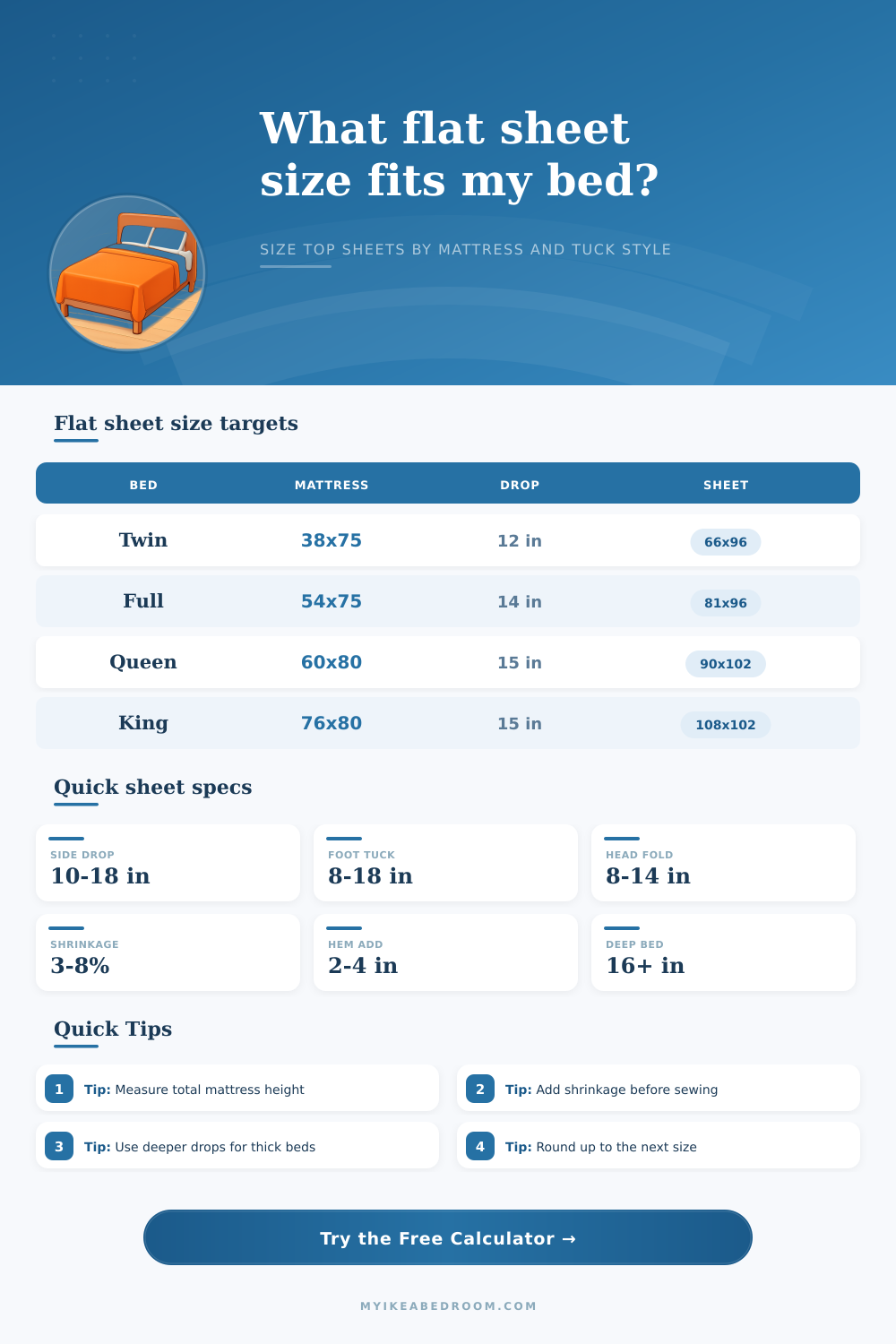
| Twin | 38 x 75 in / 97 x 191 cm | 66 x 96 in / 168 x 244 cm | Guest, kids, daybed, bunk |
| Twin XL | 38 x 80 in / 97 x 203 cm | 66 x 102 in / 168 x 259 cm | Dorm and adjustable twin XL |
| Full | 54 x 75 in / 137 x 191 cm | 81 x 96 in / 206 x 244 cm | Full and compact guest bed |
| Queen | 60 x 80 in / 152 x 203 cm | 90 x 102 in / 229 x 259 cm | Most primary and guest queen beds |
| King | 76 x 80 in / 193 x 203 cm | 108 x 102 in / 274 x 259 cm | Wide beds and shared covers |
| California king | 72 x 84 in / 183 x 213 cm | 108 x 106 in / 274 x 269 cm | Long mattresses needing extra length |
| Tuck style | Side drop target | Foot tuck target | Head fold target |
|---|---|---|---|
| Minimal drape | Mattress depth + 2 in | 6 in / 15 cm | 8 in / 20 cm |
| Balanced everyday | Mattress depth + 3 in | 12 in / 30 cm | 12 in / 30 cm |
| Hotel tuck | Mattress depth + 5 in | 16 in / 41 cm | 14 in / 36 cm |
| Deep mattress | Mattress depth + 6 in | 18 in / 46 cm | 14 in / 36 cm |
| No foot tuck | Mattress depth + 2 in | 0 in / 0 cm | 10 in / 25 cm |
| Fabric width | Usable width after selvedge | Panel note | Good for |
|---|---|---|---|
| 45 in / 114 cm | 43 in / 109 cm | Usually 2 to 3 panels | Crib, twin pieced sheets |
| 54 in / 137 cm | 52 in / 132 cm | Usually 2 panels | Twin, full pieced sheets |
| 60 in / 152 cm | 58 in / 147 cm | Often 2 panels | Twin through queen pieced sheets |
| 90 in / 229 cm | 88 in / 224 cm | Continuous for many queen sheets | Full, queen, some king plans |
| 108 in / 274 cm | 106 in / 269 cm | Continuous for most beds | Queen, king, California king |
| Scenario | Mattress and depth | Suggested finished size | Reason to adjust |
|---|---|---|---|
| Low twin bunk | 38 x 75 x 8 in | 64 x 94 in | Less side bulk under guard rails |
| Deep queen | 60 x 80 x 16 in | 96 x 110 in | Extra side drop and foot tuck |
| Shared king | 76 x 80 x 13 in | 108 x 104 in | More width for two sleepers |
| Long Cal king | 72 x 84 x 12 in | 106 x 110 in | Length matters more than width |
| RV short queen | 60 x 75 x 10 in | 88 x 96 in | Compact length reduces laundry bulk |
The calculator reports the sheet size after hemming and after expected fabric shrinkage.
Use this when comparing to packaged flat sheet dimensions.
The cut size adds hem allowance and shrinkage buffer before sewing, washing, or pre-shrinking.
Use this when cutting yardage.
The side drop is measured from the mattress top edge down the side, including depth and visible drape.
Increase it for tall beds.
The foot tuck is extra length that wraps under the foot of the mattress.
Decrease it for no-tuck summer setups.
Measure the loaded bed. A topper, thick protector, or pillow-top mattress changes the side drop more than the labeled mattress size does.
Round up for comfort. If the recommended size lands near a standard flat sheet, choose the larger size when the bed is shared or the mattress is deep.
To ensure that the flat sheets stays on the bed without tugging at it, one must first understand the measurements of the bed. Sheet sizes are often selected according to the labels on the packages of the sheet, but the measurements of the sheet do not always match the measurements of the bed. Sheets are able to remain on the bed due to the extra fabric that is include in the sheet to cover the depth of the mattress and to tuck underneath the mattress.
If a sheet does not include enough extra fabric to cover the mattress and allow for a tuck underneath the mattress, the sheet may become loose on the bed and potentially pull away from the bed when the sleeper move during the night. However, if a sheet includes too much extra fabric, the extra fabric may bunch underneath the mattress. The depth of the mattress is one of the critical measurements of the mattress that will affect the size of the sheet that is need to cover the mattress.
How to Measure Your Mattress for Flat Sheets
Mattresses are often labeled as being a certain depth, but the depth of the mattress may increase if a mattress topper or protector is placed upon the bed. Therefore, you must measure the depth of the mattress to ensure that the sheet will be able to cover the entire mattress and provide for a proper side-drop of the sheet. Beyond mattress depth, the other measurements of importance include the foot tuck and head fold of the sheet.
The foot tuck is the amount of fabric underneath the mattress that will help to hold the sheet in place on the bed. The head fold of the sheet is the amount of fabric along the top of the sheet that will allow the sleeper to fold the sheet over the blankets upon there bed. These two measurements are critical in that they will alter the total length of the sheet that is needed.
Any changes in the amount of fabric that is included for a foot tuck or head fold will impact the total length of the sheet. Another important measurement that must be taken into consideration is shrinkage. Shrinkage refers to the way in which certain fabrics, like cotton, may shrink when the sheet is laundered in the washing machine and dryer.
Therefore, extra fabric must be allowed for the sheet according to the type of fabric to allow for shrinkage. Additionally, you must also account for the amount of fabric that is allocated for the hems of the sheet. While the amount of fabric for a single hem is relatively small in comparison to the sheet, the amount of fabric for all of the seams of the sheet collectively has an impact upon the total amount of fabric for the sheet.
The calculator included at the top of this sheet will calculate each of these measurements for you after entering the depth of your mattress, the tuck style of your sheet, and the fabric details for the sheet. The calculator will provide you with the finished size of the sheet as well as the cut size of the sheet. The cut size of the sheet will include allowances for shrinkage and hems of the sheet.
Additionally, the calculator will provide you with the closest standard sheet size, the number of fabric panels that you will need for the sheet, and the width of each fabric panel. If your fabric panels are narrow, you will require more panels to cover the sheet; the wider the panels, the few that you will require for your sheet. Standard sheets are manufactured in sizes that typically fit the majority of mattresses, such as twin, full, queen, and king sizes.
However, the sheets may not appropriately fit mattresses that are deep in nature or are extra-long twin mattresses. If the sleepers mattress is outside of the standard measurements of sheets, it is possible that they will need to purchase a larger sheet or a custom cut sheet for their bed. These reference tables can help the sleeper to understand the measurements of each sheet and mattresses in comparison to one another.
In addition to the measurements of the mattress, another consideration for the sleeper is the amount of drape that they would like in the sheet. The drape of the sheet is the amount of fabric that hangs off of the sides of the bed. For some individuals, they may desire their sheet to have a long drape such that it reaches the floor.
For others, they may prefer their sheet to have a short drape such that it does not come in contact with the amount of dust or pet hair that may land upon the bed. The presets for tuck styles allow the sleeper to choose the amount of drape that they would like for their sheet. Another consideration that is important for the sleeper is the width of the fabric.
The width of the fabric will impact the number of panels of fabric that are required for the sheet. The narrower the fabric bolts, the more panels of fabric the sleeper will require. Conversely, the wider the fabric bolts, the fewer panels of fabric will be required to create the sheet.
The final test of the sheet is to wash the sheet and to use the sheet for several sleep cycles. After the sheet has been laundered and used, it may shift on the sleepers bed. If the sheet shifts on the bed, it indicate that the sheet may not have the proper measurements for the sleepers bed.
You should of checked the depth first. Dont forget to account for the moddern fabric types as well. It is actualy alot of work.