Flagstone Quantity Calculator
Estimate patio or walkway flagstone from length and width or custom area, then adjust for stone thickness, irregular shapes, joint gaps, and waste.
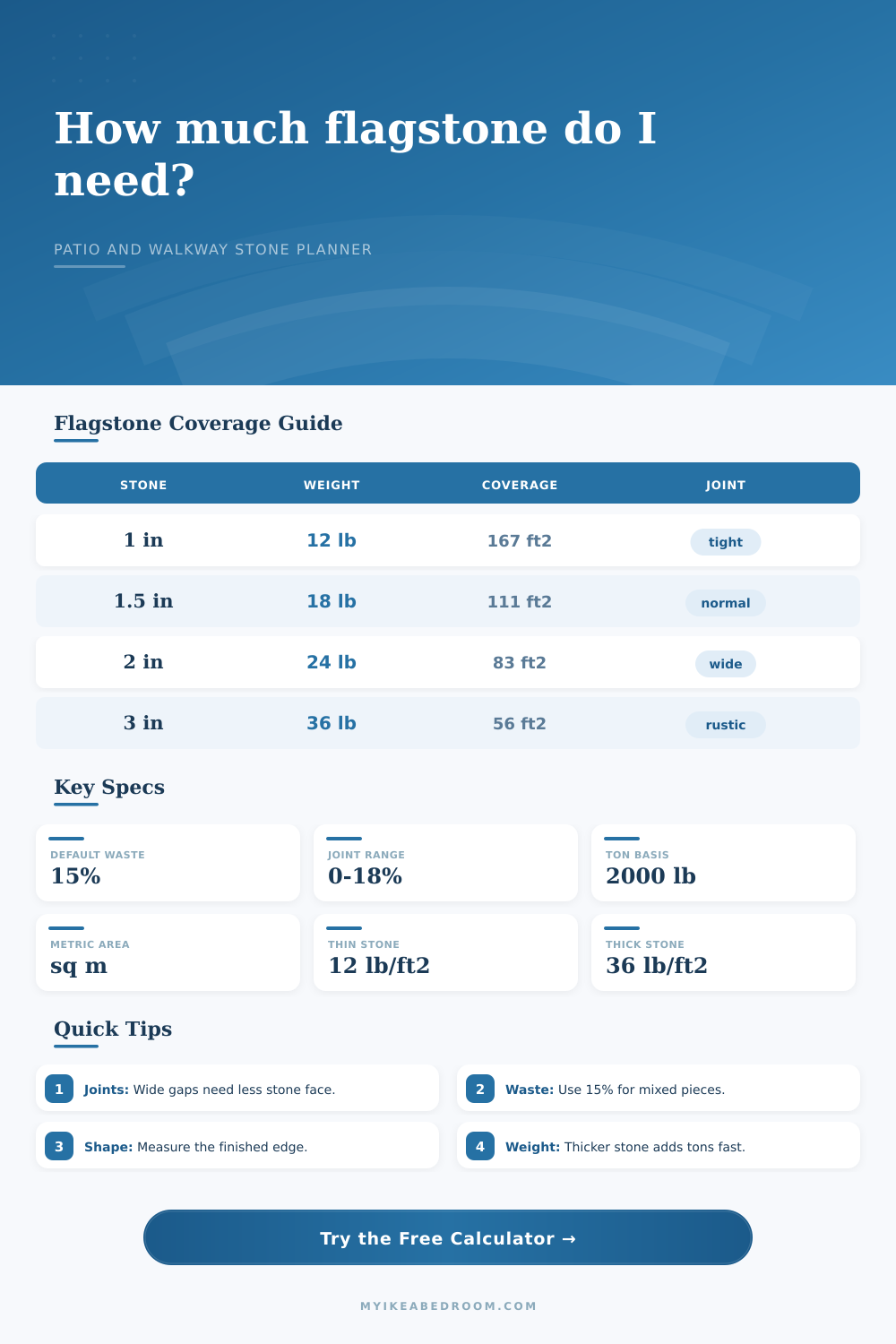
| Stone thickness | Base weight per sq ft | Approx coverage per ton | Best use in the calculator |
|---|---|---|---|
| Thin 1 in flagstone | 12 lb/sq ft | About 167 sq ft before joints and waste | Light foot-traffic patios over a prepared setting bed |
| Standard 1.5 in flagstone | 18 lb/sq ft | About 111 sq ft before joints and waste | Typical patios and walkways with mixed pieces |
| Patio 2 in flagstone | 24 lb/sq ft | About 83 sq ft before joints and waste | Durable walks, sitting areas, and larger slabs |
| Heavy 2.5 in flagstone | 30 lb/sq ft | About 67 sq ft before joints and waste | Chunkier natural pieces and heavy-use paths |
| Thick 3 in flagstone | 36 lb/sq ft | About 56 sq ft before joints and waste | Rustic slabs, thick steps, and very durable surfaces |
| Factor | Calculator effect | Typical setting | Planning note |
|---|---|---|---|
| Tight joints | 0% gap credit | Sawn or carefully sorted pieces | Finished area is nearly all stone face |
| Normal joints | 10% gap credit | Common sand or stone-dust patio joints | Stone face area is finished area divided by 1.10 |
| Garden gaps | 18% gap credit | Stepping stones, planted joints, wide gravel joints | Less stone face covers the same finished outline |
| Mixed irregular | 1.08x fitting factor | Typical natural flagstone pallets | Extra stone covers cutting, sorting, and unusable edges |
| Very irregular | 1.22x fitting factor | Fieldstone shapes and rustic broken pieces | Use with 18% to 20% waste for selective layout work |
| Preset | Finished area | Typical stone profile | Expected planning range |
|---|---|---|---|
| Front walk 3 x 30 | 90 sq ft / 8.4 sq m | 1.5 in, normal joints, 12% waste | About 0.8 to 1.0 tons |
| Garden path 4 x 40 | 160 sq ft / 14.9 sq m | 1.5 in, wide joints, 15% waste | About 1.4 to 1.7 tons |
| Dining patio 12 x 16 | 192 sq ft / 17.8 sq m | 2 in, normal joints, 15% waste | About 2.4 to 2.8 tons |
| Courtyard 18 x 18 | 324 sq ft / 30.1 sq m | 2 in, tight joints, 18% waste | About 4.0 to 4.8 tons |
| Metric terrace 4 x 6 m | 24 sq m / 258 sq ft | 1.5 in, normal joints, 15% waste | About 2.4 to 2.9 tons |
| Finished surface | Metric equivalent | 1.5 in stone at 15% waste | 2 in stone at 15% waste |
|---|---|---|---|
| 80 sq ft | 7.4 sq m | About 0.8 tons with normal joints | About 1.1 tons with normal joints |
| 120 sq ft | 11.1 sq m | About 1.2 tons with normal joints | About 1.6 tons with normal joints |
| 200 sq ft | 18.6 sq m | About 1.9 tons with normal joints | About 2.6 tons with normal joints |
| 300 sq ft | 27.9 sq m | About 2.8 tons with normal joints | About 3.9 tons with normal joints |
Don’t estimate your patio as if you were treating flagstone like carpet. Stone isn’t rectangular; it’s not going to fit neatly into place, which means you can’t simply measure out width and length. There will be dust and waste.
Flagstone doesn’t just cover a surface; it consist of rocks stacked on top of each other that must be planned for and cut. You’re purchasing mass, not only square footage. It’s simple math, but it takes comprehension to know what thick means in terms of weight. One inch stone is roughly 12 pounds per square foot. Three inches is 36. Same appearance, three times heavier than the weight. The heavier the stone, the less square footage per ton. Delivery and installation changes as well. This isn’t a filler, this is moving earth.
How to Calculate Flagstone for Your Patio
The number of stones also depends on size of joint gaps. If they are tight, more stone is needed to fill the gaps; if wide (with moss or gravel), you need less stone because ground shows through. The closer the joint, the more stone you need. That impacts appearance of path and your cost. A wide joint = 10% fewer stones for a joint credit so need 10% less of the stone face.
Irregular shapes affect how well pieces fits together. If you’re dealing in naturaly flagstone, expect to have some pieces that don’t fit in exactly. To account for this, order slightly more, eight percent more then a typical lot, perhaps. Order twenty-two percent more if your stone is very rustic. This is not waste; it is simply the price paid when working with nature.
How shape and thickness alter coverage appear on the reference table. Allowance for waste on job will help protect your project. More extras will be required if you have a lot of curves, or want to group colors. For mixed layouts add 15-20% extra. That way you won’t be lacking any good piece.
You’re charged by ton, so it all gets converted into tons in the calculator. Tons, not square feet, are what you get billed for.
What kind of base will stone sit on? In general, a properly compacted gravel base is necessary (it allows water to drain through and also keeps it from settling). Heavier slab works well for high-traffic spots such as a dining area. For low-traffic spots like a garden path, thinner stone do fine. What’s your vision for how it should feel? Do you want a casual path or a more formal plaza?
Always check your delivery access first. You need room to get that dump truck backing in there. A ton of stone is mighty heavy. Don’t underestimate it. And don’t think small either. Order a bit extra. Better to have some left over for fixing things then having to wait until next load of stone arrives. The weather doesn’t wait. Neither should of you or the work.