Fitted Sheet Pocket Depth Calculator
Calculate the fitted sheet pocket depth you need from mattress height, toppers, pads, shrinkage, fabric stretch, corner shape, and the pocket label on the sheet package.
Choose a common bed stack, then adjust each layer and fabric behavior to match the sheet you are checking.
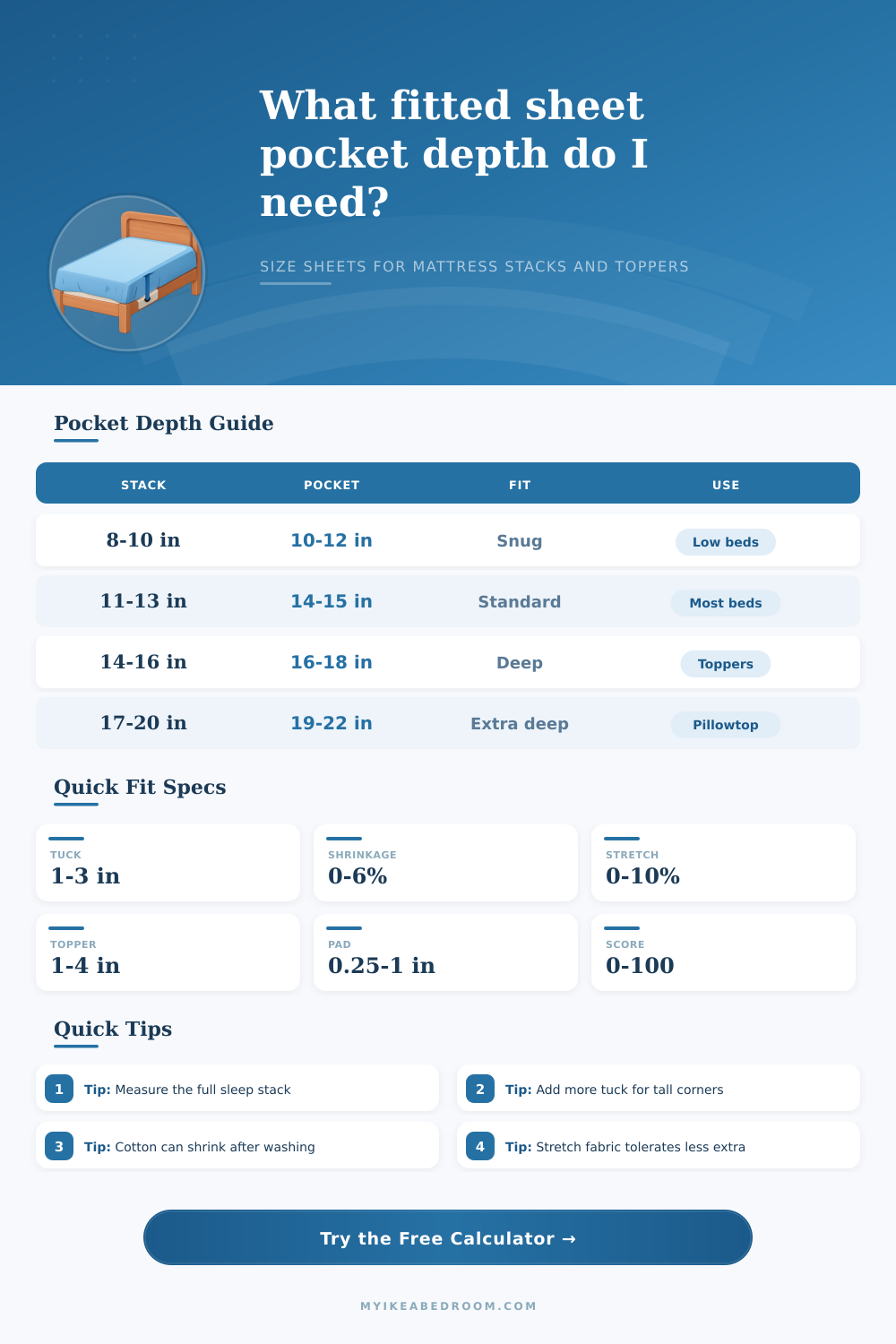
| Measured stack | Minimum pocket | Common label | Best use |
|---|---|---|---|
| 6 to 8 in | 8 to 10 in | Standard | Kids beds, bunks, low foam mattresses |
| 9 to 11 in | 11 to 13 in | Standard | Most basic twin, full, and queen mattresses |
| 12 to 14 in | 14 to 16 in | Deep | Modern mattresses with pads or protectors |
| 15 to 17 in | 17 to 19 in | Deep | Mattress plus topper or soft pillowtop |
| 18 to 21 in | 20 to 24 in | Extra deep | Thick stacks with featherbeds or multiple layers |
| Fabric | Stretch credit | Default shrink | Fit note |
|---|---|---|---|
| Cotton percale | 1% | 4% | Crisp fabric, needs accurate depth |
| Cotton sateen | 2% | 3% | Smooth drape, still low stretch |
| Linen | 3% | 5% | Relaxed hand, may loosen with wear |
| Jersey knit | 8% | 2% | Stretchy, forgiving on tall corners |
| Microfiber | 3% | 1% | Stable, light, low shrinkage |
| Flannel | 2% | 6% | Warm fabric, allow more laundry room |
| Size | Imperial | Metric | Corner tension |
|---|---|---|---|
| Twin | 38 x 75 in | 97 x 191 cm | Low to medium |
| Full | 54 x 75 in | 137 x 191 cm | Medium |
| Queen | 60 x 80 in | 152 x 203 cm | Medium |
| King | 76 x 80 in | 193 x 203 cm | Higher elastic load |
| EU queen | 63 x 79 in | 160 x 200 cm | Check label match |
| Condition | Add depth | Why it matters | Calculator field |
|---|---|---|---|
| Platform frame | 0.5 to 1 in | Less hand room makes shallow pockets harder to seat | Fit preference |
| Rounded foam corner | 0.25 to 0.75 in | Elastic travels farther around the vertical corner | Corner radius |
| Slippery topper | 0.5 to 1.5 in | Extra layers can shift and pull fabric upward | Corner pull |
| Weak elastic | 1 to 2 in | Older elastic needs more tuck to stay seated | Elastic setup |
| Frequent hot wash | 1 to 2 in | Shrinkage reduces usable pocket depth over time | Shrinkage |
Measure the whole stack. Pocket depth is based on the mattress plus topper, pad, protector, and the under-mattress tuck, not the mattress label alone.
Check usable depth after washing. If cotton, linen, or flannel sheets are washed warm or dried hot, shrinkage can turn a perfect new fit into a tight corner fit.
Fitted sheets are items of bedding that must covers the entire surface of a mattress. Many individuals find that fitted sheets doesnt remain on there beds due to the fitted sheets not having enough pocket depth to remain secure to the mattress. The pocket depth for fitted sheets is the distance from the top of the mattress to the bottom of the mattress.
The pocket depth also includes the extra fabric that must be tucked underneath the mattress. If the mattress have insufficient pocket depth, the fitted sheet may become pull away from the corners of the mattress. Additionally, if the mattress does not have enough pocket depth for the fitted sheet, the fitted sheet may not remain securing to the mattress while sleeping.
How to Measure Your Bed for a Fitted Sheet
To ensure that fitted sheets will fit correctly on a mattress, it is important to measure the total height of the sleep surface that the fitted sheet will cover. The total height of the sleep surface is not just the height of the mattress that will be slept upon. Many people sleeps on their mattresses that have mattress pad, mattress protectors, and memory foam toppers.
These sleep surface additions increases the total height of the sleep surface. Therefore, fitted sheets must have a deeper pocket to accommodate the total height of the sleep surface. Each individual layer of sleep surface pad that is placed on the mattress should be measured to determine the total height of the sleep surface that the fitted sheet will cover.
The type of fabric that people use to create fitted sheets can also impact how well the fitted sheet will fit onto the mattress. For instance, fitted sheets that use percale fabric will have less give in their fabric than fitted sheets with jersey knit fabric. Percale fabric does not stretch much, whereas the jersey knit fabric can stretch at the corners of the fitted sheet.
Therefore, fitted sheets with percale fabric will require a pocket depth that equal the total height of the sleep surface. Fitted sheets that use jersey knit fabric may have slightly less pocket depth than the total height of the sleep surface. Additionally, fabrics like cotton and flannel may shrink when the fitted sheet are washed.
If the fitted sheet is made out of fabrics that shrink when washed, the pocket depth will be smaller than the total height of the sleep surface. Because of this, fitted sheets should of have extra room for shrinkage of the cotton or flannel fabrics. The type of mattress that is used and the type of bed frame also impact the depth of the pocket of fitted sheets.
For instance, mattresses that use rounded edges on their foams require the fitted sheet to have a deeper pocket than mattresses whose edge foam is more pointedly than rounded. Additionally, platform beds do not provide enough space underneath the mattress for fitted sheets to be tucked underneath. In these instances, fitted sheets must have a greater gripping ability of the mattress.
The shape of the mattress and the type of bed frame should be considered when purchasing fitted sheets. The type of mattress has an impact on how fitted sheets functions. An error that many individuals make is only measuring there mattress when measuring the total height of the sleep surface.
If individuals only measure the height of the mattress, the depth of the pocket of the purchased fitted sheet will be insufficient for the total height of the sleep surface. The fitted sheet may slip off the mattress while sleeping. To avoid the purchase of a fitted sheet that slip off the sleep surface, you should measure the total height of the sleep surface before purchasing a fitted sheet.
Additionally, if an individual purchases a fitted sheet with a deeper pocket than their mattress have, the fitted sheet will stay on the mattress while sleeping and will not have to secure it each mornings. Youll find that actualy getting the right depth is alot harder than it looks. One of the most common mistakes is ignoring mattress’s depth.