Firewood Cord Volume Calculator
Convert stacked racks, loose deliveries, row depth, log length, void factor, face cords, full cords, and moisture shrinkage into practical firewood volume results.
Pick a stack or delivery shape, then adjust dimensions, rows, loose yield, void space, and shrinkage to match your actual pile.
Firewood volume results
| Measure | Typical dimensions | Stacked volume | Full cord share |
|---|---|---|---|
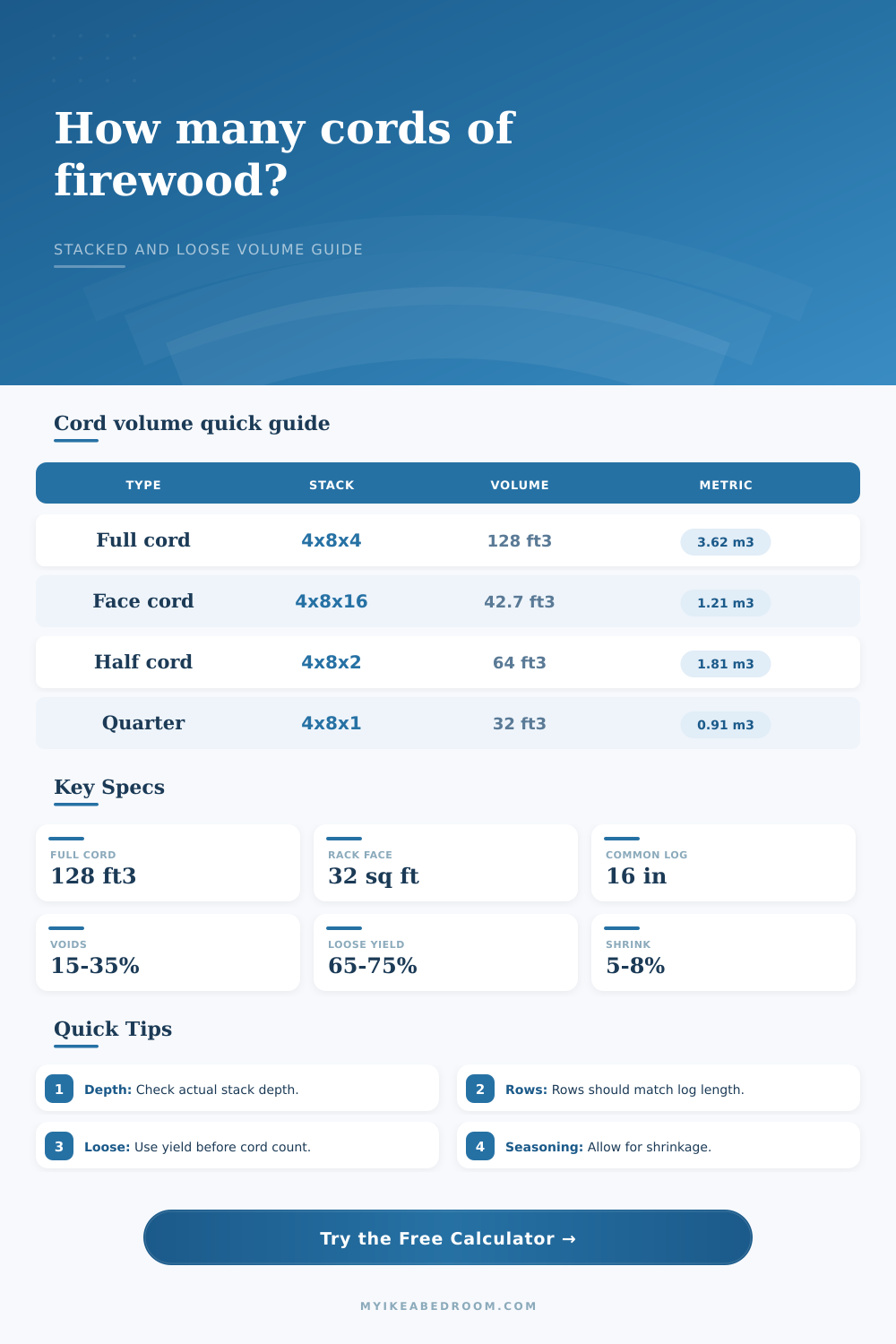
| Full cord | 4 ft × 8 ft × 4 ft | 128 ft³ / 3.62 m³ | 1.00 cord |
| Half cord | 4 ft × 8 ft × 2 ft | 64 ft³ / 1.81 m³ | 0.50 cord |
| Face cord, 16 in | 4 ft × 8 ft × 16 in | 42.7 ft³ / 1.21 m³ | 0.33 cord |
| Face cord, 18 in | 4 ft × 8 ft × 18 in | 48 ft³ / 1.36 m³ | 0.38 cord |
| Quarter cord | 4 ft × 8 ft × 1 ft | 32 ft³ / 0.91 m³ | 0.25 cord |
| Loose condition | Yield to stacked | Loose ft³ per full cord | When to use it |
|---|---|---|---|
| Very loose tossed splits | 60% | 213 ft³ | Fresh dump trailer, little settling |
| Average loose delivery | 70% | 183 ft³ | Typical tipped pile or truck bed |
| Settled loose pile | 75% | 171 ft³ | Load has bounced or settled |
| Loose crate stack | 80% | 160 ft³ | Contained crate with straighter pieces |
| Hand stacked rack | 100% | 128 ft³ | Use stacked measurement directly |
| Log length | One face cord volume | Rows for 4 ft depth | Full cord share |
|---|---|---|---|
| 12 in / 30 cm | 32 ft³ | 4 rows | 0.25 cord |
| 16 in / 41 cm | 42.7 ft³ | 3 rows | 0.33 cord |
| 18 in / 46 cm | 48 ft³ | 2.7 rows | 0.38 cord |
| 20 in / 51 cm | 53.3 ft³ | 2.4 rows | 0.42 cord |
| 24 in / 61 cm | 64 ft³ | 2 rows | 0.50 cord |
| Wood condition | Void factor | Shrinkage allowance | Calculator note |
|---|---|---|---|
| Straight uniform splits | 15% to 22% | 3% to 5% | Tightest common stack |
| Mixed household splits | 22% to 30% | 5% to 8% | Good default for stacked wood |
| Rounds and chunky pieces | 28% to 38% | 4% to 7% | More air pockets between logs |
| Small stove splits | 18% to 26% | 6% to 9% | Many pieces, fairly tight stack |
| Slabwood and odd offcuts | 35% to 45% | 3% to 7% | Irregular shape needs caution |
| Stack example | Dimensions | Stacked volume | Cord equivalent |
|---|---|---|---|
| Small porch rack | 4 ft × 4 ft × 16 in | 21.3 ft³ | 0.17 cord |
| Face cord rack | 8 ft × 4 ft × 16 in | 42.7 ft³ | 0.33 cord |
| Double face row | 8 ft × 4 ft × 32 in | 85.3 ft³ | 0.67 cord |
| Full cord bay | 8 ft × 4 ft × 4 ft | 128 ft³ | 1.00 cord |
| Two-cord shed | 16 ft × 4 ft × 4 ft | 256 ft³ | 2.00 cords |
A cord (the standard unit of stacked firewood) contain 128 cubic feet. When I order firewood, however, it never come that way. Sometimes there’s one row on my porch rack, sometimes I get a loose pile delivered to my driveway. Other times it’s a chaotic heap in somebody’s pickup truck.
The dimensions you enter into the calculator do all the conversion and coefficient guessing for you, converting those irregular shapes into an easy-to-understand volume so you know actualy what you are paying for. What do those numbers mean?
How to Measure Your Firewood Pile
First off, a cord isn’t all solid wood; it’s a measure of stacked space. That means that a full cord (standard size) have eight-foot length, four-foot height, and four-foot depth. It is the geometry of box. But within that box there is only approximately 75% real wood, everything else are airspace between the split logs. That difference is important since what you’re buying is the space the wood takes up including all that empty space.
When you measure a pile of firewood, you has to make allowances for additional airspace if it’s a loose pile. Because a tossed pile settles when stacked, you reduce its volume by interlocking the pieces. That’s why the tool also ask for the yield factor for a loose-to-stacked pile.
A lot of folks mix up a full and face cord. A full cord has sixteen inches of wood on top (the “face”). A face cord have only one layer or row, which mean it has only a third as much wood. Sometimes when selling firewood, sellers will not specify the depth and leave it implied that they’re offering a full cord. With the calculator, you can enter how many rows there is across the width/depth and that clears things up, do you have a deep stack in your shed, or is this thin rack? If you’ve got a row of three, each at sixteen inches, you’re getting close to a full cord’s depth. It is an easy double-check to avoid costly confusion.
One other variable that’s frequently overlooked are moisture shrinkage. Wet wood take up more space different than it will once it dries out. During the winter months of drying out and seasoning, the wood fibers will settle down and contract, decreasing your apparent pile size by a couple or even a few percentage points. There’s a space on the tool where you can input your moisture shrinkage allowance to account for this seasonal settling. It is a small thing but it is important if you are aiming for a particular heat output per season. You don’t necessarily want to know how large your pile is in October; you want to know how much useable fuel you’ll have come February.
On the page are also reference tables that lay out typical scenarios like the amount of material you can get for a loose trailer delivery and how much will fit into each bay on a shed. It help ground all these numbers in something real. How many times have you heard “I’ve got X cords of firewood” but forgotten to convert it yourself? Seventy percent is typical once you stack a pile tight. Leave that off, and you’ll over-estimate what you have. When you choose “loose” as your measurement type, the calculator handle that adjustment for you. Just enter the approximate size of your pile.
It is about control. That’s what knowing how much wood you have means. Knowing won’t keep you from running out of firewood in the middle of winter, but it will stop you from paying to much for air, which is just as important. Regardless of whether you buy your fuel wood or split your own, taking a few minutes to do the math and get a sense of amount really matters.
The numbers don’t lie: When you look at the true cubic footage, you’ll heat with confidence, planning based off the actual amount of fuel available to you. No more guesswork…you know what’s up there, and you’re not going to run out.