Fire Pit Patio Size Calculator
Estimate the finished patio diameter or length by width for a fire pit seating layout using pit size, chair depth, circulation aisle, heat clearance, side table room, border, shape, and walkway entry.
Load a real fire pit patio arrangement, then tune the clearances for the exact chair style, walkway opening, and border you want to keep clear.
| Seating type | Typical depth | Front heat gap | Planning note |
|---|---|---|---|
| Upright dining chair | 2.0 to 2.5 ft | 3.0 to 3.5 ft | Works for compact patios where chairs are not deeply reclined. |
| Club chair | 2.7 to 3.2 ft | 3.5 to 4.0 ft | Needs more back clearance because the seat is wider and heavier. |
| Adirondack chair | 3.2 to 3.8 ft | 4.0 to 5.0 ft | Deep recline pushes the outer patio edge farther away from the pit. |
| Outdoor sofa | 3.0 to 3.6 ft | 3.5 to 4.5 ft | Best in rectangle or oval layouts with a wider entry opening. |
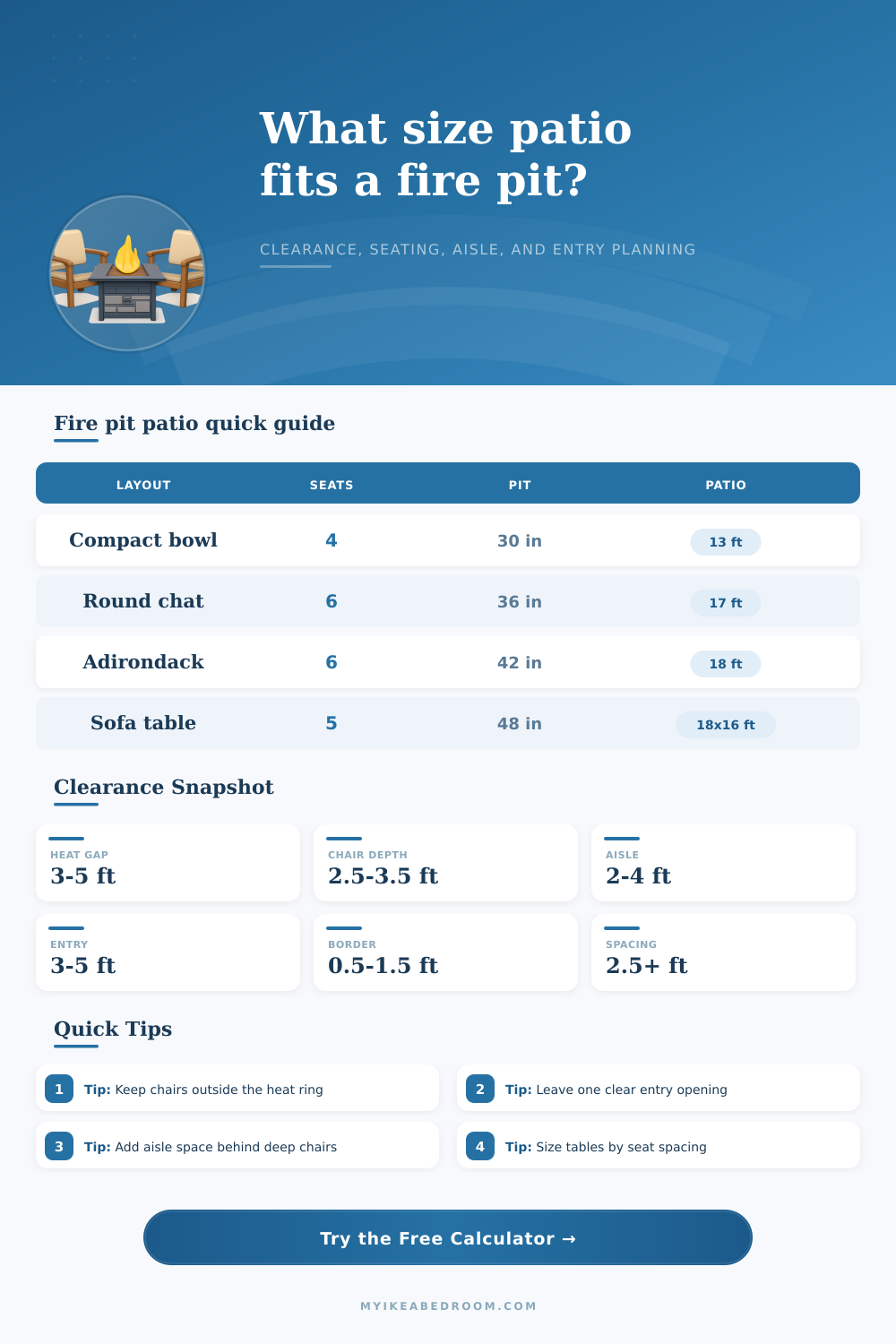
| Arrangement | Seats | Pit diameter | Usual patio diameter |
|---|---|---|---|
| Small bowl with slim chairs | 4 | 2.5 ft | 12 to 14 ft |
| Round conversation group | 5 to 6 | 3.0 ft | 15 to 18 ft |
| Adirondack circle | 5 to 6 | 3.5 ft | 17 to 20 ft |
| Large lounge ring | 7 to 8 | 4.0 ft | 20 to 24 ft |
| Clearance item | Compact | Comfortable | Use when |
|---|---|---|---|
| Entry opening through seating arc | 3.0 ft | 4.0 to 5.0 ft | Guests should be able to enter without squeezing between chair backs. |
| Behind-chair circulation aisle | 2.0 ft | 3.0 to 4.0 ft | Use the larger band when chairs are moved often. |
| Outer border or paver band | 0.5 ft | 1.0 to 1.5 ft | Useful for edge restraint, gravel bands, or planting transitions. |
| Entry landing depth | 2.0 ft | 3.0 to 5.0 ft | Adds a small clear landing where the walkway meets the patio. |
| Table rhythm | Add per seat | Best fit | Spacing effect |
|---|---|---|---|
| No side tables | 0 ft | Dining chairs or benches | Patio size is driven mostly by heat and chair depth. |
| Shared small tables | 0.5 to 0.8 ft | Four to six chair circles | Adds tangent arc so chairs do not crowd cup tables. |
| Table between most chairs | 1.0 to 1.3 ft | Adirondack or club seating | Often makes seating arc the size driver. |
| Deep lounge layout | 1.4 to 1.8 ft | Sofas, chaises, and ottomans | Usually works better in rectangle or oval patios. |
When planning a patio for a fire pit, one must take into consideration more than just the size of the fire pit. Many people makes the mistake of only measuring the fire pit to determine the size of there patio. Beyond the fire pit itself, you must make calculations for the area required for heat dissipation, seating area, and the circulation of individuals movement within the patio altogether.
If these three areas are not include in the calculation of the total size of the patio, the patio will likely be too small for the individual that will use it. The area for heat dissipation is referred to as a heat gap, and such an area must be included in the plan for the patio. Such a gap is necessary in order to prevent the individuals from feeling too hotly while sitting within the patio area.
How to Plan a Patio for a Fire Pit
The heat gap can not be too large, however, or the individuals may feel too cold while sitting around the fire. In addition to the heat gap, you must also consider the depth of the chair. The depth of the chairs will vary according to the types of chairs that you are to be used in the patio area.
Deep chairs, like Adirondack chairs, will require more space than standard chair. Thus, the depth of each chair must be measured prior to the construction of the patio. In addition to the areas for the fire pit, the chairs, and the heat gap, an area for circulation of the individuals must be provided.
Such an area will allow for the individuals to walk around the patio area without colliding with the patio furniture or the other individuals that is using the patio. By providing such an area, the patio will remain functional for the number of individuals that will use it. The inclusion of these three areas will increase the total diameter of the patio overall.
The shape of the patio will also help to dictate the type of use that it will have within the area. Round patios are common, and often provide for an even distance between each individual and the center of the fire. Round patios, however, may leave areas of grass unused within small yard.
Rectangular and square patios may be more efficient in the area that is available, especially with the use of sectional sofas. These shapes, however, may lead to dead space within the corner of the patio. An oval patio may provide some benefits as a middle ground between a round and rectangular patio.
The type of furniture that you are to be used within the patio will dictate the size of the patio. Adirondack chairs, for instance, are deep chairs that require more space than other types of chair. Thus, the depth of each chair will have an impact upon the total size of the patio.
Such measurements must be made before the construction of the patio. In addition to the size of the patio, you must also plan the entry point for individuals into the patio area. If the patio area is established as a complete circle, it is possible that the chairs will prevent individuals from entering the patio.
An opening must be provided in the circle of chairs to allow for entry into the patio area. Because this creates less seating area, the patio may need to be made larger to provide for the same number of individuals. Thus, making the patio larger to provide for entry points to the patio is necessary.
Finally, another consideration is in the size of the heat gap. The heat radiated from the fire may be more or less heat based off the type of wood that is used within the fire. The heat may also leave the patio if there is strong wind.
Thus, providing for a heat gap that is more than necessary will allow for the patio to remain comfortable for the individuals in the area. Thus, calculating each of these factor will ensure that the patio will be functional for the individuals that use it.