Fire Pit Gas BTU Calculator
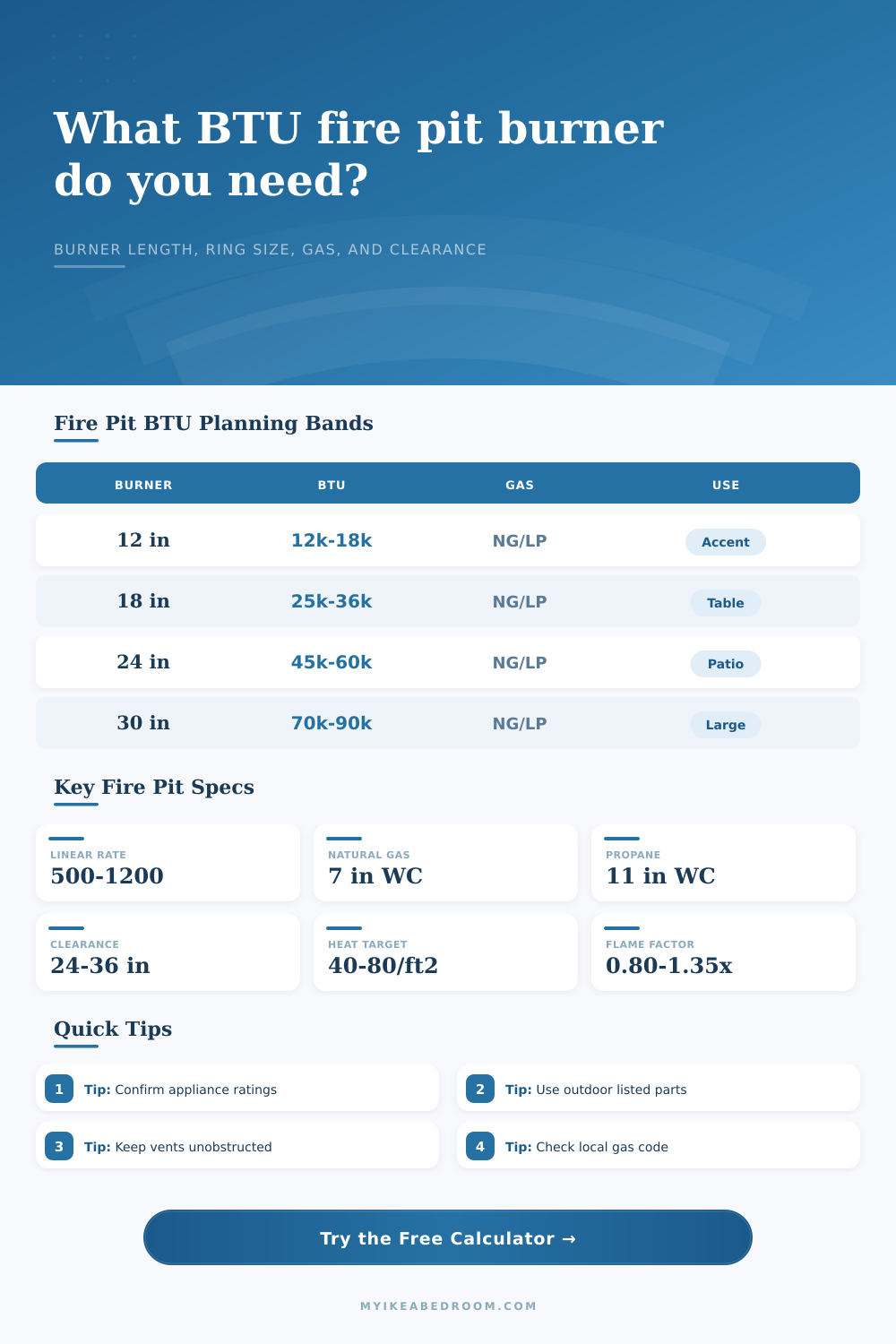
Estimate outdoor fire pit BTU/hr from burner length or ring diameter, BTU per linear inch, gas type, flame height, inlet pressure, patio heat target, and clearance.
🔥Burner and Fire Pit Presets
⚙Gas BTU Inputs
Fire pit gas BTU result
🧮Core Fire Pit Reference Cards
📊Fire Pit BTU Reference Tables
| Burner size | Equivalent length | At 750 BTU/in | At 1,000 BTU/in |
|---|---|---|---|
| 12 in straight | 12 in | 9,000 BTU/hr | 12,000 BTU/hr |
| 18 in straight | 18 in | 13,500 BTU/hr | 18,000 BTU/hr |
| 24 in H burner | 41 in | 30,600 BTU/hr | 40,800 BTU/hr |
| 18 in ring | 57 in | 42,400 BTU/hr | 56,500 BTU/hr |
| 24 in ring | 75 in | 56,500 BTU/hr | 75,400 BTU/hr |
| 30 in dual ring | 141 in | 106,000 BTU/hr | 141,400 BTU/hr |
| Rate setting | BTU/hr per inch | Best match | Flame note |
|---|---|---|---|
| Low ribbon | 500 | Narrow table slot | Small visible flame |
| Steady flame | 750 | Conversation table | Balanced appearance |
| Full flame | 1,000 | Most patio pits | Common planning value |
| High flame | 1,200 | Large open bowl | Needs careful gas supply |
| Use case | BTU/hr per ft² | 100 ft² target | Planning note |
|---|---|---|---|
| Ambience only | 40 | 4,000 BTU/hr | Visual flame focus |
| Cool evening | 55 | 5,500 BTU/hr | Light seating comfort |
| Breezy patio | 70 | 7,000 BTU/hr | Open air loss allowed |
| Exposed area | 85 | 8,500 BTU/hr | Wind reduces useful heat |
| Gas type | Reference pressure | BTU flow rule | Use in calculator |
|---|---|---|---|
| Natural gas | 7 in WC | BTU/hr / 1,030 | Shows cubic ft/hr |
| Propane | 11 in WC | BTU/hr / 21,600 | Shows lb/hr |
| Lower pressure | Below reference | Square root factor | Reduces burner estimate |
| Higher pressure | Above reference | Square root factor | Raises review need |
| Clearance result | Ratio | Calculator status | Planning response |
|---|---|---|---|
| Meets target | 100% or more | Clearance ok | Use listed appliance limits |
| Close | 85% to 99% | Review | Confirm exact manual clearance |
| Short | 60% to 84% | Reduce flame | Move combustibles or lower input |
| Very short | Below 60% | Stop and review | Do not treat as ready |
| Scenario | Burner setup | Typical BTU band | Gas planning note |
|---|---|---|---|
| Small table insert | 12 to 18 in linear | 12,000 to 25,000 | Works with modest flame settings |
| Rectangular patio pan | 24 to 30 in linear | 35,000 to 60,000 | Check supply line capacity |
| Round bowl pit | 18 to 24 in ring | 45,000 to 80,000 | Ring diameter drives output |
| Large dual ring | 24 to 30 in dual | 90,000 to 140,000 | Needs serious gas volume review |
| H burner feature | 30 to 36 in H layout | 50,000 to 90,000 | Branch length increases BTU |
| Wide lounge flame | 36 in linear | 45,000 to 70,000 | Pressure drop can matter |
💡BTU Planning Tips
When most folks purchase a new gas fire pit, there’s a certain panic that sets in. They attempt to light it up for the first time and notice the fire lacks a roaring inferno, having only a sad blue ribbon instead. You paid good money for this. For the furnitures and the stone bowl. And you want a show. What you got was a simmer.
Turns out, the issue isn’t with the pit itself. Rather it’s about the math. It is about the size of the burner versus the size of your gas supply. Most homeowners base their guesses of BTUs required by how large they think the fire will be in the catalog photo. In doing so, they neglect actual surface area of the burner and physical constraints of their gas line. That leads to disappointment.
How to Choose the Right Gas Fire Pit Size
After that, all you do is plug in your dimensions and the calculator does the rest. It links the physical size of your burner with the thermal output needed for your space.
So first you define how your burners is laid out: Do you have a round ring burner? Or a straight linear tube? How wide is it? That’s important because a round ring with a diameter of twenty-four inches has vastly more surface area than does a straight line of twenty-four inches. The calculator figures out the circumference for you, and next applies its BTU per linear inch rate which is the key factor.
Is it a low ribbon flame? It is five hundred BTUs per inch. Is it a full roaring flame? It is one thousand or more. What do you want? Choose between a high flame (for drama) or a gentle glow (for mood). Everything else depends on the input you make here.
The next one is the kind of gas. Natural gas and propane do not behave the same. Propane runs at a higher reference pressure and has more energy density than natural gas, which runs at a lower pressure. This means the tool take into account what kind of gas you are running to adjust how much it calculates the flow should be.
So if you selected natural gas as your fuel source but have a weak regulator or very thin gas line to your fire pit so the inlet pressure drops then the flame shrinks. The calculator has a pressure adjustment so you can see if your supply is enough for the burner you selected. It is related through square root rule, so small changes in pressure makes a noticeable change in output. It is a small thing, but it matters.
And then there’s the room. In this case, it is the patio. Input the square footage of the seating area you wish to warm. It will tell you if that amount of heat is enough to keep you comfortable based off your burners’ output, or if you are simply wasting money on visual appeal. Being warm is quite different than looking warm. An accent burner might make an awesome addition to your design, but not add one bit of warmth to the air. Likewise, a giant patio burner may be more than necessary for heating a small table. This tool aims to strike that balance.
The last bit of the puzzle is safety. And this is where I think people tend to skip over the clearance check. You measure distance from your fire to any nearby furniture or walls, and then compare it against standard safety targets. In other words, if you have limited space, don’t expect to be able to turn up the BTUs and get away with it, the flame will hit something that you’d prefer not to catch on fire. Better to scale down the input in this situation than run the risk. The page has reference tables that make this clear. They show which burner size fit each type of setting, such as a coffee table versus a large lounge area.
A lot of folks overthink this project and forget the basics. Then they install the largest burner that will fit and are left wondering what went wrong.
Here’s the deal: match the supply to the space and match the supply to the hardware. Respect the gas pressure limits. And respect the clearance requirements. The calculator takes the guesswork out of initial planning and provides a baseline for the fire pit. It allows you to find out whether your dream fire pit is physically possible using your current setup. If the numbers don’t look right then you can change the flame height or change the size of the burner before spending a dime. It’s a simple check that will save you a lot of trouble down the road.
Get the pressure right and get the size right and you’ll get the fire you want. You should of checked it first.