Fence Stain Calculator
Estimate exterior wood stain from fence length, height, open gaps, sides, texture absorption, coats, post and rail allowance, and brush or sprayer waste.
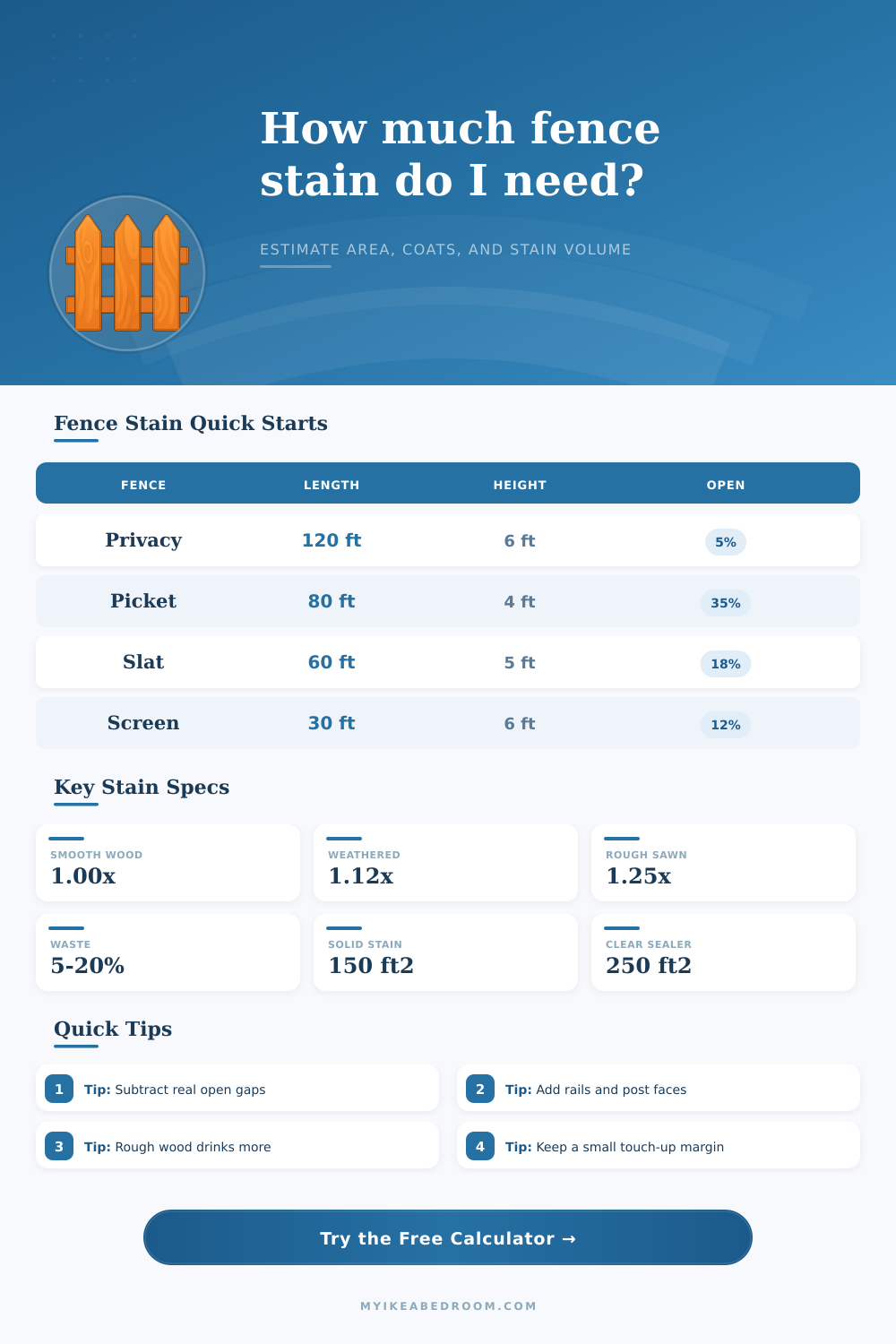
Presets use real outdoor fence patterns. Select one, then adjust the measurements and coating assumptions for your fence.
Clear sealer
Typical coverage: 200 to 300 sq ft per gallon on smooth boards.
Use when: the wood is even, clean, and needs water repellency more than color.
Semi-transparent stain
Typical coverage: 150 to 250 sq ft per gallon depending on species and age.
Use when: grain should show and fence color only needs moderate evening.
Semi-solid stain
Typical coverage: 125 to 200 sq ft per gallon with stronger pigment load.
Use when: weathering is visible but some board texture should remain readable.
Solid stain
Typical coverage: 100 to 175 sq ft per gallon, often with two thin coats.
Use when: old boards, color mismatch, or repaired sections need the most uniform finish.
| Fence style | Typical open area | Sides usually coated | Post and rail allowance | Calculator note |
|---|---|---|---|---|
| Board-on-board privacy | 0% to 5% | 1 or 2 | 10% to 18% | Little gap deduction, but many edges and overlaps. |
| Standard privacy panel | 3% to 8% | 1 or 2 | 10% to 15% | Good default for vertical cedar or pine boards. |
| Picket fence | 25% to 45% | 2 | 15% to 25% | Open gaps reduce panel area, but picket edges add work. |
| Horizontal slat fence | 10% to 25% | 1 or 2 | 8% to 16% | Use the actual spacing between slats for best results. |
| Post and rail | 60% to 80% | All visible faces | 25% to 45% | High open area, but rails and posts dominate the stain need. |
| Wood surface | Factor | Why it changes volume | Coverage adjustment | Best input choice |
|---|---|---|---|---|
| Smooth planed boards | 1.00x | Tight fibers hold stain near label coverage. | No increase | New smooth pine, fir, or sanded panels. |
| Sanded cedar or redwood | 1.08x | Open-grain softwood absorbs slightly more. | Add 8% | Fresh cedar pickets or redwood screens. |
| Weathered older boards | 1.12x | Sun-raised grain and checks drink extra stain. | Add 12% | Cleaned fence boards that feel dry or fuzzy. |
| Rough-sawn fence boards | 1.25x | Texture and end fibers create more surface. | Add 25% | Rough cedar, ranch panels, and saw-textured boards. |
| Very porous or thirsty wood | 1.35x | Deep weathering can pull stain below the surface. | Add 35% | Old softwood, repaired panels, or uneven reclaimed boards. |
| Product type | Smooth wood | Weathered wood | Rough-sawn wood | Metric equivalent |
|---|---|---|---|---|
| Clear water repellent | 250 to 300 sq ft/gal | 200 to 250 sq ft/gal | 150 to 200 sq ft/gal | 6.1 to 7.4 m²/L smooth |
| Transparent oil stain | 200 to 275 sq ft/gal | 175 to 225 sq ft/gal | 130 to 180 sq ft/gal | 4.9 to 6.7 m²/L smooth |
| Semi-transparent stain | 150 to 250 sq ft/gal | 125 to 200 sq ft/gal | 100 to 160 sq ft/gal | 3.7 to 6.1 m²/L smooth |
| Semi-solid stain | 125 to 200 sq ft/gal | 110 to 175 sq ft/gal | 90 to 140 sq ft/gal | 3.1 to 4.9 m²/L smooth |
| Solid color stain | 100 to 175 sq ft/gal | 90 to 150 sq ft/gal | 75 to 125 sq ft/gal | 2.5 to 4.3 m²/L smooth |
| Project | Starting dimensions | Open area | Texture | Waste range |
|---|---|---|---|---|
| Backyard privacy run | 120 ft x 6 ft x 2 sides | 5% | Rough-sawn | 10% to 15% |
| Front picket fence | 80 ft x 4 ft x 2 sides | 35% | Sanded cedar | 8% to 12% |
| Horizontal patio screen | 60 ft x 5 ft x 1 side | 18% | Smooth planed | 5% to 10% |
| Deck railing panels | 45 ft x 3 ft x 2 sides | 55% | Weathered | 12% to 18% |
| Garden screen or gate | 30 ft x 6 ft x 2 sides | 12% | Cedar or redwood | 8% to 15% |
Measure the true open area. For pickets, slats, lattice, and rail fences, subtract the actual gaps before adding post and rail allowance. This keeps a high-open fence from being treated like a solid wall.
Separate texture from waste. Rough-sawn wood increases the area that drinks stain, while overspray and brush waste is a handling margin. Keeping them separate gives a cleaner estimate.
One downside of buying too little fence stain is having 5 feet of cedar left with only one quart of stain to cover it. What happened? You assumed a fence was a flat wall and applied the same principle as a flat wall. Fence is a three dimensional object that are textured, has gaps, and areas you cannot reach. Plus you went to hardware store at dusk and then waited for rain to pass. Now the wood isn’t dry but you are prepping it. Don’t let this happen! Learn about effects of fence shape on products required.
When you plug in dimensions into calculator on page, it figures out rest of math. It spares you guessing at conversions and other coefficients. But to not mess up, you need to know what all these numbers represent.
How to Calculate Fence Stain Needs
A lot of folks think a six-foot privacy fence means length times height. Wrong. A lot of those privacy fences is solid. However, stain soaks into them rapidely because of end grain, overlaps, and nail holes. To compensate, the tool allow you to pick a wood texture factor. Although rough-sawn boards may appear flat from across yard, up close they feature peaks and valleys. They present an additional surface area that needs more product then smooth siding would, even though the colored finish looks the same.
Another factor that can impact stain usage is open space. Large areas like spaces between picket on a fence, large horizontal slat fencing, large open screen in gardens, etc., will have big gaps that do not touch any stain. You are paying for the footprint of those open spaces. On something like a picket fence, you can use our calculator to take that portion out immediately to ensure an accurate estimate.
Clear sealers and solid stains acts different than open wood. In some cases, they will simply not cover the gap at all. Semi-solid stains need to bridge gaps without running off edges. The balance here is what makes the difference between a nice even finish or one with streaks emphasizing every shadow line in your design.
Rails and posts are another thing people tend to forget until they’re out of product. Most of the time we see vertical boards which gets all of the attention. But those eight-foot posts has four sides to them as well. They’ve got corners and caps too which will use material at twice the rate of their flat facing surfaces. Giving yourself a percentage allowance for those structural components will ensure you don’t run dry when you reach the corners. It is a little tweak, but one that makes a difference. The tool does this so you won’t be surprised when a lot of your product goes into end grain of your support columns.
Another cost to consider is waste. Brushing a fence in high winds feels like painting a ghost, because half the stain lands on grass or drifts back onto already-coated sections. And even with a sprayer, it’ll land on parts you’ve already painted and blow back toward them again. That’s why I added a waste margin field to calculator. If you are using a sprayer on a windy afternoon, fifteen percent would of been a reasonable guess (not paranoid), just realistic. Better to have a half-gallon of leftover touch-up paint than a need to visit a now-closed hardware store to buy some more.
This page lists the average coverage rate of each type of stain. Use this table to determine how much you need in gallons by deciding between a clear, penetrating, oil finish versus a solid stain. Because solid colors are more like paint, which covers well and hides imperfection, they will also go on thick and only cover so far. On the other hand, clear oils penetrate further into wood fibers. Since they don’t sit on top, they thin into the wood, so they covers less per gallon. How many gallons you need changes dramaticly based off what product you select. Read the label before relying too heavily on the estimate.
There’s math involved with staining a fence. And I don’t mean it’s a work of art; it’s a math problem. There’s no altering the shape of overlapping slats, or the porous nature of weathered cedar. The numbers do what they do. The key is measuring twice and calculating once. That keeps both your budget and the duration of your weekend under control. It turns a Saturday afternoon project into a long weekend of supply runs. Because it’s not simply about covering the wood; it’s about finishing the task before the dew settles and sun sinks below horizon.