Fence Rail Quantity Calculator
Estimate fence bay count, rail stock pieces, rail rows, total linear length, post count, overlap or scarf allowance, cuts, offcuts, waste, and fasteners for privacy, picket, ranch, screen, stepped, and gate sections.
Load a common rail layout, then adjust measured run, post spacing, rail rows, stock length, gate openings, corner or end posts, scarf allowance, fasteners, and waste.
2x4 wood rails
Best for: privacy, picket, and shadowbox fence runs.
Common stock lengths are 8 ft, 10 ft, and 12 ft. Two fasteners at each end are typical.
Vinyl rail kits
Best for: panelized fences with routed posts.
Kit rails often match fixed post centers, so use the kit span as the stock length.
Metal tube rails
Best for: ranch, pool, and clean modern layouts.
Longer stock can reduce splices, but brackets may set the true clear bay length.
Round ranch rails
Best for: open boundary and field fencing.
Use 12 ft or 16 ft stock when posts can be spaced to match the rail system.
| Preset | Typical use | Starting rows | Rail stock |
|---|---|---|---|
| Privacy fence rails | Tall wood fence with pickets or boards attached to rails. | 3 rows | 8 ft 2x4 rails |
| Picket fence rails | Lower front or garden fence with lighter pickets. | 2 rows | 8 ft 2x3 or 2x4 rails |
| Ranch rail fence | Open field or driveway edge with longer post spacing. | 3 rows | 12 ft to 16 ft rails |
| Garden screen | Short privacy screen, planter edge, or patio divider. | 2 to 3 rows | 6 ft to 8 ft slim rails |
| Stepped fence run | Sloped boundary where rails are cut bay by bay. | 3 rows | 8 ft rails with higher waste |
| Fence style | Usual rail rows | Post spacing target | Planning note |
|---|---|---|---|
| 3 ft to 4 ft picket | 2 rows | 6 ft to 8 ft | Add a third row if pickets are heavy or wind exposure is high. |
| 5 ft to 6 ft privacy | 3 rows | 6 ft to 8 ft | Top, middle, and bottom rails keep boards flatter. |
| 7 ft to 8 ft privacy | 4 rows | 6 ft to 8 ft | Taller fences need more rail support and stronger posts. |
| Ranch or field rail | 2 to 4 rows | 8 ft to 12 ft | Match post spacing to the rail length where possible. |
| Decorative screen | 2 to 3 rows | 4 ft to 6 ft | Shorter bays reduce flex in slim rail profiles. |
| Stock length | Good bay match | Typical offcut pattern | Use when |
|---|---|---|---|
| 6 ft stock | 4 ft to 6 ft bays | Small offcuts when posts are tight. | Garden screens, gates, and short decorative runs. |
| 8 ft stock | 6 ft to 8 ft bays | Moderate offcuts on stepped or corner runs. | Most privacy and picket fence rails. |
| 10 ft stock | 5 ft or 10 ft rhythm | Can split into two shorter bays cleanly. | Custom layouts with regular half-length bays. |
| 12 ft stock | 6 ft or 12 ft rhythm | Efficient on ranch and long straight runs. | Long rails where transport and handling are practical. |
| 16 ft stock | 8 ft or 16 ft rhythm | Fewer splices but longer leftover pieces. | Open ranch rails and straight boundary runs. |
| Rail connection | Fasteners per end | Ends per bay rail | Calculator model |
|---|---|---|---|
| Wood rail to post face | 2 screws or nails | 2 ends | Bay count x rows x 2 ends x fasteners per end. |
| Rail bracket or clip | 2 to 4 screws | 2 brackets | Enter bracket screw count as fasteners per rail end. |
| Vinyl routed rail | 0 to 2 locks | 2 ends | Use the field for clips, locks, or screws actually supplied. |
| Metal tube bracket | 2 to 4 screws or bolts | 2 ends | Add separate anchor hardware if brackets fasten to masonry. |
| Spliced continuous rail | Extra splice screws | At stock joints | The calculator adds a splice fastener allowance from rail pieces. |
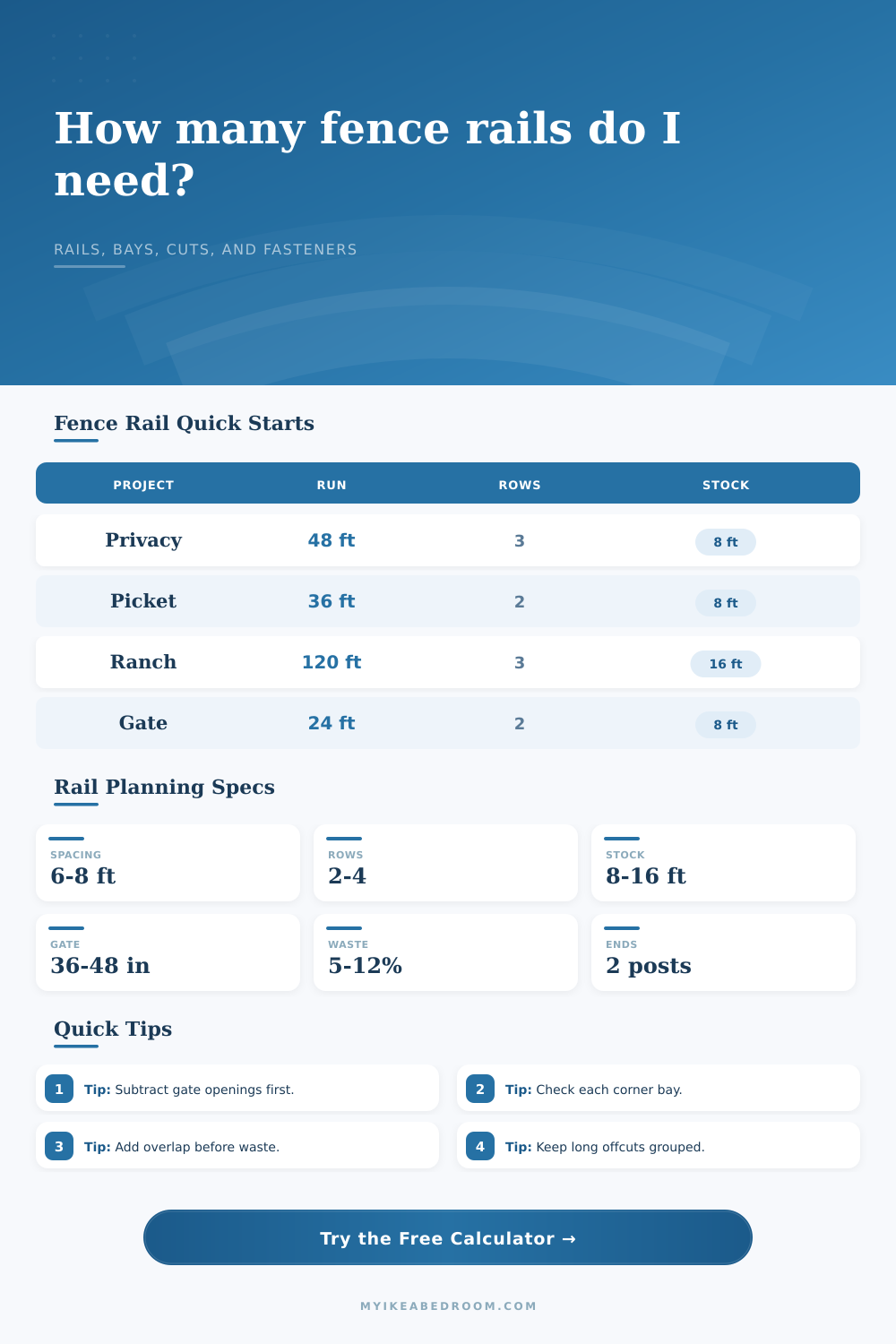
Separate gate openings from rail length. Subtract gates before solving bays, then add the gate-side posts and any extra rails for the gate frame as a separate checklist item.
Match stock length to the bay rhythm. If the offcut pool is high, adjust post spacing slightly or choose longer stock so repeated bays cut cleaner.
Is the board long? No problem… Unless that fence is longer than the board, causing panic standing there in the lumber aisle. It’s easy to do the math, then you have to add variables like corner returns and gates to cut through. Also, rail stock doesn’t always match post spacing exactley. A quantity calculator becomes the insurance policy.
It makes sure you don’t run short or buy too many by translating your dimensions into a list of what to order. This keeps you focused on keeping things right along the line.
How to Count Fence Materials Correctly
Homeowners tend to under-estimate how fast number of rails multiplies once you start adding bays and rows. Typically, a simple privacy fence use three horizontal rails that hold vertical boards well. With eight-foot high posts along a forty-eight-foot run, it may look like you only have to count six sections of board. But you need to remember that each gate opening interrupts the line of rails and adds extra post (on both sides) to frame out the gate. So you take away width of your gate from your total run, then you count your bays….then you add your structural posts back. Because if you don’t, you’ll scramble later for some short filler boards.
Material selection impacts waste and thought process when cutting. If you choose wood (the typical stuff: 2×4’s), you can easily splice pieces together to fit posts on center. This results in less waste because you don’t have to cut a single piece for each bay, unless they happens to line up perfectly anyway. The calculator accounts for that by allowing you to enter whatever the actual stock length is (say you’re building a garden screen in 8 foot bays versus building a ranch style fence with 16 ft long pieces). Fewer joints mean a better structure and it look cleaner too.
There is always a trade-off, though. You must choose between convenience and being efficient with materials. It’s a pain in the ass carrying 16ft long pieces around by yourself.
Until it’s too late, allowing for waste seems random. A common rule of thumb: tack on eight percent; add an additional 4 percent if there is lots of corners and turns or if you want more security (perhaps because the fence will be steeper). If you feel confident in your cuts and know how level your land is, you can alter that number accordingaly.
To compensate for overlapping or scarfed joints, meaning rails don’t span a bay at once, but instead get spliced into place, the tool factors in a couple of inches each time. This creates a secure locked joint between two boards. This is better than having them butt ends-to-ends which risks splitting apart as they stretch with use.
The second thing most folks overlook is estimating fasteners. They calculate how many screws they will need for pickets but fail to realize that rails must also be secured to posts, typically using two fasteners at either end. Multiply the rows (number of bays) by number of rails and then multiply by two because there are two ends per rail section. That’s quite a few more screws than you may have expected!
The page has a helpful reference table that spells this out, including how that math can change based off kit vs. You can also build it from brackets. This way you don’t end up making that last minute run to the hardware store which happens when you didn’t have enough. Shopping without stress saves money.
To save on materials, plan ahead so that all your posts are spaced as close to the same length as your stock. For example if the post calculator says there will be a lot of small scraps, move your post locations around a couple of inches, if your lot permits this little change can convert three short unusable pieces into an actual useable board. This is all about working with the grain of your material not against it.
There’s an element of math to fencing, too (it’s not just carpentry). You can create a neat-looking straight line or you can build a fence that stands up over time and is proportionate. Let the numbers dictate what you buy. Make sure the first set of measurements take their time; when those last screws are driven home, you’ll see why your fence holds strong. The confidence in it comes from knowing each rail has been checked before making any cuts.