Fence Picket Spacing Calculator
Set the picket count, gap, and order quantity for straight runs, corners, shadowbox panels, and sloped fence lines without losing clean spacing.
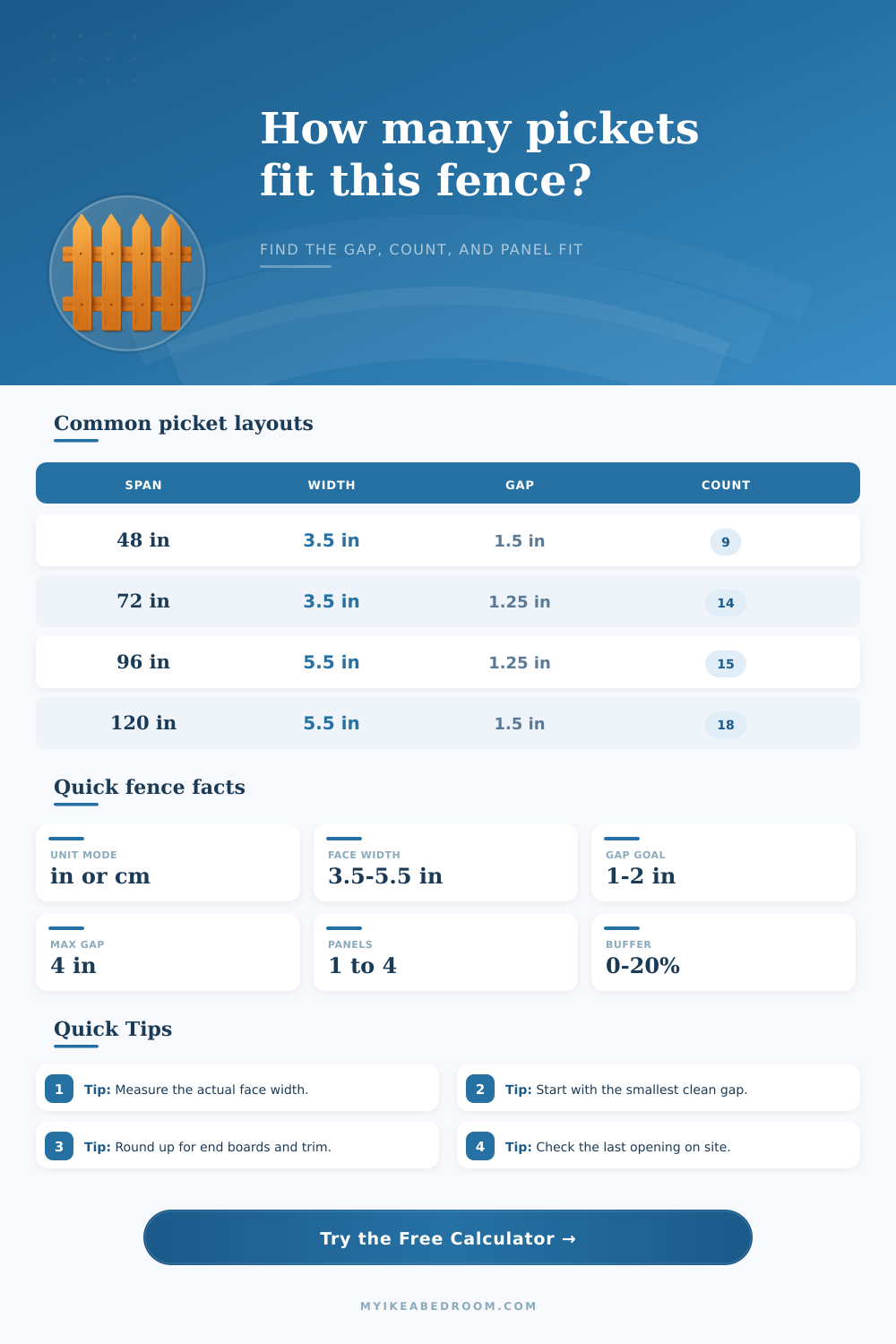
| Span example | Width | Gap | Count |
|---|---|---|---|
| 48 in run | 3.50 in | 1.50 in | 10 |
| 60 in corner | 3.50 in | 1.25 in | 13 |
| 84 in screen | 5.50 in | 1.75 in | 12 |
| 120 in run | 3.50 in | 2.00 in | 22 |
| Picket profile | Wt/ft | Typical width | Best use |
|---|---|---|---|
| Cedar picket | 0.42 | 3.50 in | Classic privacy board |
| Pine picket | 0.46 | 3.50 in | Paint-ready board |
| Aluminum picket | 0.28 | 3.50 in | Slim modern look |
| Steel picket | 0.95 | 3.50 in | Rigid security fill |
| Opening | Meaning | Visual feel | Use case |
|---|---|---|---|
| 2.5 in | Tight | Dense | Privacy |
| 3.0 in | Balanced | Even | Most runs |
| 3.5 in | Open | Airy | Wide bays |
| 4.0 in | Code limit | Max safe | Check local |
| Imperial | Metric | Imperial | Metric |
|---|---|---|---|
| 1 in | 25.4 mm | 4 in | 101.6 mm |
| 12 in | 304.8 mm | 36 in | 914.4 mm |
| 48 in | 1.22 m | 96 in | 2.44 m |
| 120 in | 3.05 m | 144 in | 3.66 m |
Code-first fit
Uses the smallest count that keeps the opening under the limit. Best when the fence line must stay strict and predictable.
Balanced fit
Targets the chosen gap first, then adjusts count to fit the span. Best for a clean, symmetrical visual rhythm.
Tight privacy
Pushes spacing tighter than the target gap. Best for a more closed look on short sections or decorative runs.
Open screen
Leaves more breathing room while staying within the opening cap. Best for wide spans that need a lighter finish.
Measure the actual picket face, not the nominal label, then run the layout from the inside faces of the posts.
Snap a test line first, then check the last gap before cutting the full batch or ordering extras.
Fence picket spacing require precise mathematical calculation and careful measurement because incorrect calculation will result in incorrect spacing between fence picket and wasted fencing material. Although fence span is one measurement to take into consideration when calculating spacing between fence picket, it is not the only measurement that must be taken into consideration. The person must subtract the width of the post inset from the total span of the fence to find the clear distance that the pickets will occupy.
Once the person know the total clear distance for the fence picket, they can divide that total distance by the width of a single picket (including the desired gap between picket). Although the calculation yield an ideal number of picket to be used for the fence, the individual will have to round this number to the nearest whole picket. The actual width of the fence picket is often different than the labeled width of the fence picket.
How to Measure and Space Fence Pickets
For instance, an fence picket labeled as 1×4 may have a face width of 3.5 inches rather than the labels indicated 4 inches. The person must measure the actual face width of the fence picket to determine how many fence picket will fit into the total clear distance of the fence. If the person does not use the actual face width of the fence picket in the calculation of how many fence picket will be used in the fence, the gaps between fence picket will be even.
Additionally, the possible bevel and curve of the fence picket must be accounted for when calculating the total number of fence picket. The width of the gap between fence picket determine the privacy level that the fence will offer to the observation of the individual standing outside the fence line. Small gap between fence picket (such as 1 inch) will provide more privacy then fence picket with larger gap between the picket (such as 2 inch gap).
Additionally, larger gap between fence picket allow for the movement of air and light through the fence; however, local building code may limit the size of fence gap to a maximum of 4 inches. Large gap in fences may allow for small pet or children to pass through the fence line. If the fence design include slopes or corners, they will complicate the fence installation process.
On sloped lot, fence picket installed at an angle will appear to have larger gap between the picket from the ground. When building corner in the fence, the picket spacing should be symmetrical on both side of the fence corner to ensure even appearance of the fence. Additionally, fence panel made up of several fence picket should contain the same number of fence picket to ensure the even jointing of fence panel.
Additionally, end inset can be used to even further assist fence installation by enabling fence picket to be centered within the fence post. End inset provide a buffer for the fence picket to accommodate any irregularity in the fence post. Many fence builder may ignore the use of end inset; however, if end inset are ignored, the fence picket may even appear to have different size gap at each fence post.
Finally, it is a recommended practice to order extra fence picket (such as ten percent more picket than required) because some fence picket will inevitablly split or be cut incorrectly during the fence building process. Before nailing the fence picket to the fence frame, fence picket should be tested to ensure proper fit and spacing. Test picket should be placed within the fence without the use of nail to determine proper spacing between the picket.
Additionally, a chalk line can be snapped across the clear span of the fence to ensure the picket remain in a straight line. Testing the layout of fence picket with three test picket can help to verify the size of the gap between the fence picket. This test will allow the fence builder to determine the proper width between fence picket before installing the fence picket.
Finally, the size of the last gap between fence picket must be verified because the size of the last gap may not be the same as the other gap due to rounding error in the mathematical calculation of the number of fence picket. You should of checked the measurements twice so you dont waste alot of money on extra furnitures. Its actualy quite easy if you follow the plan.
The project could of gone faster if the worker dont make mistakes. One more thing, the pickets width is important.