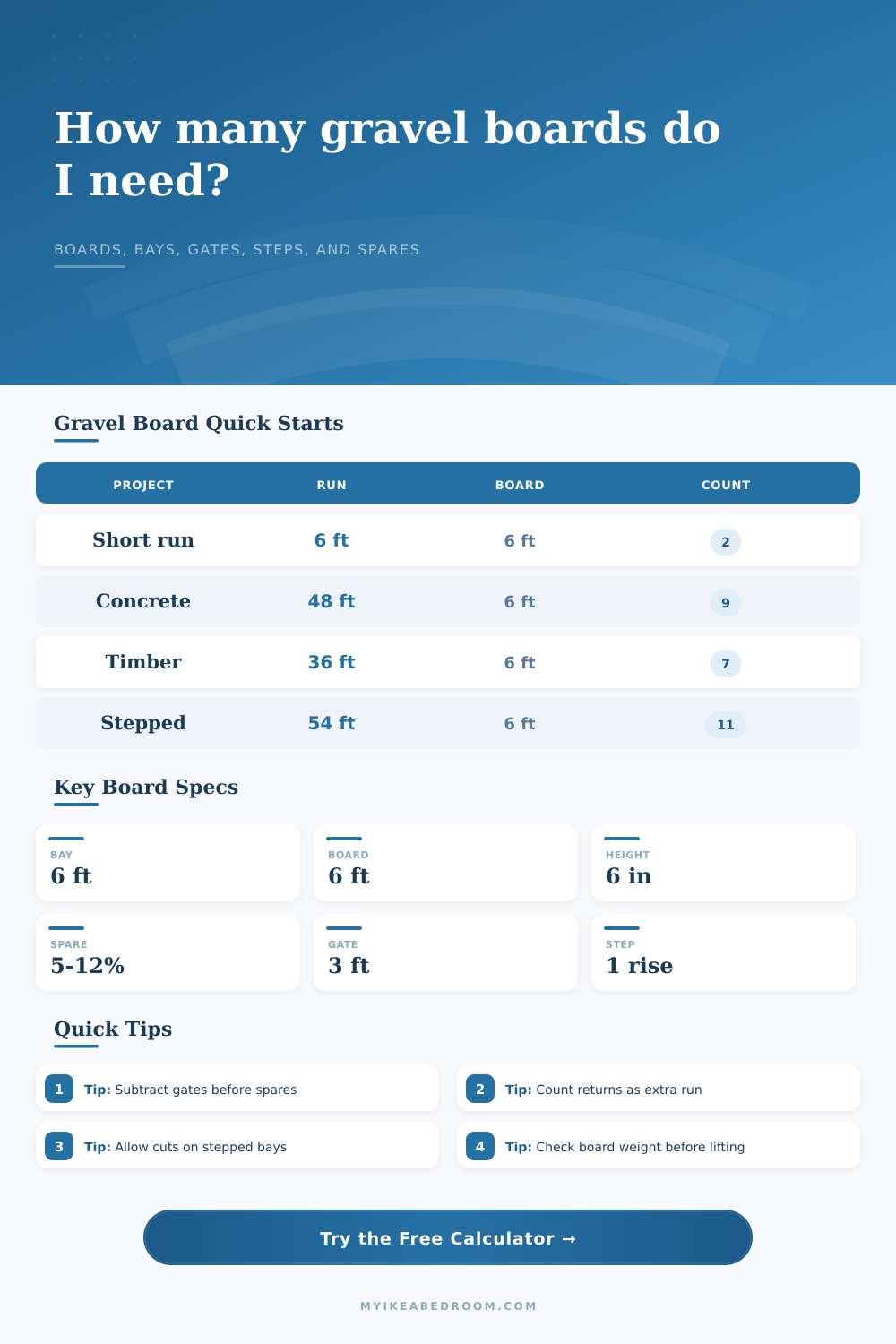
Fence Gravel Board Quantity Calculator
Estimate gravel boards from the usable fence run, bay width, board size, gate openings, corner returns, stepped height allowance, spares, and material weight.
▣Project presets
Choose a starting point, then adjust the measurements to match your fence layout.
〉Fence inputs
Gravel board estimate
▦Gravel board material comparison grid
☰Reference tables
| Formula item | Calculator formula | Why it matters | Result output |
|---|---|---|---|
| Net board run | Run + returns - gate openings | Only board the fence line that needs boards | Total linear length |
| Bay count | Ceiling(net run / bay width) | Rounds partial bays up to a working bay | Bay coverage |
| Board count | Full bay boards + cut bay boards + step boards | Handles short final bays and stepped risers | Boards before spare |
| Spare boards | Ceiling(raw boards x spare %) | Adds breakage and sorting allowance | Final board count |
| Common board size | Imperial equivalent | Typical bay use | Cutting note |
|---|---|---|---|
| 1.83 m x 150 mm | 6 ft x 6 in | One board per 6 ft bay | Usually no cut on square bays |
| 1.83 m x 300 mm | 6 ft x 12 in | Tall bottom board or raised base | Heavier; check post slots |
| 2.40 m x 150 mm | 7 ft 10 in x 6 in | Longer custom post spacing | Cut ends need sealing if timber |
| 3.00 m x 150 mm | 9 ft 10 in x 6 in | Continuous rails or custom bays | May need two-person handling |
| Preset | Main assumptions | Board outcome | Best used for |
|---|---|---|---|
| 6 ft fence run | One 6 ft bay, 5% spare | One working board plus spare rounding | Small repair or sample bay |
| Concrete boards | 48 ft run, 6 ft bays, 8% spare | Eight bays plus spare | Standard garden boundary |
| Stepped garden fence | 54 ft run, 6 slope steps | Extra board allowance for step faces | Sloping garden line |
| Gate bay | 42 ft run with one 3 ft opening | Gate opening deducted before spare | Run broken by a pedestrian gate |
| Adjustment | How to enter it | Calculator effect | Planning note |
|---|---|---|---|
| Gate openings | Count openings and average width | Subtracts total gate width from run | Measure between gate posts |
| Corner returns | Add the combined return length | Adds to the net board run | Include both sides of an L shape |
| Slope steps | Count each stepped board rise | Adds one board-height linear allowance | Useful for exposed step ends |
| Spare percentage | Use 5% to 15% for most runs | Rounds spare boards upward | Higher for concrete breakage risk |
!Calculation tips
Imagine a simple image of horizontal rails and vertical posts. It doesn’t look like that when it comes to rotting wood touching moist ground. Your bottom board might be lifted by mud, or rot away in a few years. That is not good. A gravel board are the answer. It absorbs all that abuse from curious pets, sprinklers and soil. Your fence panel remain nice and clean… and in one piece.
Quantity is key. These thing are heavy and cumbersome to work with. Typically they come on pallets in bulk which takes up space in your driveway till you use them. It is best to have enough to complete the project but not too much to store. Once you know the board specs and length of your run, the calculator above do the rest. No more guesswork about cut waste and partial bays.
Why You Need Gravel Boards
The next thing is how long is your fence line? How many metres will be used by boards? Measure all the straight bits and add on the return runs around corners. Gate openings count as a complete stop in the run. So if it’s a three foot gate then those three feet don’t require a gravel board beneath them. Don’t buy more than you need. Measure out the widths subtracting the gate early on.
The most common mistake is people forgetting to account for returns. Returns are small sections of fence that top off a T junction or an L shaped corner. They can really add up fast across a big area, but they still needs to be kept off the ground. The number of cuts you’ll do depends on the length of your board, which also determines how many bays you can install. A standard six foot long board fit perfectly into a standard six foot bay. In this case you never have to make a cut.
But life isn’t always so tidy. What if your last bay is only four feet? Or maybe all your post spacing are five feet apart instead? You’re going to have to cut the board down to size. That means pulling out the diamond blade saw and doing some concrete cutting, which makes a lot of dust. Or, for timber, you would use a fine toothed circular saw, which still creates some waste. Either way, it means more cuts, more waste, and no reuse potential.
To account for this, the calculator breaks each board down into whole boards and partials. The partials are counted as separate units so you know exactly how many full boards to buy, and how many will become cut pieces. This lets you picture actual work in putting it together.
Then there’s the slope. Math doesn’t account for this extra layer. A flat surface has all bays the same. But as the ground elevation changes, each bay drops down, so you must shorten each board by that same amount. You want it to be level against the ground. So if your fence drops six inches across ten bays, you may have six short pieces plus extra allowances for trimmed ends.
The tool just needs to know how many steps there is and will automatically add that linear allowance to the total material required. This way you don’t run out of boards half-way down the hill because you didn’t anticipate enough trimming waste. Small detail, but on sloping terrain, it stops project delays.
The other factor that drastically affects weight is what type of material you choose. Wood will be much lighter, though it will also rot out and have insect issues. Concrete weighs about 20 kg/meter and doesn’t rot or draw bugs. Depending on which material you choose and how many boards, the tool calculate the total weight for you. That allows you to determine whether you need to order more help or get some lifting equipment. When you’re ten bays in, carrying a hundred pound concrete slab by yourself isn’t going to work. Order the materials first so you can know how heavy it’ll be before you start the project. You should of rented a dolly or call up some muscles then.
The off-cuts and other inevitable damage are factored in as percentage spares. Drop it on a piece of stone and you crack concrete. Nail poorly and the timber will split. Without bloating the cost of your purchase, five-to-12-percent allows for spares. Better to go over by an additional board rather than wait for your return visit to the yard to finish the job.
The tally is a single total number that includes all of this, net needs plus step allowances plus spares. This becomes the order number against which you can match quotes, or confirm the delivery time frame, before making any post hole.
Actually, it’s better to check everything again. You could of had more issues if you didnt plan. The luxurios finish depends on it. It is naturaly hard to get right. Most people finds it difficult. If you dont use a gravel board the wood dissapears into the dirt. That is realy bad for your fence.