Fabric Yardage Conversion Calculator
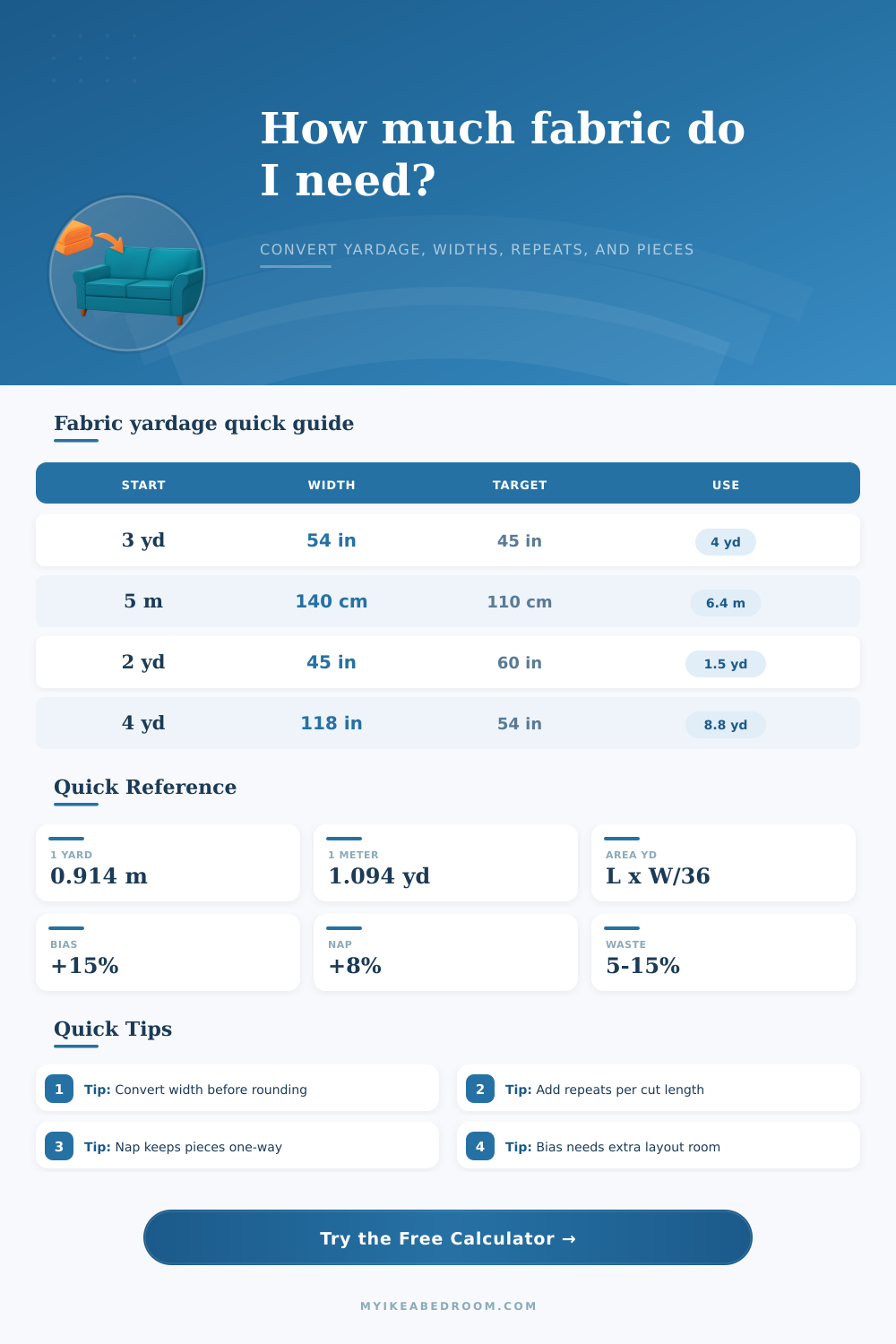
Convert fabric length between yards and meters, adjust yardage when changing bolt width, then include pieces, seam allowance, grain direction, nap direction, pattern repeat, and waste.
Load a common sewing or home textile setup, then tune the widths, repeats, seam allowance, nap, grain, and waste for your actual fabric.
Yardage breakdown
| Starting length | Width | Target width | Equivalent length |
|---|---|---|---|
| 3 yd | 54 in | 45 in | 3.6 yd before layout allowances. |
| 5 yd | 45 in | 54 in | 4.17 yd before rounding and repeats. |
| 4 m | 140 cm | 110 cm | 5.09 m before seam and waste. |
| 2 yd | 108 in | 54 in | 4 yd when area is kept equal. |
| Fabric width | Typical label | Best conversion use | Planning note |
|---|---|---|---|
| 44 to 45 in | Cotton or craft | Quilt tops, small panels, bias strips | Width changes often increase yardage for home projects. |
| 54 in | Drapery or upholstery | Cushions, chair panels, curtain fabric | A common target when converting home decor yardage. |
| 58 to 60 in | Wide apparel or denim | Slipcovers, bedding panels, wide cuts | May reduce joins compared with 45 in fabric. |
| 108 to 118 in | Extra-wide backing | Quilt backing, duvet backs, sheeting | Often trades short yardage for a much wider bolt. |
| Layout factor | Typical addition | When to use it | Calculator treatment |
|---|---|---|---|
| Straight grain | 0% | Most panels, cushions, curtains, and bedding | Keeps the width conversion as the main adjustment. |
| Cross grain | -5% | Only when the fabric can be rotated safely | Reduces layout allowance but still rounds upward. |
| Bias grain | 15% | Binding, shaped covers, diagonal layouts | Adds layout room after seam and repeat math. |
| One-way nap | 8% to 12% | Velvet, corduroy, directional prints, pile fabric | Adds one-way placement allowance before waste. |
| Project type | Usual width | Repeat concern | Waste range |
|---|---|---|---|
| Curtain panels | 54 in or wider | Medium to high if patterned | 8% to 15% for hems, matching, and squaring. |
| Quilt backing | 108 in or pieced | Low unless directional | 5% to 10% plus quilting overhang. |
| Slipcover panels | 54 to 60 in | High for stripes and nap | 12% to 20% for shaped pieces and matching. |
| Bias binding | 45 in or 54 in | Usually none | 10% to 18% because diagonal layout creates offcuts. |
Simple unit swap
yards to meters
Best when the fabric width and layout stay the same and you only need a shop-friendly length unit.
Width conversion
area preserved
The calculator keeps square area equivalent by multiplying length by old width divided by target width.
Piece layout
cuts rounded up
Repeats, seam allowance, and the piece count are handled before waste and roll rounding are applied.
Directional goods
nap protected
One-way fabric gets extra allowance because pieces cannot be flipped to nest as tightly on the bolt.
When you are sewing with fabric, you must consider the widths of that fabric. The width of the fabric will determine how many yard of fabric youll need for your sewing project. While many person may assume that if a pattern requires three yards of fabric, that three yards of fabric will be sufficient regardless of the width of that fabric, this is not true.
If the pattern is designed for fabric that is 60 inches in width but the fabric that you purchase is only 45 inches in width, you will not have enough fabric to complete the sewing project. Consequently, you will need to purchase more fabric if the width of the fabric that you purchase are less than the width of the fabric required by the sewing project. By using a calculator to determine how many square inch of fabric you will need and by purchasing enough fabric to ensure that the total number of square inches of fabric that you purchase is the same than the total number of square inches of fabric that you require for the project, you will be sure that you dont have a shortage of fabric once you begin to sew.
How to Buy Enough Fabric for Sewing
In addition to the width of the fabric, you also need to consider the amount of fabric that is required to account for the seam allowance for the sewing project. Seam allowances are the amount of fabric that is added to the sewing project to allow for the piece of fabric to be sewn together. If the sewing project include many panels of fabric, the amount of fabric that is required for the seam allowances will be significant.
To avoid not having enough fabric once you begin to sew the project, you should of purchased enough fabric to account for these seam allowances. Furthermore, in addition to the width and seam allowances of the fabric, another factor to consider is the pattern repeat of the fabric. Many fabrics has a pattern repeat, which is the distance between the start of one pattern element and the start of the next similar pattern element.
For sewing projects that use fabrics with a pattern, such as curtains that has a floral print, it is important to sew the panels of fabric so that the pattern repeat lines up on each panel of fabric. To line up the pattern repeat, you often have to cut the panels of fabric at specific interval. Fabric that you cut at specific intervals will have some waste.
Consequently, you will have to purchase extra fabric to account for this waste in order to ensure that the pattern line up on each panel of fabric. Fabric direction is another factor to consider when purchasing fabric for a sewing project. For fabrics that have a nap, such as velvet or corduroy, the direction in which the fibers of the fabric lie is referred to as the nap of the fabric.
If the naps of two pieces of fabric point in different directions, the fabrics may appear to be a different color. To avoid the fabric looking differently in different areas of the project, you need to sew all of the pattern pieces with the same direction of the nap. Consequently, you will have to purchase extra fabric to allow for the direction of the naps to be even on all of the pieces of fabric.
If you would like to cut the fabric on the bias, you will need to purchase even more fabric than you would if you cut the fabric along the grain of the fabric. Cutting the fabric on the bias means cutting the fabric at a 45 degree angle to the grain of the fabric. By cutting the fabric on the bias, some of the fabric will be waste.
Consequently, you will have to purchase extra fabric to account for this waste. It is also common to purchase an additional amount of fabric to account for any waste that may occur during the sewing process. Errors in sewing, such as cutting the fabric crookedly or having to rip out a seam in order to sew it correctly will result in waste of fabric.
To account for this possible waste, it is common practice to purchase a ten-percent waste allowance for the project. By purchasing a ten percent waste allowance for your project, you will have enough fabric to account for any error in sewing the project. By considering each of these factor, such as the width of the fabric, the seam allowances, the pattern repeat, the direction of the naps in fabrics that have naps, the way that the fabric is cut (on the bias or not), and the waste allowance for potential errors in sewing, you can be sure that you have enough fabric for your sewing project.
You should pay attention to teh fabrics size and making sure you dont run out of materials. Its important to recieve enough fabric so your project looks moddern and beautifull.